
As filed with the Securities and Exchange Commission on September 4, 2026.
Registration No. 333-298195
UNITED STATES
SECURITIES AND EXCHANGE COMMISSION
Washington, D.C. 20549
AMENDMENT NO. 1 TO
FORM S-1
REGISTRATION STATEMENT UNDER THE SECURITIES ACT OF 1933
|
CLEARONE, INC. |
|
(Exact Name of Registrant as Specified in Its Charter) |
|
Nevada |
3661 |
87-0398877 |
|
(State or other jurisdiction of |
(Primary Standard Industrial |
(I.R.S. Employer |
|
7533 S Center View Ct. # 5311 |
|
(Address, Including Zip Code, and Telephone Number, Including Area Code, of Registrant’s Principal Executive Offices) |
|
|
GKL Registered Agents of NV, Inc. 3064 Silver Sage Drive, Suite 150, Carson City, Nevada 89701, +1 (888) 682-4368 |
|
|
(Name, Address, Including Zip Code, and Telephone Number, Including Area Code, of Agent For Service) |
||
|
Copies of communications to: |
|
Virgil Hlus Jun Ho Song |
Mitchell Nussbaum, Esq. Angela Dowd, Esq. Lili Taheri, Esq. Loeb & Loeb LLP New York, New York 10154 (212) 407-4000 |
Approximate Date of Commencement of Proposed Sale to the Public: As soon as practicable after this Registration Statement becomes effective.
If any of the securities being registered on this Form are to be offered on a delayed or continuous basis pursuant to Rule 415 under the Securities Act of 1933, other than securities offered only in connection with dividend or interest reinvestment plans, check the following box. ☒
If this Form is filed to register additional securities for an offering pursuant to Rule 462(b) under the Securities Act, please check the following box and list the Securities Act registration statement number of the earlier effective registration statement for the same offering. ☐
If this Form is a post-effective amendment filed pursuant to Rule 462(c) under the Securities Act, check the following box and list the Securities Act registration statement number of the earlier effective registration statement for the same offering. ☐
If this Form is a post-effective amendment filed pursuant to Rule 462(d) under the Securities Act, check the following box and list the Securities Act registration statement number of the earlier effective registration statement for the same offering. ☐
Indicate by check mark whether the registrant is a large accelerated filer, an accelerated filer, a non-accelerated filer, a smaller reporting company, or an emerging growth company. See the definitions of “large accelerated filer,” “accelerated filer”, “smaller reporting company” and “emerging growth company” in Rule 12b-2 of the Exchange Act.
|
Large accelerated filer |
☐ |
Accelerated filer |
☐ |
|
Non-accelerated filer |
☒ |
Smaller reporting company |
☒ |
|
|
|
Emerging growth company |
☐ |
If an emerging growth company, indicate by check mark if the registrant has elected not to use the extended transition period for complying with any new or revised financial accounting standards† provided pursuant to Section 7(a)(2)(B) of the Securities Act. ☐
The Registrant hereby amends this Registration Statement on such date or dates as may be necessary to delay its effective date until the Registrant shall file a further amendment which specifically states that this Registration Statement shall thereafter become effective in accordance with Section 8(a) of the Securities Act of 1933 or until the Registration Statement shall become effective on such date as the Securities and Exchange Commission, acting pursuant to said Section 8(a), may determine.
EXPLANATORY NOTE
This registration statement contains two forms of prospectuses: one to be used in connection with the public offering of up to 4,285,714 units through the placement agent named on the cover page of this prospectus (the “Primary Offering Prospectus”) and one to be used in connection with the potential resale by selling stockholders of up to 2,496,162 shares of Common Stock (the “Resale Prospectus”).
The Resale Prospectus is substantively identical to the Primary Offering Prospectus, except for the following principal points:
- they contain different outside and inside front covers and back covers;
- they contain different “Offering” sections in the “Prospectus Summary” section;
- they contain different “Use of Proceeds” sections;
- the “Risks Related to this Offering” section of the Primary Offering Prospectus is deleted from the Resale Prospectus;
- the “Capitalization”, “Dilution”, “Description of the Securities We are Offering” and “Legal Matters” sections of the Primary Offering Prospectus are deleted from the Resale Prospectus;
- a “Selling Stockholders” section is included in the Resale Prospectus; and
- they contain different “Plan of Distribution” sections.
The Company has included in this registration statement a set of alternate pages after the back-cover page of the Primary Offering Prospectus (the “Alternate Pages”) to reflect the foregoing differences in the Resale Prospectus, as compared to the Primary Offering Prospectus. The Primary Offering Prospectus will exclude the Alternate Pages and will be used for the Primary Offering. The Resale Prospectus will be substantively identical to the Primary Offering Prospectus except for the addition or substitution of the Alternate Pages.
The information in this preliminary prospectus is not complete and may be changed. We may not sell these securities until the registration statement filed with the U.S. Securities and Exchange Commission is effective. This preliminary prospectus is not an offer to sell these securities and it is not soliciting an offer to buy these securities in any jurisdiction where the offer or sale is not permitted.
|
PRELIMINARY PROSPECTUS |
|
SUBJECT TO COMPLETION |
|
DATED SEPTEMBER 4, 2026 |
Minimum Offering: 2,857,143 Units
Maximum Offering: 4,285,714 Units
Each Unit consisting of one share of Common Stock and one Warrant to purchase one share of Common Stock
ClearOne, Inc.
|
|
We are offering, on a best-efforts basis, a minimum of 2,857,143 units (“Units”) and a maximum of 4,285,714 Units at a price of $3.50 per Unit. Each Unit consists of one share of our common stock, par value $0.001 per share (the “Common Stock”), and one warrant to purchase one share of Common Stock (“Warrant”).
The Units have no stand-alone rights and will not be certificated or issued as stand-alone securities. The issuance of such Units may result in the issuance, in the aggregate, of 20% or more of the Company’s outstanding Common Stock or voting power immediately following the closing of the transaction. Accordingly, the Company has determined that, for purposes of complying with Nasdaq Listing Rule 5635(d), stockholder approval is required in connection with the issuance of such securities. The Company obtained the requisite stockholder approval for purposes of Nasdaq Listing Rule 5635(d) on August 25, 2026. The Warrants will initially have an exercise price of $10.00 per share of Common Stock, will be exercisable immediately, and will expire six months from the date of issuance.
Our Common Stock is traded on Nasdaq under the symbol “CLRO.” On September 3, 2026, the closing price for our Common Stock, as reported on Nasdaq, was $5.13 per share. There is no established trading market for the Warrants and we do not intend to list the Warrants on any securities exchange or nationally recognized trading system.
The Units will be offered at a fixed price and are expected to be issued in a single closing. The minimum aggregate amount of proceeds for this offering to close is $10,000,000 up to the maximum amount of $15,000,000. However, notwithstanding the foregoing, the shares of our Common Stock underlying any Warrants will be offered on a continuous basis pursuant to Rule 415 under the Securities Act of 1933, as amended (the “Securities Act”).
We have engaged ThinkEquity LLC (the “Placement Agent”) to act as our exclusive Placement Agent in connection with this offering. The Placement Agent has agreed to use its reasonable best efforts to solicit offers to purchase the securities offered by this prospectus. The Placement Agent is not purchasing or selling any of the securities we are offering, and the Placement Agent is not required to arrange the purchase or sale of any specific number or dollar amount of securities. We have agreed to pay the Placement Agent, the Placement Agent fees set forth in the table below and to provide certain other compensation to the Placement Agent. See “Plan of Distribution” for more information regarding these arrangements.
Investing in the Common Stock is highly speculative and involves a high degree of risk, including the risk of losing your entire investment. See “Risk Factors” beginning on page 15 to read about factors you should consider before buying our Common Stock.
Neither the Securities and Exchange Commission nor any state securities commission has approved or disapproved of these securities or determined if this prospectus is truthful or complete. Any representation to the contrary is a criminal offense.
|
|
|
Per Unit |
|
Minimum Offering |
Maximum Offering |
||||
|
Public offering price |
|
$ |
3.50 |
|
$ |
10,000,000 |
$ |
15,000,000 |
|
|
Placement Agent fees(1) |
|
$ |
0.21 |
|
$ |
600,000 |
$ |
900,000 |
|
|
Proceeds, before expenses, to us |
|
$ |
3.29 |
|
$ |
9,400,000 |
$ |
14,100,000 |
|
| (1) | The Placement Agent fees shall equal 6% of the gross proceeds of the securities sold by us in this offering. The Placement Agent will receive compensation in addition to the Placement Agent fees described above. See “Plan of Distribution” for a description of compensation payable to the Placement Agent. |
The delivery to purchasers of the securities in this offering is expected to be made on or about , 2026, subject to satisfaction of certain customary closing conditions.
ThinkEquity
The date of this prospectus is , 2026

This prospectus is a part of a registration statement on Form S-1 for the offering by us of units of our securities. You should rely only on the information contained in this prospectus. Neither we nor the Placement Agent have authorized anyone to provide you with additional information or information different from that contained in this prospectus. We take no responsibility for, and can provide no assurance as to the reliability of, any other information that others may give to you.
You should read this prospectus together with the additional information described below under the heading “Where You Can Find More Information” in this prospectus. We may also provide a prospectus supplement or post-effective amendment to the registration statement to add information to, or update or change information contained in, this prospectus. The information contained in this prospectus, or any free writing prospectus is accurate only as of its date, regardless of its time of delivery or of any sale of Common Stock. Our business, financial condition, results of operations and prospects may have changed since that date. This prospectus does not contain all of the information included in the registration statement. For a more complete understanding of this offering, you should refer to the registration statement, including its exhibits.
As used in this prospectus, the terms “we”, “us” “our”, “ClearOne” and the “Company” refer to ClearOne, Inc., a corporation incorporated pursuant to the laws of the state of Nevada, unless otherwise specified.
Trademarks
Cortigent, Inc. (“Cortigent”) owns or has rights to its trademarks, service marks and trade names used in connection with the operation of its business, including its corporate name, logo, and website name. Other trademarks, service marks and trade names appearing in this prospectus are the property of their respective owners. Solely for convenience, some of the trademarks, service marks and trade names referred to in this prospectus are listed without the ® and ™ symbols, but Cortigent will assert, to the fullest extent under applicable law, the rights to its trademarks, service marks and trade names.
Implications of Being a Smaller Reporting Company
We are a “smaller reporting company” as defined in the Securities Exchange Act of 1934, as amended (the “Exchange Act”). We may take advantage of certain of the scaled disclosures available to smaller reporting companies and will be able to take advantage of these scaled disclosures for so long as the market value of the common stock held by non-affiliates is less than $250.0 million measured on the last business day of our second fiscal quarter, or our annual revenue is less than $100.0 million during the most recently completed fiscal year and the market value of the common stock held by non-affiliates is less than $700.0 million measured on the last business day of our second fiscal quarter. As a result, the information in this prospectus and that we provide to our investors in the future may be different than what you might receive from other public reporting companies.
This prospectus contains certain forward-looking statements. Forward-looking statements may include, but are not limited to, statements with respect to our business, strategy, operations and financial performance, as well as our plans, objectives and expectations for our business operations and financial performance and condition. Often, but not always, forward-looking statements can be identified by the use of words and phrases such as “plans,” “expects,” “is expected,” “budget,” “scheduled,” “estimates,” “forecasts,” “intends,” “aims”, “seeks”, “potential”, “anticipates,” or “believes” or variations (including negative variations) of such words and phrases, or statements that certain actions, events or results “may,” “could,” “would,” “might” or “will” be taken, occur or be achieved.
Forward-looking statements are based on the opinions and estimates of management as of the date such statements are made and are based on various assumptions such as future business and property integrations remaining successful; favorable and stable general macroeconomic conditions, securities markets, legislation, taxation, controls, regulations and political or economic developments; and the ability to continue raising the necessary capital to finance operations. Forward-looking statements involve known and unknown risks, uncertainties and other factors which may cause our actual results, performance or achievements to be materially different from any future results, performance or achievements expressed or implied by the forward-looking statements. Such factors include, but are not limited to, such matters as:
- general business, economic, competitive, political and social uncertainties;
- significant capital requirements;
- dependence on key personnel and third-party relationships;
- the impact of any infringement actions or other litigation brought against us;
- competition from other providers and products;
- our ability to develop and commercialize products and services;
- changes in government regulation;
- our ability to complete capital raising transactions;
- Cortigent’s ability to develop commercial products, obtain necessary FDA or other regulatory marketing authorizations, and successfully market them into the U.S. and other markets;
- Cortigent’s ability to compete in its industry;
- Cortigent’s expectations regarding its financial performance, including its future anticipated revenue and costs;
- the sufficiency of Cortigent’s cash, and investments to meet its liquidity needs;
- Cortigent’s ability to attract, retain, and maintain good relations with its customers;
- Cortigent’s ability to anticipate market needs or develop new or enhanced offerings and services to meet those needs as well as its expectations about how market trends will affect its business;
- Cortigent’s ability to stay in compliance with laws and regulations, including tax laws and U.S. Food and Drug Administration regulations, that currently apply or may become applicable to its business both in the U.S. and internationally and its expectations regarding various laws and restrictions that relate to its business;
- Cortigent’s ability to anticipate the effects of existing and developing laws and regulations, including with respect to taxation, and privacy and data protection that relate to its business;
- Cortigent’s ability to effectively manage its growth and maintain its corporate culture;
- Cortigent’s ability to identify, recruit, and retain skilled personnel, including key members of senior management;
- Cortigent’s ability to successfully identify, manage, consummate, and integrate any existing and potential acquisitions;
- Cortigent’s ability to maintain, protect, and enhance its intellectual property; and
- other factors detailed herein under “Risk Factors.”
The preceding list is not intended to be an exhaustive list of all forward-looking statements. The forward-looking statements are based on our beliefs, assumptions, and expectations of future performance, duly considering all information currently available to us. These statements are only predictions based on our current expectations and forecasts about future events and trends that we believe may affect our business, financial condition, results of operations, prospects, business strategy and financial needs. There are important factors that could cause our actual results, levels of activity, performance, or achievements to differ materially from the results, levels of activity, performance or achievements expressed or implied by the forward-looking statements. In particular, you should consider the risks provided under “Risk Factors” in this prospectus. These risks are not exhaustive. Other sections of this prospectus include additional factors that could adversely impact our business and financial performance. Furthermore, new risks and uncertainties emerge from time-to-time, and it is not possible for us to predict all risks and uncertainties that could have an impact on the forward-looking statements contained in this prospectus.
In addition, statements that “we believe” and similar statements reflect our beliefs and opinions on the relevant subject. These statements are based upon information available to us as of the date of this prospectus, and while we believe such information forms a reasonable basis for such statements, such information may be limited or incomplete, and our statements should not be read to indicate that we have conducted an exhaustive inquiry into, or review of, all potentially available relevant information.
You should not rely upon forward-looking statements as predictions of future events. Although we believe that the expectations reflected in the forward-looking statements are reasonable, we cannot guarantee that future results, levels of activity, performance and events and circumstances reflected in the forward-looking statements will be achieved or will occur. Each forward-looking statement speaks only as of the date of the particular statement. Except as required by law, we undertake no obligation to update publicly any forward-looking statements for any reason after the date of this prospectus, to conform these statements to actual results or to changes in our expectations. All subsequent written and oral forward-looking statements attributable to us or persons acting on our behalf are expressly qualified in their entirety by the cautionary statements contained above and throughout this prospectus.
Each of ClearOne and Cortigent obtained the industry, market and competitive position data in this prospectus from their respective internal estimates and research as well as from industry and general publications and research, surveys and studies conducted by third parties. Information that is based on estimates, forecasts, market research or similar methodologies is inherently subject to uncertainties, and actual events or circumstances may differ materially from events and circumstances that are assumed in this information based on various factors, including those discussed in “Risk Factors.”
Overview and Corporate History
ClearOne was incorporated in Utah in 1983 and reincorporated in Delaware in 2018. Effective April 22, 2026, we reincorporated from Delaware to Nevada. Our Common Stock is listed on Nasdaq under the symbol “CLRO.”
Historically, we were a global provider of conferencing, collaboration, and AV streaming solutions for voice and visual communications. Following the October 24, 2025 disposition of substantially all operating assets and intellectual property to Biamp Systems, LLC (“Biamp”), we no longer manufacture or sell products. Our continuing operations are now limited to (i) fulfilling warranty and technical support obligations for legacy products, (ii) maintaining public-company compliance and governance, (iii) collecting accounts receivable and recovering prepaid assets and (iv) evaluating and pursuing strategic alternatives, including potential mergers or other transactions intended to maximize stockholder value.
The Merger
On July 1, 2026, we entered into an Agreement and Plan of Merger (the “Merger Agreement”) by and among ClearOne, CLRO Merger Sub, Inc., a wholly-owned subsidiary of ClearOne (“Merger Sub”), Vivani Medical, Inc. (“Vivani”), and Cortigent, a wholly owned subsidiary of Vivani, pursuant to which, subject to the satisfaction or waiver of certain conditions, including the Financing (as defined herein), Merger Sub will merge with and into Cortigent, with Cortigent surviving as a wholly-owned subsidiary of ClearOne (the “Merger” or the “Transaction”). Post-Merger, ClearOne is referred to as the “Combined Company”.
The completion of the Merger is subject to customary closing conditions and other conditions set forth in the Merger Agreement. There can be no assurance that the Merger, or any other contemplated transaction under the Merger Agreement will be completed on the anticipated terms, or at all. Until the closing of the Merger, ClearOne’s business will continue to consist primarily of maintaining its public-company status, complying with reporting and listing obligations, managing remaining corporate and legacy matters, and seeking to preserve available cash resources.
Information About Cortigent
Cortigent, through its predecessor Second Sight Medical Products, Inc. (“Second Sight”), is a pioneer in developing precision targeted neurostimulation systems to help patients recover critical body functions. Cortigent’s technology combines advanced neuroscience with proprietary microelectronics, software, and data processing capabilities to provide artificial vision and potentially restore muscle movement. Cortigent’s first commercial system, Argus II®, a retinal implant, was approved by the U.S. Food and Drug Administration (“FDA”) under a Humanitarian Device Exemption (“HDE”) and has provided artificial vision to hundreds of profoundly blind people who were implanted with this device. Building on this neurostimulation platform Cortigent has completed an early feasibility clinical trial to evaluate a more advanced system for artificial vision named “Orion”. Cortigent is further exploring the application of its core neurostimulation technology for accelerating the recovery of arm and hand function in patients who are partially paralyzed due to stroke. In February 2023, Cortigent held a meeting with FDA staff to commence discussions of an early feasibility clinical study in stroke victims. We believe that additional future applications of Cortigent’s platform technology may have the potential to generate substantial business growth over time. To date neither Cortigent, nor the prior operations of Second Sight Medical Products, Inc., have generated net income from sales of the now discontinued Argus II product. Cortigent will not generate revenues unless and until it completes the development of and attains the regulatory marketing approval for Orion or other neurostimulation systems under development.
Both the Argus II and Orion devices create artificial vision by using electrical stimulation. Artificial vision does not restore normal stereoscopic vision or vision with color but rather perceptions of light and shapes requiring implantees to interpret their environment through specialized training. Artificial vision can aid in supporting basic tasks such as finding a doorway, detecting another person’s presence, following a sidewalk or locating an object. For the Argus II device, the stimulation is delivered to the surviving cells of the retina which convey the activity to the brain via the optic nerve. For the Orion device, electrical stimulation is delivered directly to the visual cortex, the region of the brain responsible for vision. The pattern of electrical stimulation corresponds to the images captured by a small video camera mounted in the center of the glasses that the patient wears and is connected to the video processing unit (“VPU”). The VPU is a battery-powered device worn by the user, typically on a belt or a strap, that sends power and stimulation commands to the implant and receives diagnostic information from the implant via the external antenna of the glasses.
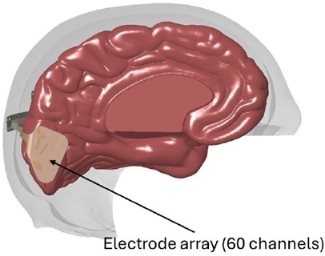
Argus II users underwent surgery to implant an electrode array inside the eye on the surface of the retina and affix a small electronics case (like a metal button) and an antenna to the outer surface of the eye. A small cable traverses the eye wall, connecting the electronics case to the array. Orion users undergo cranial surgery to implant an electrode array placed on the surface of the brain on the visual cortex and have a small electronics case and an antenna implanted on the outside of the skull, but completely covered by the scalp. A small cable passes through the skull to connect the array to the electronics case. No part of the device penetrates or cuts into the brain tissue itself.
The quality of the artificial vision created by both the Argus II and Orion systems varies from patient-to-patient. The perception typically appears as a collection of up to 60 small points of light that correspond to the brightness of the different regions of the visual image detected by a camera. With scanning and repetition, patients can use their perception of the lights to construct a better understanding of their environment.
The Argus II design process began in 2004. The Argus II was a novel device that required the components to be developed internally. The Argus II feasibility study commenced in 2006.
In March 2011, the Argus II® Retinal Prosthesis System was approved for commercial use in the European Union to provide visual perception in patients with profound blindness due to retinitis pigmentosa (“RP”), a rare condition. The device was initially available in the United Kingdom, France, Germany and several other countries at a price of approximately USD $115,000. In February 2013, the FDA approved Argus II under an HDE, and in August 2013, the reimbursement price for Medicare patients was approved at approximately $150,000. More than 350 profoundly blind people around the world have received Argus II retinal implants. Many of these patients have been using their Argus implants for more than 10 years, confirming Cortigent’s high manufacturing standards and product reliability. The market opportunity for the Argus II was limited to the small number of patients who have profound blindness due to RP, and Cortigent discontinued production and marketing of the Argus system in 2019 due to resulting commercial considerations.
Cortigent designed and built its next generation system, the Orion® Visual Cortical Prosthesis System (“Orion”) to make artificial vision available to a much larger group of individuals who are blind due to a wider range of causes, including glaucoma, diabetic retinopathy, optic nerve injury or disease and eye injury. The Orion system leverages over 25 years of experience in precision neurostimulation for artificial vision. It is designed to bypass the diseased or injured visual pathway and to transmit electrical pulses wirelessly to an array of electrodes implanted on the surface of the brain’s visual cortex to provide the perception of patterns of light. To be eligible for the Orion system, patients must be bilaterally blind with bare or no light perception. This is defined as non-measurable binocular visual acuity, or 5° or less visual field in each eye. Cortigent refers to these eligibility criteria as “profound blindness.” Cranial surgery is required to place the electrode array onto the brain’s surface; the Orion system has been designed so as not to require penetration of the brain tissue. The design process began in 2014 and required substantial changes to the Argus II implant electronics to generate higher currents with a redesigned array for implantation on the brain cortex rather than within the eye.
Figure 1. Illustration of the Orion array implanted on the visual cortex.
In November 2017, Cortigent commenced an Early Feasibility Study of Orion (the “Orion EFS”) in six subjects who enrolled at two medical sites, the Ronald Reagan UCLA Medical Center in Los Angeles (“UCLA”) and the Baylor College of Medicine in Houston (“Baylor”). Regularly scheduled visits at both sites were paused in mid-March 2020 due to the COVID-19 outbreak; visits at UCLA resumed in September 2020 and at Baylor in December 2020. Three of the six subjects were explanted after the third year of the study. The remaining three subjects completed visits through six years. The Orion EFS ended in March 2025, and one subject had the device explanted at the end of the study. We have three-year safety data for all six subjects, and six-year safety data for three subjects:
|
|
● |
Orion safety data: Five subjects experienced a total of 17 adverse events (AEs) and one subject did not report any adverse events related to the device or to surgery through March 2025. One was considered a serious adverse event (“SAE”) and all other adverse events were not serious. The single SAE, a seizure, occurred about three months post-implant, was resolved safely and quickly, and did not require a hospital stay. The investigators determined that this SAE was device-related and not unexpected as it had been disclosed as a potential safety risk in the subject informed consent form. The SAE occurred as during attempt to explore the optimal treatment frequency, which is a key stimulation parameter. The SAE occurred at a specific frequency. All adverse events are evaluated by an independent medical safety monitoring (“IMSM”) committee. With the IMSM committee’s input, Cortigent thereafter kept stimulation frequencies for all subjects below the level that induced the SAE, and Cortigent has not observed any other seizures in this or any other participant. The FDA requires medical device manufacturers to follow 21 CFR 820 and maintain a Quality Management System (“QMS”). As a part of QMS, Cortigent conforms to ISO 14971, an FDA-recognized standard, to identify the hazards associated with the medical device, to estimate and evaluate the associated risks, to control these risks, and to monitor the effectiveness of the controls.
There have been no serious adverse events due to the device or surgery since June 2018. One subject chose to have the device explanted before the 36th month due to an unrelated medical condition. Two other subjects subsequently requested explantation for reasons unrelated to the device’s efficacy or safety. Cortigent’s IMSM has determined that the reasons for these explants were not related to the device or the surgery. |
|
|
● |
Orion efficacy data: Cortigent has three-year efficacy data for five of the six original subjects (one did not participate in this assessment), and five-year efficacy data for three subjects. Cortigent assesses efficacy by looking at three measures of visual function: 1) Square localization – Orion subjects sit in front of a touch screen and are asked to touch within the boundaries of a square when it appears; 2) Direction of motion – Subjects are asked to identify the direction of the motion of a line that traverses a screen; and 3) Grating visual acuity – a measure of visual acuity that is adapted for very low vision. Five of the six original subjects completed the planned efficacy assessments at 36 months post-implant and although not part of the EFS (as defined herein) protocol, three completed these assessments at 60 months. |
| – | For square localization, at 36 months, five of the six original subjects remained in the study and all performed significantly better with the system turned on versus turned off. At 60 months, three of the six original subjects remained in the study and all performed significantly better. | |
| – | For direction of motion, at 36 months, the five subjects remaining in the study all performed significantly better with the system turned on than with it turned off. At 60 months, the three subjects remaining in the study all performed significantly better with the assistance of Orion. | |
| – | For grating visual acuity, at 36 months, two of the five subjects remaining in the study had measurable visual acuity with the system turned on compared to none with the device turned off. At 60 months, two of three remaining subjects had measurable visual acuity with the assistance of Orion, as compared to none with the system turned off. |
Another efficacy measurement of day-to-day functionality and benefit is the Functional Low-Vision Observer Rated Assessment (“FLORA”). The FLORA assessments were performed by independent, third-party specialists who spent time with each of the subjects in their homes. The specialist asked each subject a series of questions and observed each subject performing 15 or more daily living tasks with the Orion system turned on and with it turned off, such as finding light sources, following a sidewalk, or sorting laundry. The specialist then determined if the system was providing a benefit, was neutral, or impaired the subject’s ability to perform these tasks. All four subjects who completed the FLORA evaluation at 36 months had positive or mildly positive results indicating that the Orion system was providing benefit. This evaluation was not performed at the 60-month timepoint. Cortigent plans to work with the FDA to gain agreement on the additional clinical studies that will be required to secure marketing approval for Orion.
The FDA categorizes electronic medical devices that are implanted as Class III. Both the Argus II and Orion are in this Class III category and require FDA approval. Class III devices face higher burdens to attain regulatory approval than Class I or Class II devices; Cortigent successfully navigated a special version of this approval process with the Argus II system. The Argus II clinical trial enrolled patients with late-stage retinitis pigmentosa, a rare disease, affecting less than four thousand Americans. This small potential market size of fewer than 8,000 individuals enabled the Argus II to qualify for an HDE, which the FDA granted in February 2013.
In November 2017, the FDA granted an Expedited Access Pathway (“EAP”) designation to the Orion system to treat individuals who are bilaterally blind due to non-cortical etiology and who are not candidates for any other commercially approved vision restoration therapy. The Breakthrough Device Program (“BDP”) subsumed the EAP program and its devices in December 2018. Breakthrough Device designations, such as granted to Orion, are intended to accelerate medical device development, assessment, and review, while preserving the statutory standards for premarket approval. In 2018, the FDA designated Orion as a Breakthrough Device. This provides Cortigent with enhanced access to guidance from FDA expert staff and, we believe, could accelerate the path to commercial approval. The process of medical device development is inherently uncertain, and no assurance can be given that this designation will increase the likelihood of Orion being approved for marketing and commercialization. The potential patient population for Orion is expected to include blindness due to most common causes, including glaucoma, diabetic retinopathy, eye trauma, optic nerve damage, and retinitis pigmentosa. According to a company-sponsored 2018 study by Fletcher Spaght Inc., there are about 82,000 Americans who could potentially benefit from the Orion system.
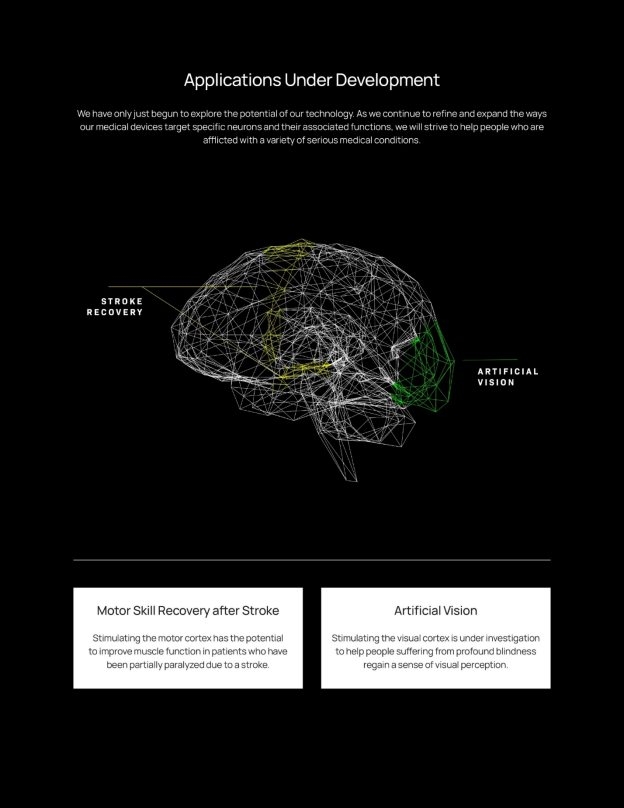
Cortigent is developing a platform technology with multiple potential applications: Cortigent’s current-generation miniature neurostimulation device with 60 independently controlled cortical stimulation channels, supported by reliability data from the Argus II and Orion programs, is expected to serve as a platform for targeting other conditions with high unmet medical need. Technical evaluations of potential new indications for the technology began in 2021. We believe that Cortigent’s most promising next target will be to apply cortical neurostimulation to improve recovery of arm and hand function in partially paralyzed stroke patients who are undergoing rehabilitation after stroke. This medical treatment concept is supported by evidence from clinical studies conducted by Northstar Neuroscience, Inc. in the early 2000s using a single-channel electrical stimulation device that was placed on the motor cortex, the area of the brain surface that controls hand and arm motion (the same surface area of the brain where our device will be placed). Northstar reported achieving positive patient results in its Phase 1 and Phase 2 clinical studies (Cramer 2007) but a pivotal Phase 3 study failed to achieve statistical significance at the 4-week primary endpoint. Northstar was unable to obtain FDA approval and was eventually dissolved. It has been reported that a clinical benefit was demonstrated at six months (Levy 2016). We believe that Cortigent’s 60-channel cortical stimulation device has the potential to target neuron populations more precisely and generate favorable clinical results.
Like Orion, the Stroke Recovery System will require cranial surgery; in this case to place the electrode array on the motor cortex. Cortigent began to design the stroke system in 2022, and during February 2023, studied what could be the optimal array placement on the motor cortex of a cadaver. Cortigent has filed a National Institutes of Health (“NIH”) grant application to seek non-dilutive funding to support this program but it was not initially awarded. Cortigent plans to reapply for grant funding in 2027. In addition, in February 2023 Cortigent held a pre-submission (“Pre-Sub”) meeting with FDA staff to discuss commencing an Early Feasibility Study of the stroke recovery system. Cortigent has applied for a Breakthrough Device designation for the Stroke Recovery System in April 2023 and the FDA denied the designation in June 2023. Cortigent intends to reapply for Breakthrough Device designation once clinical data supporting this novel approach is acquired. If Cortigent fails to secure this designation, it may experience slower interactions with the FDA that could delay our projected development timelines.
Cortigent is targeting substantial revenue opportunities; there is a large addressable market: The potential patient population for Orion is expected to include blindness due to most common causes, including glaucoma, diabetic retinopathy, eye trauma, optic nerve damage, and retinitis pigmentosa. Second Sight, the predecessor to Cortigent, sponsored a U.S. market study conducted by Fletcher Spaght, Inc. in 2018, which concluded at that time that there are about 82,000 Americans who could potentially benefit from the Orion system. Based upon the results, Cortigent estimates that the total addressable market for Orion is approximately 82,000 persons in the United States, assuming the target indication is achieved, which is “profound blindness due to glaucoma, diabetic retinopathy, optic nerve injury or disease and eye injury.” Cortigent believes that about one-third of these patients could be reached by a marketing program. Cortigent may seek reimbursement similar to or higher than the $150,000 per device that was approved by the Centers for Medicare and Medicaid Services (“CMS”) for the Argus II system. Therefore, the commercial market for Orion could approximate $4 billion by the time of launch, a market that may be up to 20 times larger than for Argus II. Cortigent believes that outside the United States there are substantially more blind people who could potentially benefit from Orion (Europe, Asia, and the rest of the world).
Regarding the Stroke Recovery System, there are approximately 7.6 million living Americans who have reported a stroke in their lifetime (Tsao 2022). The commercial potential for a medical device that can improve motor function in partially paralyzed stroke victims is large. Each year, approximately 610,000 persons in the United States have a first stroke (Kissela 2012). Among the over 80% of people who survive a first stroke, the most common neurological deficit is motor weakness on one side of the body (hemiparesis), and approximately 40% of these stroke victims suffer moderate to severe motor impairment that requires special care (Gresham 1995). If Orion achieves treatment success, as to which we can make no assurance, we estimate that it could potentially benefit up to 195,000 U.S. stroke victims each year, creating a total addressable market estimated at approximately $6.0 billion by the time of system launch.
Several critical development and regulatory milestones must be accomplished in order to complete and market the Orion and Stroke Recovery Systems. Risks of failing to achieve successful clinical trials, obtaining regulatory approvals, and securing favorable product reimbursement for patients covered by Medicare and other types of insurance are material. Even with a successful trial, it could be determined that certain patient subpopulations cannot be effectively treated by our devices, which would reduce our product sales potential. The development process may take longer and be more costly than anticipated and Cortigent may not achieve reimbursement levels similar to the one received for its Argus II device or obtain other suitable reimbursement levels that Cortigent may require. Presently, Cortigent has no commercial revenues and any of these outcomes could require substantial additional funding. No assurance can be made that clinical trials will demonstrate safety and efficacy or will lead to commercial products.
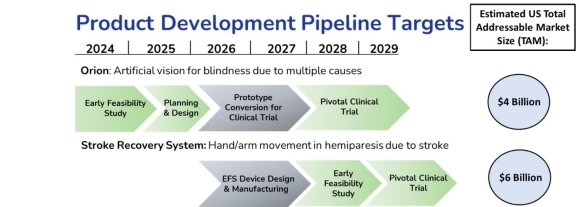
Clinical trial planning: Orion EFS, completed in March 2025, was extended at Cortigent’s election to span over six years to allow for additional exploratory research to improve vision quality, for example by enhanced contrast filtering or by software modifications. The research included a new stimulation technique called “Dynamic Current Steering,” which has the potential to substantially improve visual perception if the initial results are confirmed in larger-scale studies. Cortigent is preparing to manufacture and validate new Orion devices for a planned pivotal clinical trial, which is expected to involve approximately 60 profoundly blind patients at approximately 10 U.S. trial sites. These are internal estimates and the size and scope of the Orion pivotal clinical trial, including establishment of primary endpoint(s), will depend upon further review and collaboration with the FDA. Cortigent intends to commence the potentially pivotal clinical trial in late 2027, and expects to complete the pivotal trial in late 2029. Should Cortigent meet its primary endpoint(s) and subsequently obtain FDA clearance, it expects to launch Orion in the U.S. in 2030.
Cortigent plans to conduct a Stroke Early Feasibility Study (the “Stroke EFS”) in parallel with manufacturing of the Orion devices in late 2027. For the Stroke EFS, Cortigent anticipates manufacturing modified clinical trial devices. Cortigent anticipates a shorter time for stroke recovery subjects to reach the Stroke EFS endpoint than for Orion EFS subjects (nine months versus 12 months, respectively). Depending upon the outcomes of the Stroke EFS, Cortigent plans to commence a pivotal clinical trial for the Stroke Recovery System in early 2029. Upon further review and collaboration with the FDA, Cortigent will determine patient population size and other parameters of the Stroke Recovery System pivotal trial. Cortigent expects to complete the pivotal trial by late 2030, and if successful, commercially launch the Stroke Recovery System in 2031.
The target clinical development timelines for Orion and the Stroke Recovery System, shown in the diagram below, are subject to further discussions and collaborations with the FDA and assume that adequate financing will be available to fund the execution of clinical development programs. Clinical trials require FDA approvals and clearances. No assurance can be given that Cortigent will be able to obtain these approvals and clearances, that it will obtain approval of a marketable device or that it will be able to launch commercially successful products.
Product development pipeline targets: 1,2
1 Subject to adequate financing including proceeds of current offering and future financings.
2 The Orion and Stroke Recovery Systems are investigational devices that require FDA approval. No assurance can be made that clinical trials will demonstrate safety and efficacy or will lead to commercial products.
The timeline presented represents management’s estimate of the time required to complete each stage. No assurance can be given that these timelines will prove correct.
Intellectual property: Cortigent has amassed an extensive intellectual property estate consisting of rights (as of June 30, 2026) to 146 issued U.S. patents, 11 issued European patents (nationalized in France and Germany, or a unitary patent plus Great Britain), two pending U.S. patent applications, including a March 2023 filing covering the stroke recovery device under development, one pending European patent applications, three issued U.S. design patents and two issued European design registrations (with two corresponding issued British design registrations). Cortigent’s patent estate covers the foundational technologies invented during the development of the Argus and Orion devices with approximately 100 of Cortigent’s issued U.S. patents reaching the end of their term by the end of 2029. The remaining patent estate in the U.S. extends into 2038 and covers the core technologies of neurostimulation techniques for implantable devices and achieving implant longevity, which are integral to Cortigent’s current and future product lines, including the planned Stroke Recovery System.
Pre-revenue company: Cortigent is a pre-revenue company with a history extending from 1998, including the history of our predecessor Second Sight, of recurring operating losses that are likely to continue for the foreseeable future. Cortigent will require substantial additional capital, including the proceeds of this offering, to continue development of its products and fund clinical trials. See “Risk Factors.” To decrease its operating expenses, Cortigent reduced its staff and currently employs five full-time persons and four consultants as of September 4, 2026. Cortigent is subject to the risks and uncertainties associated with a business with no revenue and limited cash resources that is developing novel medical devices. Cortigent’s consolidated financial statements have been prepared on a going concern basis, and Cortigent’s financial condition creates doubt as to whether it will be able to continue as a going concern. Cortigent’s future operations are dependent upon the successful completion of equity or debt financing, and the achievement of profitable operations at an indeterminate time in the future. No assurance can be given that Cortigent will be successful in achieving or maintaining profitability. Second Sight incurred operating losses and generated negative cash flows since its inception and financed its operations principally through equity investments and borrowings. As a pre-revenue company, Cortigent’s ability to generate sufficient revenues to fund operations is uncertain. For the three and six months ended June 30, 2026 and the fiscal years ended December 31, 2025 and 2024, Cortigent generated no revenue from operations and incurred a net loss of $0.3 million, $1.0 million, $3.1 million and $2.2 million, respectively.
Competition: The medical device industry is characterized by a rapid evolution of technologies, significant competition and defensive positioning regarding intellectual property. While Cortigent believes that its platforms, technology, knowledge, experience, and scientific resources provides it with unique competitive advantages and a leadership position, Cortigent expects to face competition from major medical device companies, academic institutions, governmental agencies, and public and private research institutions, among others.
Cortigent is unaware of medical devices comparable to the Orion system (designed to restore certain forms of functional vision in persons who have become blind due to a broad range of causes) that have been approved by regulatory agencies in the U.S. or Europe. Other visual prosthesis companies with demonstrated technologies under development include Science Corp., which acquired certain technological assets relating to artificial vision from Pixium Vision SA. Pixium was developing the PRIMA (sub-retinal implant) in Dry-AMD patients and in 2017, announced approval for two feasibility studies and in 2020 initiated a pivotal study. In January 2024, Pixium announced the opening of judicial liquidation proceedings. Subsequently, Science Corp. acquired certain Pixium technology assets relating to artificial vision. Pivotal study results were reported in October 2025 and in July 2026, Science Corp. announced the launch of their system to treat geographic age-related macular degeneration in Europe.
Bionic Vision Technologies, based in Australia, is developing a Bionic Eye Visual Prosthesis System, and has completed a two-year feasibility study in seven patients in Australia. It has announced a partnership with Cirtec Medical in the U.S. and is believed to be planning a pivotal clinical trial.
Other companies are developing stimulation devices with electrode arrays which penetrate the brain, unlike Orion, which is placed on the brain’s surface. The Illinois Institute of Technology’s Intracortical Visual Prosthesis has been designated as a Breakthrough Device and has advanced to an early feasibility study in the U.S. To date, three patients have been implanted. A Belgian startup, ReVision Implant, has reported that it has developed a brain prosthesis designed to partially restore vision for people who have lost their sight over the past five years and that human implants for a preliminary study may occur during 2026.
Neuralink Corp. has developed a brain-computer interface device with penetrating cortical electrodes (the “N1” implant) that records and decodes neural signals and has initiated human clinical studies. In January 2024, Neuralink initiated a clinical study named PRIME (Precise Robotically Implanted Brain-Computer Interface) to evaluate safety and initial effectiveness in enabling paralyzed individuals to control external devices. Neuralink has since announced expansion of its PRIME clinical program beyond the United States, including trial sites in the United Kingdom and Canada. Neuralink has also announced a speech-related clinical program referred to as VOICE (Vocal Output Interface for Communication Enhancement) for individuals with severe and irreversible speech impairment and has announced that it received FDA Breakthrough Device Designation for a device intended to restore communication in such individuals. Based on publicly available statements, Neuralink has reported that as of June 30, 2026, it had approximately 26 participants enrolled globally in its clinical trials. Neuralink has publicly released demonstrations showing certain implanted participants using the system to control a computer interface, including cursor control and typing in home settings, and has stated that participants have accumulated thousands of cumulative device-use days. Neuralink has publicly stated that it has not observed serious device-related adverse events to date.
Several other companies are developing implanted BCI devices for recording neural signals including Synchron (intravascular electrodes), Precision Neuroscience (non-penetrating arrays), and Paradromics (penetrating electrodes); however, these technologies have not been approved or demonstrated to safely and effectively stimulate neural tissue.
Neuralink has also announced development of a vision restoration program referred to as Blindsight™, for which it has received FDA Breakthrough Device Designation that is described as involving cortical stimulation for vision restoration. Based on publicly available information as of February 2026, Neuralink has not disclosed FDA Investigational Device Exemption (“IDE”) authorization for first-in-human cortical stimulation studies for a vision restoration implant or any other indication. In contrast, Cortigent’s development programs are focused on implantable cortical stimulation systems designed to restore vision and motor function through patterned electrical stimulation. While both recording and stimulation involve implantable neural interfaces, the underlying technology architecture, therapeutic mechanism, and clinical objectives differ, and Cortigent believes continued advancements across the broader brain-computer interface sector reflect increasing validation and momentum for implantable neurotechnology platforms.
In the field of medical device-assisted stroke rehabilitation, Mobia Medical, Inc. (formerly MicroTransponder Inc.) (Nasdaq: MOBI) sells the Vivistim® FDA-approved vagus nerve stimulator (“VNS”). The combination of VNS with traditional rehabilitation therapy is intended to assist the brain in forming the connections necessary to regain motor function. Enspire DBS Therapy, Inc. is conducting a pivotal Phase 2/3 clinical trial named Rehab with Electrical Stimulation Therapy to Optimize Rehabilitation Effect (“RESTORE”) to evaluate if Deep Brain Stimulation (“DBS”) for Stroke is safe and to help understand if Deep Brain Stimulation plus Physical Therapy (DBS + Rehab) may improve arm function in patients who continue to have significant impairment after stroke. RESTORE is planned to enroll 40 subjects in its Pilot phase and an additional 162 in its Pivotal phase and expected to be complete in June 2030. The Enspire DBS system targets stimulation of the dentate nucleus area of the cerebellum. Although these systems and Cortigent’s proposed Stroke Recovery System similarly utilize electrical stimulation, Cortigent expects that its technology has the potential to deliver more targeted direct cortical stimulation that could provide comparatively superior results.
Physical Rehabilitation Therapy is currently the standard of care for stroke. A trained physical therapist assists a patient in practicing prescribed physical movements lost due to stroke. Repetition of physical movement may help remap the neural pathways in the brain lost due to stroke. The VNS system and the system proposed by Cortigent are intended to work in combination with physical rehabilitation therapy and are not a replacement for physical rehabilitation therapy. Physical therapists also teach patients how to use mobility devices such as orthoses, prostheses, canes, walkers, wheelchairs, and in some cases, therapy includes the use of robotics.
Other approaches to address deficits in grip after stroke utilize neural recording to drive external robotics or gloves. Kandu Inc’s IpsiHand uses EEG to record and decode activity to drive a robotic handpiece exoskeleton and was granted De Novo marketing authorization by the FDA in April 2021. In April 2026, Epia Neuro announced that it will soon seek approval to implant a BCI device designed to translate brain signals into actional commands for an assistive glove to aid in grip for survivors of stroke with paralysis. In contrast to the Cortigent system, these technologies do not electrically stimulate neural tissue.
Any therapeutic candidates that Cortigent successfully develops and commercializes will compete with other vision restoration devices or currently approved therapies and new devices or therapies that may become available in the future. Cortigent’s competitors may have significantly greater financial resources and expertise in research and development, manufacturing, preclinical testing, conducting clinical trials, obtaining regulatory approvals, and marketing approved products. Smaller or early-stage companies may also prove to be significant competitors, particularly through collaborative arrangements with large and established companies. These early stage and more established competitors also compete with Cortigent in recruiting and retaining qualified scientific and management personnel and establishing clinical trial sites and achieving patient registration for clinical trials, as well as in acquiring technologies complementary to, or necessary for, Cortigent’s programs. Cortigent believes the continued advancement of clinical-stage neural interface technologies by multiple companies reflects increasing validation of the underlying science and regulatory pathways, which may support broader adoption and commercialization of implantable neurostimulation systems.
Government Regulation: Government authorities in the United States, at the federal, state, and local levels, and in other countries, extensively regulate, among other things, the research, development, testing, manufacture, quality control, approval, labeling, packaging, storage, record-keeping, promotion, advertising, distribution, post-approval monitoring and reporting, marketing, and export and import of products such as those Cortigent is developing. Any medical device that Cortigent develops must be approved by the FDA before it may be legally marketed in the U.S. and marketing in other countries will require approvals by appropriate foreign regulatory agencies in such countries.
See the sections titled “Business” and “Information about Cortigent” for additional details.
Corporate Information
ClearOne was originally incorporated in the State of Utah in July 1983. We subsequently reincorporated in the State of Delaware in October 2018 and, effective April 22, 2026, reincorporated in the State of Nevada. In November 2012, we changed our name from “ClearOne Communications, Inc.” to “ClearOne, Inc.”
Our head office is located at 7533 S Center View Ct. #5311, West Jordan, Utah 84084, and our registered and records office is located at 3064 Silver Sage Drive, Suite 150, Carson City, Nevada 89701 USA. Our telephone number is (801) 975‑7200.
|
Securities Offered By Us |
A minimum of 2,857,143 Units up to a maximum of 4,285,714 Units at a public offering price of $3.50 per Unit. Each Unit consists of one share of Common Stock and one Warrant to purchase one share of Common Stock. On August 25, 2026, a majority of our stockholders approved the potential issuance of the Units for purposes of compliance with applicable stockholder approval requirements, including those applicable under Nasdaq Listing Rule 5635(d), as the offering price is below the Nasdaq Minimum Price and the issuance resulted in the issuance of 20% or more of our outstanding Common Stock. |
|
Description of the Warrants |
Each Warrant is initially exercisable at a price of $10.00. The Warrants will expire six months after the date of issuance. See “Risk Factors” for more information regarding the exercisability of the Warrants. This prospectus also relates to the offering of the shares of Common Stock issuable upon exercise of the Warrants. The terms of the warrants will be governed by a Warrant Agent Agreement, dated as of the closing date of this offering, between us and Colonial Stock Transfer Co., Inc., as the warrant agent (the “Warrant Agent”).For more information regarding the Warrants, you should carefully read the section titled “Description of the Securities We are Offering” in this prospectus. |
|
Public Offering Price of Units |
$3.50 per Unit. |
|
Common Stock to be Outstanding, if Minimum Offering is Sold |
5,532,554 shares of Common Stock. (1) |
|
Common Stock to be Outstanding, if Maximum Offering is Sold |
6,961,126 shares of Common Stock.(1) |
|
Best Efforts Offering |
We have agreed to offer and sell the securities offered hereby directly to the purchasers. We have retained ThinkEquity LLC to act as our exclusive Placement Agent to use its reasonable best efforts to solicit offers to purchase the securities offered by this prospectus. The Placement Agent is not required to buy or sell any specific number of the securities offered hereby. See “Plan of Distribution” beginning on page 55 of this prospectus. |
|
Use Of Proceeds
|
Assuming all of the securities we are offering in this offering are sold, we estimate that our net proceeds from this offering will be approximately $13,750,000. However, this is a best efforts offering and we may not sell all or any of these securities offered pursuant to this prospectus; as a result, we may receive significantly less in net proceeds. The minimum aggregate amount of proceeds for this offering to close is $10,000,000 up to the maximum amount of $15,000,000. We intend to use the net proceeds from this offering for (i) repayment of loan to First Finance Ltd., (ii) research and development studies of Orion and Stroke Recovery System, (iii) for Orion pivotal clinical trial and conversion of a prototype to market-ready device, (iv) for manufacturing and assembly of new devices and for (v) general working capital, including expenses related to the Merger. See section titled “Use of Proceeds” for more information. |
| Transfer agent, warrant agent and registrar: | The transfer agent and registrar for our common stock and the warrant agent for the warrants is Colonial Stock Transfer Co., Inc., |
|
Risk Factors |
Investing in our Common Stock involves a high degree of risk. See “Risk Factors” in this prospectus, as well as the other information included or incorporated by reference in this prospectus, for a discussion of factors you should carefully consider before investing in our Common Stock. |
|
Symbol And Listing |
Our shares of Common Stock are listed on Nasdaq under the symbol “CLRO”. On September 3, 2026, the last reported sale price of our Common Stock on Nasdaq was $5.13 per share. There are no established public trading markets for the Warrants, and we do not expect such markets to develop. We do not intend to list the Warrants on any securities exchange or other trading market. |
| (1) | The number of shares of Common Stock shown above to be outstanding after this offering is based on 2,675,412 shares of Common Stock issued and outstanding on a non-diluted basis as of the date of this prospectus. In addition to the number of shares of Common Stock outstanding as of the date of this prospectus, we have reserved 4,285,714 shares of Common Stock issuable upon exercise of the Warrants. |
An investment in our securities involves a high degree of risk. Prior to making a decision about investing in our securities, you should carefully consider the risk factors described below and the risk factors discussed in the sections entitled “Risk Factors” contained in our most recent Annual Report on Form 10-K, as amended, and Quarterly Report on Form 10-Q, as may be amended, supplemented or superseded from time to time by other reports we file with the SEC and incorporated by reference in this prospectus, together with all of the other information contained in this prospectus. Additional risks and uncertainties not presently known to us, or that we currently view as immaterial, may also impair our business. If any of the risks or uncertainties described in our SEC filings or this prospectus or any additional risks and uncertainties actually occur, our business, financial condition and results of operations could be materially and adversely affected. In that case, the trading price of our Common Stock could decline and you might lose all or part of your investment.
Risks Related to this Offering
Management will have broad discretion as to the use of the proceeds from this offering, and we may not use the proceeds effectively.
We intend to use the net proceeds from this offering for working capital and general corporate purposes, including expenses related to the Merger. As a result, our management will have broad discretion as to the use of the net proceeds from any offering by us and could use them for purposes other than those contemplated at the time of this offering. Accordingly, you will be relying on the judgment of our management with regard to the use of these net proceeds, and you will not have the opportunity, as part of your investment decision, to assess whether the proceeds are being used appropriately. It is possible that the proceeds will be invested in a way that does not yield a favorable, or any, return for the Company.
A large number of shares issued in this offering may be sold in the market following this offering, which may depress the market price of our Common Stock.
A large number of shares issued in this offering may be sold in the market following this offering, which may depress the market price of our Common Stock. Sales of a substantial number of shares of our Common Stock in the public market following this offering could cause the market price of our Common Stock to decline. If there are more shares of our Common Stock offered for sale than buyers are willing to purchase, then the market price of our Common Stock may decline to a market price at which buyers are willing to purchase the offered shares of our Common Stock and sellers remain willing to sell the shares. All of the securities issued in the offering will be freely tradable without restriction or further registration under the Securities Act.
You will experience immediate dilution in the net tangible book value per share of the Common Stock you purchase, and may experience additional dilution in the future.
Because the effective price per Unit being offered hereby may be higher than the net tangible book value per share of our Common Stock, you may experience dilution to the extent of the difference between the effective offering price per Unit you pay in this offering and the net tangible book value per share of our Common Stock immediately after this offering. Assuming the sale of 2,857,143 Units (the minimum Units being offered) at a public offering price of $3.50 per Unit and our net tangible book value as of June 30, 2026, assuming no exercises of Warrants, and after deducting the Placement Agent fees and estimated offering expenses payable by us, you will incur immediate dilution in as adjusted net tangible book value of approximately $3.13 per share. Assuming the sale of 4,285,714 Units (the maximum Units being offered) at a public offering price of $3.50 per Unit and our net tangible book value as of June 30, 2026, assuming no exercises of Warrants, and after deducting the Placement Agent fees and estimated offering expenses payable by us, you will incur immediate dilution in as adjusted net tangible book value of approximately $2.93 per share. As a result of the dilution to investors purchasing securities in this offering, investors may receive less than the purchase price paid in this offering, if anything, in the event of the liquidation of our company. See the section entitled “Dilution” below for a more detailed discussion of the dilution you will incur if you participate in this offering.
This offering may cause the trading price of our Common Stock to decrease.
The number of shares of Common Stock and Warrants we propose to issue and ultimately will issue if this offering is completed, may result in an immediate decrease in the market price of our Common Stock. This decrease may continue after the completion of this offering. We cannot predict the effect, if any, that the availability of shares for future sale represented by the Warrants issued in connection with the offering will have on the market price of our Common Stock from time to time, but future exercises may also result in a decrease in the market price of our Common Stock.
This is a best efforts offering, and we may not raise the maximum amount we are offering.
The Placement Agent has agreed to use its reasonable best efforts to solicit offers to purchase the securities in this offering. The Placement Agent has no obligation to buy any of the securities from us or to arrange for the purchase or sale of any specific number or dollar amount of the securities. We may sell fewer than all of the securities offered hereby, which may significantly reduce the amount of proceeds received by us. Thus, we may not raise the amount of capital we believe is required for our operations in the short-term and may need to raise additional funds, which may not be available or available on terms acceptable to us. The minimum aggregate amount of proceeds for this offering to close is $10,000,000 up to the maximum amount of $15,000,000.
There is no public market for the Warrants being offered by us in this offering.
There is no established public trading market for the Warrants, and we do not expect a market to develop. In addition, we do not intend to apply to list the Warrants on any national securities exchange or other nationally recognized trading system. Without an active market, the liquidity of the Warrants will be limited.
Except as otherwise set forth in the Warrants, holders of the Warrants offered hereby will have no rights as stockholders with respect to the shares of Common Stock underlying the Warrants until such holders exercise their Warrants acquire our Common Stock.
Except as otherwise set forth in the Warrants, until holders of the Warrants acquire shares of our Common Stock upon exercise thereof, such holders of the Warrants will have no rights with respect to the shares of our Common Stock underlying such Warrants, such as voting rights.
The sale or potential sale by certain selling security holders of 2,496,162 shares of Common Stock may cause the market price of our Common Stock to decline causing material losses to Investors in this Offering.
Concurrent to our registering Units to be sold in this offering, we are also registering for certain selling stockholders, 2,496,162 shares of Common Stock which they beneficially hold. These shares represent 93.30% of the total issued and outstanding shares of Common Stock before the offering and will represent 13.22% and 12.29%, of the total issued and outstanding shares of Common Stock after giving effect to the Merger (including the 12,500,000 Consideration Shares to be issued to Vivani and the 855,000 Advisor Shares) and this offering, if the minimum and maximum number of Units are sold, respectively.
The sale of our Common Stock by the selling security holders could increase volatility and share selling volume in trading markets and could cause declines to the prices of the Common Stock resulting in material losses to purchasers in this offering.
Risks Related to Our Business and Industry
We will require additional financing to fund our operations and obligations, which may not be available to us on acceptable terms or at all, and our auditor has expressed substantial doubt about our ability to continue as a going concern.
As of December 31, 2025, we had approximately $0.7 million of cash and cash equivalents and restricted cash. Following the October 2025 disposition of certain operating assets and the resulting reduction in revenue-generating activities, our continuing activities primarily consist, among other things, of maintaining public company compliance and fulfilling ongoing obligations, including warranty servicing and technical support related to products sold prior to the Asset Sale (as defined herein), managing remaining assets and liabilities, and evaluating and pursuing strategic alternatives. These activities are not expected to generate revenue at levels sufficient to fund ongoing operating costs. As a result, we will require additional financing and/or the completion of one or more equity or debt financing alternatives, merger and acquisition transactions, divestiture of assets, licensing opportunities, joint ventures, collaborations or other commercial arrangements with other companies, or other special transactions (each, a “Strategic Transaction”) to fund ongoing operating costs, professional fees, compliance costs, and other obligations as they become due.
Our audited consolidated financial statements and the accompanying notes thereto for the years ended December 31, 2025 and 2024 have been prepared on a going concern basis. We have incurred significant losses and experienced negative cash flows, and substantial doubt exists about our ability to continue as a going concern. We may not be able to obtain the necessary financing, complete a Strategic Transaction, or otherwise improve our liquidity position on acceptable terms or at all. The outcome of these matters cannot be predicted with any certainty at this time. Our financial statements do not include any adjustments to the amounts and classification of assets and liabilities that may be necessary should we be unable to continue as a going concern.
Following the disposition of certain operating assets, we have limited continuing activities that are not expected to generate revenue at levels sufficient to fund ongoing operating costs.
Our continuing activities are not expected to generate material revenue at levels sufficient to fund ongoing operating costs. As a result, our ability to sustain operations depends on numerous factors, including the successful completion of the Merger, successful completion of one or more Strategic Transactions, our ability to obtain additional financing, the successful development and commercialization of acquired technologies and products, market acceptance of such products, our ability to attract and retain qualified personnel, competitive conditions and general economic and capital markets conditions. Many of these factors are beyond our control. If we are unable to obtain additional capital or complete the Merger or a Strategic Transaction on acceptable terms or at all, we may be required to significantly curtail operations or pursue an orderly wind-down of the Company, which could result in reduced recoveries for stockholders.
We expect to continue to incur expenses associated with operating as a public company, pursuing Strategic Transactions, integrating acquired businesses, raising capital and complying with applicable legal and regulatory requirements. There can be no assurance that our operations will generate sufficient revenues to offset these expenses or that we will achieve profitability in the future. If we are unable to generate sufficient revenue or obtain additional financing when needed, our business, financial condition, results of operations and prospects could be materially adversely affected.
We may be unable to attract and retain management and other personnel.
Our future success depends to a significant extent on the continued service and performance of our directors, executive officers and other key personnel. As a small public company with limited financial resources, we face significant competition for qualified executives, technical personnel, research and development personnel and other employees from larger and better-capitalized companies.
In addition, the Merger would result in significant changes to our business, management structure and operations. Our ability to successfully execute our business strategy following the acquisition, if completed, will depend in part upon our ability to attract, retain, motivate and integrate qualified management, technical and operational personnel. The loss of key employees or the inability to recruit and retain qualified personnel could delay product development, impair commercialization efforts, disrupt operations, reduce productivity and adversely affect our ability to achieve our strategic objectives.
Competition for qualified personnel is particularly intense in the medical technology, neurostimulation and related industries in which we expect to operate following the acquisition. We may be unable to retain existing personnel or attract additional personnel with the experience and expertise necessary to support our future growth. If we are unable to do so, our business, financial condition, results of operations and prospects could be materially adversely affected.
We incur significant costs as a result of operating as a public company, and our management is required to devote substantial time to compliance initiatives.
As a public company, we incur significant legal, accounting and other expenses. In addition, the Sarbanes-Oxley Act of 2002 (the “Sarbanes-Oxley Act”), as well as rules subsequently implemented by the SEC have imposed various requirements on public companies, including establishment and maintenance of effective disclosure and financial controls and changes in corporate governance practices. Our management and other personnel devote a substantial amount of time to these compliance initiatives. Moreover, these rules and regulations result in increased legal and financial compliance costs and will make some activities more time-consuming and costly.
The Sarbanes-Oxley Act requires, among other things, that we maintain effective internal controls for financial reporting and disclosure. In particular, we are required to perform system and process evaluation and testing of our internal controls over financial reporting to allow management to report on the effectiveness of our internal controls over financial reporting, as required by Section 404 of the Sarbanes-Oxley Act. Our testing may reveal deficiencies in our internal controls over financial reporting that are deemed to be material weaknesses. We have incurred and continue to expect to incur significant expense and devote substantial management effort toward ensuring compliance with Section 404. Moreover, if we do not comply with the requirements of Section 404, or if we identify deficiencies in our internal controls that are deemed to be material weaknesses, the market price of our stock could decline and we could be subject to sanctions or investigations by the SEC or other regulatory authorities, which would entail expenditure of additional financial and management resources.
General economic and political conditions could have a material adverse effect on our business.
External factors can affect our financial condition. Such external factors include general domestic and global economic conditions, such as interest rates, tax law including tax rate changes, and factors affecting global economic stability, and the political environment regarding healthcare in general. We cannot predict to what extent the global economic conditions may negatively impact our business. For example, negative conditions in the credit and capital markets could impair our ability to access the financial markets for working capital and could negatively impact our ability to borrow.
Risks Related to the Merger
The Merger may not be consummated unless important conditions are satisfied or waived and there can be no assurance that the Merger will be consummated.
The Merger Agreement contains a number of conditions that must be satisfied or waived (to the extent permitted by applicable law) to consummate the Merger. Those conditions include, among others:
- completion of the Financing, or the Financing being consummated substantially concurrently with the closing of the Merger;
- ClearOne’s continued listing on Nasdaq and approval for listing, subject to official notice of issuance, of the shares of Common Stock to be issued in the Merger;
- no applicable law, order or other restraint preventing the Merger or the other transactions contemplated by the Merger Agreement;
- the accuracy of the representations and warranties of the parties, subject to the materiality standards set forth in the Merger Agreement;
- compliance by the parties with their respective covenants under the Merger Agreement;
- there being no material adverse effect on ClearOne, Cortigent or their respective businesses;
- the termination, waiver or inapplicability of specified investor agreements with Cortigent and any debt owed to Vivani, in each case as provided in the Merger Agreement;
- delivery of lock-up agreements and other supplemental agreements contemplated by the Merger Agreement;
- satisfaction of ClearOne’s minimum net cash requirement, as applicable;
- receipt of Nasdaq approval for ClearOne’s initial listing application for the Combined Company;
- the reconstitution of the Combined Company’s board of directors and management;
- ClearOne having net cash of at least $50,000, excluding the net proceeds of the Financing; and
- the execution of a voting agreement by Vivani whereby Vivani agrees to vote its shares of Common Stock in support of ClearOne’s director designee and the equity moratorium protections during the Equity Moratorium Period (as defined in the Merger Agreement).
The Merger Agreement contains provisions that could discourage a potential competing acquirer of either ClearOne or Cortigent.
The Merger Agreement contains “no shop” provisions that restrict each of ClearOne’s and Cortigent’s ability to solicit, initiate or knowingly encourage and induce, or take any other action designed to facilitate competing third-party proposals relating to a merger, reorganization or consolidation of the company or an acquisition of the company’s stock or assets. In addition, the other party generally has an opportunity to offer to modify the terms of the Merger in response to any competing acquisition proposals before the board of directors of the company that has received a third-party proposal may withdraw or qualify its recommendation with respect to the Merger.
The Merger Agreement does not permit either ClearOne or Cortigent to terminate the Merger Agreement in order to pursue a superior proposal. These provisions could discourage a potential third-party acquirer that might have an interest in acquiring all or a significant portion of ClearOne or Cortigent from considering or proposing an acquisition, even if it were prepared to pay consideration with a higher per share cash or market value than the market value proposed to be received or realized in the Merger.
The market price of our Common Stock may be volatile, and the value of your investment could decline significantly.
The trading price for the Common Stock has been, and we expect it to continue to be, volatile. The price at which the Common Stock trades depends upon a number of factors, including our historical and anticipated operating results, our financial situation, announcements of new products by us or our competitors, our ability or inability to raise the additional capital we may need and the terms on which we raise it, and general market and economic conditions. Some of these factors are beyond our control. Broad market fluctuations may lower the market price of the Common Stock and affect the volume of trading in our stock, regardless of our financial condition, results of operations, business or prospects. It is impossible to assure you that the market price of our shares of Common Stock will not fall in the future.
Failure to consummate the Merger could negatively impact respective future operations and financial results of ClearOne and Cortigent and the future stock price of ClearOne.
If the Merger is not consummated for any reason, ClearOne and Cortigent may be subjected to a number of material risks, including the following:
- a decline in the market price of the shares of our Common Stock to the extent that the current market price reflects a market assumption that the Merger will be consummated and will be beneficial to the value of ClearOne after the closing date of the Merger;
- having to pay certain costs related to the Merger, such as legal, accounting, financial advisory, printing and mailing fees, which must be paid regardless of whether the Merger is consummated;
- addressing the consequences of operational decisions made since the signing of the Merger Agreement, including because of restrictions on ClearOne’s or Cortigent’s operations imposed by the terms of the Merger Agreement and decisions to delay or defer capital expenditures; and
- negative reactions from the respective stockholders, suppliers, or employees.
In addition to the above risks, ClearOne may be required, under certain circumstances, to pay a termination fee of $250,000, which may materially and adversely affect our financial condition. The business of ClearOne or Cortigent may be adversely impacted by the failure to pursue other beneficial opportunities due to the focus of ClearOne and Cortigent management on the Merger. A failure to consummate the Merger may also result in negative publicity, reputational harm, litigation against ClearOne or Cortigent or their respective directors and officers, and a negative impression of the companies in the financial markets.
If the Merger is not consummated, we cannot assure the Cortigent stockholders or the ClearOne stockholders that these risks will not materialize and will not materially adversely affect the business, financial results and stock price of the respective companies. Because the Merger is conditioned upon the other transaction being consummated, neither transaction may be completed if the proposals required for the consummation of the transaction is not approved.
Legal proceedings in connection with the Merger, the outcomes of which are uncertain, could delay or prevent the completion of the Merger.
In connection with transactions like the Merger, it is not uncommon for lawsuits to be filed against the parties and/or their respective directors and officers. Although no lawsuits have yet been filed in connection with the Merger, it is possible that such actions may arise and, if they do arise, to seek, among other things, injunctive relief and an award of attorneys’ fees and expenses. Defending such lawsuits could require ClearOne and Cortigent to incur significant costs and draw the attention of ClearOne’s and Cortigent’s management teams away from the consummation of the Merger and the management of their respective businesses. Further, the defense or settlement of any lawsuit or claim that remains unresolved at the time the Merger is consummated may adversely affect the Combined Company’s business, financial condition, results of operations and cash flows. Such legal proceedings could delay or prevent the Merger from being consummated within the expected timeframe.
Risks Related to the Business of the Combined Company
Combining the two companies may be more difficult, costly or time consuming than expected, and the Combined Company may not realize all of the anticipated benefits of the Merger.
ClearOne and Cortigent have operated and, until the consummation of the Merger, will continue to operate, independently. The Combined Company may not be able to successfully achieve the anticipated benefits of the Merger at all or they may take longer to realize than expected. The difficulties of operating the Combined Company may include, among others:
- the diversion of management attention to integration matters;
- difficulties in integrating functions, personnel and systems;
- potential unknown liabilities, adverse consequences and unforeseen increased expenses associated with the Merger; and
- declines in results of operations, financial condition or cash flows.
Many of these factors are outside the control of ClearOne and Cortigent, and any one of them could result in increased costs, decreased expected revenues and diversion of management time and energy, which could materially impact the business, financial condition, results of operations and cash flows of the Combined Company. These factors could cause dilution to the earnings per share of the Combined Company, decrease or delay the expected benefits of the Merger and negatively impact the price of the Common Stock. As a result, it cannot be assured that the Combined Company will realize the full benefits anticipated from the Merger within the anticipated time frames, or at all.
In addition, following the Merger, ClearOne will become responsible for Cortigent’s liabilities and obligations, including with respect to legal, financial, regulatory, and compliance matters. These obligations will result in additional cost and investment by ClearOne and, if ClearOne has underestimated the amount of these costs and investments or if ClearOne fails to satisfy any such obligations, ClearOne and Cortigent may not realize the anticipated benefits of the Merger. Further, it is possible that there may be unknown, contingent or other liabilities or problems that may arise in the future, the existence and/or magnitude of which ClearOne and Cortigent was previously unaware. Any such liabilities or problems could have an adverse effect on the Combined Company’s business, financial condition, results of operations or cash flows.
Further, following completion of the Merger, the Combined Company will be susceptible to many of the risks described herein and risks related to Cortigent’s business. To the extent any of the events in the risks occur, those events could cause the potential benefits of the Merger not to be realized and the market price of the Combined Company’s common stock to decline.
ClearOne and Cortigent will incur substantial direct and indirect costs as a result of the Merger and the Combined Company will incur substantial direct and indirect costs following the Merger.
ClearOne and Cortigent will incur substantial expenses in connection with and as a result of consummating the Merger, and over a period of time following the consummation of the Merger, ClearOne also expects to incur substantial expenses as a Combined Company. A portion of the transaction costs related to the Merger will be incurred regardless of whether the Merger is consummated. While ClearOne and Cortigent have assumed that a certain level of transaction expenses will be incurred, factors beyond ClearOne and Cortigent’s control could affect the total amount or the timing of these expenses. These expenses could adversely affect the financial condition, results of operations and cash flows of the Combined Company following the consummation of the Merger.
If the perceived benefits of the Merger do not meet the expectations of investors or securities analysts, the market price of ClearOne’s securities or, following the Merger, the Combined Company’s securities, may decline.
The market value of ClearOne’s securities at the time of the Merger may vary significantly from their prices on the date the Merger Agreement was executed or the date of this prospectus.
In addition, following the Merger, the market price of the Combined Company’s common stock may fluctuate significantly in response to numerous factors, some of which are beyond the Combined Company’s control, such as:
- adverse regulatory decisions;
- the Combined Company’s dependence on third parties;
- future issuances of common stock or other securities;
- the recruitment or departure of key personnel;
- actual or anticipated variations in quarterly operating results;
- fluctuation of the market values of any of the Combined Company’s potential strategic investments;
- issuances of debt or equity securities;
- compliance with the Combined Company’s contractual obligations
- ineffectiveness of the Combined Company’s internal controls;
- general political and economic conditions;
- effects of natural or man-made catastrophic events; and
- other events or factors, many of which are beyond the Combined Company’s control.
Risks Relating to Ownership of Our Common Stock
Sales of a substantial number of shares of our Common Stock in the public market by us or by our existing stockholders, or the perception that they may occur, could cause our stock price to decline.
Sales of substantial amounts of our Common Stock by us, including in connection with this offering, or by our stockholders, announcements of the proposed sales of substantial amounts of our Common Stock or the perception that substantial sales may be made, could cause the market price of our Common Stock to decline. We may issue additional shares of our Common Stock in follow-on offerings to raise additional capital, upon the exercise of options or Warrants, or in connection with acquisitions or corporate alliances, including the Merger. We also plan to issue additional shares to our employees, officers, directors or consultants in connection with their services to us. Due to these factors, sales of a substantial number of shares of our Common Stock in the public market could occur at any time and could reduce the market price of our Common Stock.
If we fail to meet all applicable Nasdaq requirements, Nasdaq could delist our Common Stock, which could adversely affect the market liquidity of our Common Stock and the market price of our Common Stock could decrease.
We cannot assure you that we will be able to meet the continued listing standards of Nasdaq.
On June 20, 2024, we received a letter from the Listing Qualifications Staff (the “Staff”) of Nasdaq, notifying us that, based upon the closing bid price of the Company’s ordinary shares for the last 30 consecutive business days, we were not in compliance with the requirement to maintain a minimum bid price of $1.00 per share for continued listing on Nasdaq, as set forth in Nasdaq Listing Rule 5550(a)(2) (the “Minimum Bid Price Requirement”), which matter serves as a basis for delisting our securities from Nasdaq. Nasdaq provided us with a 180-day compliance period through December 17, 2024 to regain compliance. On December 18, 2024, we received a letter from Nasdaq advising that the Company was granted a 180-day extension to June 16, 2025 to regain compliance with the Minimum Bid Price Requirement, in accordance with Nasdaq Listing Rule 5810(c)(3)(A). On June 18, 2025, we received a letter from Nasdaq advising that we had not regained compliance with the Minimum Bid Price Requirement as of June 16, 2025 and that the trading in our Common Stock on Nasdaq would be suspended as of the opening of trading on June 25, 2025 and we would be delisted from Nasdaq. On June 24, 2025, we received a letter from Nasdaq advising that our Common Stock had traded above $1.00 per share for the ten consecutive trading days ending June 24, 2025 and had regained compliance with the Minimum Bid Price Requirement and the Company would not be delisted.
On January 10, 2025, we received a letter from Staff notifying us that because we did not hold an annual meeting of stockholders in 2024, the Company is not in compliance with the requirement to conduct an annual meeting of stockholders no later than one year after the end of its fiscal year, as set forth in Nasdaq Marketplace Rule 5620(a) (the “Annual Meeting Requirement”). Nasdaq required us to submit a compliance plan and could grant an extension through June 30, 2025. On February 24, 2025, we submitted a compliance plan to Nasdaq, and on June 3, 2025, we received a letter from Nasdaq advising that the Company regained compliance with the Annual Meeting Requirement and the Company would not be delisted.
On April 7, 2026, we received a letter from Staff notifying us that we were no longer in compliance with any of the alternative continued listing standards set forth in Nasdaq Marketplace Rule 5550(b) (the “Continued Listing Requirements”). In accordance with Nasdaq Marketplace Rule 5810(c)(2)(A), the Company had a period of 45 calendar days from April 7, 2026, or until May 22, 2026, to submit to Nasdaq a plan to regain compliance with the Continued Listing Requirements. On May 22, 2026, we submitted a compliance plan to Nasdaq.
If we fail to meet all applicable Nasdaq requirements, Nasdaq could delist our Common Stock, which could adversely affect the market liquidity of our Common Stock and the market price of our Common Stock could decrease.
You may experience future dilution as a result of future equity offerings.
In order to raise additional capital for general corporate purposes, in the future we may offer additional shares of our Common Stock or other securities convertible into or exchangeable for our Common Stock at prices that may be lower than the current price per share of our Common Stock. In addition, investors purchasing shares or other securities in the future could have rights superior to existing stockholders. The price per share at which we sell additional shares of our Common Stock, or securities convertible or exchangeable into Common Stock, in future transactions may be higher or lower than the price per share paid by investors in prior offerings.
We have not paid dividends in the past and do not expect to pay dividends in the future, and any return on investment may be limited to the value of our Common Stock.
We do not have a policy of paying regular cash dividends on our Common Stock. Although we have declared special dividends in the past, including special cash dividends and a special stock dividend, we do not anticipate paying regular cash dividends on our Common Stock in the foreseeable future. The payment of dividends on our Common Stock will depend on our earnings, financial condition and other business and economic factors affecting us at such time as our board of directors may consider relevant. If we do not pay dividends, our common stock may be less valuable because a return on your investment will only occur if our stock price appreciates.
General Risk Factors
Economic downturns and political and market conditions beyond our control, could adversely affect our business, financial condition, results of operations and prospects.
Our financial performance is subject to global and U.S. economic conditions and their impact on levels of spending by users. Economic recessions have had, and may continue to have, far reaching adverse consequences across many industries, which may adversely affect our business, financial condition, results of operations and prospects. Should we experience a further downturn resulting from negative economic conditions, our business, financial condition, results of operations or prospects may be materially and adversely affected.
Continued inflation may harm our business and financial condition.
If our costs become subject to significant inflationary pressures, we may not be able to offset these higher costs through price increases, additional insurance coverage, or other pricing adjustments to our business operations. Our inability or failure to do so could harm our business, financial condition, and operating results.
We may be subject to litigation in the operation of our business. An adverse outcome in one or more proceedings could adversely affect our business.
We may in the future face the risk of claims, lawsuits and other proceedings involving intellectual property, privacy, securities, tax, labor and employment, regulatory and compliance, commercial disputes, services and other matters. Litigation to defend us against claims by third parties, or to enforce any rights that we may have against third parties, may be necessary, which could result in substantial costs and diversion of our resources, causing a material adverse effect on our business, financial condition, results of operations and prospects.
Any litigation in which we are a party may result in an onerous or unfavorable judgment that may not be reversed upon appeal, or in payments of substantial monetary damages or fines, the posting of bonds requiring significant collateral, letters of credit or similar instruments, or we may decide to settle lawsuits on similarly unfavorable terms. These proceedings could also result in reputational harm, criminal sanctions, consent decrees or orders preventing us from offering certain products or requiring a change in business practices in costly ways or requiring development of non-infringing or otherwise altered products or technologies. Litigation and other claims and regulatory proceedings against us could result in unexpected disciplinary actions, expenses, and liabilities, which could have a material adverse effect on its business, financial condition, results of operations and prospects.
We could be subject to future governmental investigations and inquiries, legal proceedings, and enforcement actions. Any such investigation, inquiry, proceeding or action could adversely affect our business.
We have received formal and informal inquiries from time-to-time, from government authorities and regulators, regarding compliance with laws and other matters, and we may receive such inquiries in the future, particularly as we grow and expand our operations. Violation of existing or future regulations, regulatory orders or consent decrees could subject us to substantial monetary fines and other penalties that could adversely affect our business, financial condition, results of operations and prospects. In addition, it is possible that future orders issued by, or inquiries or enforcement actions initiated by, government or regulatory authorities could cause us to incur substantial costs, expose us to unanticipated liability or penalties, or require us to change our business practices in a manner materially adverse to our business, financial condition, results of operations and prospects.
Our insurance may not provide adequate levels of coverage against claims.
We intend to maintain insurance that we believe is customary for businesses of our size and type. However, there are types of losses we may incur that cannot be insured against or that we believe are not economically reasonable to insure. Moreover, any loss incurred could exceed policy limits or not exceed our applicable deductible, and policy payments made to us may not be made on a timely basis. Such losses could adversely affect our business, financial condition, results of operations and prospects.
We are currently operating in a period of economic uncertainty and capital markets disruption, which has been significantly impacted by geopolitical instability due to the ongoing military conflict between Russia and Ukraine and as to the United States and Israel and their conflict with Iran.
U.S. and global markets are experiencing volatility and disruption following the escalation of geopolitical tensions and ongoing or recent military conflict between Russia and Ukraine, and between Israel and Hamas. In February 2022, Russia launched a full-scale military invasion of Ukraine. In February 2026 the United States and Israel launched their aerial attacks of Iran. Although the length and impact of the ongoing military conflicts are highly unpredictable, these conflicts could lead to market disruptions, including significant volatility in commodity prices, availability of the credit markets and capital markets. These military actions and the resulting sanctions could adversely affect the global economy and financial markets and lead to instability and lack of liquidity in capital markets, potentially making it more difficult for us to obtain additional funds. Any of the abovementioned factors could affect our business, prospects, financial condition, and operating results. The extent and duration of military action, sanctions and resulting market disruptions are impossible to predict, but could be substantial. Any such disruptions may also magnify the impact of other risks described in this prospectus.
Risks Related to Dependence on Cortigent’s Commercial Products
Cortigent currently has no commercial products or product revenue, will be required to expend significant resources for the foreseeable future, and may never become profitable.
To date, neither Cortigent nor Second Sight have generated net income from sales of the now discontinued Argus II product. Cortigent will not generate revenues unless and until it completes the development and attains the marketing approval for Orion or other neurostimulation systems being developed. Cortigent has relied principally on financing from the sale of equity securities and the receipt of government and other grants to fund its operations. Cortigent expects that its future financial results will depend primarily on its success in further developing its neurostimulation systems, conducting FDA-approved clinical trials and obtaining regulatory clearances or approvals for launching, selling, and supporting its medical device systems. To establish these operations, Cortigent will need to expend significant resources on hiring additional personnel, conducting continued scientific and product research and development, engaging in further pre-clinical and clinical investigation, giving expanded attention to intellectual property development and prosecution, seeking domestic and international regulatory approvals, marketing and promotion, capital expenditures, working capital, general and administrative expenses, and fees and expenses associated with its capital raising efforts. No assurance can be made that clinical trials will demonstrate safety and efficacy or will lead to commercial products.
Cortigent expects to incur costs and expenses related to consulting, laboratory development, hiring of scientists, engineers, sales representatives and other operational personnel, and the continued development of relationships with potential partners as it continues to seek regulatory clearance or approval for its products. As a pre-revenue company, Cortigent continues to incur significant operating losses, and it expects to continue to incur additional losses for at least the next several years. Cortigent cannot assure you that it will generate revenue or be profitable in the future. Cortigent’s future or updated products may never be cleared or approved or become commercially viable or accepted for use.
Investment in medical device technology entails material uncertainty and is highly speculative. It requires substantial capital expenditure upfront and over time. There is significant risk that any potential product will fail to demonstrate adequate safety, efficacy, clinical utility or acceptance by physicians and patients. Investors should evaluate an investment in Cortigent duly considering the uncertainties encountered by development stage medical technology companies in a competitive environment. Orion and stroke recovery products may fail to effectively treat the entire target patient populations, the regulatory approval of novel products and devices can be more expensive and take longer than Cortigent may anticipate, Cortigent has no commercial products or product revenue on which to rely, and Cortigent may not achieve a reimbursement level similar to the one Second Sight obtained for its Argus II device, or obtain other suitable reimbursement levels that Cortigent may require. There can be no assurance that Cortigent’s efforts will be successful or that Cortigent will ultimately be able to achieve profitability. Even if Cortigent achieves profitability, Cortigent may not be able to sustain or increase profitability on a quarterly or annual basis. Cortigent’s failure to become and remain profitable could adversely affect the market price of its common stock and could significantly impair its ability to raise capital, expand its business or continue to implement its business plan.
Cortigent will be required to conduct expensive and time-consuming clinical and non-clinical studies to support the filing of a Premarket Approval (“PMA”) application with the U.S. FDA and similar applications with other countries’ regulatory bodies, and regulatory approval of such applications will be required to commercialize its products. The clinical trial and regulatory review and approval standards for Cortigent’s type of novel technology is uncertain and subject to change during its development program. The inability to meet expected regulatory criteria for clinical studies or regulatory applications would significantly and adversely affect Cortigent’s business prospects.
Regulatory Status and Pathway for Orion. In October 2019, Second Sight reached a tentative agreement with FDA that its FLORA is an adequate efficacy endpoint for an Orion pivotal study, provided that it is validated. Validation will require demonstrating that multiple assessors will consistently rate performance similarly. There can be no assurance that Cortigent will be successful in validating FLORA. Cortigent has not received FDA agreement on the safety endpoints for an Orion pivotal trial. A Patient Preference Information (“PPI”) study is FDA’s preferred method for determining patient acceptance of risk. Cortigent completed a qualitative phase of a PPI study in January 2022 and is planning to initiate a more rigorous quantitative phase of a PPI study in the fourth quarter of 2026 to assist in determining blind patients’ willingness to accept risk for the potential benefits of Orion. The safety endpoint is a crucial factor in determining the size (number of participants) of a pivotal trial. No assurance can be given that Cortigent will reach agreement with the FDA on the safety endpoints for an Orion pivotal trial, or that the safety endpoints will lead to a trial size that Cortigent can support. While Cortigent believes that a single, well-designed, pivotal trial may be adequate to support an FDA marketing application, the FDA may, for a variety of potential reasons, conclude that more than one additional study is required to seek regulatory approval.
Regulatory Status and Pathway for Stroke Recovery System. In February 2023, Cortigent held a Pre-Sub meeting with FDA to discuss commencing an Early Feasibility Study of Stroke EFS. If the Stroke EFS is approved and completed with favorable results, Cortigent expects to engage in further discussions with FDA regarding the necessary clinical trials and regulatory pathways for it to seek approval of a Stroke Recovery System. The proposed feasibility study may fail to generate favorable results, but even if it is deemed successful, the remaining clinical and regulatory process may take several years or longer. Cortigent applied for a Breakthrough Device designation for the Stroke Recovery System in April 2023, and the FDA denied the designation in June 2023. Cortigent intends to reapply for Breakthrough Device designation once clinical data supporting Cortigent’s novel approach is available. If it fails to secure this designation, Cortigent may experience slower interactions with the FDA, which could delay its projected development timelines.
Even if Cortigent obtains regulatory approvals, Cortigent’s commercial and financial success depends on its products being accepted in the market, and if not achieved, will result in its not being able to generate revenues to support its operations.
Even if Cortigent obtains regulatory marketing approval, commercial success of its products will depend, among other things, on their acceptance by healthcare professionals such as retinal specialists, ophthalmologists, brain surgeons, cardiovascular specialists, neurologists, general practitioners, low vision therapists and mobility experts, hospital purchasing and controlling departments, patients, and other members of the medical community. The degree of market acceptance of any of Cortigent’s product candidates will depend on factors that include:
- cost of treatment;
- pricing and availability of alternative products;
- the extent of available third-party coverage or reimbursement;
- perceived efficacy, safety, and functionality of Cortigent’s products and the surgical procedures required to use Cortigent’s products relative to other future products and medical solutions; and
- prevalence and severity of adverse side effects associated with treatment.
The activities of competitive medical device companies, or others, may limit Cortigent’s revenue from the sale of the Orion and other neurostimulation systems.
Cortigent’s commercial opportunities may be reduced if its competitors develop or market products that are more effective, are better tolerated, receive better reimbursement terms, achieve greater acceptance by physicians, have better distribution channels, or are less costly. Currently, to Cortigent’s knowledge, no other competing medical devices comparable to the Orion system have been approved by regulatory agencies in the U.S. or Europe to restore certain functional vision in persons who have become blind due to a broad range of causes. Other visual prosthesis companies with technologies under development include Science Corp. which acquired certain technological assets relating to artificial vision from Pixium Vision SA. Pixium was developing the PRIMA (sub-retinal implant) in Dry-AMD patients and in 2017, announced approval for two feasibility studies and in 2020 initiated a pivotal study. In January 2024, Pixium announced the opening of judicial liquidation proceedings. Subsequently in April 2024, it was announced that Science Corp., a developer of brain-computer interface technology, acquired certain Pixium technology assets for Pixium’s PRIMA retinal implant. Pivotal study results were reported in October 2025 and in July 2026, Science Corp. announced the launch of their system to treat geographic age-related macular degeneration in Europe.
Bionic Vision Technologies, based in Australia, is developing a Bionic Eye Visual Prosthesis System, and has completed a two-year feasibility study in seven patients in Australia. It has announced a partnership with Cirtec Medical in the U.S. and is believed to be planning a pivotal clinical trial.
Other companies are developing stimulation devices with electrode arrays which penetrate the brain, unlike Orion, which is placed on the brain’s surface. The Illinois Institute of Technology’s Intracortical Visual Prosthesis (ICVP) has been designated as a Breakthrough Device and has advanced to an early feasibility study in the U.S. To date, three patients have been implanted. A Belgian startup, ReVision Implant, has reported that it has developed a brain prosthesis designed to partially restore vision for people who have lost their sight over the past five years and that human implants for a preliminary study may occur during 2026.
Neuralink Corp. has developed a brain-computer interface device with penetrating cortical electrodes (the “N1” implant) that records and decodes neural signals and has initiated human clinical studies. In January 2024, Neuralink initiated a clinical study named PRIME (Precise Robotically Implanted Brain-Computer Interface) to evaluate safety and initial effectiveness in enabling paralyzed individuals to control external devices. Neuralink has since announced expansion of its PRIME clinical program beyond the United States, including trial sites in the United Kingdom and Canada. Neuralink has also announced a speech-related clinical program referred to as VOICE (Vocal Output Interface for Communication Enhancement) for individuals with severe and irreversible speech impairment and has announced that it received FDA Breakthrough Device Designation for a device intended to restore communication in such individuals. Based on publicly available statements, Neuralink has reported that as of June 30, 2026 it had approximately 26 participants enrolled globally in its clinical trials. Neuralink has publicly released demonstrations showing certain implanted participants using the system to control a computer interface, including cursor control and typing in home settings, and has stated that participants have accumulated thousands of cumulative device-use days. Neuralink has publicly stated that it has not observed serious device-related adverse events to date.
Several other companies are developing implanted BCI devices for recording neural signals including Synchron (intravascular electrodes), Precision Neuroscience (non-penetrating arrays), and Paradromics (penetrating electrodes); however, these technologies have not been approved or demonstrated to safely and effectively stimulate neural tissue.
Neuralink has also announced development of a vision restoration program referred to as Blindsight™, for which it has received FDA Breakthrough Device Designation that is described as involving cortical stimulation for vision restoration. Based on publicly available information as of June 2026, Neuralink has not disclosed FDA IDE authorization for first-in-human cortical stimulation studies for a vision restoration implant or any other designation. In contrast, Cortigent’s development programs are focused on implantable cortical stimulation systems designed to restore vision and motor function through patterned electrical stimulation. While both recording and stimulation involve implantable neural interfaces, the underlying technology architecture, therapeutic mechanism, and clinical objectives differ, and we believe continued advancements across the broader brain-computer interface sector reflect increasing validation and momentum for implantable neurotechnology platforms.
In the field of medical device-assisted stroke rehabilitation, Mobia Medical, Inc. (formerly MicroTransponder Inc.) (Nasdaq: MOBI) sells the Vivistim® FDA-approved VNS. The combination of VNS with traditional rehabilitation therapy is intended to assist the brain in forming the connections necessary to regain motor function. Enspire DBS Therapy, Inc. is conducting a pivotal Phase 2/3 clinical trial named RESTORE to evaluate if DBS for Stroke is safe and to help understand if Deep Brain Stimulation plus Physical Therapy (DBS + Rehab) may improve arm function in patients who continue to have significant impairment after stroke. RESTORE is planned to enroll 40 subjects in its Pilot phase and an additional 162 in its Pivotal phase and expected to be complete in June 2030. The Enspire DBS system targets stimulation of the dentate nucleus area of the cerebellum. Although these systems and Cortigent’s proposed Stroke Recovery System similarly utilize electrical stimulation, we expect that Cortigent’s technology has the potential to deliver more targeted direct cortical stimulation that could provide comparatively superior results.
Other approaches to address deficits in grip after stroke utilize neural recording to drive external robotics or gloves. Kandu Inc’s IpsiHand uses EEG to record and decode activity to drive a robotic handpiece exoskeleton and was granted De Novo marketing authorization by the FDA in April 2021. In April 2026, Epia Neuro announced that it will soon seek approval to implant a BCI device designed to translate brain signals into actional commands for an assistive glove to aid in grip for survivors of stroke with paralysis. In contrast to the Cortigent system, these technologies do not electrically stimulate neural tissue.
Many privately and publicly funded universities and other organizations are engaged in research and development of potentially competitive products and therapies, such as stem cell and gene therapies, some of which may target multiple indications of Cortigent’s product candidates. These organizations include pharmaceutical companies, biotechnology companies, public and private universities, hospital centers, government agencies and research organizations. Cortigent’s competitors include large and small medical device and biotechnology companies that may have significant access to capital resources, competitive product pipelines, substantial research and development staff and facilities, and extensive experience in medical device development.
Cortigent may face substantial competition in the future and may not be able to keep pace with the rapid technological changes, which may result from others discovering, developing, or commercializing products before or more successfully than Cortigent.
The development and commercialization of new medical devices is highly competitive and is characterized by extensive research and development and rapid technological change. Physicians and persons who may be suitable for Cortigent’s neurostimulation systems likely will consider many factors including product reliability, clinical outcomes, product availability, price and available reimbursement, and product and patient support services that Cortigent may or may not be able to provide. Market share as it develops can change quickly due to technological innovation and other business factors. Major shifts in industry market share within the medical device industry have occurred that may have arisen in connection with performance and reliability problems of various medical devices, physician advisories and/or safety alerts, reflecting the importance of product quality and reliability in the medical device industry. Any quality problems with Cortigent’s processes, goods and services could harm its reputation for producing high-quality products and would erode its competitive advantage, sales, and market share. Cortigent’s competitors may develop products or other novel approaches and technologies to deal with treating blindness that are more effective, safer, or less costly than any that Cortigent is developing, and if those products gain market acceptance its revenue and financial results could be adversely affected.
If Cortigent fails to develop new products or enhance existing products, its leadership in the markets it serves could erode, and its business, financial condition and results of operations may be adversely affected.
Results from Cortigent’s limited initial trials at UCLA and Baylor College of Medicine may not be predictive of, and its ongoing development efforts may never demonstrate, the commercial feasibility of Orion or Cortigent’s other technologies.
Cortigent’s research and development efforts remain subject to all risks associated with the development of new medical technology. Cortigent’s Orion technology, though based on the FDA-approved Argus II retinal prosthesis, is not yet fully developed. The underlying technology, including the further development and refinement of Cortigent’s Orion technology, may be affected by unanticipated technical or other problems, other development and, or research issues, and the possible insufficiency of funds needed in order to complete development of these products or devices. Regulatory and clinical hurdles, adverse reactions experienced in trials, ambiguous or inadequate efficacy in studies or clinical trials, or other operational or regulatory challenges also may result in delays and cause Cortigent to incur additional expenses that may increase its need for capital and result in additional losses. There is a risk that patients will request explantation for reasons unrelated to the device’s safety or efficacy. For example, three of the six subjects implanted in the Orion EFS were explanted at the subjects’ request during the study. They were explanted after the third year of the study; however, one subject did not complete all components of the year three assessment. This resulted in Cortigent’s having three-year safety data for all six subjects, but three-year efficacy data for five of the six subjects. For the remaining three subjects, Cortigent acquired five-year safety and efficacy data. Cortigent’s IMSM has determined that the reasons for the explants were not related to the device or the surgery. The explants represent a limit in the long-term data that can be collected in the current study. If Cortigent cannot complete, or if it experiences significant delays in developing its technology, applications, or products for use by those patients who can benefit from functional vision restoration, particularly after incurring significant expenditures, Cortigent’s business may fail, and investors may lose the entirety of their investment. No assurance can be made that clinical trials will demonstrate safety and efficacy or will lead to commercial products.
Since Cortigent’s predecessor, Second Sight, has a history of operating losses and Cortigent has no current revenue producing operations, the future of its business is difficult to evaluate.
Cortigent’s operations have consisted of the continued development and clinical studies of its core technologies and implementation of the early parts of Cortigent’s business plan. Cortigent’s predecessor company, Second Sight, incurred significant operating losses each year since its inception and Cortigent will continue to incur additional losses for the next several years. In addition, Cortigent’s losses may be greater than expected and its operating results may suffer. Cortigent has limited historical financial data upon which it may base its projected revenue and its planned operating expenses. This operating history makes it difficult to evaluate its technology or prospective operations and business prospects.
Clinical development involves a lengthy and expensive process with an uncertain outcome, and results of earlier studies and initial trials may not be predictive of future trial results.
Clinical testing is expensive and can require several or more years to complete, and its outcome is inherently uncertain. Failure or delay can occur at any time during the clinical trial process. The clinical trial requirements for a novel complex technology such as Cortigent’s are uncertain but could include multiple phases of trials of increasing size and complexity, and FDA or other regulatory authorities may change their views on the clinical requirements during the term of Cortigent’s development program, leading to further and unexpected costs, delays, and risks of failure. Success in nonclinical studies and early feasibility studies do not ensure that expanded clinical trials used to support regulatory submissions will be successful. These setbacks may be caused by, among other things, nonclinical findings made while studies or clinical trials are underway, and safety or efficacy observations, including previously unreported adverse events. Even if Cortigent’s clinical trials are completed, the results may be insufficient to obtain regulatory approval or clearance for its product candidates. No assurance can be made that clinical trials will demonstrate safety and efficacy or will lead to commercial products.
Interim “top-line” and preliminary results from Cortigent’s clinical trials that it announces or publishes from time- to-time may change as more patient data becomes available and are subject to audit and verification procedures that could result in material changes to the final data.
Cortigent may publish interim top-line or preliminary results from its clinical trials from time-to-time. Interim results from clinical trials are subject to the risk that one or more of the clinical outcomes may materially change as patient enrollment continues, and more patient data become available. Preliminary or top line results also remain subject to audit and verification procedures that may result in the final data being materially different from the preliminary data that Cortigent may have previously published. As a result, interim and preliminary data should be viewed with caution until the final data are available. Differences between preliminary or interim data and final data could significantly harm Cortigent’s business prospects and may cause the trading price of its common stock to fluctuate significantly.
Risks Related to Cortigent’s Liquidity and Capital Resources
Cortigent will require substantial additional capital to support Cortigent’s clinical trials and growth plans, and such capital may not be available on terms acceptable to Cortigent, if at all. This could hamper growth and adversely affect Cortigent’s business.
Cortigent intends to make significant investments to support its clinical trials and business growth and will require substantial additional funds to respond to business challenges, including the need to develop new product offerings and features or enhance its existing platform, improve operating infrastructure, or acquire complementary businesses, personnel, and technologies. Accordingly, Cortigent may need to engage in equity or debt financings to secure additional funds. Cortigent’s ability to obtain additional capital when required will depend on its business plans, investor demand, Cortigent’s operating performance, capital markets conditions and other factors. If Cortigent raises additional funds by issuing equity, equity-linked or debt securities, such as preferred stock as authorized by its charter, those securities may have rights, preferences, or privileges senior to the rights of currently issued and outstanding equity or debt, and existing stockholders may experience dilution. If Cortigent is unable to obtain additional capital when required, or on satisfactory terms, Cortigent’s ability to continue to support business growth or to respond to business opportunities, challenges or unforeseen circumstances could be adversely affected, and Cortigent’s business, financial condition, results of operations and prospects may be harmed.
Cortigent may invest in or acquire other businesses, and its business may suffer if it is unable successfully integrate acquired businesses or otherwise manage the growth associated with multiple acquisitions.
As part of business strategy, Cortigent may make acquisitions as opportunities arise to add new or complementary businesses, products, brands, or technologies. In some cases, the costs of such acquisitions may be substantial, including required professional fees and due diligence efforts. There is no assurance that the time and resources expended on pursuing a particular acquisition will result in a completed transaction, or that any completed transaction will ultimately be successful. In addition, Cortigent may be unable to identify suitable acquisition or strategic investment opportunities or may be unable to obtain any required financing or regulatory approvals, and therefore may be unable to complete such acquisitions or strategic investments on favorable terms, if at all. Cortigent may decide to pursue acquisitions with which its investors may not agree, and Cortigent cannot assure investors that any acquisition or investment will be successful or otherwise provide a favorable return on investment. In addition, acquisitions and the integration thereof require significant time and resources, and place significant demands on Cortigent’s management, as well as on its operational and financial infrastructure. In addition, if Cortigent fails to successfully close transactions or integrate new teams, or integrate the products and technologies associated with these acquisitions, its business could be seriously harmed. Acquisitions may expose Cortigent to operational challenges and risks, including:
- the ability to profitably manage acquired businesses or successfully integrate the acquired businesses’ operations, personnel, financial reporting, accounting and internal controls, technologies, and products;
- increased indebtedness and the expense of integrating acquired businesses, including significant administrative, operational, economic, geographic, or cultural challenges in managing and integrating the expanded or combined operations;
- entry into jurisdictions or acquisition of products or technologies with which Cortigent have limited or no prior experience, and the potential of increased competition with new or existing competitors resulting from such acquisition(s);
- diversion of management’s attention and the over-extension of Cortigent’s operating infrastructure and its management systems, information technology systems, and internal controls and procedures, which may be inadequate to support growth;
- the ability to fund Cortigent’s capital needs and any cash flow shortages that may occur if anticipated revenue is not realized or is delayed, whether by general economic or market conditions, or unforeseen internal difficulties; and
- the ability to retain or hire qualified personnel required for expanded operations.
Cortigent’s acquisition strategy may not succeed if it’s unable to remain attractive to target companies or expeditiously close transactions. Issuing shares of Cortigent’s capital stock to fund an acquisition would cause economic dilution to existing stockholders. If Cortigent develops a reputation for being a difficult acquirer or having an unfavorable work environment, or target companies view Cortigent’s securities unfavorably, Cortigent may be unable to consummate key acquisition transactions essential to corporate strategy and its business, financial condition, results of operations and prospects may be seriously harmed.
Materials necessary to manufacture Orion and Cortigent’s other neurostimulation systems in development may not be available on commercially reasonable terms, or at all, which may delay development, manufacturing, and commercialization of Cortigent’s products.
Cortigent relies on various suppliers to provide various materials, components, and services necessary to produce the Orion system and its next generation product candidates. Certain suppliers are currently sole source because of Cortigent’s low manufacturing volumes and its need for specialty technical or other engineering expertise. Cortigent’s principal sole source suppliers include Thin Film Industries, Inc. for metallization of traces on the ceramic substrate, Morgan Advanced Materials plc for brazing the ceramic substrate to the metal wall of a device, Nusil Technology LLC for silicone over-molding, and UHV Sputtering, Inc. for metal deposition on flexible circuits. Although to date this has not occurred, Cortigent’s suppliers may be unable or unwilling to deliver these materials and services on a timely basis or on commercially reasonable terms or may be unable or unwilling to provide materials that meet regulatory compliance criteria. Should this occur, Cortigent would seek to qualify alternative suppliers or to develop in-house manufacturing capability, which would be subject to FDA review and approval, but may be unable to do so or FDA may not approve any such proposed changes. In the event of any of these circumstances Cortigent may incur delays and added expense that could negatively impact developmental timelines and regulatory agreements.
The Argus II and Orion devices used in the clinical studies were manufactured internally and Cortigent has maintained this technical expertise. Cortigent plans to engage two US-based contract manufacturing organizations (“CMOs”) to produce both the Orion and the Stroke Recovery System for upcoming clinical trials. Following an in-depth evaluation, Cortigent selected a preferred manufacturer for the electrode arrays and another to assemble and release the finished medical device systems. Contract negotiations are ongoing and Cortigent expects to engage these companies after completing the current offering. However, Cortigent cannot assure that it will engage the CMOs until contracts are signed. Cortigent may need to identify alternative suppliers if one or more parties decline to sign an agreement with it, or the terms are deemed unfavorable. To date, Cortigent has not experienced any material disruptions to its operations due to Cortigent’s reliance on these limited number of suppliers and contract manufacturers.
Substantial design or manufacturing process modifications and regulatory approval might be required to facilitate or qualify an alternate supplier or CMOs. Even if Cortigent were to qualify alternative suppliers or CMOs, the substitution of suppliers or CMOs may be at a higher cost and cause time delays, including those associated with additional possible FDA review, which could impede the development and production of its medical device systems, reduce gross profit margins, and impact its ability to deliver Orion and, or the Stroke Recovery System as may be timely required. Any vendor changes could result in a material adverse impact on its operations and financial condition.
Any failure or delay in completing studies or clinical trials for new product candidates or the next generation of Cortigent’s products and the expense of those studies or trials could adversely affect its business.
Preclinical studies and clinical trials required to demonstrate the safety and efficacy of incremental changes, including any new implants, wearable accessories, or software enhancements are time consuming and expensive. If Cortigent is required to conduct additional clinical trials or other studies with respect to any of Cortigent’s product candidates beyond those that it has contemplated, if it is unable to successfully complete its clinical trials or other studies, or if the results of these trials or studies are not positive or are only modestly positive, Cortigent may be delayed in obtaining marketing approval for those product candidates, it may not be able to obtain marketing approval, or it may obtain approval for indications that are not as broad as intended. Cortigent’s product development costs also will increase if it experiences delays in testing or approvals.
The completion of clinical trials for Cortigent’s product candidates could be delayed because of its inability to manufacture or obtain from third parties, materials sufficient for use in preclinical studies and clinical trials. Cortigent may experience delays in patient enrollment and variability in the number and types of patients available for clinical trials or difficulty in maintaining contact with patients after treatment, resulting in incomplete data. Poor effectiveness of product candidates during clinical trials; unforeseen safety issues or side effects; and governmental or regulatory delays and changes in regulatory requirements and guidelines could also negatively impact Cortigent.
If Cortigent incurs significant delays in its clinical trials, its competitors may be able to bring their products to market before Cortigent does, which could harm Cortigent’s ability to commercialize its products or potential products. If Cortigent experiences any of these occurrences, its business will be materially harmed.
Cortigent’s predecessor, Second Sight, previously laid off the majority of its employees, including key members of its executive management team, because the COVID-19 outbreak affected its ability to fund its operations. Cortigent underwent another reduction-in-force in October 2023, to further reduce operating expenses. Loss of any management executive or any other principal member of the Cortigent management team or Cortigent’s inability to attract and retain skilled employees could impair its ability to identify, develop and market new products or effectively deal with regulatory and reimbursement matters. To the extent that Cortigent loses experienced personnel, it is critical that it recruit or develop other employees, hire new qualified personnel, and successfully manage the transfer of critical knowledge. No assurance can be given that it will be able to do so.
Cortigent could be adversely affected by violations of the U.S. Foreign Corrupt Practices Act and similar worldwide anti-bribery laws.
The U.S. Foreign Corrupt Practices Act and similar worldwide anti-bribery laws generally prohibit companies and their intermediaries from making improper payments to non-U.S. officials for the purpose of obtaining or retaining business. Cortigent intends to adopt policies for compliance with these anti-bribery laws, which often carry substantial penalties. Cortigent cannot assure you that its internal control policies and procedures will always protect Cortigent from reckless or other inappropriate acts committed by Cortigent’s affiliates, employees or agents. Violations of these laws, or allegations of such violations, could have a material adverse effect on its business, financial position and results of operations, and could cause the market value of Cortigent’s common stock to decline.
Risks Related to Intellectual Property and Other Legal Matters
If Cortigent or its licensors are unable to protect its/their intellectual property, then Cortigent’s financial condition, results of operations, and the value of Cortigent’s technology and products could be adversely affected.
Patents and other proprietary rights are essential to Cortigent’s business, and its ability to compete effectively with other companies is dependent upon the proprietary nature of its technologies. Cortigent also relies upon trade secrets, know-how, continuing technological innovations and licensing opportunities to develop, maintain and strengthen its competitive position. Cortigent seeks to protect these, in part, through confidentiality agreements with certain employees, consultants and other parties. Cortigent’s success will depend in part on the ability of it, and its licensors, to obtain, maintain (including making periodic filings and payments) and enforce patent protection of intellectual property, in particular, those patents to which Cortigent has secured exclusive rights. Cortigent’s licensors may not successfully prosecute or continue to prosecute the patent applications which Cortigent has licensed. Even if patents are issued in respect of these patent applications, Cortigent or its licensors may fail to maintain these patents, may determine not to pursue litigation against entities that are infringing upon these patents, or may pursue such enforcement less aggressively than necessary. Without adequate protection for the intellectual property that Cortigent owns or licenses, other companies might be able to offer substantially identical products for sale, which could unfavorably affect Cortigent’s competitive business position and harm its business prospects. Even if issued, patents may be challenged, invalidated, or circumvented, which could limit Cortigent’s ability to stop competitors from marketing similar products or limit the length of the term of patent protection that Cortigent may have for its products.
In addition, Cortigent jointly owns seven patents (expiring between 2028-2038) with certain third parties, including the Johns Hopkins University, Advanced Medical Electronics Corporation, and Lawrence Livermore National Security, LLC, wherein Cortigent does not have an agreement with each co-owner as to commercialization and enforcement of the co-owned patents. Each co-owner may independently exploit, without consent of, and without accounting to, the other co-owners. A jointly owned patent cannot be enforced unless all owners join in the lawsuit. If a co-owner refuses to participate, the lawsuit cannot proceed. Co-owners may assign or license (non-exclusively) the patent to a third party, including an accused infringer, instead of joining in the suit. Also, although Cortigent is responsible in each instance for the costs of maintaining these co-owned patents, each co-owner has no obligation to share with Cortigent any proceeds they may receive related to the co-owned properties. Without agreements permitting Cortigent to control the commercialization and enforcement of the co-owned patents, other companies might be able to obtain rights to the co-owned patents, which could unfavorably affect Cortigent’s competitive business position and harm its current or future business prospects.
Litigation or third-party claims of intellectual property infringement or challenges to the validity of Cortigent’s patents would require it to use resources to protect its technology and may prevent or delay the development, regulatory approval or commercialization of the Orion system or new product candidates.
If Cortigent is the target of claims by third parties asserting that its products or intellectual property infringe upon the rights of others, it may be forced to incur substantial expenses or divert employee resources from its core business and, if successful, claims could result in Cortigent’s having to pay substantial damages or prevent Cortigent from developing one or more product candidates. Further, if a patent infringement suit were brought against Cortigent or its collaborators, it or they could be forced to stop or delay research, development, manufacturing or sales of the product or product candidate that is the subject of the suit. The validity of some of Cortigent’s European patents have been challenged. If Cortigent experiences patent infringement claims, or if it elects to avoid potential claims others may be able to assert, Cortigent or its collaborators may choose to seek, or be required to seek, a license from the third-party, and would most likely be required to pay license fees or royalties, or both. Any license necessary under such circumstances may not be available on acceptable terms, or at all. Even if Cortigent or its collaborators were able to obtain such license, the rights may be nonexclusive, which would give Cortigent’s competitors access to the same intellectual property.
Ultimately, Cortigent could be prevented from commercializing a product, or be forced to cease some aspect of its business operations if, as a result of actual or threatened patent infringement claims, Cortigent or its collaborators are unable to enter into licenses on acceptable terms. This could harm Cortigent’s business significantly. The cost to Cortigent of any litigation or other proceeding, regardless of its merit, even if resolved in its favor, could be substantial. Some of Cortigent’s competitors may be able to bear the costs of such litigation or proceedings more effectively than Cortigent should they have greater financial resources. Uncertainties resulting from the initiation and continuation of patent litigation or other proceedings could have a material adverse effect on Cortigent’s ability to compete in the marketplace. Intellectual property litigation and other proceedings may, regardless of their merit, also absorb significant management time and employee resources.
If Cortigent fails to comply with its obligations in the agreements under which it licenses development or commercialization rights to products or technology from third parties, it could lose license rights that are important to its business.
Cortigent holds an exclusive license from the Doheny Eye Institute (“DEI”) to control commercialization and enforcement of intellectual property co-owned between the parties relating to the Argus II visual prosthesis and Orion cortical visual prosthesis. In 2002, Cortigent’s predecessor company entered into a Research and Licensing Agreement with DEI, which ended in 2006 and was replaced by a Cost Reimbursement Consortium Agreement signed in 2006, which remains in place. This license imposes various commercialization, milestone payment, profit sharing, insurance, and other obligations on Cortigent. If Cortigent fails to comply with any material obligations, DEI will have the right to terminate the license, which covers part of the Argus and Orion systems. The existing or future patents to which Cortigent has rights based on its agreements with DEI may be too narrow to prevent third parties from developing or designing around these patents. Additionally, Cortigent may lose its exclusive rights to the patents and patent applications it co-owns with DEI in the event of a breach or termination of the license agreement. The license, and Cortigent’s obligation to pay to DEI a 0.5% royalty on the net sales of licensed products, expires with the expiration of the last of the licensed patents in June 2032, or earlier if those patents are found to be invalid or abandoned by the parties. Cortigent has paid approximately $356,000 in research milestone payments and royalties to DEI under the agreement through 2019. No further milestone obligations remain under the agreement. Cortigent has sold no licensed products since 2019, and no additional royalties are payable or due. Cortigent licenses DEI’s interest in the patents to maintain its exclusive use on that intellectual property. Should the license terminate, Cortigent retains the right to utilize the intellectual property but may not be able to prevent others from doing so, in which case Cortigent may lose a competitive advantage.
If Cortigent is unable to protect the intellectual property used in its products, others may be able to copy its innovations, which may impair its ability to compete effectively in Cortigent’s markets.
The enforcement of Cortigent’s patents involves complex legal and scientific questions and can be uncertain. As of June 30, 2026, Cortigent has rights in 146 issued U.S. patents, 11 issued European patents (nationalized in France and Germany or a unitary patent plus Great Britain), two pending U.S. patent applications, one pending European patent applications, three issued U.S. design patents, and two issued European design registrations (with two corresponding issued British design registrations). Cortigent’s patent estate covers the foundational technologies invented during the development of the Argus and Orion devices with approximately 100 of its issued U.S. patents reaching the end of their term by the end of 2029. The remaining patent estate, primarily in the U.S., extends into 2038, and covers the core technologies of neurostimulation techniques for implantable devices and achieving implant longevity, which are integral to Cortigent’s current and future product lines, including the planned Stroke Recovery System. Cortigent’s patent applications may be challenged or fail to result in issued patents and its existing or future patents and registrations may be too narrow to prevent third parties from developing or designing around its intellectual property and in such event, Cortigent may lose competitive advantage and its business may suffer. Further, the patent applications that Cortigent has filed may fail to result in issued patents and the claims may need to be amended. Even after amendment, a patent may not be issued and in such event, Cortigent may not obtain the exclusive use of the intellectual property that it seeks and may lose competitive advantage which could result in harm to its business.
As noted above, Cortigent’s patent estate encompasses various forms of patent protection in the United States, Great Britain, and Europe. Depending on the jurisdiction and the type of patent protections available, Cortigent has sought to obtain “utility patents,” “design patents,” and design registrations. In all instances, the issued patent/registration may lapse or expire prematurely, if renewal/maintenance fees are not timely paid.
Although the patentability requirements vary among different jurisdictions, invention patents (or utility patents as referred to in the U.S.) generally protect something new, useful, and non-obvious and undergo an extensive examination prior to issuance. The base term of a U.S. utility patent is 20 years from the filing date of the earliest-filed, non-provisional, patent application from which the patent claims priority. Europe also recognizes a patent term of 20 years from the priority date for invention patents. Cortigent’s U.S. patents are estimated to expire between 2026 and January 2038. Cortigent’s European patents have been nationalized in France, Great Britain, and Germany and are estimated to expire between April 2027 and December 2036. These patent term estimates are based on issued patents, which may be challenged, invalidated, or circumvented by competitors. The patent expiration estimates do not include any term adjustments or supplemental protection certificates that may be obtained in the future.
U.S. patent laws provide for the granting of design patents to any person who has invented any new and non-obvious ornamental design for an article of manufacture. A design patent protects only the appearance of an article, but not its structural or functional features. A design patent issued prior to May 13, 2015 has a term of 14 years from grant, and no fees are necessary to maintain a design patent in force. Effective May 13, 2015, the patent term has been revised to 15 years from the date of patent grant for design patents issuing from both national design applications and international design applications designating the United States. Cortigent has three granted U.S. design patents, which expire between August 2028 and November 2031.
In Europe, the European Union Intellectual Property Office (“EUIPO”) provides registration of community designs. A Registered Community Design (“RCD”), which must be novel and have an individual character, grants exclusive rights covering the outward appearance of a product, or part of it, resulting from the features of, in particular, the lines, contours, colors, shape, texture and/or materials of the product itself and/or its ornamentation. An RCD is initially valid for five years from the filing date and can be renewed for five-year periods, up to a maximum of 25 years. Community Designs use one single registration procedure, providing holders with strong and uniform protection in the 27 Member States of the European Union. As of January 1, 2021, the UK was no longer subject to the EUIPO design regime. For an EU RCD issued and active as of December 31, 2020, a corresponding UK registered design right was automatically created. The application filing dates of all impacted EU RCDs will be maintained for each cloned UK design right, and the corresponding UK design right will remain active and in force, subject to the same renewal deadlines and ultimate term of protection as the corresponding EU RCD. However, moving forward, each UK design registration will be treated as if it had been applied for and originally registered under UK law, and renewal payments will be separately required for each cloned UK registration. Cortigent has two issued European design registrations (with two corresponding issued British design registrations), which expire between December 2032 and November 2040.
If Cortigent does not obtain patent term extension for any product candidates it may develop, Cortigent’s business may be materially harmed.
Patents have a limited lifespan. Due to the amount of time required for the development, testing and regulatory review of new product candidates, patents protecting such candidates might expire before or shortly after such candidates are commercialized. As a result, Cortigent’s owned and licensed patent portfolio may not provide it with sufficient rights to exclude others from commercializing products similar or identical to Cortigent’s. In the U.S., if all maintenance fees are timely paid, the natural expiration of a patent is generally 20 years from its earliest U.S. filing date. Various extensions may be available, but the life of a patent, and the protection it affords, is limited. Once the patent life has expired for a product, Cortigent may be open to competition from competitive products. At the time of the expiration of the relevant patents, the underlying technology covered by such patents can be used by any third party, including competitors. Although the patent term extensions under the Drug Price Competition and Patent Term Restoration Act of 1984 (the “Hatch-Waxman Act”) in the United States may be available to extend the patent term, Cortigent cannot provide any assurances that any such patent term extension will be obtained and, if so, for how long.
Depending upon the timing, duration, and specifics of any FDA marketing approval of any product candidates Cortigent may develop, one or more of its U.S. patents may be eligible for limited patent term extension under the Hatch-Waxman Act. The Hatch-Waxman Act permits a patent term extension of up to five years as compensation for patent term lost during the FDA regulatory review process. A patent term extension cannot extend the remaining term of a patent beyond a total of 14 years from the date of product approval, if granted, applies only to the single patent sought to be extended, and only those claims covering the approved product, a method for using it, or a method for manufacturing it may be extended. Medical device patents eligible for patent term extension are those covering medical devices approved under Section 515 of the Federal Food, Drug, and Cosmetic Act (“FFDCA”), the so called “Class III” medical devices. However, Cortigent may not be granted an extension because of, for example, failing to exercise due diligence during the testing phase or regulatory review process, failing to apply within applicable deadlines, failing to apply prior to expiration of relevant patents, or otherwise failing to satisfy applicable requirements. Moreover, the applicable period or scope of patent protection afforded could be less than Cortigent requests. If Cortigent is unable to obtain a patent term extension or the term of any such extension is less than it requests, Cortigent’s competitors may obtain approval of competing products following Cortigent’s patent expiration, and business, financial condition, results of operations, and prospects could be materially harmed.
Third-party claims of intellectual property infringement may prevent or delay Cortigent’s development and commercialization activities for Orion.
Although Cortigent is not currently aware of any litigation or other proceedings or third-party claims of intellectual property infringement related to its product candidates, including the Argus II or Orion systems, the medical device industry is characterized by many litigation cases regarding patents and other intellectual property rights. Other parties may in the future allege that Cortigent’s activities infringe their patents or that Cortigent is employing their proprietary technology without authorization. Cortigent may not have identified all the patents, patent applications or published literature that affect Cortigent’s business either by blocking its ability to commercialize its product, by preventing the patentability of one or more aspects of its products or those of its licensors, or by covering the same or similar technologies that may affect its ability to market its product.
Even in the absence of litigation, Cortigent may need to obtain licenses from third parties to advance Cortigent’s research or allow commercialization of its product candidates, and it has done so from time-to-time. Cortigent may fail to obtain future licenses at a reasonable cost or on reasonable terms, if at all. In such event, Cortigent may be unable to further develop and commercialize one or more of its product candidates, which could harm its business significantly.
Cortigent may become involved in future lawsuits to protect or enforce its patents or the patents of its licensors, which could be expensive, time consuming and unsuccessful.
Competitors may infringe Cortigent’s patents or the patents of its licensors. To counter infringement or unauthorized use, Cortigent may file infringement claims, which can be expensive and time consuming. Further, in an infringement proceeding, a court may decide that a patent of Cortigent or of Cortigent’s licensors is not valid or is unenforceable or may refuse to stop the other party from using the technology at issue on the grounds that Cortigent’s patents do not cover the technology in question. An adverse result in any litigation or defense proceedings could put one or more of Cortigent’s patents at risk of being invalidated or interpreted narrowly and could put Cortigent’s patent applications at risk of not being issued.
The U.S. Patent and Trademark Office (“USPTO”) may initiate interference or derivation proceedings to determine the priority of inventions described in or otherwise affecting Cortigent’s patents and patent applications or those of Cortigent’s collaborators or licensors. An unfavorable outcome could require Cortigent to cease using the technology or to attempt to license rights to it from the prevailing party. Cortigent’s business could be harmed if a prevailing party does not offer it a license on terms that are acceptable to Cortigent. Such proceedings may fail and, even if successful, may result in substantial costs and distraction of Cortigent’s management and other employees.
Changes in patent laws or patent jurisprudence could diminish the value of patents in general, thereby impairing Cortigent’s ability to protect its product candidates.
As is the case with other medical device companies, Cortigent’s success is heavily dependent on intellectual property, particularly patents. Obtaining and enforcing patents in the medical device industries involve both technological complexity and legal complexity. Therefore, obtaining and enforcing medical device patents is costly, time-consuming, and inherently uncertain. In addition, the America Invents Act (“AIA”), which was passed in September 2011, resulted in significant changes to the U.S. patent system.
An important change introduced by the AIA is that, as of March 16, 2013, the United States transitioned to a “first-to-file” system for deciding which party should be granted a patent when two or more patent applications are filed by different parties claiming the same invention. A third party that files a patent application in the USPTO after that date but before Cortigent could therefore be awarded a patent covering an invention of Cortigent even if it made the invention before the third party. This will require Cortigent to be cognizant going forward of the time from invention to filing of a patent application, but circumstances could prevent Cortigent from promptly filing patent applications on its inventions.
Among some of the other changes introduced by the AIA are changes that limit where a patentee may file a patent infringement suit and which may provide opportunities for third parties to challenge any issued patent with the USPTO. This applies to all U.S. patents, even those issued before March 16, 2013. Because of a lower evidentiary standard in USPTO proceedings compared to the evidentiary standard in U.S. federal courts necessary to invalidate a patent claim, a third party could potentially provide evidence in a USPTO proceeding sufficient for the USPTO to hold a claim invalid even though the same evidence would be insufficient to invalidate the claim if first presented in a district court action.
Accordingly, a third party may attempt to use the USPTO procedures to invalidate Cortigent’s patent claims that would not have been invalidated if first challenged by the third party as a defendant in a district court action. The AIA and its implementation could increase the uncertainties and costs surrounding the prosecution of Cortigent or its licensors’ patent applications and the enforcement or defense of Cortigent or its licensors’ issued patents.
Additionally, the U.S. Supreme Court has ruled on several patent cases in recent years either narrowing the scope of patent protection available in certain circumstances or weakening the rights of patent owners in certain situations. In addition to increasing uncertainty regarding Cortigent’s ability to obtain patents in the future, this combination of events has created uncertainty with respect to the value of patents, once obtained. Depending on decisions by Congress, the federal courts and the USPTO, the laws and regulations governing patents could change in unpredictable ways that could weaken Cortigent’s ability to obtain new patents or to enforce its existing patents and patents that it might obtain in the future. Similarly, the complexity and uncertainty of European patent laws have also increased in recent years. In addition, the European patent system is relatively stringent in the type of amendments that are allowed during prosecution. Complying with these laws and regulations could limit Cortigent’s ability to obtain new patents in the future that may be important for its business.
Obtaining and maintaining Cortigent’s patent protection depends on compliance with various procedural, document submission, fee payment and other requirements imposed by governmental patent agencies, and Cortigent’s patent protection could be reduced or eliminated for non-compliance with these requirements.
Periodic maintenance and annuity fees on any issued patent are due to be paid to the USPTO and European and other patent agencies over the lifetime of a patent. In addition, the USPTO and European and other patent agencies require compliance with several procedural, documentary, fee payment and other similar provisions during the patent application process. While an inadvertent failure to make payment of such fees or to comply with such provisions can in many cases be cured by payment of a late fee or by other means in accordance with the applicable rules, there are situations in which such noncompliance will result in the abandonment or lapse of the patent or patent application, and the partial or complete loss of patent rights in the relevant jurisdiction. Non-compliance events that could result in abandonment or lapse of a patent or patent application include failure to respond to official actions within prescribed time limits, non-payment of fees and failure to properly legalize and submit formal documents within prescribed time limits. If Cortigent or its licensors fail to maintain the patents and patent applications covering Cortigent’s product candidates or if Cortigent or its licensors otherwise allow Cortigent’s patents or patent applications to be abandoned or lapse, its competitors might be able to enter the market, which would hurt Cortigent’s competitive position and could impair its ability to successfully commercialize its product candidates in any indication for which they are approved.
Cortigent enjoys only limited geographical protection with respect to certain patents and it may not be able to protect its intellectual property rights throughout the world.
Filing, prosecuting, and defending patents covering product candidates in all countries throughout the world would be prohibitively expensive. Competitors may use Cortigent and its licensors’ technologies in jurisdictions where Cortigent has not obtained patent protection to develop their own products and, further, may export otherwise infringing products to territories where Cortigent and its licensors have patent protection, but enforcement is not as strong as that in the U.S. or the EU. These products may compete with Cortigent’s product candidates, and Cortigent and Cortigent’s licensors’ patents or other intellectual property rights may not be effective or sufficient to prevent them from competing.
In addition, Cortigent may decide to abandon national and regional patent applications before grant. The grant proceeding of each national or regional patent is an independent proceeding, which may lead to situations in which applications might in some jurisdictions be refused by the relevant patent offices while granted by others. For example, unlike other countries, China has a heightened requirement for patentability, and specifically requires a detailed description of medical uses of a claimed drug. It is also quite common that depending on the country, the scope of patent protection may vary for the same product candidate or technology.
The laws of some jurisdictions do not protect intellectual property rights to the same extent as the laws or rules and regulations in the U.S. and the EU, and many companies have encountered significant difficulties in protecting and defending such rights in such jurisdictions. The legal systems of certain countries, particularly certain developing countries, do not favor the enforcement of patents, trade secrets and other intellectual property protection, which could make it difficult for Cortigent to stop the infringement of its patents or marketing of competing products in violation of Cortigent’s proprietary rights generally. Proceedings to enforce patent rights in other jurisdictions, whether successful or not, could result in substantial costs and divert Cortigent’s efforts and attention from other aspects of Cortigent’s business, could put Cortigent’s patents at risk of being invalidated or interpreted narrowly, and Cortigent’s patent applications at risk of not issuing, and, or could provoke third parties to assert claims against Cortigent.
Cortigent may not prevail in any lawsuits that it initiates, and the damages or other remedies awarded, if any, may not be commercially meaningful. Accordingly, efforts to enforce intellectual property rights around the world may be inadequate to obtain a significant commercial advantage from the intellectual property that Cortigent develops or licenses. Furthermore, while Cortigent intends to protect its intellectual property rights in expected significant markets, Cortigent cannot ensure that it will be able to initiate or maintain similar efforts in all jurisdictions in which it may wish to market its product candidates. Accordingly, Cortigent’s efforts to protect intellectual property rights in such countries may be inadequate, which may have an adverse effect on its ability to successfully commercialize product candidates in all expected significant foreign markets. If Cortigent or its licensors encounter difficulties in protecting, or are otherwise precluded from effectively protecting, the intellectual property rights important for its business in such jurisdictions, the value of these rights may be diminished, and Cortigent may face additional competition from others in those jurisdictions.
Some countries also have compulsory licensing laws under which a patent owner may be compelled to grant licenses to third parties. In addition, some countries limit the enforceability of patents against government agencies or government contractors. In these countries, the patent owner may have limited remedies, which could materially diminish the value of such patent. If Cortigent’s or any of its licensors are forced to grant a license to third parties with respect to any patents relevant to its business, Cortigent’s competitive position may be impaired. Cortigent may not be able to prevent, alone or with Cortigent’s licensors, misappropriation of Cortigent’s proprietary rights, particularly in countries where the laws may not protect those rights as fully as in the United States.
Cortigent may be subject to damages resulting from claims that it or its employees have wrongfully used or disclosed alleged trade secrets of its competitors or are in breach of non-competition or non-solicitation agreements with its competitors.
Cortigent could in the future be subject to claims that it or its employees have inadvertently or otherwise used or disclosed alleged trade secrets or other proprietary information of former employers, competitors, or other third parties. Although Cortigent endeavors to ensure that its employees and consultants do not use the intellectual property, proprietary information, know-how or trade secrets of others in their work for Cortigent, it may in the future be subject to claims that Cortigent caused an employee to breach the terms of his or her non-competition or non-solicitation agreement, or that Cortigent or these individuals have, inadvertently or otherwise, used or disclosed the alleged trade secrets or other proprietary information of a former employer or competitor. Litigation may be necessary to defend against these claims. Even if Cortigent is successful in defending against these claims, litigation could result in substantial costs and could be a distraction to management. If Cortigent’s defense to those claims fails, in addition to paying monetary damages, a court could prohibit Cortigent from using technologies or features that are essential to its product, if such technologies or features are found to incorporate or be derived from the trade secrets or other proprietary information of the former employers or other third parties. An inability to incorporate technologies or features that are important or essential to Cortigent’s product may prevent it from selling that product. In addition, Cortigent may lose valuable intellectual property rights or personnel. Moreover, any such litigation or the threat thereof may adversely affect Cortigent’s ability to hire employees or contract with independent sales representatives. A loss of key personnel or their work product could hamper or prevent Cortigent’s ability to commercialize its product.
Cortigent may rely on government funding and collaboration with government entities for its product development, which adds uncertainty to our research and development efforts and may impose requirements that increase the costs of development, commercialization and production of any programs developed under those government-funded programs.
Because Cortigent anticipates the resources necessary to develop its product candidates will be substantial, Cortigent has explored and been granted, and may continue to explore, funding and development collaboration opportunities with the U.S. government and its agencies. For example, Cortigent has received funding from the NIH. Cortigent has no control or input over whether an application for grant funding or any other funding will be accepted or approved, in full or in part, and Cortigent cannot provide investors with any assurances that it will receive such funding.
Contracts and grants funded by the U.S. government and its agencies, contain provisions that reflect the government’s substantial rights and remedies, many of which are not typically found in commercial contracts, including powers of the government to:
- reduce or modify the government’s obligations under such agreements without the consent of the other party;
- claim rights, including intellectual property rights, in products and data developed under such agreements;
- audit contract-related costs and fees, including allocated indirect costs;
- suspend the contractor or grantee from receiving new contracts pending resolution of alleged violations of procurement laws or regulations;
- impose U.S. manufacturing requirements for products that embody inventions conceived or first reduced to practice under such agreements;
- suspend or debar the contractor or grantee from doing future business with the government;
- control and potentially prohibit the export of products;
- pursue criminal or civil remedies under the False Claims Act, False Statements Act, and similar remedy provisions specific to government agreements; and
- limit the government’s financial liability to amounts appropriated by the U.S. Congress on a fiscal-year basis, thereby leaving some uncertainty about the future availability of funding for a program even after it has been funded for an initial period.
If Cortigent receives such grants or agreements, it may not have the right to prohibit the U.S. government from using certain technologies developed by Cortigent, and it may not be able to prohibit third parties, including its competitors, from using those technologies in providing products and services to the U.S. government. Further, under such agreements, Cortigent could be subject to obligations to, and the rights of, the U.S. government set forth in the Bayh-Dole Act of 1980, whereby the U.S. government may have rights in certain inventions developed under these government-funded agreements, including a non-exclusive, non-transferable, irrevocable worldwide license to use inventions for any governmental purpose. In addition, the U.S. government could have the right to require Cortigent to grant exclusive, partially exclusive, or nonexclusive licenses to any of these inventions to a third party if it determines that: (i) adequate steps have not been taken to commercialize the invention; (ii) government action is necessary to meet public health or safety needs; or (iii) government action is necessary to meet requirements for public use under federal regulations, also referred to as “march-in rights.” Although the U.S. government’s historic restraint with respect to these rights indicates they are unlikely to be used, any exercise of the march-in rights could harm Cortigent’s competitive position, business, financial condition, results of operations, and prospects. In the event Cortigent would be subject to the U.S. government’s exercise of such march-in rights, Cortigent may receive compensation that is deemed reasonable by the U.S. government in its sole discretion, which may be less than what Cortigent might be able to obtain in the open market.
Additionally, the U.S. government requires that any products embodying any invention generated using U.S. government funding be manufactured substantially in the United States. The manufacturing preference requirement can be waived if the owner of the intellectual property can show that reasonable but unsuccessful efforts have been made to grant licenses on similar terms to potential licensees that would be likely to manufacture substantially in the U.S., or that domestic manufacture is not commercially feasible. This preference for U.S. manufacturers may limit Cortigent’s ability to contract with non-U.S. manufacturers for products covered by such intellectual property.
Although Cortigent may need to comply with some of these obligations, not all of the aforementioned obligations may be applicable to Cortigent unless and only to the extent that Cortigent receives a government grant, contract or other agreement. However, as an organization, Cortigent is relatively new to government contracting and new to the regulatory compliance obligations that such contracting entails. If Cortigent were to fail to maintain compliance with those obligations, it may be subject to potential liability and to termination of its contracts, which may have a materially adverse effect on its ability to develop Orion and the Stroke Recovery System.
Cortigent is increasingly dependent on sophisticated information technology systems, including systems from third parties, and if it fails to properly maintain the integrity of Cortigent’s data or if Cortigent’s products do not operate as intended, Cortigent’s business could be materially and adversely affected.
Cortigent is increasingly dependent on sophisticated information technology systems for Cortigent’s products and infrastructure, and it relies on these information technology systems, including technology from third-party vendors, to process, transmit and store electronic information in Cortigent’s day-to-day operations. Cortigent uses industry standard security measures to protect its IT infrastructure. Cortigent holds no customer social security numbers nor any or personal financial information of customers. While Cortigent holds medical information of customers, it follows all Health Insurance Portability and Accountability Act (“HIPAA”) and Health Information Technology for Economic and Clinical Health Act (“HITECH”) guidelines safeguarding customer medical information. Cortigent continuously monitors, upgrades, and expands the systems it operates to improve information systems capabilities. Cortigent’s information systems require an ongoing commitment of significant resources to maintain, protect, and enhance existing systems and develop or contract new systems to keep pace with continuing changes in information processing technology, evolving systems and regulatory standards, and the increasing need to protect patient and customer information. In addition, third parties may attempt to hack into Cortigent’s products or systems and may obtain data relating to patients with Cortigent’s products or proprietary information. If Cortigent fails to maintain or protect Cortigent’s information systems and data integrity with cyber security effectively, it could have difficulty attracting patients, have problems in determining product cost estimates and establishing appropriate pricing, have difficulty preventing, detecting, and controlling fraud, have disputes with customers, physicians, and other health care professionals, have regulatory sanctions, fines, or penalties imposed, have increases in operating expenses, incur expenses or lose revenue as a result of a data privacy breach, or suffer other adverse consequences. There can be no assurance that Cortigent’s process of upgrading and expanding Cortigent’s information systems capabilities, protecting and enhancing Cortigent’s systems including cyber security methods, and developing new systems to keep pace with continuing changes in information processing technology will be successful or that additional systems issues will not arise in the future. Cortigent’s products contain hardware and software protections which are intended to prevent unauthorized access or control of Cortigent’s implanted device. However, if an unauthorized user breaches Cortigent’s controls and gains access to one of Cortigent’s devices implanted in a patient, serious harm, injury and/or death may result. Any significant breakdown, intrusion, interruption, corruption, or destruction of these systems, as well as any data breaches, could have a material adverse effect on Cortigent’s business.
Cortigent has had no breaches of its information systems or controls. Cortigent’s industry standard IT security measures are designed according to guidelines from the National Institute of Standards and Technology (NIST), the Sarbanes Oxley Act, the HIPAA, the HITECH, and the FDA 21 CFR Part 11.
Some key protective measures include physical access restriction, firewall systems with intrusion detection and malware scanning features, virtual private network or VPN for any required remote access, a separate Wi-Fi network, high endpoint protection including ransomware protection and proactive responses, and several layers of incoming email protection against attacks. Cortigent uses equipment and software from leading vendors for these roles and maintain support and update subscriptions for them. All portable computers are configured for full-disk encryption. Access and attempted access to information systems are logged. Backups of internal server systems are updated overnight Monday through Friday of each week.
Data derived from clinical trials is held by a third-party supplier that has been audited for ISO 27001 compliance, and is de-identified for subject safety and subject privacy. Access is limited to those who directly need to use that data, and these personnel are trained in proper handling of sensitive data.
Product liability lawsuits could divert Cortigent’s resources, result in substantial liabilities and reduce the commercial potential of Cortigent’s products.
Cortigent faces a risk of product liability claims arising from the prosthesis being implanted, and it is possible that it may be held liable for injuries of patients who receive Cortigent’s product. These lawsuits may divert Cortigent’s management from pursuing Cortigent’s business strategy and may be costly to defend. In addition, if Cortigent is held liable in any of these lawsuits, it may incur substantial liabilities and may be forced to limit or forego further commercialization of one or more of Cortigent’s products. Cortigent maintains no product liability insurance relating to Cortigent’s studies, clinical trials and commercial sales, and while it intends to obtain such coverage prior to the closing of the offering, may not be able to obtain or maintain sufficient insurance coverage at an acceptable cost or otherwise to protect against potential product liability claims, which could prevent or inhibit the commercial production and sale of Cortigent’s products. If the use of Cortigent’s products harm or are alleged to harm people, it may be subject to costly and damaging product liability claims that exceed Cortigent’s policy limits and cause Cortigent significant losses that could seriously harm Cortigent’s financial condition or reputation and ability to carry forward its business.
Legislative or regulatory reform of the health care system in the U.S. and foreign jurisdictions may adversely impact Cortigent’s business, operations, or financial results.
Cortigent’s industry is highly regulated and changes in law may adversely impact Cortigent’s business, operations, or financial results. Under the second Trump administration, the FDA has undergone significant changes including leadership changes, new policy directions and reductions in staffing, all of which may pose potential and unpredictable risks of delay or changes in expected regulatory requirements. In March 2010, the Patient Protection and Affordable Care Act, and a related reconciliation bill were signed into law. This legislation changes the current system of healthcare insurance and benefits intended to broaden coverage and control costs. The law also contains provisions that will affect companies in the medical device industry and other healthcare related industries by imposing additional costs and changes to business practices.
In some foreign countries, including countries in Europe, and in Canada, the pricing of approved medical devices is subject to governmental control. In these countries, pricing negotiations with governmental authorities can take 12 months or longer after the receipt of regulatory approval and product launch. To obtain reimbursement or pricing approval in certain countries, Cortigent may be required to conduct a clinical trial that compares the cost-effectiveness of Cortigent’s product candidate to other available therapies. Cortigent’s business could be materially harmed if reimbursement of Cortigent’s products is unavailable or limited in scope or amount or if pricing is set at unsatisfactory levels.
Cortigent cannot predict what healthcare reform initiatives may be adopted in the future. Further U.S. federal and state legislative and regulatory developments appear likely, and other reform may be underway in Europe. These reforms could have an adverse impact on Cortigent’s ability to obtain timely regulatory approval for new products and on anticipated revenues from product candidates, both of which may affect Cortigent’s overall financial condition.
Risks Relating to Cortigent’s Financial Results and Need for Financing
Cortigent’s consolidated financial statements have been prepared on a going concern basis and its financial condition creates doubt as to whether it will be able to continue as a going concern.
Cortigent’s consolidated financial statements have been presented on the basis that its business is a going concern, which contemplates the realization of assets and the satisfaction of liabilities in the normal course of business. Cortigent is subject to the risks and uncertainties associated with a business with no revenue that is developing novel medical devices, including limitations on its operating capital resources. Cortigent has incurred recurring operating losses and negative operating cash flows since inception, and expects to continue to incur operating losses and negative operating cash flows for the foreseeable future. Cortigent’s future operations are dependent upon successful development and commercialization of its products, attaining regulatory approvals, the outcomes of lengthy and costly patient studies, the identification and successful completion of equity or debt financing, and the achievement of profitable operations at an indeterminate time in the future. No assurance can be given that Cortigent will be successful in completing any of these endeavors or in achieving or maintaining profitability. See Risk Factors below concerning Cortigent’s needs for additional capital to support its operations and growth.
Risks Related to Cortigent’s Business and Industry
In this section, “Parent” or “Vivani” refers to Vivani Medical, Inc.
Cortigent has incurred operating losses since inception and likely will continue to incur losses for the foreseeable future.
Cortigent has had a history of operating losses and it expects that operating losses will continue into the near term. Although Cortigent has had sales of the Argus II product, these sales were insufficient to cover Cortigent’s operating expenses. Given the limited addressable market of Argus II, Cortigent no longer markets the Argus II and has focused all of Cortigent’s resources on the development of Orion and Cortigent’s Stroke Recovery System, as we explore other applications for its core neurostimulation technology. Cortigent’s ability to generate positive cash flow will hinge on Cortigent’s ability to develop novel neurostimulation medical device systems, correctly price Cortigent’s products to Cortigent’s markets, and obtain government and private insurance reimbursement. As of June 30, 2026, Cortigent’s Net parent deficit was $(3.4) million. Cortigent also had a $3.5 million liability obligation to Vivani which will be forgiven prior to the closing of the merger with ClearOne. Funding in excess of $3.5 million has been recorded as contributions and included in net parent deficit on Cortigent’s condensed consolidated balance sheet. Cortigent can give no assurance that it will be profitable even if it successfully commercializes Cortigent’s products. Failure to become and remain profitable may adversely affect the market price of Cortigent’s common stock and Cortigent’s ability to raise capital and continue operations.
Cortigent’s business is subject to international economic, political, and other risks that could negatively affect Cortigent’s results of operations or financial position.
Cortigent anticipates that revenue from Europe and other countries outside the U.S. may be material to Cortigent’s future success. Accordingly, Cortigent’s operations are subject to risks associated with doing business internationally, including:
- currency exchange variations;
- extended collection timelines for accounts receivable;
- greater working capital requirements;
- multiple legal frameworks and unexpected changes in legal and regulatory requirements;
- the need to ensure compliance with the numerous regulatory and legal requirements applicable to Cortigent’s business in each of these jurisdictions and to maintain an effective compliance program to ensure compliance with these requirements;
- political changes in the foreign governments impacting health policy and trade;
- tariffs, export restrictions, trade barriers and other regulatory or contractual limitations that could impact Cortigent’s ability to sell or develop Cortigent’s products in certain foreign markets;
- trade laws and business practices favoring local competition; and
- adverse economic conditions, including the stability and solvency of business financial markets, financial institutions and sovereign nations and the healthcare expenditure of domestic or foreign nations.
The realization of any of these or other risks associated with operating in Europe or other non-U.S. countries could have a material adverse effect on Cortigent’s business, results of operations or financial condition.
Cortigent is subject to stringent domestic and foreign medical device regulation and any unfavorable regulatory action may materially and adversely affect Cortigent’s financial condition and business operations.
Cortigent’s products, development activities and manufacturing processes are subject to extensive and rigorous regulation by numerous government agencies, including the FDA and comparable foreign agencies. To varying degrees, each of these agencies monitors and enforces Cortigent’s compliance with laws and regulations governing the development, testing, manufacturing, labeling, marketing, distribution, and the safety and effectiveness of Cortigent’s medical devices. The process of obtaining marketing approval or clearance from the FDA and comparable foreign bodies for new products, or for enhancements, expansion of the indications or modifications to existing products, could:
- take a significant, indeterminate amount of time;
- result in product shortages due to regulatory delays;
- require the expenditure of substantial resources;
- involve rigorous pre-clinical and clinical testing, and possibly post-market surveillance;
- involve modifications, repairs, or replacements of Cortigent’s products;
- require design changes to Cortigent’s products;
- result in limitations on the indicated uses of Cortigent’s products; and
- result in Cortigent’s never being granted the regulatory approval(s) Cortigent seeks.
Any of these occurrences that Cortigent might experience will cause Cortigent’s operations to suffer, harm Cortigent’s competitive standing and result in further losses that adversely affect Cortigent’s financial condition.
Cortigent has ongoing responsibilities under FDA and international regulations, both before and after a product is commercially released, if ever. For example, Cortigent is required to comply with the FDA’s Quality System Regulation (“QSR”), which mandates that manufacturers of medical devices adhere to certain quality assurance requirements, which pertain to, among other things, validation of manufacturing processes, controls for purchasing product components, and documentation practices. As another example, the Medical Device Reporting regulation requires Cortigent to provide information to the FDA whenever there is evidence that reasonably suggests that a device may have caused or contributed to a death or serious injury, or that a malfunction occurred which would be likely to cause or contribute to a death or serious injury upon recurrence. Compliance with applicable regulatory requirements is subject to continual review and is monitored rigorously through periodic inspections by the FDA. If the FDA were to conclude that Cortigent is not in compliance with applicable laws or regulations, or that any of Cortigent’s medical devices are ineffective or pose an unreasonable health risk, the FDA could ban such medical devices, detain or seize such medical devices, order a recall, repair, replacement, or refund of such devices, or require Cortigent to notify health professionals and others that the devices present unreasonable risks of substantial harm to the public health. The FDA has been increasing its scrutiny of the medical device industry and the government is expected to continue to scrutinize the industry closely with inspections and possibly enforcement actions by the FDA or other agencies. Additionally, the FDA may restrict manufacturing and impose other operating restrictions, enjoin and restrain certain violations of applicable law pertaining to medical devices and assess civil or criminal penalties against Cortigent’s officers, employees, or Cortigent. Any adverse regulatory action, depending on its magnitude, may restrict Cortigent from effectively manufacturing, marketing, and selling Cortigent’s products. In addition, negative publicity and product liability claims resulting from any adverse regulatory action could have a material adverse effect on Cortigent’s financial condition and results of operations.
The number and type of preclinical and clinical tests that will be required for regulatory approval of Cortigent’s specific, novel and complex devices are highly uncertain and may vary or change depending on various factors, including the disease or condition to be treated, the jurisdiction in which Cortigent is seeking approval and the regulations applicable to that particular medical device. Regulatory agencies, including those in the U.S., Canada, Europe, and other countries where medical devices are regulated, can delay, limit or deny approval of a product for many reasons. For example:
- a medical device may not be safe or effective;
- regulatory agencies may interpret data from preclinical and clinical testing differently than Cortigent does;
- regulatory agencies may not approve Cortigent’s manufacturing processes;
- regulatory agencies may conclude that Cortigent’s device does not meet quality standards for durability, long-term reliability, biocompatibility, electromagnetic compatibility, electrical safety, or other reasons; and
- regulatory agencies may change their approval policies or adopt new regulations.
The FDA may make requests or suggestions regarding conduct of Cortigent’s clinical trials, resulting in an increased risk of difficulties or delays in obtaining regulatory approval in the United States. Any of these occurrences could prove materially harmful to Cortigent’s operations and business.
Any revenue from sales of Orion or other neurostimulation systems being developed will be dependent upon the pricing and reimbursement guidelines adopted in each country, and if pricing and reimbursement levels are inadequate to achieve profitability Cortigent’s operations will suffer.
Cortigent’s financial success is dependent on Cortigent’s ability to price Cortigent’s products in a manner acceptable to government and private payers while still maintaining Cortigent’s profit margins. Numerous factors that may be beyond Cortigent’s control may ultimately impact pricing of its products and determine whether Cortigent is able to obtain reimbursement or reimbursement at adequate levels from governmental programs and private insurance. If Cortigent is unable to obtain reimbursement or Cortigent’s products are not adequately reimbursed, it will experience reduced sales, and Cortigent’s revenues likely will be adversely affected, and it may not become profitable.
Obtaining reimbursement approvals is time consuming, requires substantial management attention, and is expensive. Cortigent’s business will be materially adversely affected if Cortigent does not receive approval for reimbursement of its products under government programs and from private insurers on a timely or satisfactory basis. Limitations on coverage could also be imposed at the local Medicare Administrative Contractor level or by fiscal intermediaries in the U.S., and by regional or national funding agencies in Europe. Cortigent’s business could be materially adversely affected if the Medicare program, local Medicare Administrative Contractors, or fiscal intermediaries were to make such a determination and deny, restrict, or limit the reimbursement of Cortigent’s products. Similarly, in Europe, governmental and other agencies could deny, restrict, or limit the reimbursement of Cortigent’s products at the hospital, regional or national level. Cortigent’s business also could be adversely affected if surgeons and the facilities within which they operate are not adequately reimbursed by Medicare and other funding agencies for the cost of the procedure in which they implant Cortigent’s products on a basis satisfactory to the administering surgeons and their facilities. If the local contractors that administer the Medicare program and other funding agencies are slow to reimburse surgeons or provider facilities for Cortigent’s products, the surgeons and facilities may delay their payments to Cortigent, which would adversely affect Cortigent’s working capital requirements. Also, if the funding agencies delay reimbursement payments to the hospitals, any increase to their working capital requirements could reduce their willingness to treat patients who wish to have Cortigent’s devices implanted. If reimbursement for Cortigent’s products is unavailable, limited in scope or amount, or if pricing is set at unsatisfactory levels, Cortigent’s business will be materially harmed.
Cortigent’s medical devices or other product candidates may cause undesirable side effects or have other properties that could delay or prevent their regulatory approval, limit the commercial profile of an approved label, or result in significant negative consequences following marketing approval, if any.
To obtain marketing approval for Orion, or the Stroke Recovery System, or other neurostimulation systems that may be developed, Cortigent must demonstrate safety and efficacy through clinical trials as well as additional supporting data. If Cortigent’s products are associated with undesirable side effects in clinical trials or have characteristics that are unexpected, Cortigent may need to interrupt, delay, or abandon development, cause its devices to have reduced functionality, or limit development to more narrow uses or subpopulations in which the undesirable side effects or other characteristics are less prevalent, less severe, or more acceptable from a risk-benefit perspective. Cortigent conducted an initial feasibility clinical study of Orion at UCLA and Baylor between November 2017 and March 2025. Cortigent cannot guarantee that any positive results in this limited trial will successfully translate to a pivotal clinical trial. See “Prospectus Summary” above. It is not uncommon to observe results in human clinical trials that are unexpected based on limitations of prior trials, and many product candidates fail in large clinical trials despite promising limited clinical trial results. Moreover, clinical data is often susceptible to varying interpretations and analyses, and many companies that believed their product candidates to have performed satisfactorily in preclinical studies and clinical trials nonetheless failed to obtain marketing approval for their products. No assurance can be given that Cortigent will not encounter similar results in its clinical trials.
Human subjects in Cortigent’s clinical trials may suffer significant adverse events, tolerability issues or other side effects associated with the surgical implantation, chronic implantation, device performance, and chronic use of Cortigent’s medical devices. No assurance can be given that Cortigent will not encounter adverse events in Cortigent’s Orion trial(s) or trials with respect to its Stroke Recovery System. The observed efficacy and extent of light perception and vision restoration for subjects implanted with Orion in Cortigent’s Orion EFS may not be maintained over the long term or may not be observed in a larger, pivotal clinical trial. If any further clinical trial of Orion or the Stroke Recovery System fails to demonstrate efficacy to the satisfaction of regulatory authorities or does not otherwise produce positive results, Cortigent may incur additional costs or experience delays in completing, or ultimately be unable to complete, the development and commercialization of Orion or the Stroke Recovery System.
For example, in June 2018, one subject in the Orion EFS experienced a seizure while in the clinic when Second Sight was evaluating a specific video stimulation algorithm. The seizure resolved quickly with medication and the subject was released from the clinic without need for hospitalization or further treatment. The subject was allowed to continue using the Orion device after the serious adverse event was reviewed by a safety committee for the study and clinicians at the implanting institution.
If Cortigent’s medical devices experience defects, or significant adverse events, or other side effects are observed in any of Cortigent’s future studies or clinical trials, we may have difficulty recruiting subjects to the study or clinical trial, subjects may drop out of the study or trial, or we may be required to abandon the study or trial or development efforts of that product candidate altogether. Cortigent, the FDA, or other applicable regulatory authorities in addition to Institutional Review Boards (“IRB”) or Data and Safety Monitoring Committees may suspend clinical trials of Cortigent’s neurostimulation systems at any time for various reasons, including a belief that subjects in such trials are being exposed to unacceptable health risks. Devices developed in the prosthesis industry that initially showed promise in early-stage studies have later been found to cause side effects that prevented their further development. Even if the side effects do not preclude Cortigent’s products from obtaining or maintaining marketing approval, undesirable side effects may inhibit market acceptance of the approved product due to its actual or perceived safety and tolerability profile. Any of these developments could materially harm Cortigent’s business, financial condition, and prospects.
Should Orion, or the Stroke Recovery System, or other neuromodulation systems that may be developed obtain marketing approval, adverse effects associated with such system may also develop after approval and could lead to requirements for conducting additional clinical safety trials, placing additional warnings in the labeling, imposing significant restrictions, or withdrawing the product from the market while further incurring attendant costs of explants and exposure to litigation. Cortigent cannot predict whether Cortigent’s products being developed will cause significant adverse effects in humans that would preclude or lead to the revocation of regulatory approval. However, any such event, were it to occur, would cause substantial harm to Cortigent’s business and financial condition.
Cortigent is also subject to stringent government regulation in European and other foreign countries, which could delay or prevent Cortigent’s ability to sell Cortigent’s products in those jurisdictions.
Cortigent may pursue market authorizations for its neurostimulation systems in additional jurisdictions and undergo further audits. For Cortigent to market products in Europe and some other international jurisdictions, Cortigent and Cortigent’s distributors and agents must obtain required regulatory registration(s) or approval(s). The approval procedure varies among countries and jurisdictions and can involve additional testing, and the time and costs required to obtain an approval may differ from that required to obtain an approval from the FDA. FDA approval does not ensure approval by regulatory authorities in other countries or jurisdictions, and approval by one foreign regulatory authority does not ensure approval by regulatory authorities in other foreign countries or jurisdictions or by the FDA. Violations of foreign laws governing use of medical devices may lead to actions against Cortigent by the FDA as well as by foreign authorities. Cortigent must also comply with extensive regulations regarding safety, efficacy, and quality in each jurisdiction where it seeks approval(s). Cortigent may not be able to obtain all the required regulatory registrations or approval(s), or it may be required to incur significant costs in obtaining or maintaining any regulatory registrations or approval(s) it receives. Delays in obtaining any necessary registration(s) or approval(s) required for marketing Cortigent’s products, failure to receive these registration(s) or approval(s), or future loss of previously obtained registration(s) or approval(s) would limit Cortigent’s ability to sell its products. For example, international regulatory bodies have adopted various regulations governing product standards, packaging requirements, labeling requirements, import restrictions, tariff regulations, duties, and tax requirements. These types of regulations vary from country-to-country. In order to sell Cortigent’s products in Europe, Cortigent must reestablish its ISO 13485:2016 certification and CE mark certification, which have lapsed. The CE mark is an international symbol of quality and compliance with applicable European medical device directives. Failure to reinstate and maintain the ISO 13485:2016 certification or CE mark certification or other international regulatory approvals would prevent Cortigent from selling in some countries in Europe and elsewhere and could harm Cortigent’s business materially.
Even if Cortigent obtains clearance or approval to sell Cortigent’s products, it is subject to ongoing requirements and inspections that could lead to the restriction, suspension, or revocation of Cortigent’s clearance.
Cortigent, as well as any potential collaborative partners such as distributors, will be required to adhere to applicable FDA regulations regarding good manufacturing practice, which include among other things, testing, control, and documentation requirements. Cortigent is subject to similar regulations in foreign countries. Even if regulatory approval of a product is granted, the approval may be subject to limitations on the indicated uses for which the product may be marketed or to the conditions of approval may contain requirements for costly post-marketing testing and surveillance to monitor the safety or efficacy of the product. Ongoing compliance with good manufacturing practice and other applicable regulatory requirements is strictly enforced in the U.S. through periodic inspections by state and federal agencies, including the FDA, and in international jurisdictions by comparable agencies. Failure to comply with these regulatory requirements could result in, among other things, warning letters, fines, injunctions, civil penalties, recall or seizure of products, total or partial suspension of production, failure to obtain premarket clearance or premarket approval for devices, withdrawal of approvals previously obtained, and criminal prosecution. The restriction, suspension or revocation of regulatory approvals or any other failure to comply with regulatory requirements would limit Cortigent’s ability to operate and could increase Cortigent’s costs.
Cortigent has no large-scale manufacturing experience, which could limit Cortigent’s growth.
Cortigent’s limited manufacturing experience may not enable it or any outside suppliers to make Cortigent’s products in the volumes that would be necessary for it to achieve a significant number of commercial sales. Cortigent’s product involves new and technologically complex materials and processes. As Cortigent moves from making product for clinical trials to larger quantities for greater commercial distribution, it must develop new internal or external manufacturing techniques and processes that allow it to scale production. Cortigent may not be able to establish and maintain reliable, efficient, full-scale manufacturing at commercially reasonable costs in a timely fashion. Difficulties Cortigent encounters in manufacturing scale-up, or Cortigent’s failure to implement and maintain Cortigent’s or outside manufacturing facilities in accordance with good manufacturing practice regulations, international quality standards or other regulatory requirements, could result in a delay or termination of production. To date, Cortigent’s manufacturing activities have largely been to provide units for clinical testing and commercial sales of the now discontinued Argus II system by Second Sight. Cortigent may face substantial difficulties in re-establishing and maintaining adequate manufacturing capabilities and capacity, and in obtaining the manufacturing from outside suppliers necessary to produce Cortigent’s products at a larger commercial scale. Such difficulties may impact the quality of Cortigent’s products and adversely affect Cortigent’s ability to increase sales.
To establish its sales and marketing infrastructure, Cortigent will need to grow the size of its organization, and it may experience delays or other difficulties in managing this growth.
As Cortigent’s development and commercialization plans and strategies evolve, it will need to expand the size of its employee base for managerial, operational, sales, marketing, financial and other resources. Future growth would impose significant added responsibilities on members of management, including the need to identify, recruit, maintain, motivate, and integrate additional employees. Cortigent’s management team may have to use a substantial amount of time to manage these growth activities. Cortigent’s future financial performance and its ability to commercialize its neuromodulation systems and other product candidates and compete effectively will depend, in part, on Cortigent’s ability to timely and effectively manage any future growth and related costs. Cortigent may not be able to effectively manage a rapid pace of growth and, or timely implement improvements to Cortigent’s management infrastructure and control systems.
Cortigent may acquire additional businesses or form strategic alliances in the future, and it may not realize the benefits of such acquisitions or alliances.
Cortigent may acquire additional businesses or products, form strategic alliances, or create joint ventures with third parties that it believes will complement or augment its planned development activities and business. If Cortigent acquires businesses with promising markets or technologies, it may not be able to realize the benefit of acquiring such businesses if it is unable to successfully integrate them with Cortigent’s existing operations and company culture. Cortigent may have difficulty in developing, manufacturing, and marketing the products of a newly acquired company that enhances the performance of Cortigent’s combined businesses or product lines to realize value from expected synergies. Cortigent cannot assure that, following an acquisition, it will achieve the revenues or specific net income that justifies the acquisition.
The gross proceeds from this offering will be $10,000,000 if we sell the minimum number of Units and $15,000,000 if we sell the maximum number of Units that we are offering. After deducting Placement Agent fees and estimated offering expenses payable by us, we expect to receive net proceeds of $9,050,000 from this offering if we sell the minimum number of Units offered and $13,750,000 if we sell the maximum number of Units offered. However, because this is a best efforts offering, the actual offering amount, Placement Agent’s fees and net proceeds to us are not presently determinable and may be substantially less than the maximum amounts set forth on the cover page of this prospectus.
We intend to use the net proceeds from this offering, together with our existing resources, as follows:
|
|
Minimum Offering |
Maximum Offering |
|
|
Description of Use |
Dollar Amount (Millions) |
Dollar Amount (Millions) |
|
|
|
|
|
|
|
Research and development studies for Orion and the Stroke Recovery System |
$2 |
$2 |
|
|
Repayment of the loan from First Finance Ltd. |
$1.1 |
$1.1 |
|
|
Planned Orion pivotal clinical trial and conversion of the Orion prototype to a market-ready device |
$1 |
$1 |
|
|
Manufacture and assembly of new devices for use in Orion and Stroke Recovery Systems studies and clinical trials |
$4 |
$4 |
|
|
General working capital including payment of Merger expenses |
Remaining balance |
Remaining balance |
|
As a first priority, we plan to use $1.1 million to repay the loan from First Finance Ltd. On June 30, 2026, we entered into a Loan Agreement with First Finance Ltd., pursuant to which First Finance Ltd. agreed to lend us a principal amount of up to $1,000,000 in the aggregate (the “Loan”). The Loan is structured in tranches, with an initial tranche of $500,000 and additional tranches of $250,000 each, in each case on dates mutually agreed by the parties. As at the date of this prospectus, the interest rate on the Loan is 11% per annum, calculated daily on the basis of a 360-day year, accruing from the applicable advance date until repayment of the Loan in full. Overdue interest is compounded and added to the principal amount of the Loan. The maturity date of the Loan is the earlier of (i) six months following June 30, 2026, being December 30, 2026, or (ii) such other date as the parties may mutually agree in writing. We expect that First Finance Ltd. will be investing $1.0 million in this offering to purchase 285,714 shares of our Common Stock.
We plan to use these proceeds over an approximate 18-month period following receipt of proceeds from this offering to pay for various Orion research studies including MRI compatibility and vision improvement techniques, to convert the Orion prototype into a market ready device for the pivotal clinical trial, to manufacture devices to be used in the Orion and Stroke Recovery System clinical studies, to seek FDA clearance to conduct these studies, to select and qualify Cortigent’s clinical trial sites, and for other activities relating to study or trial preparation. Cortigent also expects to conduct pricing and reimbursement market research for the Orion and Stroke Recovery System and to complete Cortigent’s Orion patient preference information (PPI) study, which will help Cortigent determine its safety endpoints in cooperation with the FDA. Cortigent will require additional funding to complete the Orion pivotal clinical trial and initial Stroke Recovery System study. Determining the cost of the Orion pivotal trial will depend on such factors as the size of the study, its duration, site selections and site training, writing and establishing protocols acceptable to the FDA, the accepted safety endpoints, and other terms and conditions that we will jointly establish in cooperation with the FDA.
The Units offered in this offering consist of one share of Common Stock and one Warrant. To the extent that the Warrants are exercised for cash and generate aggregate gross proceeds to the Company of $30.0 million or more, we currently intend to use such proceeds, together with our existing cash resources, to fund the costs of the Orion pivotal clinical trial and the initial Stroke Recovery System clinical study.
Certain aspects of Cortigent’s technology may be developed in tandem in that Cortigent’s current-generation neurostimulation device is intended to be used for both Orion and for the Stroke Recovery System with the electrode arrays being substantially identical, other than for (i) a slight variation in shape; and (ii) placement on different areas of the brain cortex (surface). The Orion is implanted so as to address the visual cortex while the Stroke Recovery System device is intended to be implanted on the motor cortex. In October 2023, Cortigent reapplied for grant funding of up to $8.0 million from the National Institutes of Health (NIH) after receiving reviewers’ comments on Cortigent’s original application. Based on further communications with grant reviewers Cortigent believes that it is unlikely to receive any grant in the current funding cycle. Cortigent is planning to submit a new application in 2027 for a grant that could be awarded in the next funding cycle. No assurance can be given that any such application will result in an awarded grant. If awarded, Cortigent expects this funding potentially would cover the principal cost of the initial Stroke Recovery System study.
This expected use of the net proceeds represents our intentions based on our current plans and business conditions, which could change in the future as our plans and business conditions evolve. As of the date of this prospectus, we cannot predict with certainty all particular uses for the net proceeds to be received upon the closing of this offering or the amounts that we will actually spend on the uses set forth above. The amounts and timing of our actual expenditures may vary significantly depending on numerous factors, including the progress of our development in U.S. and other geographical markets, as well as any collaborations that we may enter into with third parties for our current or future product candidates or strategic opportunities that become available to us, and any unforeseen cash needs. As a result, our management will retain broad discretion over the allocation of the net proceeds from this offering.
Pending our use of proceeds from this offering, we intend to invest the net proceeds in a variety of capital preservation instruments, including short-term, investment-grade, interest-bearing instruments and U.S. government securities.
Market Information
Our Common Stock is listed on Nasdaq under the symbol “CLRO”.
Stockholders
As of September 4, 2026, there were 2,675,412 shares of our Common Stock issued and outstanding held by approximately 288 holders of record. Each broker dealer or clearing corporation that holds shares for customers is counted as a single holder of record.
Dividend Policy
We do not have a policy of paying regular cash dividends on our Common Stock. Although we have declared special dividends in the past, including special cash dividends and a special stock dividend, we do not anticipate paying regular cash dividends on our Common Stock in the foreseeable future.
We presently intend to retain our earnings, if any, to finance the development and growth of our business and operations and do not anticipate declaring or paying cash dividends on our Common Stock in the foreseeable future.
Any future determination as to the declaration and payment of dividends, if any, will be at the discretion of our board of directors and will depend on then-existing conditions, including our operating results, financial condition, contractual restrictions, capital requirements, business prospects, and other factors our board of directors may deem relevant.
The following table shows our cash and cash equivalents and capitalization as of June 30, 2026 as follows:
- on an actual basis; and
- on a pro forma as adjusted basis to give effect to (i) the Merger, (ii) the issuance of 855,000 shares of Common Stock to be issued pursuant to agreements with the Company in connection with past advisory services provided to the Company and to be provided on an ongoing basis and (iii) our issuance and sale of 2,857,143 Units in this offering (the minimum that may be sold by us in this offering) at a public offering price of $3.50 per Unit, resulting in net proceeds to us of $9,050,000 after deducting estimated Placement Agent fees and estimated offering expenses payable. The pro forma as adjusted amounts also give effect to the $1,875,000 transaction/advisory fee payable to ThinkEquity in connection with the Merger — a nonrecurring cost of the Merger rather than an offering expense — which is reflected as a reduction of cash in the table above.
- on a pro forma as adjusted basis to give effect to (i) the Merger, (ii) the issuance of 855,000 shares of Common Stock to be issued pursuant to agreements with the Company in connection with past advisory services provided to the Company and to be provided on an ongoing basis and (iii) our issuance and sale of 4,285,714 Units in this offering (the maximum that may be sold by us in this offering) at a public offering price of $3.50 per Unit, resulting in net proceeds to us of $13,750,000 after deducting estimated Placement Agent fees and estimated offering expenses payable. The pro forma as adjusted amounts also give effect to the $1,875,000 transaction/advisory fee payable to ThinkEquity in connection with the Merger — a nonrecurring cost of the Merger rather than an offering expense — which is reflected as a reduction of cash in the table above.
|
|
As of June 30, 2026 (Dollars in thousands) |
||
|
|
Actual |
Minimum Offering |
Maximum Offering |
|
Cash and cash equivalents |
$75 |
$7,718 |
$12,418 |
|
Debt: |
|||
|
Short-term note payable |
500 |
500 |
500 |
|
Stockholders’ equity (deficit): |
|||
|
Common stock, $0.001 par value |
3 |
19 |
20 |
|
Additional paid-in capital |
37,500 |
21,388 |
26,087 |
|
Accumulated other comprehensive loss |
(340) |
— |
— |
|
Accumulated deficit |
(37,544) |
(14,475) |
(14,475) |
|
Total stockholders’ equity (deficit) |
$(381) |
$6,932 |
$11,632 |
|
Total capitalization |
$119 |
$7,432 |
$12,132 |
If you invest in our Units in this offering, your ownership interest will be diluted immediately to the extent of the difference between the public offering price per Unit and the as adjusted net tangible book value per share of our Common Stock immediately after this offering. Our historical net tangible book value as of June 30, 2026, was approximately $(381,000), or $(0.14) per share. Our historical net tangible book value is the amount of our total tangible assets less our total liabilities. Historical net tangible book value per share represents historical net tangible book value divided by the number of shares of our Common Stock outstanding as of June 30, 2026.
After giving effect to (i) the Merger, (ii) the issuance of 855,000 shares of Common Stock to be issued pursuant to agreements with the Company in connection with past advisory services provided to the Company and to be provided on an ongoing basis and (iii) our issuance and sale of 2,857,143 Units in this offering (assuming we sell the minimum number of Units offered by this prospectus) at a public offering price of $3.50 per Unit, after deducting Placement Agent fees and estimated offering expenses payable by us, our pro forma as adjusted net tangible book value as of June 30, 2026 would have been approximately $0.37 per share. This represents an immediate increase in actual net tangible book value per share of $0.51 to our existing stockholders and an immediate dilution in actual net tangible book value per share of approximately $3.13 to new investors purchasing Units in this offering.
After giving effect to (i) the Merger, (ii) the issuance of 855,000 shares of Common Stock to be issued pursuant to agreements with the Company in connection with past advisory services provided to the Company and to be provided on an ongoing basis and (iii) our issuance and sale of 4,285,714 Units in this offering (assuming we sell the maximum number of Units offered by this prospectus) at a public offering price of $3.50 per Unit, after deducting Placement Agent fees and estimated offering expenses payable by us, our pro forma as adjusted net tangible book value as of June 30, 2026 would have been approximately $0.57 per share. This represents an immediate increase in actual net tangible book value per share of $0.71 to our existing stockholders and an immediate dilution in actual net tangible book value per share of approximately $2.93 to new investors purchasing Units in this offering.
Dilution per share to new investors purchasing Common Stock in this offering is determined by subtracting as adjusted net tangible book value per share after this offering from the public offering price per Unit paid by new investors.
The following table illustrates this per share dilution:
|
|
Minimum Offering |
Maximum Offering |
|
Public offering price per Unit |
$3.50 |
$3.50 |
|
Actual net tangible book value per share as of June 30, 2026 |
$(0.14) |
$(0.14) |
|
Increase in net tangible book value per share as of June 30, 2026 |
$0.51 |
$0.71 |
|
Pro forma as adjusted net tangible book value per share immediately after this offering |
$0.37 |
$0.57 |
|
Dilution per share to new investors purchasing Units in this offering |
$3.13 |
$2.93 |
The actual net tangible book value per share above is based on 2,675,412 shares of Common Stock outstanding as of June 30, 2026. The pro forma as adjusted net tangible book value per share, the increase in net tangible book value per share, and the dilution per share to new investors are based on 18,887,555 shares of Common Stock (assuming the minimum number of Units is sold) and 20,316,126 shares of Common Stock (assuming the maximum number of Units is sold), in each case giving effect to the 12,500,000 Consideration Shares issuable to Vivani in the Merger, the 855,000 shares issuable to certain advisors, and the 2,857,143 and 4,285,714 Units, respectively, sold in this offering. The share amounts above exclude the following, which were outstanding as of June 30, 2026:
-
5,336 shares of Common Stock issuable upon the exercise of outstanding options granted under our equity incentive plans at a weighted average exercise price of $96.60 per share;
-
624,702 shares of Common Stock issuable upon the exercise of outstanding Warrants.
The foregoing discussion assumes no exercises of the Warrants issued as part of the Units. In addition, we may choose to raise additional capital due to market conditions or strategic considerations. To the extent that additional capital is raised through the sale of equity or convertible debt securities, the issuance of these securities could result in further dilution to our stockholders.
Overview and Corporate History
ClearOne was incorporated in Utah in 1983 and reincorporated in Delaware in 2018. Effective April 22, 2026, we reincorporated from Delaware to Nevada. Our Common Stock is listed on Nasdaq under the symbol “CLRO.”
We were previously engaged in the design, development, and marketing of professional audio conferencing, microphone, and video collaboration solutions.
October 2025 Asset Sale
On October 24, 2025, the Company completed the sale of certain intellectual property, product inventory, and non-exclusive rights to customer data to Biamp for gross cash consideration of $3.0 million (the “Asset Sale”) pursuant to an Asset Purchase Agreement dated the same date. Biamp did not assume any warranty or technical support obligations. The Company retained its books and records, all equity interests in subsidiaries, certain minor assets (including a limited amount of inventory held solely to service warranties), and all public-company assets and obligations.
Post-Asset-Sale Operations
Following the Asset Sale, the Company no longer manufactures or sells products and maintains a limited inventory and provides customer support services to satisfy warranty claims. Its continuing activities consist solely of (i) fulfilling warranty and technical support obligations on legacy products in accordance with published policies, (ii) managing and liquidating remaining assets of the Company’s legacy operating business, (iii) evaluating potential Strategic Transactions; (iv) collecting accounts receivable and recovering prepaid assets, (v) satisfying outstanding liabilities, and (vi) maintaining public-company compliance. These activities are transitional in nature and are not expected to generate material revenue.
Strategy and Strategic Alternatives
The Company is actively evaluating strategic alternatives intended to enhance stockholder value. These alternatives may include without limitation one or more special transactions, an investment in, or an acquisition of a private operating company, additional asset sales, or other actions that maximize value for stockholders. The closing of the Asset Sale on October 24, 2025 triggered the mandatory redemption of all outstanding shares of the Company’s Class A Redeemable Preferred Stock. The Class A Redeemable Preferred Stock was redeemed at par on April 21, 2026.
Significant Ownership Changes
On October 30, 2025, Edward D. Bagley sold 700,000 shares of Common Stock to First Finance Ltd. pursuant to a Securities Purchase Agreement dated as of October 30, 2025 by and between First Finance Ltd. and Edward D. Bagley at a purchase price of $3.00 per share of Common Stock.
Effective November 24, 2025, First Finance Ltd. converted 3,026 shares of our Class B Preferred Stock into 503,662 shares of Common Stock.
On March 2, 2026, we entered into a Securities Purchase Agreement with First Finance Ltd., pursuant to which we agreed to issue and sell 437,500 of our Common Stock at a purchase price of $4.00 per share, for aggregate gross proceeds of $1,750,000 (the “2026 SPA”). The warrants issued pursuant to the 2026 SPA have an exercise price of $5.00 per share and are exercisable for a period of two years following issuance. It is a condition to Vivani’s obligations to consummate the closing of the Merger Agreement for First Finance Ltd. to have waived any right to receive value in respect of any warrants held by it or its affiliates. On August 4, 2026, all warrants issued pursuant to the 2026 SPA were cancelled.
On June 30, 2026, we entered into a Loan Agreement with First Finance Ltd., pursuant to which First Finance Ltd. agreed to lend us a principal amount of up to $1,000,000 in the aggregate (the “Loan”). The Loan is structured in tranches, with an initial tranche of $500,000 and additional tranches of $250,000 each, in each case on dates mutually agreed by the parties. As at the date of this prospectus, both the interest rate on the Loan is 11% per annum, calculated daily on the basis of a 360-day year, accruing from the applicable advance date until repayment of the Loan in full. Overdue interest is compounded and added to the principal amount of the Loan. The maturity date of the Loan is the earlier of (i) six months following June 30, 2026, being December 30, 2026, or (ii) such other date as the parties may mutually agree in writing. We expect that First Finance Ltd. will be investing $1.0 million in this offering to purchase 285,714 shares of our Common Stock.
As of September 4, 2026, First Finance Ltd. beneficially owned approximately 61.34% of our outstanding Common Stock.
The Merger
On July 1, 2026, the Company, Merger Sub, Cortigent and Vivani entered into the Merger Agreement. Pursuant to the Merger Agreement, and subject to the terms and conditions set forth therein, Merger Sub will merge with and into Cortigent, with Cortigent continuing as the surviving corporation and becoming a wholly-owned subsidiary of ClearOne.
Cortigent is a neurotechnology company focused on the development of implantable brain-computer interface technologies and neurostimulation solutions. Through the proposed acquisition, we intend to expand our business operations beyond its historical collaboration and communications product lines and establish a platform focused on advanced medical technology and neurostimulation-related opportunities. The Transaction is expected to provide us with access to Cortigent’s technology portfolio, management expertise, and strategic development initiatives.
Pursuant to the Merger Agreement, Vivani, as the sole stockholder of Cortigent, will receive 12,500,000 shares (each, a “Consideration Share”) of Common Stock as consideration for all of the issued and outstanding shares of Common Stock.
In connection with the Transaction, we agreed to undertake a financing transaction through the registration statement of which this prospectus forms a part, pursuant to which we intend to raise gross proceeds of not less than $10.0 million and not more than $15.0 million through the issuance of Units (the “Financing”). Completion of the Financing is a condition to the closing of the Merger. If the Merger is not consummated for any reason, we and Cortigent may be subjected to a number of material risks and will be required to pay certain costs related to the Merger, which must be paid regardless of whether the Merger is consummated. See “Risk Factors”.
Upon completion of the Transaction, the board of directors of the Combined Company is expected to consist of five directors: Adam Mendelsohn, who will serve as Chairman, Jonathan Adams, John Bowers, Linda Szyper and Eric Robinson. Mr. Robinson is expected to serve as Chairman of the Audit Committee. The executive officers of the Combined Company are expected to include Jonathan Adams as President and Chief Executive Officer, Simon Brewer as Chief Financial Officer and Principal Accounting Officer, and Rachel Evans as Corporate Secretary.
The Merger Agreement contemplates certain post-closing governance and capital structure arrangements, including a 12‑month equity issuance moratorium following closing, subject to specified exceptions. In connection with the Transaction, we will issue 855,000 shares of our Common Stock to certain of our advisors pursuant to agreements with the Company in connection with past advisory services provided to the Company and to be provided on an ongoing basis (the “Advisor Stock Issuance”), and, at closing, intend to grant up to 1,400,000 stock options to certain individuals affiliated with Cortigent. Prior to closing, Vivani and Cortigent are required to take actions to ensure that no Cortigent options, warrants, restricted stock units or other equity-based securities remain outstanding other than shares of Cortigent common stock.
The consummation of the Transaction is subject to the satisfaction or waiver of a number of conditions, including approval of the Transaction by ClearOne stockholders and by Cortigent’s sole stockholder Vivani, completion of the financing, the effectiveness of the registration statement of which this prospectus forms a part, our continued listing on Nasdaq and other customary closing conditions. The Merger Agreement may be terminated by either party if the Transaction has not been completed by or before December 28, 2026, subject to certain extension rights and other provisions set forth therein.
The following table sets forth certain information with respect to the beneficial ownership of our Common Stock as of September 4, 2026:
-
each of our directors;
-
each of our named executive officers;
-
all of our current directors, named executive officers and executive officers as a group; and
-
each person or group known by us to be the beneficial owner of more than 5% of our Common Stock.
We have determined beneficial ownership in accordance with the rules of the SEC, and thus it represents sole or shared voting or investment power with respect to our securities. Unless otherwise indicated below, to our knowledge, the persons and entities named in the table have sole voting and sole investment power with respect to all shares that they beneficially owned, subject to community property laws where applicable.
We have based our calculation of the percentage of beneficial ownership on 2,675,412 shares of our Common Stock, NIL shares of our Class A Preferred Stock and NIL shares of our Class B Preferred Stock outstanding as of September 4, 2026. We have deemed shares of our Common Stock subject to stock options that are currently exercisable or exercisable within 60 days of September 4, 2026 to be outstanding and to be beneficially owned by the person holding the stock option for the purpose of computing the percentage ownership of that person. We did not deem these shares outstanding, however, for the purpose of computing the percentage ownership of any other person.
Unless otherwise indicated, the address of each beneficial owner listed in the table below is c/o ClearOne, Inc., 7533 S Center View Ct., #5311, West Jordan, UT 84084. The information provided in the table is based on our records, information filed with the SEC and information provided to us, except where otherwise noted.
|
|
|
Amount and Nature of Beneficial Ownership |
|
||
|
Name of Beneficial Owner(1) |
|
Common Stock |
|
% of Common Stock(2) |
|
|
Directors and Executive Officers |
|
|
|
|
|
|
Derek L. Graham |
|
351 |
|
* |
|
|
Eric Boehnke(3) |
|
- |
|
- |
|
|
Lisa B. Higley(4) |
|
1,633 |
|
* |
|
|
Youngsun Park |
|
- |
|
- |
|
|
Eric L. Robinson |
|
2,006 |
|
* |
|
|
Bruce Whaley |
|
1,467 |
|
* |
|
|
Simon Brewer |
|
- |
|
* |
|
|
All current directors and executive officers as a group (seven persons) (5) |
|
5,457 |
|
* |
|
|
Greater than 5% stockholders |
|
|
|
|
|
|
First Finance Ltd.(6) |
|
1,641,162 |
|
61.3% |
|
|
Edward D. Bagley(7) |
|
142,669 |
|
5.3% |
|
| * | Represents less than 1%. |
| (1) | Except as otherwise indicated, we believe that the beneficial owners of the Common Stock listed above, based on information furnished by such owners, have sole investment and voting power with respect to such shares, subject to community property laws where applicable. Beneficial ownership is determined in accordance with the rules of the Securities and Exchange Commission and generally includes voting or investment power with respect to securities. Common stock or preferred stock subject to options, warrants or convertible securities currently exercisable or convertible or exercisable or convertible within 60 days, are deemed outstanding for purposes of computing the percentage ownership of the person holding such options, warrants or convertible securities, but are not deemed outstanding for purposes of computing the percentage ownership of any other person. |
| (2) | Percentage of Common Stock is based on 2,675,412 shares of our Common Stock issued and outstanding as of September 4, 2026. No shares of Class A Preferred Stock or Class B Preferred Stock are outstanding. |
| (3) | Subject to the approval of our stockholders and other applicable requirements, Gang3 Capital Ltd. will receive 140,000 shares of our Common Stock to be issued pursuant to an agreement with the Company in connection with past advisory services provided to the Company and to be provided on an ongoing basis. Eric Boehnke exercises voting and dispositive power with respect to the shares of our Common Stock that are beneficially owned by Gang3 Capital Ltd. |
| (4) | Lisa Higley, who was appointed a Director effective July 20, 2020, is the daughter of Edward D. Bagley, and each of them has previously disclaimed beneficial ownership of Common Stock beneficially owned by the other. The share amounts indicated for Ms. Higley do not include any shares held by Edward D. Bagley, 437 shares owned by her spouse, or 150,175 shares held by a trust in which she is a co-trustee. |
| (5) | Excludes 140,000 shares of our Common Stock to be issued to Gang3 Capital Ltd. |
| (6) | Beneficial ownership information for First Finance Ltd. is based on a Schedule 13D/A filed November 26, 2025 and a Schedule 13D/A filed March 6, 2026. First Finance Ltd. exercises sole investment and dispositive power with respect to all such shares. By virtue of his pecuniary interest in and control of First Finance Ltd. as its controlling shareholder and director, Andrew Hromyk may be deemed to beneficially own all such shares. The principal business address of First Finance Ltd. and Mr. Hromyk is 520 Newport Center Drive, Suite 650, Newport Beach, CA 92660. |
| (7) | Mr. Edward D. Bagley has sole voting and dispositive power over 142,669 shares, including 2,001 shares issuable upon the exercise of options. He may be deemed to own an additional 23,684 shares owned individually by his spouse, Carolyn Bagley, but disclaims beneficial ownership of those shares, which are excluded from the table above. Based on a Schedule 13D/A filed November 26, 2025. The share amounts for Mr. Bagley do not include any shares held by E. Bryan Bagley or Lisa Higley. |
Description of Common Stock
The following information describes the authorized share capital of the Company, as well as certain provisions of our articles of incorporation (the “Articles”) and our bylaws (the “Bylaws”). This description is only a summary. You should also refer to our Articles, which have been filed with the SEC as exhibits to the registration statement of which this prospectus forms a part.
General
The aggregate number of shares that we have authority to issue is 200,000,000, of which 150,000,000 shares are Common Stock, with a par value of $0.001 per share, and 50,000,000 shares are preferred stock, with a par value of $0.001 per share. Of the 50,000,000 authorized shares of our preferred stock, 2,069,065 shares are designated as Class A Redeemable Preferred Stock and 5,100 shares are designated as Class B Convertible Preferred Stock.
As of September 4, 2026, 2,675,412 shares of Common Stock are issued and outstanding and no shares of preferred stock are issued and outstanding. There are no redemption or sinking fund provisions applicable to the shares of our Common Stock, and such shares are not entitled to any preemptive rights.
Our Common Stock is entitled to one vote per share on all matters submitted to a vote of our stockholders, including the election of directors. Except as otherwise provided by law or as provided in any resolution adopted by our board of directors providing for the issuance of any series of preferred stock, the holders of our Common Stock possess all voting power. There is no cumulative voting in the election of directors. Stockholders holding at least 33⅓% of the stock issued and outstanding and entitled to vote thereat, present in person or represented by proxy, will constitute a quorum at all meetings of the stockholders for the transaction of business except as otherwise provided by statute or by the articles of incorporation. When a quorum is present or represented at any meeting, the vote of the stockholders of a majority of the stock having voting power present in person or represented by proxy will be sufficient to elect members of our board of directors or to decide any question brought before such meeting, unless the question is one upon which by express provision of statute or of the articles of incorporation, a different vote is required in which case such express provision will govern and control the decision of such question. Any action which may be taken by the vote of our stockholders at a meeting may be taken without a meeting if authorized by the written consent of our stockholders holding at least a majority of the voting power, unless the provisions of the statutes or of the Articles require a greater proportion of voting power to authorize such action in which case such greater proportion of written consents will be required.
Our board of directors has the power to amend our Bylaws. As a result, our board of directors can change the quorum and voting requirements at a meeting of our stockholders, subject to the applicable laws.
Subject to the preferential rights of our preferred stock, the holders of shares of our Common Stock will be entitled to receive, when and if declared by our board of directors, out of the assets of our company which are by law available therefor, dividends payable either in cash, in property or in shares of capital stock. In the event of any dissolution, liquidation or winding up of the affairs of our company, after distribution in full of the preferential amounts, if any, to be distributed to the holders of shares of our preferred stock, holders of our Common Stock will be entitled, unless otherwise provided by law or our Articles, to receive all of the remaining assets of our company of whatever kind available for distribution to stockholders ratably in proportion to the number of shares of our Common Stock held by them respectively.
Our Common Stock is not convertible or redeemable and has no preemptive, subscription or conversion rights. There are no conversions, redemption, sinking fund or similar provisions regarding our Common Stock.
Description of Preferred Stock
The preferred stock may be divided into and issued in series. The board of directors of ClearOne is authorized to divide the authorized shares of preferred stock into one or more series, each of which shall be so designated as to distinguish the shares thereof from the shares of all other series and classes. The board of directors is authorized, within any limitations prescribed by law and this Article, to fix and determine the designations, rights, qualifications, preferences, limitations and terms of the shares of any series of preferred stock including but not limited to the following:
The rate of dividend, the time of payment of dividends, whether dividends are cumulative, and the date from which any dividends shall accrue;
|
• |
Whether shares may be redeemed, and, if so, the redemption price and the terms and conditions of redemption; |
|
| • |
The amount payable upon shares in the event of voluntary or involuntary liquidation; |
|
| • |
Sinking fund or other provisions, if any, for the redemption or purchase of shares; |
|
| • |
The terms and conditions on which shares may be converted, if the shares of any series are issued with the privilege of conversion; |
|
| • |
Voting powers, if any, provided that if any of the preferred stock or series thereof shall have voting rights; and |
|
| • |
Subject to the foregoing, such other terms, qualifications, privileges, limitations, options, restrictions, and special or relative rights and preferences, if any, of shares or such series as the board of directors of the Company may, at the time so acting, lawfully fix and determine under the laws of the State of Nevada. |
The Company shall not declare, pay or set apart for payment any dividend or other distribution (unless payable solely in shares of Common Stock or other class of stock junior to the preferred stock as to dividends or upon liquidation) in respect of Common Stock, or other class of stock junior to the preferred stock, nor shall it redeem, purchase or otherwise acquire for consideration shares of any of the foregoing, unless dividends, if any, payable to holders of preferred stock for the current period (and in the case of cumulative dividends, if any, payable to holders of preferred stock for the current period and in the case of cumulative dividends, if any, for all past periods) have been paid, are being paid or have been set aside for payment, in accordance with the terms of the preferred stock, as fixed by the board of directors.
In the event of the liquidation of the Company, holders of preferred stock shall be entitled to receive, before any payment or distribution on the Common Stock or any other class of stock junior to the preferred stock upon liquidation, a distribution per share in the amount of the liquidation preference, if any, fixed or determined in accordance with the terms of such preferred stock plus, if so provided in such terms, an amount per share equal to accumulated and unpaid dividends in respect of such preferred stock (whether or not earned or declared) to the date of such distribution. Neither the sale, lease or exchange of all or substantially all of the property and assets of the Company, nor any consolidation or merger of the Company, shall be deemed to be a liquidation for the purposes of the foregoing.
Articles of Incorporation and Bylaws
There are no provisions in our Articles or our Bylaws that would delay, defer or prevent a change in control of our company and that would operate only with respect to an extraordinary corporate transaction involving our company, such as a merger, reorganization, tender offer, sale or transfer of substantially all of its assets, or liquidation.
Stockholder Approval
The issuance of the Units (and the shares of Common Stock underlying the Warrants) is subject to, among other things, our having obtained the requisite stockholder approval as required by applicable law and Nasdaq Listing Rule 5635(d) and any other applicable Nasdaq stockholder approval requirements, which approval was obtained on August 25, 2026.
Common Stock
The material terms and provisions of our Common Stock are described under the caption “Description of Capital Stock.”
Warrants
The Warrants will be issued under a warrant agent agreement between us and Colonial Stock Transfer Co., Inc., as warrant agent. The following summary of certain terms and conditions of the Warrants is not complete and is subject to, and qualified in its entirety by, the form of warrant agent agreement and the accompanying form of Warrant, which is filed as an exhibit to the registration statement of which this prospectus forms a part. Prospective investors should carefully review the terms and provisions of the form of Warrant for a complete description of the terms and conditions of the Warrants.
Duration and Exercise Price
Each Warrant offered hereby will have an initial exercise price per share of $10.00. The Warrants will expire six months from the date of issuance. The Warrants will be immediately exercisable and may be exercised at any time until the Warrants are exercised in full for a period of six months from the date of issuance. The exercise price and number of common shares issuable upon exercise is subject to appropriate adjustment in the event of stock dividends, stock splits, reorganizations or similar events affecting our common shares and the exercise price.
Exercisability
Each common warrant may be exercised, in cash at the election of the holder at any time following the date of issuance until six months from the date of issuance. The common warrants will be exercisable in whole or in part by delivering to us a completed instruction form for exercise and complying with the requirements for exercise set forth in the common warrant.
Exercise Limitation
In general, a holder will not have the right to exercise any portion of a common warrant if the holder (together with its Attribution Parties (as defined in the common warrant)) would beneficially own in excess of 4.99% or 9.99%, at the election of the holder, of the number of common shares outstanding immediately after giving effect to the exercise, as such percentage ownership is determined in accordance with the terms of the common warrant. However, any holder may increase or decrease such percentage to any other percentage not in excess of 9.99% upon notice to us, provided that any increase in this limitation will not be effective until 61 days after such notice from the holder to us and such increase or decrease will apply only to the holder providing such notice.
Form
The Warrants will be issued in certificated form as individual warrant agreements to the investors.
Fractional Shares
No fractional common shares will be issued upon the exercise of the common warrants. Rather, the number of common shares to be issued will, at our election, either be rounded up to the nearest whole number or we will pay a cash adjustment in respect of such final fraction in an amount equal to such fraction multiplied by the exercise price.
Transferability
Subject to applicable laws, the Warrants may be offered for sale, sold, transferred or assigned at the option of the holder upon surrender of the Warrants to us together with the appropriate instruments of transfer.
Exchange Listing
There is no established trading market for the Warrants and we do not plan on applying to list the Warrants on Nasdaq, any other national securities exchange or any other nationally recognized trading system.
Fundamental Transactions
In the event of a fundamental transaction, generally including any reorganization, recapitalization or reclassification of our common shares, the sale, transfer or other disposition of all or substantially all of our properties or assets, our consolidation, merger, amalgamation or arrangement with or into another person, the acquisition of more than 50% of our outstanding common shares, or any person or group becoming the beneficial owner of 50% of the voting power represented by our outstanding common shares, the holder shall have the right to receive, for each common share that would have been issuable upon such exercise immediately prior to the occurrence of such fundamental transaction, the number of common shares of the successor or acquiring corporation or of us if we are the surviving corporation, and any additional consideration receivable as a result of such fundamental transaction by a holder of the number of common shares for which the common warrant was exercisable immediately prior to such fundamental transaction.
Rights as a Stockholder
Except by virtue of such holder’s ownership of shares of our Common Stock or as otherwise set forth in the Warrants, the holder of a Warrant does not have the rights or privileges of a holder of our Common Stock, including any voting rights, until the holder exercises the Warrant.
We have engaged ThinkEquity LLC to act as our exclusive Placement Agent to solicit offers to purchase the securities offered by this prospectus. The Placement Agent is not purchasing or selling any such securities, nor is it required to arrange for the purchase and sale of any specific number or dollar amount of such securities, other than to use its “reasonable best efforts” to arrange for the sale of such securities by us. Therefore, we may not sell all of the securities being offered. The minimum aggregate amount of proceeds for this offering to close is $10,000,000 up to the maximum amount of $15,000,000. The terms of this offering are subject to market conditions and negotiations between us, the Placement Agent and prospective investors. The Placement Agent will have no authority to bind us by virtue of their placement agency agreement. This is a best efforts offering. The Placement Agent may retain sub-agents and selected dealers in connection with this offering.
Delivery of the securities (if any) offered hereby is expected to occur on or about [●], 2026, subject to the completion of the Financing as a condition to the closing of the Merger and the satisfaction of certain other customary closing conditions.
If the Merger is not consummated for any reason, we and Cortigent may be subjected to a number of material risks and will be required to pay certain costs related to the Merger, which must be paid regardless of whether the Merger is consummated. See “Risk Factors”.
Fees and Expenses
The following table shows the public offering price, Placement Agent commissions and proceeds, before expenses, to us.
|
|
|
Per Unit |
|
Minimum Offering |
Maximum Offering |
||||
|
Public offering price |
|
$ |
3.50 |
|
$ |
10,000,000 |
$ |
15,000,000 |
|
|
Placement Agent fees(1) |
|
$ |
0.21 |
|
$ |
600,000 |
$ |
900,000 |
|
|
Proceeds, before expenses, to us |
|
$ |
3.29 |
|
$ |
9,400,000 |
$ |
14,100,000 |
|
| (1) | We have agreed to pay the Placement Agent a cash fee equal six percent (6%) of the gross proceeds from securities sold by us this offering; provided, however, that such Placement Agent fee will be credited against the merger and acquisition advisory fee (in cash) pursuant to that certain advisory agreement between the Placement Agent and us (as described below), with respect to investors introduced by us and investors who are affiliates or employees of the Placement Agent. The securities that may be purchased by the affiliates or employees of the Placement Agent in this offering will be less than 10% of the outstanding common equity of the Company, including any right to receive such securities within 60 days of the Placement Agent’s participation in this offering. The affiliates or employees of the Placement Agent who may purchase securities in this offering will purchase securities under the same terms and purchase price paid by investors in this offering. |
In addition, we have agreed to pay certain of the Placement Agent’s out-of-pocket accountable expense, up to $7,500 for the cost of Placement Agent’s clearing firm settlement expenses for the Offering and the fees and expenses of the Placement Agent’s legal counsel not to exceed $100,000 in the aggregate.
We estimate that the total expenses of the offering payable by us, including registration and filing fees, printing fees and legal and accounting expenses, but excluding the Placement Agent fees above, will be approximately $350,000.
Right of First Refusal
Until [________], 2027, six (6) months from the effective date of the registration statement of which this prospectus is a part, the Placement Agent shall have an irrevocable right of first refusal (the “Right of First Refusal”), to act as sole and exclusive investment banker, sole and exclusive book-runner, sole and exclusive financial advisor, sole and exclusive underwriter and/or sole and exclusive placement agent, at the Placement Agent’s sole and exclusive discretion, for each and every future public and private equity and debt offering, including all equity linked financings (each, a “Subject Transaction”), during such six (6) month period, of the Company, or any successor to or subsidiary of the Company, on terms and conditions customary to the Placement Agent for such Subject Transactions. The Placement Agent will have the sole right to determine whether or not any other broker dealer will have the right to participate in any Subject Transaction and the economic terms of any such participation. For the avoidance of any doubt, we shall not retain, engage or solicit any additional investment banker, book-runner, financial advisor, underwriter and/or placement agent in a Subject Transaction without the express written consent of the Placement Agent.
We have agreed to notify the Placement Agent of our intention to pursue a Subject Transaction, including the material terms thereof, by providing written notice thereof by registered mail or overnight courier service addressed to the Placement Agent. If the Placement Agent fails to exercise its Right of First Refusal with respect to any Subject Transaction within ten (10) Business Days after the receipt of such written notice, then the Placement Agent shall have no further claim or right with respect to the Subject Transaction. The Placement Agent may elect, in its sole and absolute discretion, not to exercise its Right of First Refusal with respect to any Subject Transaction; provided that any such election by the Placement Agent shall not adversely affect the Placement Agent’s Right of First Refusal with respect to any other Subject Transaction during the six (6) month period agreed to above.
Indemnification
We have agreed to indemnify the Placement Agent against certain liabilities, including liabilities under the Securities Act and liabilities arising from breaches of representations and warranties contained in our placement agency agreement with the Placement Agent. We have also agreed to contribute to payments the Placement Agent may be required to make in respect of such liabilities.
Regulation M
The Placement Agent may be deemed to be an underwriter within the meaning of Section 2(a)(11) of the Securities Act, and any commissions received by it and any profit realized on the sale of our securities offered hereby by it while acting as principal might be deemed to be underwriting discounts or commissions under the Securities Act. The Placement Agent will be required to comply with the requirements of the Securities Act and the Exchange Act, including, without limitation, Rule 10b-5 and Regulation M under the Exchange Act. These rules and regulations may limit the timing of purchases and sales of our securities by the Placement Agent. Under these rules and regulations, the Placement Agent may not (i) engage in any stabilization activity in connection with our securities; and (ii) bid for or purchase any of our securities or attempt to induce any person to purchase any of our securities, other than as permitted under the Exchange Act, until they have completed their participation in the distribution.
Electronic Distribution
A prospectus in electronic format may be made available on a website maintained by the Placement Agent. In connection with the offering, the Placement Agent or selected dealers may distribute prospectuses electronically. No forms of electronic prospectus other than prospectuses that are printable as Adobe® PDF will be used in connection with this offering.
Other than the prospectus in electronic format, the information on the Placement Agent’s website and any information contained in any other website maintained by the Placement Agent is not part of the prospectus or the registration statement of which this prospectus forms a part, has not been approved and/or endorsed by us or the Placement Agent in its capacity as Placement Agent and should not be relied upon by investors.
Other Relationships and Affiliations
From time to time, the Placement Agent and/or their affiliates may in the future provide various investment banking and other financial services for us for which they may receive customary fees. In the course of their businesses, the Placement Agent and their affiliates may actively trade our securities or loans for their own account or for the accounts of customers, and, accordingly, the Placement Agent and their affiliates may at any time hold long or short positions in such securities or loans. Other than as described below, the Placement Agent has not provided any investment banking or other financial services to us during the 180-day period preceding the date of this prospectus.
We entered into an Advisory Agreement with ThinkEquity LLC, dated April 24, 2026, as amended on May 23, 2026, pursuant to which we agreed to pay a cash fee to ThinkEquity LLC to act as financial advisor in connection with the Merger.
Transfer and Warrant Agent
The transfer agent and registrar for our common stock and the Warrant Agent for the warrants and Pre-Funded Warrants is Colonial Stock Transfer Co., Inc..
Listing
Our Common Stock is listed on Nasdaq under the symbol “CLRO.”
Offer Restrictions Outside the United States
Other than in the United States, no action has been taken by us or the underwriters that would permit a public offering of the securities offered by this prospectus in any jurisdiction where action for that purpose is required. The securities offered by this prospectus may not be offered or sold, directly or indirectly, nor may this prospectus or any other offering material or advertisements in connection with the offer and sale of any such securities be distributed or published in any jurisdiction, except under circumstances that will result in compliance with the applicable rules and regulations of that jurisdiction. Persons into whose possession this prospectus comes are advised to inform themselves about and to observe any restrictions relating to the offering and the distribution of this prospectus. This prospectus does not constitute an offer to sell or a solicitation of an offer to buy any securities offered by this prospectus in any jurisdiction in which such an offer or a solicitation is unlawful.
Australia
This prospectus is not a disclosure document under Chapter 6D of the Australian Corporations Act, has not been lodged with the Australian Securities and Investments Commission and does not purport to include the information required of a disclosure document under Chapter 6D of the Australian Corporations Act. Accordingly, (i) the offer of the securities under this prospectus is only made to persons to whom it is lawful to offer the securities without disclosure under Chapter 6D of the Australian Corporations Act under one or more exemptions set out in section 708 of the Australian Corporations Act, (ii) this prospectus is made available in Australia only to those persons as set forth in clause (i) above, and (iii) the offeree must be sent a notice stating in substance that by accepting this offer, the offeree represents that the offeree is such a person as set forth in clause (i) above, and, unless permitted under the Australian Corporations Act, agrees not to sell or offer for sale within Australia any of the securities sold to the offeree within 12 months after its transfer to the offeree under this prospectus.
China
The information in this document does not constitute a public offer of the securities, whether by way of sale or subscription, in the People’s Republic of China (excluding, for purposes of this paragraph, Hong Kong Special Administrative Region, Macau Special Administrative Region and Taiwan). The securities may not be offered or sold directly or indirectly in the PRC to legal or natural persons other than directly to “qualified domestic institutional investors.”
European Economic Area—Belgium, Germany, Luxembourg, and Netherlands
The information in this document has been prepared on the basis that all offers of securities will be made pursuant to an exemption under the Directive 2003/71/EC (“Prospectus Directive”), as implemented in Member States of the European Economic Area (each, a “Relevant Member State”), from the requirement to produce a prospectus for offers of securities.
An offer to the public of securities has not been made, and may not be made, in a Relevant Member State except pursuant to one of the following exemptions under the Prospectus Directive as implemented in that Relevant Member State:
| • |
to legal entities that are authorized or regulated to operate in the financial markets or, if not so authorized or regulated, whose corporate purpose is solely to invest in securities; |
|
| • |
to any legal entity that has two or more of (i) an average of at least 250 employees during its last fiscal year; (ii) a total balance sheet of more than €43,000,000 (as shown on its last annual unconsolidated or consolidated financial statements) and (iii) an annual net turnover of more than €50,000,000 (as shown on its last annual unconsolidated or consolidated financial statements); |
|
| • |
to fewer than 100 natural or legal persons (other than qualified investors within the meaning of Article 2(1)(e) of the Prospectus Directive) subject to obtaining the prior consent of the Company or any underwriter for any such offer; or |
|
| • |
in any other circumstances falling within Article 3(2) of the Prospectus Directive, provided that no such offer of securities shall result in a requirement for the publication by the Company of a prospectus pursuant to Article 3 of the Prospectus Directive. |
France
This document is not being distributed in the context of a public offering of financial (securitieestrfre au public de titres financiers) in France within the meaning of Article L.411-1 of the French Monetary and Financial Code (Code Monétaire et Financier) and Articles 211-1 et seq. of the General Regulation of the French Autorité destraihés financiers (“AMF”). The securities have not been offered or sold and will not be offered or sold, directly or indirectly, to the public in France.
This document and any other offering material relating to the securities have not been, and will not be, submitted to the AMF for approval in France and, accordingly, may not be distributed or caused to distributed, directly or indirectly, to the public in France.
Such offers, sales and distributions have been and shall only be made in France to (i) qualified investors (investisseuestraintiés) acting for their own account, as defined in and in accordance with Articles L.411-2-II-2° and D.411-1 to D.411-3, D.744-1, D.754-1; and D.764-1 of the French Monetary and Financial Code and any implementing regulation and/or (ii) a restricted number of non-qualified investors (cercestraintint d’investisseurs) acting for their own account, as defined in and in accordance with Articles L.411-2-II-2° and D.411-4, D.744-1, D.754-1; and D.764-1 of the French Monetary and Financial Code and any implementing regulation.
Pursuant to Article 211-3 of the General Regulation of the AMF, investors in France are informed that the securities cannot be distributed (directly or indirectly) to the public by the investors otherwise than in accordance with Articles L.411-1, L.411-2, L.412-1 and L.621-8 to L.621-8-3 of the French Monetary and Financial Code.
Ireland
The information in this document does not constitute a prospectus under any Irish laws or regulations and this document has not been filed with or approved by any Irish regulatory authority as the information has not been prepared in the context of a public offering of securities in Ireland within the meaning of the Irish Prospectus (Directive 2003/71/EC) Regulations 2005 (the “Prospectus Regulations”). The securities have not been offered or sold, and will not be offered, sold, or delivered directly or indirectly in Ireland by way of a public offering, except to (i) qualified investors as defined in Regulation 2(l) of the Prospectus Regulations and (ii) fewer than 100 natural or legal persons who are not qualified investors.
Israel
The securities offered by this prospectus have not been approved or disapproved by the Israeli Securities Authority (the ISA), or ISA, nor have such securities been registered for sale in Israel. The shares may not be offered or sold, directly or indirectly, to the public in Israel, absent the publication of a prospectus. The ISA has not issued permits, approvals, or licenses in connection with the offering or publishing the prospectus; nor has it authenticated the details included herein, confirmed their reliability or completeness, or rendered an opinion as to the quality of the securities being offered. Any resale in Israel, directly or indirectly, to the public of the securities offered by this prospectus is subject to restrictions on transferability and must be made only in compliance with the Israeli securities laws and regulations.
Italy
The offering of the securities in the Republic of Italy has not been authorized by the Italian Securities and Exchange Commission (Commissione Nazionale per le Societa e la Borsa, “CONSOB”) pursuant to the Italian securities legislation and, accordingly, no offering material relating to the securities may be distributed in Italy and such securities may not be offered or sold in Italy in a public offer within the meaning of Article 1.1(t) of Legislative Decree No. 58 of 24 February 1998 (“Decree No. 58”), other than:
| • |
to Italian qualified investors, as defined in Article 100 of Decree no.58 by reference to Article 34-ter of CONSOB Regulation no. 11971 of 14 May 1999 (“Regulation no. 1197l”) as amended (“Qualified Investors”); and |
|
| • |
in other circumstances that are exempt from the rules on public offer pursuant to Article 100 of Decree No. 58 and Article 34-ter of Regulation No. 11971 as amended. |
Any offer, sale or delivery of the securities or distribution of any offer document relating to the securities in Italy (excluding placements where a Qualified Investor solicits an offer from the issuer) under the paragraphs above must be:
| • |
made by investment firms, banks or financial intermediaries permitted to conduct such activities in Italy in accordance with Legislative Decree No. 385 of 1 September 1993 (as amended), Decree No. 58, CONSOB Regulation No. 16190 of 29 October 2007 and any other applicable laws; and |
|
| • |
in compliance with all relevant Italian securities, tax and exchange controls and any other applicable laws. |
Any subsequent distribution of the securities in Italy must be made in compliance with the public offer and prospectus requirement rules provided under Decree No. 58 and the Regulation No. 11971, as amended, unless an exception from those rules applies. Failure to comply with such rules may result in the sale of such securities being declared null and void and in the liability of the entity transferring the securities for any damages suffered by the investors.
Japan
The securities have not been and will not be registered under Article 4, paragraph 1 of the Financial Instruments and Exchange Law of Japan (Law No. 25 of 1948), as amended (the “FIEL”) pursuant to an exemption from the registration requirements applicable to a private placement of securities to Qualified Institutional Investors (as defined in and in accordance with Article 2, paragraph 3 of the FIEL and the regulations promulgated thereunder). Accordingly, the securities may not be offered or sold, directly or indirectly, in Japan or to, or for the benefit of, any resident of Japan other than Qualified Institutional Investors. Any Qualified Institutional Investor who acquires securities may not resell them to any person in Japan that is not a Qualified Institutional Investor, and acquisition by any such person of securities is conditional upon the execution of an agreement to that effect.
Portugal
This document is not being distributed in the context of a public offer of financial securities (oferta pública de valores mobiliários) in Portugal, within the meaning of Article 109 of the Portuguese Securities Code (Código dos Valores Mobiliários). The securities have not been offered or sold and will not be offered or sold, directly or indirectly, to the public in Portugal. This document and any other offering material relating to the securities have not been, and will not be, submitted to the Portuguese Securities Market Commission (Comissăo do Mercado de Valores Mobiliários) for approval in Portugal and, accordingly, may not be distributed or caused to distributed, directly or indirectly, to the public in Portugal, other than under circumstances that are deemed not to qualify as a public offer under the Portuguese Securities Code. Such offers, sales, and distributions of securities in Portugal are limited to persons who are “qualified investors” (as defined in the Portuguese Securities Code). Only such investors may receive this document and they may not distribute it, or the information contained in it, to any other person.
Sweden
This document has not been, and will not be, registered with or approved by Finansinspektionen (the Swedish Financial Supervisory Authority). Accordingly, this document may not be made available, nor may the securities be offered for sale in Sweden, other than under circumstances that are deemed not to require a prospectus under the Swedish Financial Instruments Trading Act (1991:980) (Sw. lag (1991:980) om handel med finansiella instrument). Any offering of securities in Sweden is limited to persons who are “qualified investors” (as defined in the Financial Instruments Trading Act). Only such investors may receive this document and they may not distribute it, or the information contained in it, to any other person.
Switzerland
The securities may not be publicly offered in Switzerland and will not be listed on the SIX Swiss Exchange (“SIX”) or on any other stock exchange or regulated trading facility in Switzerland. This document has been prepared without regard to the disclosure standards for issuance prospectuses under art. 652a or art. 1156 of the Swiss Code of Obligations or the disclosure standards for listing prospectuses under art. 27 ff. of the SIX Listing Rules or the listing rules of any other stock exchange or regulated trading facility in Switzerland. Neither this document nor any other offering material relating to the securities may be publicly distributed or otherwise made publicly available in Switzerland.
Neither this document nor any other offering material relating to the securities have been or will be filed with or approved by any Swiss regulatory authority. In particular, this document will not be filed with, and the offer of securities will not be supervised by, the Swiss Financial Market Supervisory Authority (FINMA).
This document is personal to the recipient only and not for general circulation in Switzerland.
United Arab Emirates
Neither this document nor the securities have been approved, disapproved, or passed on in any way by the Central Bank of the United Arab Emirates or any other governmental authority in the United Arab Emirates, nor has the Company received authorization or licensing from the Central Bank of the United Arab Emirates or any other governmental authority in the United Arab Emirates to market or sell the securities within the United Arab Emirates. This document does not constitute and may not be used for the purpose of an offer or invitation. No services relating to the securities, including the receipt of applications and/or the allotment or redemption of such shares, may be rendered within the United Arab Emirates by the Company.
No offer or invitation to subscribe for securities is valid or permitted in the Dubai International Financial Centre.
United Kingdom
Neither the information in this document nor any other document relating to the offer has been delivered for approval to the Financial Services Authority in the United Kingdom and no prospectus (within the meaning of section 85 of the Financial Services and Markets Act 2000, as amended) (“FSMA”) has been published or is intended to be published in respect of the securities. This document is issued on a confidential basis to “qualified investors” (within the meaning of section 86(7) of FSMA) in the United Kingdom, and the securities may not be offered or sold in the United Kingdom by means of this document, any accompanying letter or other document, except in circumstances which do not require the publication of a prospectus pursuant to section 86(1) FSMA. This document should not be distributed, published, or reproduced, in whole or in part, nor may its contents be disclosed by recipients to any other person in the United Kingdom.
Any invitation or inducement to engage in investment activity (within the meaning of section 21 of FSMA) received in connection with the issue or sale of the securities has only been communicated or caused to be communicated and will only be communicated or caused to be communicated in the United Kingdom in circumstances in which section 21(1) of FSMA does not apply to the Company.
In the United Kingdom, this document is being distributed only to, and is directed at, persons (i) who have professional experience in matters relating to investments falling within Article 19(5) (investment professionals) of the Financial Services and Markets Act 2000 (Financial Promotions) Order 2005 (“FPO”), (ii) who fall within the categories of persons referred to in Article 49(2)(a) to (d) (high net worth companies, unincorporated associations, etc.) of the FPO or (iii) to whom it may otherwise be lawfully communicated (together “relevant persons”). The investments to which this document relates are available only to, and any invitation, offer or agreement to purchase will be engaged in only with relevant persons. Any person who is not a relevant person should not act or rely on this document or any of its contents.
Canada
The securities may be sold in Canada only to purchasers purchasing, or deemed to be purchasing, as principal that are accredited investors, as defined in National Instrument 45-106 Prospectus Exemptions or subsection 73.3(1) of the Securities Act (Ontario), and are permitted clients, as defined in National Instrument 31-103 Registration Requirements, Exemptions and Ongoing Registrant Obligations. Any resale of the securities must be made in accordance with an exemption from, or in a transaction not subject to, the prospectus requirements of applicable securities laws. Securities legislation in certain provinces or territories of Canada may provide a purchaser with remedies for rescission or damages if this prospectus (including any amendment thereto) contains a misrepresentation, provided that the remedies for rescission or damages are exercised by the purchaser within the time limit prescribed by the securities legislation of the purchaser’s province or territory. The purchaser should refer to any applicable provisions of the securities legislation of the purchaser’s province or territory for particulars of these rights or consult with a legal advisor. Pursuant to section 3A.3 of National Instrument 33-105 Underwriting Conflicts (NI 33-105), the underwriters are not required to comply with the disclosure requirements of NI33-105 regarding underwriter conflicts of interest in connection with this offering.
The accompanying unaudited pro forma condensed combined financial information has been prepared in accordance with Article 11 of Regulation S-X under the Securities Act and Release No. 33-10786, “Amendments to Financial Disclosures about Acquired and Disposed Businesses.” Article 11 requires pro forma financial information in specified circumstances, including where consummation of a significant business acquisition has occurred or is probable, where securities are being registered for a significant business to be acquired, or where consummation of other transactions has occurred or is probable and pro forma disclosure would be material to investors.
The unaudited pro forma condensed combined financial information has been adjusted to include estimated transaction accounting adjustments that give effect to the Merger, the issuance of Common Stock to Vivani as consideration in the Merger, the Financing as contemplated by the Merger Agreement, and other adjustments necessary to present the historical financial information of ClearOne and Cortigent on a combined pro forma basis. The pro forma adjustments are based on preliminary estimates and currently available information and assumptions that management believes are reasonable. The notes to the unaudited pro forma condensed combined financial information provide a discussion of how such adjustments were derived and presented in the unaudited pro forma condensed combined financial information.
The pro forma adjustments are preliminary and subject to change as additional information becomes available and as additional analyses are performed. Changes in facts and circumstances or the discovery of new information may result in revised estimates. Actual results and valuations may differ materially from the assumptions reflected in the accompanying unaudited pro forma condensed combined financial information.
The accompanying unaudited pro forma condensed combined balance sheet as of June 30, 2026 gives effect to the Merger and related transactions as if they had occurred on June 30, 2026. ClearOne filed its Quarterly Report on Form 10-Q for the quarterly period ended June 30, 2026 on August 14, 2026.
The accompanying unaudited pro forma condensed combined statements of operations for the three and six months ended June 30, 2026 give effect to the Merger and related transactions as if they had occurred on January 1, 2026.
The unaudited pro forma condensed combined financial information is for illustrative and informational purposes only and is not intended to represent what ClearOne’s financial position or results of operations would have been had the Merger and related transactions occurred on the dates indicated, nor is it necessarily indicative of the financial position or results of operations of the Combined Company for any future period. The unaudited pro forma condensed combined financial information does not reflect the realization of any expected cost savings, operating efficiencies, revenue enhancements, synergies, integration costs, restructuring costs or other costs that may result from the Merger, unless otherwise expressly reflected in the pro forma adjustments.
The unaudited pro forma condensed combined financial information and related notes have been derived from, and should be read in conjunction with:
| 1. |
the historical unaudited condensed consolidated financial statements of ClearOne and the accompanying notes included in ClearOne’s Quarterly Report on Form 10-Q for the quarterly period ended June 30, 2026, filed with the SEC on August 14, 2026; |
|
| 2. |
the historical audited consolidated financial statements of ClearOne and the accompanying notes included in ClearOne’s Annual Report on Form 10-K for the year ended December 31, 2025, filed with the SEC on March 31, 2026; |
|
| 3. |
the historical financial statements of Cortigent and the accompanying notes included elsewhere in this prospectus; and |
|
| 4. |
the sections entitled “Information About Cortigent,” “Risk Factors,” and “Business,” included elsewhere in this prospectus. |
The unaudited pro forma condensed combined financial information should not be relied upon as being indicative of the historical results that would have been achieved by ClearOne or Cortigent had the Merger and related transactions occurred on the dates indicated or the future results that the Combined Company will experience after the Merger.
PRO FORMA FINANCIAL INFORMATION
Unaudited Pro Forma Condensed Combined Financial information
CLEARONE, INC. AND CORTIGENT, INC.
As of June 30, 2026
(Dollar amounts in $000s except per-share data; share counts in whole shares)
|
|
ClearOne Historical |
Cortigent Historical |
Transaction Adjustments (Minimum) |
Notes |
Pro Forma Combined (Minimum) |
Transaction Adjustments (Maximum) |
Pro Forma Combined (Maximum) |
||||||
|---|---|---|---|---|---|---|---|---|---|---|---|---|---|
| ASSETS | |||||||||||||
| Current assets: | |||||||||||||
|
Cash and cash equivalents |
$ |
75 |
$ |
468 |
$ |
7,175 |
(a) | $ |
7,718 |
$ |
11,875 |
$ |
12,418 |
|
Restricted cash |
447 |
— |
— |
447 |
— |
447 |
|||||||
|
Inventories |
304 |
— |
— |
304 |
— |
304 |
|||||||
|
Prepaid expenses and other current assets |
10 |
46 |
— |
56 |
— |
56 |
|||||||
|
Current assets related to discontinued operations |
140 |
— |
— |
140 |
— |
140 |
|||||||
|
Total current assets |
976 |
514 |
7,175 |
8,665 |
11,875 |
13,365 |
|||||||
|
Long-term assets related to discontinued operations |
14 |
— |
— |
14 |
— |
14 |
|||||||
|
Deposits and other assets |
— |
2 |
— |
2 |
— |
2 |
|||||||
|
Goodwill — none recognized (recapitalization) |
— | — | — | (b) | — | — | — | ||||||
|
TOTAL ASSETS |
$ |
990 |
$ |
516 |
$ |
7,175 |
$ |
8,681 |
$ |
11,875 |
$ |
13,381 |
|
| LIABILITIES AND SHAREHOLDERS' EQUITY (DEFICIT) | |||||||||||||
| Current liabilities: | |||||||||||||
|
Accounts payable |
$ |
244 |
$ |
61 |
$ |
— |
$ |
305 |
$ |
— |
$ |
305 |
|
|
Accrued liabilities |
185 |
— |
— |
185 |
— |
185 |
|||||||
|
Accrued compensation |
— |
317 |
— |
317 |
— |
317 |
|||||||
|
Short-term note payable |
500 |
— |
— |
500 |
— |
500 |
|||||||
|
Due to Parent |
— |
3,500 |
(3,500) |
(f) |
— |
(3,500) |
— |
||||||
|
Total current liabilities |
929 |
3,878 |
(3,500) |
1,307 |
(3,500) |
1,307 |
|||||||
|
Long-term liabilities related to discontinued operations |
442 |
— |
— |
442 |
— |
442 |
|||||||
|
TOTAL LIABILITIES |
1,371 |
3,878 |
(3,500) |
1,749 |
(3,500) |
1,749 |
|||||||
| Shareholders' Equity (Deficit): | |||||||||||||
|
Common stock, $0.001 par value |
3 |
— |
16 |
(d) |
19 |
17 |
20 |
||||||
|
Additional paid-in capital |
37,500 |
— |
(16,112) |
(a)(b)(c)(d)(g) |
21,388 |
(11,413) |
26,087 |
||||||
|
Net parent investment (deficit) |
— |
(3,362) |
3,362 |
(d)(f) |
— |
3,362 |
— |
||||||
|
Accumulated other comprehensive loss |
(340) |
— |
340 |
— |
340 |
— |
|||||||
|
Accumulated deficit |
(37,544) |
— |
23,069 |
(a)(c)(d)(f)(g) |
(14,475) |
23,069 |
(14,475) |
||||||
|
TOTAL SHAREHOLDERS’ EQUITY (DEFICIT) |
$ |
(381) |
$ |
(3,362) |
$ |
10,675 |
$ |
6,932 |
$ |
15,375 |
$ |
11,632 |
|
|
TOTAL LIABILITIES AND SHAREHOLDERS’ EQUITY (DEFICIT) |
$ |
990 |
$ |
516 |
$ |
7,175 |
$ |
8,681 |
$ |
11,875 |
$ |
13,381 |
Balance check (Total assets − (Total liabilities + equity)): $0 (Minimum) / $0 (Maximum). Pro forma combined shares outstanding (basic): 18,887,555 (Min) / 20,316,126 (Max). Pro forma book value per share: $0.37 (Min) / $0.57 (Max).
CLEARONE, INC. AND CORTIGENT, INC.
For the Year Ended December 31, 2025
(Dollar amounts in $000s except per-share data; share counts in whole shares)
|
|
ClearOne Historical |
Cortigent Historical |
Transaction Adjustments |
Note |
Pro Forma Combined |
||||
|---|---|---|---|---|---|---|---|---|---|
|
Revenue |
$ |
— |
$ |
— |
$ |
— |
$ |
— |
|
|
Cost of goods sold |
328 |
— |
— |
328 |
|||||
|
Gross loss |
(328) |
— |
— |
(328) |
|||||
| Operating expenses: | |||||||||
|
Research and development, net of grants |
— |
570 |
— |
570 |
|||||
|
General and administrative, net of grants |
2,453 |
2,062 |
— |
4,515 |
|||||
|
Legal expense |
247 |
— |
— |
247 |
|||||
|
Professional fees |
1,368 |
— |
— |
1,368 |
|||||
|
Incremental stock compensation – new option grants (illustrative) |
— |
— |
997 |
(e) |
997 |
||||
|
Transaction costs – ThinkEquity advisory fee (nonrecurring) |
— |
— |
1,875 |
(a) |
1,875 |
||||
|
Listing/service charge – reverse recapitalization (nonrecurring, non-cash) |
— | — | 9,745 | (g) | 9,745 | ||||
|
Total operating expenses |
4,068 |
2,632 |
12,617 |
19,317 |
|||||
|
Operating loss |
(4,396) |
(2,632) |
(12,617) |
(19,645) |
|||||
|
Interest and other expense, net |
(145) |
(480) |
— |
(625) |
|||||
|
Loss before income taxes |
(4,541) |
(3,112) |
(12,617) |
(20,270) |
|||||
|
Provision for income taxes |
83 |
— |
— |
83 |
|||||
|
Loss from continuing operations |
(4,624) |
(3,112) |
(12,617) |
(20,353) |
|||||
|
Loss from discontinued operations, net of tax |
(21,460) |
— |
— |
(21,460) |
|||||
|
NET LOSS |
$ |
(26,084) |
$ |
(3,112) |
$ |
(12,617) |
$ |
(41,813) |
Pro forma net loss per share — Minimum and Maximum offering scenarios
|
|
Minimum ($10.0MM) |
Maximum ($15.0MM) |
||
|
Historical CLRO weighted average shares outstanding |
1,765,654 |
1,765,654 |
||
|
Add: shares issued in the Transaction (assumed outstanding since beginning of period) |
16,212,143 |
17,640,714 |
||
|
Pro forma weighted average shares outstanding |
17,977,797 |
19,406,368 |
||
|
Pro forma net loss per share – basic and diluted |
$ |
(2.33) |
$ |
(2.15) |
CLEARONE, INC. AND CORTIGENT, INC.
For the Three Months Ended June 30, 2026
(Dollar amounts in $000s except per-share data; share counts in whole shares)
|
|
ClearOne Historical |
Cortigent Historical |
Transaction Adjustments |
Note |
Pro Forma Combined |
||||
|---|---|---|---|---|---|---|---|---|---|
|
Revenue |
$ |
— |
$ |
— |
$ |
— |
$ |
— |
|
|
Cost of goods sold |
70 |
— |
— |
70 |
|||||
|
Gross loss |
(70) |
— |
— |
(70) |
|||||
| Operating expenses: | |||||||||
|
Research and development |
— |
77 |
— |
77 |
|||||
|
General and administrative |
849 |
473 |
— |
1,322 |
|||||
|
Incremental stock compensation – new option grants (illustrative) |
— |
— |
249 |
(e) |
249 |
||||
|
Transaction costs – ThinkEquity advisory fee (nonrecurring) |
— |
— |
1,875 |
(a) |
1,875 |
||||
|
Listing/service charge – reverse recapitalization (nonrecurring, non-cash) |
— | — | 9,745 | (g) |
9,745 | ||||
|
Total operating expenses |
849 |
550 |
11,869 |
13,268 |
|||||
|
Operating loss |
(919) |
(550) |
(11,869) |
(13,338) |
|||||
|
Interest and other income, net |
— |
292 |
— |
292 |
|||||
| Loss before income taxes | (919) | (258) | (11,869) | (13,046) | |||||
|
Loss from continuing operations |
(919) |
(258) |
(11,869) |
(13,046) |
|||||
|
Income from discontinued operations, net of tax |
5 |
— |
— |
5 |
|||||
|
NET LOSS |
$ |
(914) |
$ |
(258) |
$ |
(11,869) |
$ |
(13,041) |
Pro forma net loss per share — Minimum and Maximum offering scenarios
|
|
Minimum ($10.0MM) |
Maximum ($15.0MM) |
||
|
Historical CLRO weighted average shares outstanding |
2,675,412 |
2,675,412 |
||
|
Add: shares issued in the Transaction (assumed outstanding since beginning of period) |
16,212,143 |
17,640,714 |
||
|
Pro forma weighted average shares outstanding |
18,887,555 |
20,316,126 |
||
|
Pro forma net loss per share – basic and diluted |
$ |
(0.69) |
$ |
(0.64) |
CLEARONE, INC. AND CORTIGENT, INC.
For the six Months Ended June 30, 2026
(Dollar amounts in $000s except per-share data; share counts in whole shares)
|
|
ClearOne Historical |
Cortigent Historical |
Transaction Adjustments |
Note |
Pro Forma Combined |
||||
|---|---|---|---|---|---|---|---|---|---|
|
Revenue |
$ |
— |
$ |
— |
$ |
— |
$ |
— |
|
|
Cost of goods sold |
140 |
— |
— |
140 |
|||||
|
Gross loss |
(140) |
— |
— |
(140) |
|||||
| Operating expenses: | |||||||||
|
Research and development |
— |
195 |
— |
195 |
|||||
|
General and administrative |
1,629 |
1,081 |
— |
2,710 |
|||||
|
Incremental stock compensation – new option grants (illustrative) |
— |
— |
498 |
(e) |
498 |
||||
|
Transaction costs – ThinkEquity advisory fee (nonrecurring) |
— |
— |
1,875 |
(a) |
1,875 |
||||
|
Listing/service charge – reverse recapitalization (nonrecurring, non-cash) |
— | — | 9,745 | (g) |
9,745 | ||||
|
Total operating expenses |
1,629 |
1,276 |
12,118 |
15,023 |
|||||
|
Operating loss |
(1,769) |
(1,276) |
(12,118) |
(15,163) |
|||||
|
Interest and other income, net |
— |
250 |
— |
250 |
|||||
| Loss before income taxes | (1,769) | (1,026) | (12,118) | (14,913) | |||||
|
Loss from continuing operations |
(1,769) |
(1,026) |
(12,118) |
(14,913) |
|||||
|
Income from discontinued operations, net of tax |
368 |
— |
— |
368 |
|||||
|
NET LOSS |
$ |
(1,401) |
$ |
(1,026) |
$ |
(12,118) |
$ |
(14,545) |
Pro forma net loss per share — Minimum and Maximum offering scenarios
|
|
Minimum ($10.0MM) |
Maximum ($15.0MM) |
||
|
Historical CLRO weighted average shares outstanding |
2,530,384 |
2,530,384 |
||
|
Add: shares issued in the Transaction (assumed outstanding since beginning of period) |
16,212,143 |
17,640,714 |
||
|
Pro forma weighted average shares outstanding |
18,742,527 |
20,171,098 |
||
|
Pro forma net loss per share – basic and diluted |
$ |
(0.78) |
$ |
(0.72) |
Note references: (a) ThinkEquity transaction/advisory fee — nonrecurring; (e) incremental stock compensation on new option grants — illustrative; (h) listing/service charge — reverse recapitalization. See the accompanying Notes to Unaudited Pro Forma Condensed Combined Financial Statements.
CLEARONE, INC. AND CORTIGENT, INC.
(Dollar amounts in $000s except per-share/per-unit data; share counts in whole shares)
1. BASIS OF PRESENTATION
The unaudited pro forma condensed combined financial statements give effect to the merger (the "Merger") of CLRO Merger Sub, Inc. ("Merger Sub"), a wholly-owned subsidiary of ClearOne, Inc. ("ClearOne" or "CLRO"), with and into Cortigent, Inc. ("Cortigent"), with Cortigent surviving as a wholly-owned subsidiary of ClearOne, pursuant to the Agreement and Plan of Merger dated July 1, 2026 by and among ClearOne, Merger Sub, Cortigent and Vivani Medical, Inc. ("Vivani"), together with the concurrent equity financing described in Note 3 (the "Financing" and, together with the Merger, the "Transactions").
The unaudited pro forma condensed combined balance sheet as of June 30, 2026 gives effect to the Transactions as if they had occurred on that date, combining the historical unaudited condensed consolidated balance sheets of ClearOne and Cortigent. Consistent with the Financing's disclosed range, the unaudited pro forma condensed combined balance sheet is presented for both a Minimum Offering ($10,000) and a Maximum Offering ($15,000); no single point estimate is presented.
The unaudited pro forma condensed combined statements of operations for the year ended December 31, 2025 and for the six months ended June 30, 2026 give effect to the Transactions as if they had occurred on January 1, 2025 and January 1, 2026, respectively, and combine the historical results of ClearOne and Cortigent for those periods. The dollar amounts on the unaudited pro forma condensed combined statements of operations do not vary between the Minimum and Maximum Offering scenarios. Because each period is presented as if the Transactions had occurred at the beginning of that period, both of the $1,875 ThinkEquity advisory fee (Note (a)) and the $9,745 listing / service charge (Note (h)) — nonrecurring charges directly attributable to the Transactions — are reflected as transaction accounting adjustments in each unaudited pro forma condensed combined statement of operations, as well as in the unaudited pro forma condensed combined balance sheet, and are not expected to recur beyond twelve months following the Closing. The non-cash Advisor Share charge (Note (c)), being settled in equity, is reflected in the unaudited pro forma condensed combined balance sheet only; other offering costs and placement agent fees (Note (a)) are charged to additional paid-in capital. Only the number of Financing Shares deemed outstanding varies by scenario, so each unaudited pro forma condensed combined statement of operations presents pro forma weighted average shares and pro forma net loss per share for both the Minimum and Maximum scenarios.
These unaudited pro forma condensed combined financial statements are presented for informational purposes only and do not purport to represent what the actual combined results of operations or financial position of ClearOne and Cortigent would have been had the Transactions occurred on the dates indicated, nor are they necessarily indicative of future combined results. No pro forma adjustments have been made for anticipated cost savings, synergies, or other integration effects.
2. THE MERGER AND ACCOUNTING TREATMENT
Under the terms of the Merger Agreement, Vivani will receive 12,500,000 shares of ClearOne common stock (the “Consideration Shares”) in exchange for all outstanding shares of Cortigent. Because Vivani obtains a majority (approximately 62%–66%) of the combined company’s voting interests, the Merger is accounted for as a reverse recapitalization, with Cortigent as the accounting acquirer and predecessor and ClearOne as the accounting acquiree, notwithstanding that ClearOne is the surviving legal registrant.
As of the Closing, and following the October 2025 sale of substantially all of ClearOne’s operating assets and intellectual property to Biamp, the net assets of ClearOne acquired in the Merger do not meet the definition of a business under ASC 805. Accordingly, the transaction is not a business combination; it is accounted for as a reverse recapitalization, ClearOne’s identifiable net assets are recognized at carrying value (which approximates fair value, as they are predominantly monetary), and no goodwill is recognized. This accounting determination is separate from, and not inconsistent with, the Company’s Nasdaq continued-listing position.
3. PRO FORMA ADJUSTMENTS
(a) Financing. Reflects the assumed issuance of Financing Units at the Closing. Per the Merger Agreement, the Financing will raise a minimum of $10,000 (2,857,143 shares) and a maximum of $15,000 (4,285,714 shares) at an assumed price of $3.50 per Unit, each Unit including one warrant exercisable at $10.00 per share for six months, for cash only. Cash proceeds are reduced by total fees and offering costs of $2,825 (Minimum) / $3,125 (Maximum), consisting of (i) the $1,875 cash fee payable to ThinkEquity LLC as transaction/advisory compensation for the Merger (capped per the Merger Agreement, fixed regardless of the amount raised); (ii) the placement agent fee equal to 6% of gross Financing proceeds - $600 (Minimum) / $900 (Maximum); and (iii) $350 of other estimated offering costs (legal, accounting, printing, filing – estimate only). The entire $1,875 ThinkEquity fee is treated as a transaction/advisory expense of the Merger — none is allocated to Financing issuance costs — and is reflected as a non-recurring charge in each unaudited pro forma condensed combined statement of operations and as a corresponding reduction of accumulated deficit in the unaudited pro forma condensed combined balance sheet. The placement agent fee and the other offering costs, being directly attributable to the issuance of equity in the Financing, are charged to additional paid-in capital as equity issuance costs and are not expensed. The Financing Warrants are assumed to be equity-classified (fixed-for-fixed, cash exercise only, fixed six-month term, no down-round features), and will be confirmed once final warrant terms are determined.
(b) Goodwill. No goodwill is recognized. Because ClearOne’s net assets do not meet the ASC 805 definition of a business, the Merger is not a business combination; it is a reverse recapitalization in which ClearOne’s identifiable net assets are recognized at fair value (≈ carrying value). See Note (g) for the listing/service charge arising on the excess of the deemed consideration over those net assets.
(c) Advisor Shares. Reflects the assumed issuance of the maximum 855,000 Advisor Shares permitted under the Merger Agreement at an assumed fair value of $3.50 per share ($2,993), recorded as a non-recurring, non-cash charge at the assumed Closing date. Because this charge is non-cash and settled in equity, it is reflected as a charge to accumulated deficit in the unaudited pro forma condensed combined balance sheet only and is not reflected in the unaudited pro forma condensed combined statements of operations.
(d) Recapitalization. Reflects the elimination of ClearOne's historical common stock, additional paid-in capital and accumulated other comprehensive loss and the issuance of the Consideration Shares to Vivani, the Financing Shares, and the Advisor Shares, resulting in pro forma combined shares outstanding of 18,887,555 (Minimum) to 20,316,126 (Maximum). Cortigent's historical net parent Deficit, as adjusted for the debt forgiveness in Note (f), the ThinkEquity fee in Note (a) and the Advisor Share charge in Note (c), is carried forward as the combined company's accumulated deficit, consistent with reverse recapitalization accounting. Additional paid-in capital is presented as a balancing amount and will change with final terms based on the actual Transactions.
(e) Option Grants. Reflects an estimate of incremental recurring stock compensation expense for the 1,400,000 stock options to be granted at Closing to Cortigent-affiliated individuals, at an assumed exercise price of $3.50, increasing the pro forma net loss in each period. Grant-date fair value was estimated using the Black-Scholes model with assumptions for volatility (80%), risk-free interest rate (4.37%), expected term (7 years) and a 3.7 year ratable vesting period. Actual terms, and expense amounts, will likely differ from the estimate.
(f) Debt Forgiveness. Reflects the forgiveness/contribution to capital, immediately prior to the Effective Time, of Cortigent's $3,500 'Due to Parent' balance owed to Vivani, a condition of Closing under Merger Agreement Section 5.17. Because the balance is forgiven by Vivani as Cortigent’s parent, it is treated as a capital contribution and recorded in equity, with no effect on the condensed combined statements of operations.
(g) Listing / service charge. In the reverse recapitalization, Cortigent is deemed to issue equity to ClearOne’s continuing shareholders in exchange for ClearOne’s net assets and ClearOne’s public listing. The excess of the fair value of that deemed consideration (2,675,412 shares × an assumed $3.50 per share = $9,364) over the fair value of ClearOne’s identifiable net assets (a net liability of $381) — approximately $9,745 — is recognized as a one-time, non-cash listing/service charge in each unaudited pro forma condensed combined statements of operations, with an offsetting increase in additional paid-in capital (no effect on total stockholders’ equity or cash). The charge is supported by analogy to IFRS 2 (paragraph 13A and the related IFRS Interpretations Committee agenda decision) and is consistent with SEC staff practice; the per-share input will change based on ClearOne’s quoted market price at the Closing.
4. SHARE CAPITAL
Pro forma combined shares outstanding (18,887,555 Minimum to 20,316,126 Maximum) do not include: (i) the Financing Warrants (2,857,143 to 4,285,714 shares, $10.00 exercise price, 6-month term); (ii) the 1,400,000 stock options discussed in Note (e); or (iii) any other outstanding ClearOne equity awards not separately identified in these proforma condensed combined financial statements.
Cortigent, through its predecessor Second Sight, is a pioneer in developing precision (targeted) neurostimulation systems to help patients recover critical body functions. Cortigent’s technology combines advanced neuroscience with proprietary microelectronics, software, and data processing capabilities to provide meaningful visual perception (also called “artificial vision”) and potentially restore muscle movement. Cortigent’s first commercial system, manufactured and marketed by Second Sight was called Argus II®. The Argus II, a retinal implant, was approved by the United States FDA under an HDE and has provided artificial vision to hundreds of people who became blind due to a rare condition called retinitis pigmentosa and were implanted with this device.
Building on its neurostimulation platform, Cortigent completed a six-year Early Feasibility Study (“EFS”) in March 2025 to evaluate a more advanced system for artificial vision that is called Orion. Orion is intended to provide artificial vision to people who are profoundly blind due to the most common causes including glaucoma and diabetic retinopathy. The addressable patient population for Orion is estimated to be about 16 times larger than for the Argus II. Cortigent’s goal is to commence a pivotal clinical trial for Orion in about 18 months in support of an application to FDA for marketing approval.
Cortigent is exploring the application of its proprietary neurostimulation technology to accelerating the recovery of arm and hand function in patients who are partially paralyzed due to stroke. In February 2023, Cortigent held a meeting with FDA staff to commence discussions of another EFS, this time to evaluate the performance of the Stroke Recovery System, Cortigent’s second medical device in development, which is intended to improve the recovery of arm and hand movement in people who have suffered paralysis due to stroke. Beyond artificial vision and stroke recovery, Cortigent believes that additional future applications of its platform technology may have the potential to generate substantial business growth over time.
The Argus II and Orion devices create artificial vision by using electrical stimulation. Artificial vision does not restore normal stereoscopic vision or vision with color but rather perceptions of light and shapes. Post implant, patients require specialized training to interpret their environment. Artificial vision can aid in the support of basic tasks such as finding a doorway, detecting another person’s presence, following a sidewalk, or locating an object.
Argus II electrically stimulates the surviving cells of the retina, which convey the activity to the brain via the optic nerve. Cortigent expects that Orion, a more advanced device, has the potential to help significantly more people suffering from blindness. Orion is designed to deliver electrical stimulation directly to the visual cortex, which is the region of the brain responsible for vision. The pattern of electrical stimulation (a series of small electrical pulses) corresponds to the images captured by a small video camera mounted on glasses worn by the patient, which are connected to a battery-powered VPU. The VPU sends power and stimulation commands wirelessly to the implant and receives diagnostic information from the implant.
Argus II was approved for commercial use in the European Union to provide visual perception in patients with profound blindness due to retinitis pigmentosa, a rare, “orphan” condition, in March 2011. The device was initially available in the United Kingdom, France, Germany, and several other countries at a price of approximately $115,000. The FDA approved Argus II under an HDE in February 2013, and in August 2013, the reimbursement price for Medicare patients was approved at approximately $150,000. Approximately 350 profoundly blind people have received Argus II retinal implants worldwide. Many Argus II patients have benefitted from their Argus implants for more than 10 years, which Cortigent believes confirms the quality of its manufacturing and demonstrates product reliability. The market opportunity for the Argus II device was limited to the small number of patients who have profound blindness due to retinitis pigmentosa and, after reassessment of commercial considerations, the Argus II system was discontinued in 2019.
Based upon FDA approval of Argus II under an HDE, which was obtained in February 2013, Cortigent’s predecessor, Second Sight, was required to collect extended follow-up data from the 30 patients enrolled in our pre-approval trial for a period of up to 10 years post-implant, which was completed in 2019 (https://clinicaltrials.gov/study/NCT00407602).
To assess if there have been any significant changes in the device-related adverse events in the late follow-up period in subjects implanted with the Argus II device, the primary endpoint for this study was the rate of device-related adverse events in the post-approval phase. A total of 36 serious and 152 non-serious adverse events were observed in the pre- and post-approval phases of the study which spanned from 2007 through December 31, 2019. The vast majority occurred during the pre-approval phase of the study; 10 serious adverse events and 6 non-serious adverse events occurred during the post-approval phase of the study (between January 2013 and December 2019), indicating a decrease in adverse events in the late follow-up period.
The secondary endpoint for this study was the assessment of the long-term reliability of the Argus II System. Out of the 30 patients, two implants failed. One of these failures occurred at 3.9 years post-implant, the other at 4 years post-implant; both were during the pre-approval phase. As of the end of the study, December 31, 2019, the total subject-years of functional implant use was approximately 295.7 years. The observed failure rate per year was computed to be 2/295.7, which is 0.0067 failures per year.
In addition, Cortigent conducted three post-market studies to comply with surveillance regulations and requirements: an 18-subject French study (https://clinicaltrials.gov/study/NCT02303288), a 55-subject U.S. study (https://clinicaltrials.gov/study/NCT01860092), and a 60-subject European study (https://clinicaltrials.gov/study/NCT01490827). These post-market studies were designed to collect additional safety and effectiveness data in a larger population, but individually were not powered to show statistical significance. The French study was completed in 2018. In May 2019, Second Sight announced its intention to focus its resources on the Orion system and to voluntarily cease further commercial activities for Argus II (https://investors.vivani.com/investors/news-events/press-releases/detail/38/second-sight-to-accelerate-development-of-orion-visual). With no intent to market the Argus II further, the U.S. and European post-market studies were no longer needed and were terminated in 2020 with approval from the respective regulatory bodies.
In the French study, two serious (one case each of endophthalmitis and vitreous hemorrhage) and six non-serious device- or procedure-related adverse events were reported for the 18 patients. 71% of patients had a positive or mild positive assessment on the FLORA, comparable to the 65-80% positive results during the pre-approval study at different time points. The majority of the patients reported that they were somewhat or extremely satisfied with the Argus II system.
Although the U.S. and European post-approval studies were terminated early, the safety data were incorporated into a retrospective analysis of 274 clinical trial, post-approval study and commercial patients that demonstrated that the rate of patients experiencing serious adverse events was reduced in the post-approval phase compared to the clinical trial phase (https://pubmed.ncbi.nlm.nih.gov/31972801/). Overall, 40% of patients in the pre-approval clinical trial compared to 17% of patients in the post-approval phase experienced device- or surgery-related serious adverse events. In the post-approval phase, conjunctival erosion, the most prevalent adverse event, had an incidence rate of 6.2% over 5 years and 11 months.
All serious adverse events for these Argus studies were associated with the eye receiving the Argus implant. The Orion implant does not impact the eye, and the rates of these adverse events bear little relevance to the Orion implant.
Cortigent also conducted an Orion EFS, which was completed in March 2025 (https://clinicaltrials.gov/study/NCT03344848). Cortigent contracted with various universities, hospitals, and medical practices to provide these services. Payments are based on procedures performed for each patient and are charged to research and development expense as incurred. Total amounts charged to expense for the years ended December 31, 2024, and 2023 were $17,000 and $0.1 million, respectively.
Cortigent designed Orion to make artificial vision available to a much larger group of individuals who are blind due to a wide range of causes, including glaucoma, diabetic retinopathy, optic nerve injury or disease and eye injury. Orion leverages Cortigent’s more than 25 years of experience in precision, targeted neurostimulation for artificial vision. It is designed to bypass the diseased or injured visual pathway and to transmit electrical pulses wirelessly to an array of electrodes implanted on the surface of the brain’s visual cortex to provide the perception of patterns of light (see Figure 1). Cranial surgery is required to place the electrode array onto the brain’s surface; the Orion system has been designed so as not to require penetration of the brain. In 2017, the FDA designated Orion as a Breakthrough Device. This provides Cortigent with enhanced access to guidance from FDA expert staff and, Cortigent believes, could accelerate its path to commercial approval. The process of medical device development is inherently uncertain and no assurance can be given that this designation will increase the likelihood of Orion being approved for marketing and commercialization.
Figure 1. Illustration of the Orion array implanted on the visual cortex.
In November 2017, Cortigent commenced an Orion EFS in six subjects who enrolled at two medical sites, UCLA and Baylor. Regularly scheduled visits at both sites were paused in mid-March 2020 due to the COVID-19 outbreak; visits at UCLA resumed in September 2020 and at Baylor in December 2020. Three of the six subjects were explanted after the third year of the study. The remaining three subjects completed visits through six years. The Orion EFS ended in March 2025, and one subject had the device explanted at the end of the study. Cortigent has three-year safety data for all six subjects, and six-year safety data for three subjects:
|
|
● |
Orion safety data: Five subjects experienced a total of 17 AEs and one subject did not report any adverse events related to the device or to surgery through March 2025. One was considered an SAE and all other adverse events were not serious. The single SAE, a seizure, occurred about three months post-implant, was resolved safely and quickly, and did not require a hospital stay. The investigators determined that this SAE was device-related and not unexpected as it had been disclosed as a potential safety risk in the subject informed consent form. The SAE occurred as Cortigent attempted to explore the optimal treatment frequency, which is a key stimulation parameter. The SAE occurred at a specific frequency. All adverse events are evaluated by an IMSM committee. With the IMSM committee’s input, Cortigent thereafter kept stimulation frequencies for all subjects below the level that induced the SAE, and Cortigent has not observed any other seizures in this or any other participant. The FDA requires medical device manufacturers to follow 21 CFR 820 and maintain a QMS. As a part of its QMS, Cortigent conforms to ISO 14971, an FDA-recognized standard, to identify the hazards associated with the medical device, to estimate and evaluate the associated risks, to control these risks, and to monitor the effectiveness of the controls. There have been no serious adverse events due to the device or surgery since June 2018. One subject chose to have the device explanted before the 36th month due to an unrelated medical condition. Two other subjects subsequently requested explantation for reasons unrelated to the device’s efficacy or safety. Cortigent’s independent medical safety monitor (IMSM) has determined that the reasons for these explants were not related to the device or the surgery. |
|
|
● |
Orion efficacy data: Cortigent has three-year efficacy data for five of the six original subjects (one did not participate in this assessment), and five-year efficacy data for three subjects. Cortigent assesses efficacy by looking at three measures of visual function: 1) Square localization – Orion subjects sit in front of a touch screen and are asked to touch within the boundaries of a square when it appears; 2) Direction of motion – Subjects are asked to identify the direction of the motion of a line that traverses a screen; and 3) Grating visual acuity – a measure of visual acuity that is adapted for very low vision. Five of the six original subjects completed the planned efficacy assessments at 36 months post-implant and although not part of the EFS protocol, three completed these assessments at 60 months. |
| – | For square localization, at 36 months, five of the six original subjects remained in the study and all performed significantly better with the system turned on versus turned off. At 60 months, three of the six original subjects remained in the study and all performed significantly better. | ||
| – | For direction of motion, at 36 months, the five subjects remaining in the study all performed significantly better with the system turned on than with it turned off. At 60 months, the three subjects remaining in the study all performed significantly better with the assistance of Orion. | ||
| – | For grating visual acuity, at 36 months, two of the five subjects remaining in the study had measurable visual acuity with the system turned on compared to none with the device turned off. At 60 months, two of three remaining subjects had measurable visual acuity with the assistance of Orion, as compared to none with the system turned off. |
Another efficacy measurement of day-to-day functionality and benefit is the FLORA. The FLORA assessments were performed by independent, third-party specialists who spent time with each of the subjects in their homes. The specialist asked each subject a series of questions and observed each subject performing 15 or more daily living tasks with the Orion system turned on and with it turned off, such as finding light sources, following a sidewalk, or sorting laundry. The specialist then determined if the system was providing a benefit, was neutral, or impaired the subject’s ability to perform these tasks. All four subjects who completed the FLORA evaluation at 36 months had positive or mildly positive results indicating that the Orion system was providing benefit. This evaluation was not performed at the 60-month timepoint. Cortigent plans to work with the FDA to gain agreement on the additional clinical studies that will be required to secure marketing approval for Orion.
Cortigent plans to work with the FDA to reach agreement on the additional clinical studies that will be required to request marketing approval for Orion. The FDA categorizes electronic medical devices that are implanted as Class III. Both the Argus II and Orion are in this Class III category and require FDA approval. Class III devices face higher burdens to attain regulatory approval than Class I or Class II devices; Cortigent (formerly, as Second Sight) successfully navigated a special version of this approval process with the Argus II system. The Argus II clinical trial enrolled patients with late-stage retinitis pigmentosa, a rare disease, affecting less than four thousand Americans. This small potential market size of fewer than 8,000 individuals enabled the Argus II to qualify for an HDE, which the FDA granted in February 2013.
In November 2017, the FDA granted an EAP designation to the Orion system to treat individuals who are bilaterally blind due to non-cortical etiology and who are not candidates for any other commercially approved vision restoration therapy. The BDP subsumed the EAP program and its devices in December 2018. Breakthrough Device designations, such as granted to Orion, are intended to accelerate medical device development, assessment, and review, while preserving the statutory standards for premarket approval. In 2018, the FDA designated Orion as a Breakthrough Device. This provides Cortigent with enhanced access to guidance from FDA expert staff and, Cortigent believes, could accelerate its path to commercial approval. The process of medical device development is inherently uncertain, and no assurance can be given that this designation will increase the likelihood of Orion being approved for marketing and commercialization. The potential patient population for Orion is expected to include blindness due to most common causes, including glaucoma, diabetic retinopathy, eye trauma, optic nerve damage, and retinitis pigmentosa. According to a company-sponsored 2018 study by Fletcher Spaght Inc., there are about 82,000 Americans who could potentially benefit from the Orion system.
Cortigent is developing a platform technology with multiple potential applications: Cortigent’s current-generation miniature neurostimulation device with 60 independently controlled cortical stimulation channels, supported by reliability data from the Argus II and Orion programs, is expected to serve as a platform for targeting other conditions with high unmet medical need. Technical evaluations of potential new indications for the technology began in 2021. Cortigent believes that its most promising next target will be to apply cortical neurostimulation to improve recovery of arm and hand function in partially paralyzed stroke patients who are undergoing rehabilitation after stroke. This medical treatment concept is supported by evidence from clinical studies conducted by Northstar Neuroscience, Inc. in the early 2000s using a single-channel electrical stimulation device that was placed on the motor cortex, the area of the brain surface that controls hand and arm motion (the same surface area of the brain where Cortigent’s device will be placed). Northstar reported achieving positive patient results in its Phase 1 and Phase 2 clinical studies (Cramer 2007) but a pivotal Phase 3 study failed to achieve statistical significance at the 4-week primary endpoint. Northstar was unable to obtain FDA approval and was eventually dissolved. It has been reported that a clinical benefit was demonstrated at six months (Levy 2016). Cortigent believes that its 60-channel cortical stimulation device has the potential to target neuron populations more precisely and generate favorable clinical results.
Like Orion, the Stroke Recovery System will require cranial surgery; in this case to place the electrode array on the motor cortex. Cortigent began to design the stroke system in 2022, and during February 2023, Cortigent studied what it believes to be the optimal array placement on the motor cortex of a cadaver. Cortigent filed an NIH grant application to seek non-dilutive funding to support this program but it was not initially awarded. Cortigent plans to reapply for grant funding in 2027. In addition, in February 2023 Cortigent held a Pre-Sub meeting with FDA staff to discuss commencing an Early Feasibility Study of the Stroke Recovery System. Cortigent applied for a Breakthrough Device designation for the Stroke Recovery System in April 2023 and the FDA denied the designation in June 2023. Cortigent intends to reapply for Breakthrough Device designation once clinical data supporting its novel approach are acquired. If Cortigent fails to secure this designation, it may experience slower interactions with the FDA that could delay its projected development timelines.
Cortigent is targeting substantial revenue opportunities; there is a large addressable market: The potential patient population for Orion is expected to include blindness due to most common causes, including glaucoma, diabetic retinopathy, eye trauma, optic nerve damage, and retinitis pigmentosa. Second Sight, the predecessor to Cortigent, sponsored a U.S. market study conducted by Fletcher Spaght, Inc. in 2018, which concluded at that time that there are about 82,000 Americans who could potentially benefit from the Orion system. Based upon the results, Cortigent estimates that the total addressable market for Orion is approximately 82,000 persons in the United States, assuming the target indication is achieved, which is “profound blindness due to glaucoma, diabetic retinopathy, optic nerve injury or disease and eye injury.” Cortigent believes that about one-third of these patients could be reached by a marketing program. Cortigent may seek reimbursement similar to or higher than the $150,000 per device that was approved by the CMS for the Argus II system. Therefore, the commercial market for Orion could approximate $4.0 billion by the time of launch, a market that may be up to 20 times larger than for Argus II. Cortigent believes that outside the United States there are substantially more blind people who could potentially benefit from Orion (Europe, Asia, and the rest of the world).
Regarding the Stroke Recovery System, there are approximately 7.6 million living Americans who have reported a stroke in their lifetime (Tsao 2022). The commercial potential for a medical device that can improve motor function in partially paralyzed stroke victims is large. Each year, approximately 610,000 persons in the United States have a first stroke (Kissela 2012). Among the over 80% of people who survive a first stroke, the most common neurological deficit is motor weakness on one side of the body (hemiparesis), and approximately 40% of these stroke victims suffer moderate to severe motor impairment that requires special care (Gresham 1995). If Cortigent’s device achieves treatment success, as to which Cortigent can make no assurance, Cortigent estimates that the device could potentially benefit up to 195,000 U.S. stroke victims each year, creating a total addressable market estimated at approximately $6.0 billion by the time of system launch.
Several critical development and regulatory milestones must be accomplished in order to complete and market the Orion and Stroke Recovery System. Risks of failing to achieve successful clinical trials, obtaining regulatory approvals, and securing favorable product reimbursement for patients covered by Medicare and other types of insurance are material. Even with a successful trial, it could be determined that certain patient subpopulations cannot be effectively treated by Cortigent’s devices, which would reduce product sales potential of the device. The development process may take longer and be more costly than anticipated and Cortigent may not achieve reimbursement levels similar to the one Second Sight received for the Argus II device or obtain other suitable reimbursement levels that Cortigent may require. Cortigent currently has no commercial revenues and any of these outcomes could require substantial additional funding. No assurance can be made that clinical trials will demonstrate safety and efficacy or will lead to commercial products.
Clinical trial planning: The Orion EFS, completed in March 2025, was extended at Cortigent’s election to span over six years to allow for additional exploratory research to improve vision quality, for example by enhanced contrast filtering or by software modifications. The research included a new stimulation technique called “Dynamic Current Steering,” which Cortigent believes has the potential to substantially improve visual perception if the initial results are confirmed in larger-scale studies. Cortigent is preparing to manufacture and validate new Orion devices for a planned pivotal clinical trial, which Cortigent expects will involve approximately 60 profoundly blind patients at approximately 10 U.S. trial sites. These are internal estimates and the size and scope of the Orion pivotal clinical trial, including establishment of primary endpoint(s), will depend upon further review and collaboration with the FDA. Cortigent intends to commence the potentially pivotal clinical trial in late 2027, and it expects to complete the pivotal trial late 2029. Should Cortigent meet the primary endpoint(s) and subsequently obtain FDA clearance, Cortigent expects to launch Orion in the U.S. in 2030.
Cortigent plans to conduct a Stroke EFS in parallel with manufacturing of the Orion devices in late 2027. For the Stroke EFS, Cortigent anticipates manufacturing modified clinical trial devices. Cortigent anticipates a shorter time for stroke recovery subjects to reach the Stroke EFS endpoint than for Orion EFS subjects (nine months versus 12 months, respectively). Depending upon the outcomes of the Stroke EFS, Cortigent plans to commence a pivotal clinical trial for the Stroke Recovery System in early 2029. Upon further review and collaboration with the FDA, Cortigent will determine patient population size and other parameters of the Stroke Recovery System pivotal trial. Cortigent intends to complete the pivotal trial by late 2030, and if successful, commercially launch the Stroke Recovery System in 2031.
The target clinical development timelines for Orion and the Stroke Recovery System, shown in the diagram below, are subject to further discussions and collaborations with the FDA and assume that adequate financing will be available to fund the execution of Cortigent’s clinical development programs. Clinical trials require FDA approvals and clearances. No assurance can be given that Cortigent will be able to obtain these approvals and clearances, that Cortigent will obtain approval of a marketable device or that Cortigent will be able to launch commercially successful products.
Product development pipeline targets: 1,2
1 Subject to adequate financing including proceeds of current offering and future financings.
2 The Orion and Stroke Recovery Systems are investigational devices that require FDA approval. No assurance can be made that clinical trials will demonstrate safety and efficacy or will lead to commercial products.
The timeline presented represents management’s estimate of the time required to complete each stage. No assurance can be given that these timelines will prove correct.
Intellectual property: Cortigent has amassed an extensive intellectual property estate consisting of rights (as of June 30, 2026) to 146 issued U.S. patents, 11 issued European patents (nationalized in France and Germany, or a unitary patent plus Great Britain), two pending U.S. patent applications, including a March 2023 filing covering the stroke recovery device under development, one pending European patent applications, three issued U.S. design patents and two issued European design registrations (with two corresponding issued British design registrations). Cortigent’s patent estate covers the foundational technologies invented during the development of the Argus and Orion devices with approximately 100 of Cortigent’s issued U.S. patents reaching the end of their term by the end of 2029. The remaining patent estate in the U.S. extends into 2038 and covers the core technologies of neurostimulation techniques for implantable devices and achieving implant longevity, which are integral to Cortigent’s current and future product lines, including the planned Stroke Recovery System.
Pre-revenue company: Cortigent is a pre-revenue company with a history extending from 1998, including the history of its predecessor Second Sight, of recurring operating losses that are likely to continue for the foreseeable future. Cortigent will require substantial additional capital, including the proceeds of this offering, to continue development of its products and fund clinical trials. See “Risk Factors.” To decrease operating expenses, Cortigent reduced its staff and currently employs five full-time persons and four consultants as of September 4, 2026. Cortigent is subject to the risks and uncertainties associated with a business with no revenue and limited cash resources that is developing novel medical devices. Cortigent’s consolidated financial statements have been prepared on a going concern basis and its financial condition creates doubt as to whether it will be able to continue as a going concern. Cortigent’s future operations are dependent upon the successful completion of equity or debt financing, and the achievement of profitable operations at an indeterminate time in the future. No assurance can be given that Cortigent will be successful in achieving or maintaining profitability. Second Sight incurred operating losses and generated negative cash flows since its inception and financed its operations principally through equity investments and borrowings. As a pre-revenue company, Cortigent’s ability to generate sufficient revenues to fund operations is uncertain. For the three and six months ended June 30, 2026 and years ended December 31, 2025 and 2024, Cortigent generated no revenue from operations and incurred a net loss of $0.3 million, $1.0 million, $3.1 million and $2.2 million, respectively.
Competition: The medical device industry is characterized by a rapid evolution of technologies, significant competition and defensive positioning regarding intellectual property. While Cortigent believes that its platforms, technology, knowledge, experience, and scientific resources provides it with unique competitive advantages and a leadership position, Cortigent expects to face competition from major medical device companies, academic institutions, governmental agencies, and public and private research institutions, among others.
Cortigent is unaware of medical devices comparable to the Orion system (designed to restore certain forms of functional vision in persons who have become blind due to a broad range of causes) that have been approved by regulatory agencies in the U.S. or Europe. Other visual prosthesis companies with demonstrated technologies under development include Science Corp., which acquired certain technological assets relating to artificial vision from Pixium Vision SA. Pixium was developing the PRIMA (sub-retinal implant) in Dry-AMD patients and in 2017, announced approval for two feasibility studies and in 2020 initiated a pivotal study. In January 2024, Pixium announced the opening of judicial liquidation proceedings. Subsequently, Science Corp. acquired certain Pixium technology assets relating to artificial vision. Pivotal study results were reported in October 2025 and in July 2026, Science Corp. announced the launch of their system to treat geographic age-related macular degeneration in Europe.
Bionic Vision Technologies, based in Australia, is developing a Bionic Eye Visual Prosthesis System, and has completed a two-year feasibility study in seven patients in Australia. It has announced a partnership with Cirtec Medical in the U.S. and is believed to be planning a pivotal clinical trial.
Other companies are developing stimulation devices with electrode arrays which penetrate the brain, unlike Orion, which is placed on the brain’s surface. The Illinois Institute of Technology’s Intracortical Visual Prosthesis has been designated as a Breakthrough Device and has advanced to an early feasibility study in the U.S. To date, three patients have been implanted. A Belgian startup, ReVision Implant, has reported that it has developed a brain prosthesis designed to partially restore vision for people who have lost their sight over the past five years and that human implants for a preliminary study may occur during 2026.
Neuralink Corp. has developed a brain-computer interface device with penetrating cortical electrodes (the “N1” implant) that records and decodes neural signals and has initiated human clinical studies. In January 2024, Neuralink initiated a clinical study named PRIME (Precise Robotically Implanted Brain-Computer Interface) to evaluate safety and initial effectiveness in enabling paralyzed individuals to control external devices. Neuralink has since announced expansion of its PRIME clinical program beyond the United States, including trial sites in the United Kingdom and Canada. Neuralink has also announced a speech-related clinical program referred to as VOICE (Vocal Output Interface for Communication Enhancement) for individuals with severe and irreversible speech impairment and has announced that it received FDA Breakthrough Device Designation for a device intended to restore communication in such individuals. Based on publicly available statements, it has been reported that as of June 30, 2026, Neuralink had 26 participants enrolled globally in its clinical trials. Neuralink has publicly released demonstrations showing certain implanted participants using the system to control a computer interface, including cursor control and typing in home settings, and has stated that participants have accumulated thousands of cumulative device-use days. Neuralink has publicly stated that it has not observed serious device-related adverse events to date.
Several other companies are developing implanted BCI devices for recording neural signals including Synchron (intravascular electrodes), Precision Neuroscience (non-penetrating arrays), and Paradromics (penetrating electrodes); however, these technologies have not been approved or demonstrated to safely and effectively stimulate neural tissue.
Neuralink has announced development of a vision restoration program referred to as Blindsight™, for which it has received FDA Breakthrough Device Designation that is described as involving cortical stimulation for vision restoration. Based on publicly available information as of June 2026, Neuralink has not disclosed FDA IDE authorization for first-in-human cortical stimulation studies for a vision restoration implant or any other indication. In contrast, Cortigent’s development programs are focused on implantable cortical stimulation systems designed to restore vision and motor function through patterned electrical stimulation. While both recording and stimulation involve implantable neural interfaces, the underlying technology architecture, therapeutic mechanism, and clinical objectives differ, and Cortigent believes continued advancements across the broader brain-computer interface sector reflect increasing validation and momentum for implantable neurotechnology platforms.
In the field of medical device-assisted stroke rehabilitation, Mobia Medical, Inc. (formerly MicroTransponder Inc.) (Nasdaq: MOBI) sells the Vivistim® FDA-approved VNS. The combination of VNS with traditional rehabilitation therapy is intended to assist the brain in forming the connections necessary to regain motor function. Enspire DBS Therapy, Inc. is conducting a pivotal Phase 2/3 clinical trial named RESTORE to evaluate if DBS for Stroke is safe and to help understand if Deep Brain Stimulation plus Physical Therapy (DBS + Rehab) may improve arm function in patients who continue to have significant impairment after stroke. RESTORE is planned to enroll 40 subjects in its Pilot phase and an additional 162 in its Pivotal phase and expected to be complete in June 2030. The Enspire DBS system targets stimulation of the dentate nucleus area of the cerebellum. Although these systems and Cortigent’s proposed Stroke Recovery System similarly utilize electrical stimulation, Cortigent expects that its technology has the potential to deliver more targeted direct cortical stimulation that could provide comparatively superior results.
Physical Rehabilitation Therapy is currently the standard of care for stroke. A trained physical therapist assists a patient in practicing prescribed physical movements lost due to stroke. Repetition of physical movement may help remap the neural pathways in the brain lost due to stroke. The VNS system and the system proposed by Cortigent are intended to work in combination with physical rehabilitation therapy and are not a replacement for physical rehabilitation therapy. Physical therapists also teach patients how to use mobility devices such as orthoses, prostheses, canes, walkers, wheelchairs, and in some cases, therapy includes the use of robotics.
Other approaches to address deficits in grip after stroke utilize neural recording to drive external robotics or gloves. Kandu Inc’s IpsiHand uses EEG to record and decode activity to drive a robotic handpiece exoskeleton and was granted De Novo marketing authorization by the FDA in April 2021. In April 2026, Epia Neuro announced that it will soon seek approval to implant a BCI device designed to translate brain signals into actional commands for an assistive glove to aid in grip for survivors of stroke with paralysis. In contrast to the Cortigent system, these technologies do not electrically stimulate neural tissue.
Any therapeutic candidates that Cortigent successfully develops and commercializes will compete with other vision restoration devices or currently approved therapies and new devices or therapies that may become available in the future. Cortigent’s competitors may have significantly greater financial resources and expertise in research and development, manufacturing, preclinical testing, conducting clinical trials, obtaining regulatory approvals, and marketing approved products. Smaller or early-stage companies may also prove to be significant competitors, particularly through collaborative arrangements with large and established companies. These early stage and more established competitors also compete with Cortigent in recruiting and retaining qualified scientific and management personnel and establishing clinical trial sites and achieving patient registration for clinical trials, as well as in acquiring technologies complementary to, or necessary for, Cortigent’s programs. Cortigent believes the continued advancement of clinical-stage neural interface technologies by multiple companies reflects increasing validation of the underlying science and regulatory pathways, which may support broader adoption and commercialization of implantable neurostimulation systems.
Government Regulation: Government authorities in the United States, at the federal, state, and local levels, and in other countries, extensively regulate, among other things, the research, development, testing, manufacture, quality control, approval, labeling, packaging, storage, record-keeping, promotion, advertising, distribution, post-approval monitoring and reporting, marketing, and export and import of products such as those that Cortigent is developing. Any medical device that Cortigent develops must be approved by the FDA before it may be legally marketed in the U.S. and marketing in other countries will require approvals by appropriate foreign regulatory agencies in such countries.
Stroke Recovery System FDA’s Premarket Authorization Requirements
Each medical device that Cortigent seeks to commercially distribute in the U.S. will require FDA prior authorization. Although FDA may allow certain lower-risk devices to be marketed without specific authorization, or pursuant to a streamlined 510(k) clearance process a PMA application is required for higher-risk devices, including implantable devices such as Cortigent’s.
Overview of FDA Regulation of Devices Generally
Generally speaking, medical devices are classified into one of three classes—Class I, Class II, or Class III—depending on the degree of risk associated with each medical device and the extent of control needed to provide reasonable assurance of safety and effectiveness. Class I devices are deemed to be low risk and are subject to the general controls of the Food, Drug, and Cosmetic Act (“FD&C Act”), such as provisions that relate to: adulteration; misbranding; registration and listing; notification, including repair, replacement, or refund; records and reports; and good manufacturing practices. Most Class I devices are classified as exempt from premarket notification under section 510(k) of the FD&C Act, and therefore may be commercially distributed without obtaining 510(k) clearance from the FDA. Class II devices are subject to both general controls and special controls to provide reasonable assurance of safety and effectiveness. Special controls include performance standards, post market surveillance, patient registries and guidance documents. A manufacturer may be required to submit to the FDA a premarket notification requesting permission to commercially distribute some Class II devices. Devices deemed by the FDA to pose the greatest risk, such as life-sustaining, life-supporting or implantable devices, or devices deemed not substantially equivalent to a previously cleared 510(k) device, are placed in Class III. A Class III device cannot be marketed in the United States unless the FDA approves the device after submission of a PMA. However, there are some Class III devices for which FDA has not yet called for a PMA. For these devices, the manufacturer must submit a premarket notification and obtain 510(k) clearance in order to commercially distribute these devices. The FDA can also impose sales, marketing or other restrictions on devices to ensure that they are used in a safe and effective manner.
510(k) Clearance Pathway
When a 510(k) clearance is required for a device, the sponsor is required to submit a premarket notification to the FDA demonstrating that its proposed device is substantially equivalent to a predicate device, which is a previously cleared and legally marketed 510(k) device or a device that was in commercial distribution before May 28, 1976. By regulation, a premarket notification must be submitted to the FDA at least 90 days before Cortigent intends to distribute a device. As a practical matter, clearance often takes significantly longer. To demonstrate substantial equivalence, the manufacturer must show that the proposed device has the same intended use as the predicate device although it may have the same or different technological characteristics. The information in the premarket notification must demonstrate that the device is equally safe and effective and does not raise different questions of safety and effectiveness. The FDA may require further information, including clinical data, to make a determination regarding substantial equivalence. If the FDA determines that the device, or its intended use, is not substantially equivalent to a previously cleared device or use, the FDA will place the device into Class III.
There are three types of 510(k)s: traditional; special; and abbreviated. Special 510(k)s are for devices that are modified, and the modification needs a new 510(k) but does not affect the intended use or alter the fundamental scientific technology of the device. Abbreviated 510(k)s are for devices that conform to a recognized standard. The special and abbreviated 510(k)s are intended to streamline review, and the FDA intends to process special 510(k)s within 30 days of receipt.
De Novo Classification
Medical device types that the FDA has not previously classified as Class I, II or III are automatically classified into Class III regardless of the level of risk they pose. The Food and Drug Administration Modernization Act of 1997 established a new route to market for low to moderate risk medical devices that are automatically placed into Class III due to the absence of a predicate device, called the “Request for Evaluation of Automatic Class III Designation,” or the de novo classification procedure.
This procedure allows a manufacturer whose novel device is automatically classified into Class III to request down-classification of its medical device into Class I or Class II on the basis that the device presents low or moderate risk, rather than requiring the submission and approval of a PMA application. Prior to the enactment of the Food and Drug Administration Safety and Innovation Act of 2012 (“FDASIA”), a medical device could only be eligible for de novo classification if the manufacturer first submitted a 510(k) premarket notification and received a determination from the FDA that the device was not substantially equivalent. FDASIA streamlined the de novo classification pathway by permitting manufacturers to request de novo classification directly without first submitting a 510(k) premarket notification to the FDA and receiving a not substantially equivalent determination. Under FDASIA, the FDA is required to classify the device within 120 days following receipt of the de novo application. If the manufacturer seeks reclassification into Class II, the manufacturer must include a draft proposal for special controls that are necessary to provide a reasonable assurance of the safety and effectiveness of the medical device. In addition, the FDA may reject the reclassification petition if it identifies a legally marketed predicate device that would be appropriate for a 510(k) or determines that the device is not low to moderate risk or that general controls would be inadequate to control the risks and special controls cannot be developed.
Premarket Approval Pathway, Applicable to Cortigent’s Devices
A PMA application must be submitted to the FDA for Class III devices for which the FDA has required a PMA. The PMA application process is much more demanding than the 510(k) premarket notification process. A PMA application must be supported by extensive data, including but not limited to technical, preclinical, clinical trials, manufacturing and labeling to demonstrate to the FDA’s satisfaction reasonable evidence of safety and effectiveness of the device.
After a PMA application is submitted, the FDA has 45 days to determine whether the application is sufficiently complete to permit a substantive review and thus, whether the FDA will file the application for review. The FDA has 180 days to review a filed PMA application, although the review of a PMA generally occurs over a significantly longer period of time and can take up to several years. During this review period, the FDA may request additional information or clarification of the information already provided. Also, an advisory panel of experts from outside the FDA may be convened to review and evaluate the application and provide recommendations to the FDA as to the approvability of the device.
Although the FDA is not bound by the advisory panel decision, the panel’s recommendations are important to the FDA’s overall decision-making process. In addition, the FDA may conduct a preapproval inspection of the manufacturing facility to ensure compliance with the QSR. The agency also may inspect one or more clinical sites to ensure compliance with FDA’s regulations.
Upon completion of the PMA review, the FDA may: (i) approve the PMA which authorizes commercial marketing with specific prescribing information for one or more indications, which can be more limited than those originally sought; (ii) issue an approvable letter which indicates the FDA’s belief that the PMA is approvable and states what additional information the FDA requires, or the post-approval commitments that must be agreed to prior to approval; (iii) issue a not approvable letter which outlines steps required for approval, but which are typically more onerous than those in an approvable letter, and may require additional clinical trials that are often expensive and time consuming and can delay approval for months or even years; or (iv) deny the application. If the FDA issues an approvable or not approvable letter, the applicant has 180 days to respond, after which the FDA’s review clock is reset.
Humanitarian Device Exemption
A Humanitarian Use Device (“HUD”) is a “medical device intended to benefit patients in the treatment or diagnosis of a disease or condition that affects or is manifested in not more than 8,000 individuals in the United States per year.” An HDE is an application that is similar to a PMA application but is exempt from the effectiveness requirements of the FD&C Act. FDA approval of an HDE authorizes an applicant to market a HUD subject to certain profit and use restrictions. HUDs cannot be sold for profit, except in certain circumstances: (i) the device is intended for the treatment or diagnosis of a disease or condition that occurs in pediatric patients or in a pediatric subpopulation, and such device is labeled for use in pediatric patients or in a pediatric subpopulation in which the disease or condition occurs; or (ii) the device is intended for the treatment or diagnosis of a disease or condition that does not occur in pediatric patients or that occurs in pediatric patients in such numbers that development of the device for such patients is impossible, highly impracticable, or unsafe. If an HDE-approved device does not meet either of the eligibility criteria, the device cannot be sold for profit.
While the prior Argus II system was approved and marketed under an HDE, Cortigent does not plan to pursue this pathway in connection with Orion or its Stroke Recovery System.
Clinical Trials
Clinical trials are almost always required to support a PMA application and are sometimes required for 510(k) clearance. In the U.S., for significant risk devices, these trials require submission of an application for an IDE to the FDA. The IDE application must be supported by appropriate data, such as animal and laboratory testing results, showing it is safe to test the device in humans and that the testing protocol is scientifically sound. The IDE must be reviewed in advance by the FDA for a specific number of patients at specified study sites and the study may not proceed if FDA raises any objections or concerns that constitute a clinical hold, unless and until such concerns are resolved to FDA’s satisfaction. During the trial, the sponsor must comply with the FDA’s IDE requirements for investigator selection, trial monitoring, reporting and recordkeeping. The investigators must obtain patient informed consent, rigorously follow the investigational plan and study protocol, control the disposition of investigational devices and comply with all reporting and recordkeeping requirements. Clinical trials for significant risk devices may not begin until the IDE application is becomes effective pursuant to FDA’s review and the appropriate IRB at the clinical trial sites are in agreement. An IRB is an appropriately constituted group that has been formally designated to review and monitor medical research involving subjects and which has the authority to approve, require modifications in, or disapprove research to protect the rights, safety, and welfare of human research subjects. A nonsignificant risk device does not require FDA approval of an IDE; however, the clinical trial must still be conducted in compliance with various requirements of FDA’s IDE regulations and be approved by an IRB at the clinical trials sites. The FDA or the IRB at each site at which a clinical trial is being performed may order of a clinical trial to be suspended or terminated at any time for various reasons, including a belief that the risks to study subjects outweigh the benefits or a failure to comply with FDA or IRB requirements. Even if a trial is completed, the results of clinical testing may not demonstrate the safety and effectiveness of the device, may be equivocal or may otherwise not be sufficient to obtain approval or clearance of the product.
Sponsors of clinical trials of devices are required to register with clinicaltrials.gov, a public database of clinical trial information. Information related to the device, patient population, phase of investigation, study sites and investigators and other aspects of the clinical trial is made public as part of the registration.
Ongoing Regulation by the FDA
Even after a device receives FDA marketing authorization (under a 510(k) or a PMA) and is placed on the market, numerous regulatory requirements apply. These include:
| • |
establishment registration and device listing; |
|
| • |
the QSR, which requires manufacturers, including third-party manufacturers, to follow stringent design, testing, control, documentation and other quality assurance procedures during all aspects of the manufacturing process; |
|
| • |
labeling and marketing regulations and the FDA prohibitions against the promotion of products for uncleared, unapproved or “off-label” uses, and other requirements related to promotional activities; |
|
| • |
medical device reporting regulations, which require that manufactures report to the FDA if their device may have caused or contributed to a death or serious injury, or if their device malfunctioned and the device or a similar device marketed by the manufacturer would be likely to cause or contribute to a death or serious injury if the malfunction were to recur; |
|
| • |
corrections and removal reporting regulations, which require that manufacturers report to the FDA field corrections or removals if undertaken to reduce a risk to health posed by a device or to remedy a violation of the FD&C Act that may present a risk to health; and |
|
| • |
post market surveillance regulations, which apply to certain Class II or III devices when necessary to protect the public health or to provide additional safety and effectiveness data for the device. |
After a device receives FDA marketing authorization, any modification that could significantly affect its safety or effectiveness, or that would constitute a major change in its intended use, will require a new clearance or possibly a pre-market approval. The FDA requires each manufacturer to make this determination initially, but the FDA can review any such decision and can disagree with a manufacturer’s determination. If the FDA disagrees with the determination not to seek a new 510(k) clearance or PMA approval, the FDA may retroactively require to seek 510(k) clearance or pre-market approval. The FDA could also require the sponsor to cease marketing and distribution and/or recall the modified device until 510(k) clearance or pre-market approval is obtained. Also, in these circumstances, a company may be subject to significant regulatory fines and penalties.
Some changes to an approved PMA device, including changes in indications, labeling or manufacturing processes or facilities, require submission and FDA approval of a new PMA or PMA supplement, as appropriate, before the change can be implemented. Supplements to a PMA often require the submission of the same type of information required for an original PMA, except that the supplement is generally limited to information needed to support the proposed change from the device covered by the original PMA. The FDA uses the same procedures and actions in reviewing PMA supplements as it does in reviewing original PMAs.
FDA regulations require device companies to be registered with the FDA. Additionally, individual states may also require device company registration. For example, the California Department of Health Services (“CDHS”), requires such companies to register as a medical device manufacturer within the state. Because of this, the FDA and the CDHS inspect Cortigent on a routine basis for compliance with the QSR. These regulations require that Cortigent manufactures its products and maintain related documentation in a prescribed manner with respect to manufacturing, testing and control activities. Cortigent has undergone and expects to continue to undergo regular QSR inspections in connection with the manufacture of its products at its facilities. Further, the FDA requires Cortigent to comply with various FDA regulations regarding labeling. Failure by Cortigent or by its suppliers to comply with applicable regulatory requirements can result in enforcement action by the FDA or state authorities, which may include any of the following sanctions:
| • |
warning or untitled letters, fines, injunctions, consent decrees and civil penalties; |
|
| • |
customer notifications, voluntary or mandatory recall or seizure of Cortigent’s products; |
|
| • |
operating restrictions, partial suspension or total shutdown of production; |
|
| • |
delay in processing submissions or applications for new products or modifications to existing products; |
|
| • |
withdrawing approvals that have already been granted; and |
|
| • |
criminal prosecution. |
The Medical Device Reporting laws and regulations require Cortigent to provide information to the FDA when it receives or otherwise becomes aware of information that reasonably suggests that its device may have caused or contributed to a death or serious injury as well as a device malfunction that likely would cause or contribute to death or serious injury if the malfunction were to recur. In addition, the FDA prohibits an approved device from being marketed for off-label use. The FDA, states and other agencies actively enforce the laws and regulations prohibiting the promotion of off-label uses. Private party litigation involving alleged off-label marketing is also a risk. A company that is found to have improperly promoted off-label uses may be subject to significant liability, including substantial monetary penalties and criminal prosecution.
Newly discovered or developed safety or effectiveness data may require changes to a product’s labeling, including the addition of new warnings and contraindications, and may require the implementation of other risk management measures. Further, new government requirements, including those resulting from new legislation, may be established, or the FDA’s policies may change, which could delay or prevent regulatory clearance or approval of Cortigent’s products under development.
Cortigent is also subject to other federal, state and local laws and regulations relating to safe working conditions, laboratory and manufacturing practices.
Patent Term Restoration and Extension
A patent claiming a new product may be eligible for a limited patent term extension under the Hatch-Waxman Act, which permits a patent restoration of up to five years for patent term lost during product development and the FDA regulatory review. Medical device patents eligible for patent term extension are those covering medical devices approved under Section 515 of the FFDCA, the so-called “Class III” medical devices. The restoration period granted on a patent covering a product is typically one-half the time between the effective date of a clinical investigation involving human beings and the submission date of an application, plus the time between the submission date of an application and the ultimate approval date. Patent term restoration cannot be used to extend the remaining term of a patent past a total of 14 years from the product’s approval date. Only one patent applicable to an approved product is eligible for the extension, and the application for the extension must be submitted prior to the expiration of the patent in question. A patent that covers multiple products for which approval is sought can only be extended in connection with one of the approvals. The United States Patent and Trademark Office reviews and approves the application for any patent term extension or restoration in consultation with the FDA. Only one extension is granted per product per patent. In other words, if multiple patents cover an approved product, only one patent can be extended. The patent owner may submit multiple patent applications to the USPTO based on the same regulatory review period, but ultimately one patent must be chosen for patent term extension. Similar provisions are available in Europe and other foreign jurisdictions to extend the term of a patent that covers an approved product.
European Union
Cortigent’s products are regulated in the European Union as medical devices per the European Union Directive (93/42/EEC), also known as the Medical Device Directive. An authorized third party, Notified Body, must approve products for CE marking. The CE Mark is contingent upon continued compliance to the applicable regulations and the quality system requirements of the ISO 13485 standard.
Other Regions
Most major markets have different levels of regulatory requirements for medical devices. Modifications to the cleared or approved products may require a new regulatory submission in all major markets. The regulatory requirements, and the review time, vary significantly from country to country. Products can also be marketed in other countries that have minimal requirements for medical devices.
Fraud and Abuse and Other Healthcare Regulations
Federal and state governmental agencies and equivalent foreign authorities subject the healthcare industry to intense regulatory scrutiny, including heightened civil and criminal enforcement efforts. These laws constrain the sales, marketing and other promotional activities of medical device manufacturers by limiting the kinds of financial arrangements Cortigent may have with hospitals, physicians and other potential purchasers of our products. Federal healthcare fraud and abuse laws apply to our business when a customer submits a claim for an item or service that is reimbursed under Medicare, Medicaid or other federally funded healthcare programs. Patient privacy statutes and regulations by foreign, federal and state governments may also apply in the locations in which Cortigent does business. Descriptions of some of the U.S. laws and regulations that may affect our ability to operate follow.
Federal Healthcare Anti-Kickback Statute
The federal healthcare Anti-Kickback Statute (“Anti-Kickback Statute”) prohibits, among other things, persons or entities from knowingly and willfully soliciting, offering, receiving or paying any remuneration, directly or indirectly, overtly or covertly, in cash or in kind, to induce or reward either the referral of an individual for, or the purchasing, leasing, ordering, or arranging for or recommending the purchase, lease, or order of any good or service for which payment may be made, in whole or in part, by federal healthcare programs, such as the Medicare and Medicaid programs. The term “remuneration” has been broadly interpreted to include anything of value, and the government can establish a violation of the Anti-Kickback Statute without proving that a person or entity had actual knowledge of the law or a specific intent to violate it. In addition, the government may assert that a claim, including items or services resulting from a violation of the Anti-Kickback Statute, constitutes a false or fraudulent claim for purposes of the federal civil False Claims Act. The Anti-Kickback Statute is subject to evolving interpretations and has been applied by government enforcement officials to many common business arrangements in the medical device industry. There are a number of statutory exceptions and regulatory safe harbors protecting certain business arrangements from prosecution under the Anti-Kickback Statute; however, those exceptions and safe harbors are drawn narrowly, and there is no exception or safe harbor for many common business activities, such as reimbursement support programs, educational and research grants or charitable donations. The failure of a transaction or arrangement to fit precisely within one or more applicable statutory exceptions or regulatory safe harbors does not necessarily mean that it is illegal or that prosecution will be pursued. However, conduct and business arrangements that do not fully satisfy all requirements of an applicable safe harbor may result in increased scrutiny by government enforcement authorities and will be evaluated on a case-by-case basis based on a cumulative review of all facts and circumstances.
Federal Civil False Claims Act
The federal civil False Claims Act prohibits, among other things, persons or entities from knowingly presenting, or causing to be presented, a false or fraudulent claim for payment of government funds, or knowingly making, using or causing to be made or used a false record or statement material to a false or fraudulent claim to avoid, decrease or conceal an obligation to pay money to the federal government. A claim including items or services resulting from a violation of the Anti-Kickback Statute constitutes a false or fraudulent claim for purposes of the federal civil False Claims Act. Actions under the federal civil False Claims Act may be brought by the government or as a qui tam action by a private individual in the name of the government. These individuals, sometimes known as “relators” or, more commonly, as “whistleblowers,” may share in any amounts paid by the entity to the government in fines or settlement. The number of filings of qui tam actions has increased significantly in recent years. Qui tam actions are filed under seal and impose a mandatory duty on the U.S. Department of Justice to investigate such allegations. Most private citizen actions are declined by the Department of Justice or dismissed by federal courts. However, the investigation costs for a company can be significant and material even if the allegations are without merit. Various states have adopted laws similar to the federal civil False Claims Act, and many of these state laws are broader in scope and apply to all payors, and therefore, are not limited to only those claims submitted to the federal government. Medical device manufacturers and other healthcare companies are subject to other federal false claims laws, including, among others, federal criminal healthcare fraud and false statement statutes that extend to non-government health benefit programs.
Healthcare Fraud Statute
The HIPAA and its implementing regulations created federal criminal statutes that prohibit, among other things, knowingly and willfully executing, or attempting to execute, a scheme to defraud any healthcare benefit program, including private third-party payors knowingly and willfully falsifying, concealing or covering up a material fact or making any materially false, fictitious or fraudulent statement or representation, or making or using any false writing or document knowing the same to contain any materially false, fictitious or fraudulent statement or entry, in connection with the delivery of or payment for healthcare benefits, items or services.
Sunshine Act
The federal Physician Payments Sunshine Act requires certain manufacturers of drugs, devices, biologics and medical supplies for which payment is available under Medicare, Medicaid or the Children’s Health Insurance Program to report annually, with certain exceptions, to CMS information related to payments or other transfers of value made to a physician or teaching hospital, or to a third party at the request of a physician or teaching hospital, and requires applicable manufacturers and group purchasing organizations to report annually to CMS ownership and investment interests held by physicians and their immediate family members. Beginning in 2022, applicable manufacturers are required to report information regarding payments and transfers of value provided to physician assistants, nurse practitioners, clinical nurse specialists, certified nurse anesthetists and certified nurse-midwives.
Patient Data Privacy
HIPAA, as amended by HITECH, and their implementing regulations impose obligations on covered entities, such as health plans, healthcare clearinghouses and certain healthcare providers, as well as business associates that provide services involving the use or disclosure of personal health information to or on behalf of covered entities. These obligations, such as mandatory contractual terms, relate to safeguarding the privacy and security of protected health information. Many states also have laws governing the privacy and security of health information in certain circumstances, many of which differ from each other in significant ways and often are not preempted by HIPAA.
Other State Laws
Certain states also mandate implementation of commercial compliance programs, impose restrictions on device manufacturer marketing practices and/or require tracking and reporting of gifts, compensation and other remuneration to healthcare professionals and entities.
State and federal regulatory and enforcement agencies continue to actively investigate violations of healthcare laws and regulations, and the U.S. Congress continues to strengthen the arsenal of enforcement tools. Most recently, the Bipartisan Budget Act of 2018 (“BBA”) increased the criminal and civil penalties that can be imposed for violating certain federal healthcare laws, including the Anti-Kickback Statute. Enforcement agencies also continue to pursue novel theories of liability under these laws. In particular, government agencies have recently increased regulatory scrutiny and enforcement activity with respect to manufacturer reimbursement support activities and other patient support programs, including bringing criminal charges or civil enforcement actions under the Anti-Kickback Statute, federal civil False Claims Act and violations of healthcare fraud and HIPAA privacy provisions.
Enforcement and Penalties for Noncompliance with Fraud and Abuse Laws and Regulations
Compliance with these federal and state laws and regulations requires substantial resources. If Cortigent’s operations are found to be in violation of any of the laws described above or any other governmental regulations that apply to Cortigent, it may be subject to significant civil, criminal and administrative penalties, damages, fines, imprisonment, disgorgement, exclusion from participation in government healthcare programs such as the Medicare and Medicaid programs, reputational harm, administrative burdens, diminished profits and future earnings, and the curtailment or restructuring of Cortigent’s operations. Companies settling federal civil False Claims Act, Anti-Kickback Statute and other fraud and abuse cases also may be required to enter into a Corporate Integrity Agreement with the U.S. Department of Health and Human Services Office of Inspector General in order to avoid exclusion from participation (i.e., loss of coverage for their products) in federal healthcare programs such as Medicare and Medicaid. Corporate Integrity Agreements typically impose substantial costs on companies to ensure compliance.
For additional information regarding obligations under federal healthcare statues and regulations, please see the section titled “Risk Factors.” If Cortigent fails to comply with U.S. federal and state fraud and abuse laws and regulations, including those relating to kickbacks and false claims for reimbursement, Cortigent could face substantial penalties and our business operations and financial condition could be adversely affected.
United States Healthcare Reform
There have been and continue to be proposals by the federal government, state governments, regulators and third-party payors to control or manage the increased costs of healthcare and, more generally, to reform the U.S. healthcare system.
For example, in the United States in March 2010, the Patient Protection and Affordable Care Act, as amended by the Health Care and Education and Reconciliation Act (collectively, the “ACA”), was enacted. The ACA contains a number of significant provisions, including those governing enrollment in federal healthcare programs, reimbursement changes and fraud and abuse measures, all of which will impact existing government healthcare programs and will result in the development of new programs. The ACA, among other things, imposes an excise tax of 2.3% on the sale of most medical devices.
There have been judicial and Congressional challenges to certain aspects of the ACA, as well as recent efforts to repeal or replace certain aspects of the ACA. For example, since January 2017, President Trump signed two Executive Orders and other directives designed to delay the implementation of certain provisions of the ACA or otherwise circumvent some of the requirements for health insurance mandated by the ACA. Concurrently, Congress considered legislation that would repeal or repeal and replace all or part of the ACA. While Congress has not passed comprehensive repeal legislation, two bills affecting the implementation of certain taxes under the ACA have been signed into law. The Tax Cuts and Jobs Act of 2017 (“TCJA”) includes a provision repealing, effective January 1, 2019, the tax-based shared responsibility payment imposed by the ACA on certain individuals who fail to maintain qualifying health coverage for all or part of a year that is commonly referred to as the “individual mandate.” On January 22, 2018, President Trump signed a continuing resolution on appropriations for fiscal year 2018 that delayed the implementation of certain ACA-mandated fees, including the 2.3% excise tax imposed on manufacturers and importers for certain sales of medical devices through December 31, 2019. The BBA, among other things, amended the ACA, effective January 1, 2019, to close the coverage gap in most Medicare drug plans, commonly referred to as the “donut hole.” In July 2018, CMS published a final rule permitting further collections and payments to and from certain ACA qualified health plans and health insurance issuers under the ACA risk adjustment program in response to the outcome of federal district court litigation regarding the method CMS uses to determine this risk adjustment. On December 14, 2018, a Texas U.S. District Court Judge ruled that the ACA is unconstitutional in its entirety because the “individual mandate” was repealed by Congress as part of the TCJA. While the Texas U.S. District Court Judge, as well as the Trump administration and CMS, stated that the ruling will have no immediate effect pending appeal of the decision, it is unclear how this decision, subsequent appeals, and other efforts to repeal and replace the ACA will impact the ACA.
In addition, other legislative changes have been proposed and adopted since the ACA was enacted. On August 2, 2011, the Budget Control Act of 2011 was signed into law, which, among other things, includes reductions to Medicare payments to providers of 2% per fiscal year, which went into effect on April 1, 2013, and due to subsequent legislative amendments to the statute, including the BBA, will remain in effect through 2027 unless additional Congressional action is taken. On January 2, 2013, the American Taxpayer Relief Act of 2012 was signed into law, which, among other things, reduced Medicare payments to several providers, including hospitals, and increased the statute of limitations period for the government to recover overpayments to providers from three to five years.
Further, there has been heightened governmental scrutiny recently over the manner in which manufacturers set prices for their marketed products, which has resulted in several U.S. Congressional inquiries, and proposed and enacted federal and state legislation designed to bring transparency to product pricing and reduce the cost of products and services under government healthcare programs. Congress and the Trump administration each indicated that they would continue to seek new legislative and/or administrative measures to control product costs. Additionally, regional healthcare authorities and individual hospitals are increasingly using bidding procedures to determine what products to purchase, and which suppliers will be included in their healthcare programs.
Facilities
Cortigent’s headquarters are in Valencia, California. On February 1, 2023, Cortigent entered into a sublease agreement, effective March 1, 2023, to replace the Company’s then existing headquarters. Cortigent’s rental payments amounted to $22,158 per month plus operating expenses, to lease 14,823 square feet of office space at 27200 Tourney Road, Valencia, California 91355. The lease had a term of two years and two months. Cortigent also entered into a lease for storage space on January 25, 2023, in the same building at a cost of $6,775 per month for a term of two years and one month. These lease arrangements were entered into at arm’s length with unrelated parties. In November 2025 Cortigent extended the existing sublease and lease agreement into a new six-month lease covering approximately 5,000 square feet of office and storage space at the same location. On April 30, 2026, Cortigent renewed our short -term lease for an additional six months. This lease agreement with an unrelated vendor for approximately 5,000 square feet of office and storage space includes rental payments amounting to approximately $10,000 per month plus operating expenses Cortigent deems its premises adequate for its current needs though it may seek alternative or additional space as company scales its operations. Additionally, Cortigent intends to maintain a business model designed to leverage virtual technology to minimize brick and mortar facilities while optimizing its ability to attract top talented employees who may reside in almost any geographical location. As a material inducement for the lessor to execute the lease with Cortigent, Vivani guaranteed the prompt payment of all rents and all other sums payable under the lease together with all other terms and conditions to be kept and performed by Cortigent under the lease.
Employees
As of September 4, 2026, Cortigent had five full‑time employees and no part‑time employees. In addition, Cortigent engaged four consultants who provide device design and other services, each of whom remains under contract with Cortigent as of the date of this prospectus. Cortigent believes that it maintains a satisfactory working relationship with its employees, and Cortigent has not experienced any significant labor disputes or any difficulty in recruiting staff for operations. No employee is represented by a labor union.
Human Capital Resources
Employee Engagement, Talent Development and Benefits. Cortigent believes that future success largely depends upon Cortigent’s continued ability to attract and retain highly skilled employees. Cortigent expects to provide employees with competitive salaries and bonuses, and opportunities for equity ownership.
Legal Proceedings
Cortigent is not party to any material legal proceedings. From time-to-time, Cortigent may be involved in legal proceedings or subject to claims incident to the ordinary course of business. Regardless of the outcome, such proceedings or claims can have an adverse impact on Cortigent because of defense and settlement costs, diversion of resources, and other factors, and there can be no assurances that favorable outcomes will be obtained.
Some of the information contained in this discussion and analysis or set forth elsewhere in this report, including information with respect to Cortigent’s products, plans and strategy for its business and related financing, contains forward-looking statements that involve risks and uncertainties, including statements regarding Cortigent’s expected financial results in future periods. The words “anticipates,” “believes,” “could,” “estimates,” “expects,” “intends,” “may,” “might,” “plans,” “projects,” “will,” “would,” “strategy,” and similar expressions are intended to identify forward-looking statements, although not all forward-looking statements contain these identifying words. Examples of forward-looking statements include, among others, statements Cortigent makes regarding expectations for revenues, liquidity, cash flows and financial performance, the anticipated results of Cortigent’s development efforts and the timing for receipt of required regulatory approvals, insurance reimbursements and product launches, Cortigent’s financing plans and future capital requirements, its business, results of operations, financial condition or prospects, and the current tariff environment and global trade war on its business. Cortigent may not actually achieve the plans, intentions or expectations disclosed in forward-looking statements and you should not place undue reliance on Cortigent’s forward-looking statements. Actual results or events could differ materially from the plans, intentions and expectations disclosed in the forward-looking statements that Cortigent makes. Cortigent assumes no obligation to update these forward-looking statements to reflect events or circumstances after the date of this report or to reflect actual outcomes.
In March 2011, the Argus II® Retinal Prosthesis System was approved for commercial use in the European Union to provide visual perception in patients with profound blindness due to RP, a rare, “orphan” condition. The device was initially available in the United Kingdom, France, Germany, and several other countries at a price of approximately $115,000. In February 2013, the FDA approved Argus II under an HDE, and in August 2013, the reimbursement price for Medicare patients was approved at approximately $150,000. About 350 profoundly blind people around the world have received Argus II retinal implants. Many of these patients have been using their Argus implants for more than 10 years, confirming Cortigent’s very high manufacturing standards and product reliability. The market opportunity for the Argus II device has been limited to the small number of patients who have profound blindness due to RP, and the Argus system was discontinued in 2019 because of resulting commercial considerations.
Cortigent’s next generation system, the Orion, was designed and built to make artificial vision available to a much larger group of individuals who are blind due to a wide range of causes, including glaucoma, diabetic retinopathy, optic nerve injury or disease and eye injury. Based on a U.S. market study sponsored by it, Cortigent estimates that the total addressable market for Orion is approximately 82,000 Americans, which is roughly 16 times larger than for Argus II, and could potentially approximate $4 billion. Cortigent believes that there are substantially more blind people who could potentially benefit from Orion in Europe, Asia, and other areas of the world.
The Orion system, which leverages over 25 years of Cortigent’s experience in precision (targeted) neurostimulation for artificial vision, converts images captured by a miniature video camera mounted on glasses into a series of small electrical pulses. It is designed to bypass the diseased or injured visual pathway and to transmit these electrical pulses wirelessly to an array of electrodes implanted on the surface of the brain’s visual cortex to provide the perception of patterns of light (see Figure 1). Cranial surgery is required to place the electrode array onto the brain’s surface; the Orion system has been designed so as not to require penetration of the brain. In 2017, the FDA designated Orion as a Breakthrough Device. This designation provides Cortigent with enhanced access to guidance from FDA expert staff and, Cortigent believes, could accelerate Cortigent’s path to commercial approval. The process of medical device development is inherently uncertain, and no assurance can be given that this designation will increase the likelihood of Orion being approved for marketing and commercialization.
|
|
● |
Orion safety data in a small early feasibility study (Orion EFS): Five subjects experienced a total of 17 AEs and one subject did not report any adverse events related to the device or to surgery through February 2025. One was considered an SAE and all other adverse events were not serious. The single SAE, a seizure, occurred about three months post-implant, was resolved safely and quickly, and did not require a hospital stay. The investigators determined that this SAE was device-related and not unexpected as it had been disclosed as a potential safety risk in the subject informed consent form. The SAE occurred as Cortigent attempted to explore the optimal treatment frequency, which is a key stimulation parameter. The SAE occurred at a specific frequency. All adverse events are evaluated by an IMSM committee. With the IMSM committee’s input, Cortigent thereafter kept stimulation frequencies for all subjects below the level that induced the SAE, and Cortigent has observed no other seizures in this or any other participant. The FDA requires medical device manufacturers to follow 21 CFR 820 and maintain a QMS. As a part of Cortigent’s QMS, Cortigent conforms to ISO 14971, an FDA-recognized standard, to identify the hazards associated with the medical device, to estimate and evaluate the associated risks, to control these risks, and to monitor the effectiveness of the controls.
There have been no serious adverse events due to the device or surgery since June 2018. One subject chose to have the device explanted after the 36th month due to an unrelated medical condition. Two other subjects subsequently requested to have their devices explanted for reasons unrelated to the device’s efficacy or safety during their fourth year in the study. One subject was explanted after completion of the study following their sixth year. The IMSM has determined that the reasons for these explants were not related to the device or the surgery. |
|
|
● |
Orion EFS efficacy data: Cortigent has three-year efficacy data for five of the six original subjects (one did not participate in this assessment), and six-year efficacy data for three subjects. Cortigent assesses efficacy by looking at three measures of visual function: 1) Square localization – Orion subjects sit in front of a touch screen and are asked to touch within the boundaries of a square when it appears; 2) Direction of motion – Subjects are asked to identify the direction of the motion of a line that traverses a screen; and 3) Grating visual acuity, a measure of visual acuity that is adapted for very low vision. Five of the six original subjects completed the planned efficacy assessments at 36 months post-implant and although not part of the EFS protocol, three completed these assessments at 60 months. |
|
|
– |
For square localization, at 36 months, five of the six subjects participated in the study and all performed significantly better with the system turned on versus turned off. At 60 months, three of the six original subjects remained in the study and all performed significantly better with the assistance of Orion. |
|
|
– |
For direction of motion, at 36 months, five of the six original subjects remaining in the study all performed significantly better with the system turned on than with it turned off. At 60 months, the three subjects remaining in the study all performed significantly better with the assistance of Orion. |
|
|
– |
For grating visual acuity, at 36 months, two of the five subjects remaining in the study had measurable visual acuity with the assistance of Orion compared to none with the device turned off. At 60 months, two of the three remaining subjects had measurable visual acuity with the assistance of Orion, as compared to none with the system turned off. |
The FLORA is an efficacy measurement of day-to-day functionality. The FLORA assessments were performed by an independent, third-party specialist. The specialist asked each subject a series of questions and at the home of each subject, observed each subject performing 15 or more daily living tasks, such as finding light sources, following a sidewalk, or sorting laundry with the Orion system turned on and with it turned off. The specialist then determined if the system was providing a benefit, was neutral, or impaired the subject’s ability to perform these tasks. All of the four subjects who completed the FLORA evaluation at 36 months had positive or mildly positive results indicating that the Orion system was providing benefit. This evaluation was not performed at the 60-month point. Cortigent plans to work with the FDA to reach agreement on the additional clinical studies that will be required to secure marketing approval for Orion.
The FDA categorizes electronic medical devices that are implanted, which include both the Argus II and Orion, as Class III. Class III devices face higher burdens to attain regulatory approval than Class I or Class II devices; Second Sight, the predecessor to Cortigent, successfully navigated a special version of this approval process with the Argus II system. The Argus II clinical trial enrolled patients with late-stage retinitis pigmentosa, a rare disease, affecting less than 4,000 Americans. This small potential market size enabled the Argus II to qualify for an HDE, which the FDA granted in February 2013.
In November 2017, the FDA granted an EAP designation to the Orion system to treat individuals who are bilaterally blind due to non-cortical etiology and who are not candidates for any other commercially approved vision restoration therapy. The BDP subsumed the EAP program in December 2018. The BDP is intended to accelerate medical device development, assessment, and review, while preserving the statutory standards for premarket approval. According to a company-sponsored 2018 study by Fletcher Spaght Inc., there are about 82,000 Americans who could potentially benefit from the Orion system.
Cortigent is developing a platform technology with multiple potential applications: Cortigent’s current-generation miniature neurostimulation device with 60 independently controlled cortical stimulation channels, supported by reliability data from the Argus II and Orion programs, has the potential to treat other conditions with high unmet medical need. Cortigent believes that its most promising next target will be to apply cortical neurostimulation to improve muscle function in partially paralyzed stroke patients who are undergoing rehabilitation. This medical treatment concept is supported by evidence from clinical studies conducted by Northstar Neuroscience, Inc. in the early 2000s using a less advanced, single-channel electrical stimulation device with six electrodes. This device was placed on the motor cortex, the area of the brain surface that controls hand and arm motion which is the same surface area of the brain where Cortigent’s device will be placed. Northstar reported achieving positive patient results in its Phase 1 and Phase 2 clinical studies (Cramer 2007) but a pivotal Phase 3 study which was conducted based on a study design that was different from their Phase 1 and Phase 2 studies, failed to achieve statistical significance at the 4-week primary endpoint. Northstar was unable to obtain FDA approval and was eventually dissolved. It has been reported that a clinical benefit was demonstrated at six months (Levy 2016).
Like Orion, the Stroke Recovery System will require cranial surgery; in this case to place the electrode array on the motor cortex. Cortigent began to design the stroke system in 2022, and during February 2023 Cortigent studied what it believes to be the optimal array placement on the motor cortex of a cadaver. Cortigent believes that its 60-channel cortical stimulation device has the potential to target neuron populations more precisely and generate more favorable clinical results.
There are approximately 7.6 million living Americans who have reported a stroke in their lifetime (Tsao 2022). Each year approximately 610,000 Americans have a first stroke (Kissela 2012). Among the over 80% of people who survive a first stroke, the most common neurological deficit is motor weakness on one side of the body (hemiparesis), and approximately 40% of these stroke victims suffer moderate to severe motor impairment that requires special care (Gresham 1995). If the device achieves treatment success, as to which Cortigent can make no assurance, Cortigent estimates that the device could potentially benefit up to 195,000 U.S. stroke victims each year.
Cortigent is targeting substantial revenue opportunities: The Orion system, designed to provide visual perception to profoundly blind people, has an addressable market of approximately 82,000 individuals in the U.S. assuming the target indication is achieved (profound blindness due to glaucoma, diabetic retinopathy, optic nerve injury or disease and eye injury) based on a study by an independent market research firm engaged by Cortigent. Cortigent believes that about one-third of these patients could be reached by a marketing program. Depending on study results to assess clinical utility, Cortigent may seek reimbursement similar to or higher than the $150,000 per device that was approved by the CMS for the Argus II system.
Cortigent must accomplish several critical development and regulatory milestones in order to complete and market the Orion and Stroke Recovery System. Cortigent faces the material risks of failing to achieve successful clinical trials, to attain regulatory approvals, and to secure favorable product reimbursement for patients covered by Medicare and other types of insurance. Even with a successful trial, it could be determined that certain patient subpopulations cannot be effectively treated by Cortigent’s devices which would reduce Cortigent’s product sales potential. The development process may take longer and be more costly than anticipated and Cortigent may not achieve reimbursement levels similar to the one which Cortigent received for Argus II device or obtain other suitable reimbursement levels that Cortigent may require. Since Cortigent currently has no commercial revenues, any of these outcomes could require substantial additional funding. No assurance can be made that clinical trials will demonstrate safety and efficacy or will lead to commercial products.
Clinical trial planning: Orion EFS, completed in March 2025, was extended at Cortigent’s election to span over six years to allow for additional exploratory research to improve vision quality, for example by enhanced contrast filtering or by other software modifications. The research included a new stimulation technique called “Dynamic Current Steering,” which Cortigent believes has the potential to substantially improve visual perception if the initial results are confirmed in larger-scale studies. The next step will be to manufacture and validate new Orion devices for a planned pivotal clinical trial that Cortigent expects will involve approximately 60 profoundly blind patients at approximately 10 U.S. trial centers. These are internal estimates and the size of the Orion pivotal clinical trial, including establishment of the primary endpoint(s), will depend upon further review and collaborations with the FDA. Cortigent intends to commence the potentially pivotal clinical trial in late 2027, and expects to complete the pivotal trial late 2029. Should Cortigent meet its primary endpoint(s) and subsequently obtains FDA clearance, Cortigent expects to launch Orion in the U.S. in 2030.
Cortigent plans to conduct a Stroke EFS in parallel with manufacturing of the Orion devices in late 2027. For the Stroke EFS, it anticipates manufacturing modified clinical trial devices. Cortigent anticipates a shorter time for stroke recovery subjects to reach the Stroke EFS endpoint than for Orion EFS subjects (nine months versus 12 months, respectively). Depending upon the outcomes of the Stroke EFS, Cortigent plans to commence a pivotal clinical trial for the Stroke Recovery System in early 2029. Upon further review and collaboration with the FDA, Cortigent will determine patient population size and other parameters of the Stroke Recovery System pivotal trial. Cortigent intends to complete the pivotal trial by late 2030, and if successful, commercially launch the Stroke Recovery System in 2031.
The target clinical development timelines for Orion and the Stroke Recovery System are subject to further discussions and collaborations with the FDA and assume that adequate financing will be available to fund the execution of Cortigent’s clinical development programs. Clinical trials require FDA approvals and clearances. No assurance can be given that Cortigent will be able to obtain these approvals and clearances, that Cortigent will obtain approval of a marketable device or that Cortigent will be able to launch commercially successful products.
Intellectual property: Cortigent has amassed an extensive intellectual property estate consisting of rights (as of June 30, 2026) to 146 issued U.S. patents, 11 issued European patents (nationalized in France, Germany, or a unitary patent plus Great Britain), two pending U.S. patent applications, one pending European patent application, three issued U.S. design patents, and two issued European design registrations (with two corresponding issued British design registrations). Cortigent’s patent estate covers the foundational technologies invented during the development of the Argus and Orion devices with approximately 100 of Cortigent’s issued U.S. patents reaching the end of their term by the end of 2029. The remaining patent estate, primarily in the U.S., extends into 2038, and covers the core technologies of neurostimulation techniques for implantable devices and achieving implant longevity, which are integral to Cortigent’s current and future product lines, including the planned Stroke Recovery System, and therefore are expected to protect Cortigent’s current and future product lines.
Six of Cortigent’s most important issued patents are briefly described in the table below. All these patents are owned by or controlled by Cortigent, Inc. and their jurisdiction is noted.
|
US Patent/Number |
Title |
Expiration Date |
Description/Foreign Counterparts |
|
|
|
|
|
|
US9,861,820 |
Cortical Visual Prosthesis |
5/13/2036 |
The claims of US9,861,820 are directed to an implantable device. Its European counterpart is EP3294409, which has issued in Germany, France and the UK. This patent covers novel electrode design, electrode configurability options, and specific electrode array geometry. |
|
US9,592,377 |
Implantable Device for the Brain |
1/23/2030 |
The claims of US9,592,377 are directed to a neural stimulator. This patent covers novel architecture for IPG design and flat versus spike electrodes for stimulation and sensing. |
|
US7,914,842 |
Method of Manufacturing a Flexible Circuit Electrode Array |
12/27/2029 |
The claims of US7,914,842 are process claims, specifically methods for manufacturing a flexible circuit electrode array. This patent covers novel chemical processing treatment that is critical to lifetime and reliability. |
|
US10,052,478 |
Implantable Device for the Brain |
7/25/2028 |
The claims of US10,052,478 are directed to a neural stimulator. This patent includes claims specific to return electrode configuration. |
|
US8,224,454 |
Downloadable Filters for a Visual Prosthesis |
6/9/2027 |
The claims of US8,224,454 are directed to visual prostheses. This patent covers system architecture for processing video data and specific video filter designs. |
|
US8,200,338 |
Flexible Circuit Electrode Array for Improved Layer Adhesion |
5/7/2027 |
The claims of US8,200,338 are directed to a flexible circuit electrode array adapted to be used with a visual prosthesis. This patent covers configurations of thin film electrodes including electrode coating for increased surface area. |
Pursuant to Cortigent’s August 23, 2016 Research and Development Collaboration Agreement with Advanced Medical Electronics Corporation (“AME”), Cortigent has exclusive rights to design, make, use, and sell products using new technology resulting from research and development activities completed by AME staff as to certain past, existing and future government funded research projects. The rights granted in this license continue in perpetuity.
Cortigent’s Cost Reimbursement Consortium Agreement with DEI provides an exclusive license to utilize and control the commercialization of certain patents co-owned by the parties, related to the technology for visual prostheses. The agreement with DEI applies to Argus II and Orion and may be terminated upon material breach of terms or insolvency, and the agreement extends until the expiration of the last of the licensed patents in June 2032, unless the relevant patents are earlier found to be invalid or are abandoned by the parties. In addition to an obligation to pay a 0.5% royalty on the net sales of licensed products, the agreement includes such other responsibilities as patent marking, reporting, audit, confidentiality, prosecution and defense of patents, enforcement against infringers, and indemnity. Cortigent paid approximately $356,000 in research milestone payments and royalties to DEI under the agreement through 2019. Since then, Cortigent has sold no licensed products, has not been required to make any additional payments to DEI, and has no remaining milestone or other payments that are due under the agreement.
Pursuant to Cortigent’s sponsored research agreement with the Johns Hopkins University dated April 14, 2011, any inventions solely invented by employees of each entity are owned by that entity, however inventions jointly invented by inventors of both Cortigent and such entity are considered joint inventions and are owned jointly by both parties. Cortigent is responsible for all costs incurred for the filing and maintenance of any patents in exchange for an option from such entity to license that entity’s ownership rights. Cortigent did not exercise such options and as a result The Johns Hopkins University may use the inventions claimed in the respective jointly owned patents for any purpose without any obligation to Cortigent. Cortigent currently co-owns five patents with The Johns Hopkins University, including a patent that expires in 2038.
Cortigent is not using and currently does not plan to use the single patent co-owned with Lawrence Livermore National Security, LLC.
Pre-revenue company: Cortigent is a pre-revenue company with a history extending from 1998, including the history of Cortigent’s predecessor, Second Sight, of recurring operating losses that are likely to continue for the foreseeable future. Cortigent will require substantial additional capital, including the proceeds of this offering, to continue development of its products and fund clinical trials. See “Risk Factors.” To decrease its operating expenses, Cortigent reduced staff numbers and currently employs five full-time persons and four consultants as of September 4, 2026. Cortigent is subject to the risks and uncertainties associated with a business with no revenue and limited cash resources that is developing novel medical devices. Cortigent’s ability to generate sufficient future revenue to fund operations is uncertain. For the three and six months ended June 30, 2026 and the fiscal years ended December 31, 2025 and 2024, Cortigent generated no revenue from operations and incurred a net loss of $0.3 million, $1.0 million, $3.1 million and $2.2 million, respectively. Cortigent’s consolidated financial statements have been prepared on a going concern basis and Cortigent’s financial condition creates doubt as to whether Cortigent will be able to continue as a going concern. Future operations are dependent upon the successful completion of equity or debt financing, and the achievement of profitable operations at an indeterminate time in the future. No assurance can be given that Cortigent will be successful in achieving or maintaining profitability or in obtaining additional financing on acceptable terms or at all.
Critical Accounting Policies and Estimates
The preparation of Cortigent’s consolidated financial statements in conformity with generally accepted accounting principles in the United States (“GAAP”) and SEC rules and regulations require management to make estimates, assumptions and judgments that affect the amounts, liabilities, revenue, and expenses reported in the consolidated financial statements and the notes to the consolidated financial statements. On an ongoing basis, Cortigent evaluates critical accounting policies and estimates. Cortigent bases estimates on historical experience and on various other assumptions that Cortigent believes to be reasonable under the circumstances, the results of which form the basis for making judgments about the carrying values of assets and liabilities that are not readily apparent from other sources. Some of those judgments can be subjective and complex, and therefore, actual results could differ materially from those estimates under different assumptions or conditions.
Off-Balance Sheet Arrangements
As of the date of this prospectus, Cortigent does not have any off-balance sheet arrangements that have, or are reasonably likely to have, a current or future effect on its results of operations or financial condition, including, and without limitation, such considerations as liquidity and capital resources.
RESULTS OF OPERATIONS
Operating Expenses
Cortigent generally recognizes operating expenses as incurred in two general operational categories: research and development and general and administrative. Cortigent’s operating expenses also include a non-cash component related to the amortization of stock-based compensation for research and development and general and administrative personnel. Cortigent has received grants from institutions or agencies, such as the National Institutes of Health, to help fund some of the cost of Cortigent’s development efforts. Cortigent has recorded the amount of funding received from these grants as reductions to operating expenses.
|
|
● |
Research and development expenses consist primarily of employee compensation and consulting costs related to the design, development, and enhancements of current and potential future products, offset by grant revenue received in support of specific research projects. Cortigent expenses research and development costs as they are incurred. Cortigent employs five full-time persons and four consultants as of September 4, 2026. None of Cortigent’s development staff is wholly tasked to either the Orion or the Stroke Recovery System. The shared platform technology of the projects, and the experience and skill of Cortigent’s development team have allowed team members to allocate resources, efforts and time across each of the Orion and Stroke Recovery System projects. Most of that time and focus have been dedicated to device development applicable to both projects. Cortigent’s consulting neurosurgeon also assists Cortigent on both projects. Consequently, Cortigent has not tracked research and development expenses by project and has not maintained and evaluated research development expenses by project. As Cortigent proceeds to specific design refinements and manufacturing systems and to targeted clinical trials, Cortigent intends more precisely to track funds and overhead that are allocated between the Orion and the Stroke Recovery System. In connection with evaluating development timelines for Cortigent’s research and development activities for Orion and for the Stroke Recovery System in early-stage development, Cortigent will also need to determine the nature and scope of engineering and development to be performed in house and which are appropriate for assignment to outside vendors. Research and development also consist of salaries, travel and related expenses for personnel engaged in clinical and regulatory functions, as well as internal and external costs associated with conducting clinical trials and maintaining relationships with regulatory agencies, offset by grant revenue received in support of specific clinical research products. Cortigent expects clinical and regulatory expenses to be lower in the short run, inasmuch as clinical study activities related to Argus II have been closed. Over time, Cortigent expects clinical and regulatory expenses to increase, particularly if, and when, Cortigent conducts a larger pivotal clinical study of Orion. Cortigent seeks financing to hire additional staff to complete work on its new products, exploring the potential for collaboration with third parties, and planning to outsource some of the engineering work to manufacture these devices, subject to funding availability. |
|
|
● |
General and administrative expenses consist primarily of salaries and related expenses for executive, legal, finance, human resources, information technology and administrative personnel, as well as recruiting and professional fees, patent filing and annuity costs, insurance costs, and other general corporate expenses, including rent. |
Liquidity and Capital Resources
The consolidated financial statements have been presented on the basis that Cortigent’s business is a going concern, which contemplates the realization of assets and the satisfaction of liabilities in the normal course of business. Cortigent is subject to the risks and uncertainties associated with a business with no revenue that is developing novel medical devices, including limitations on Cortigent’s operating capital resources. Cortigent has incurred recurring operating losses and negative operating cash flows since inception, and Cortigent expects to continue to incur operating losses and negative operating cash flows for the foreseeable future. Future operations are dependent upon the successful completion of equity or debt financing, and the achievement of profitable operations at an indeterminate time in the future. No assurance can be given that Cortigent will be successful in achieving or maintaining profitability or in obtaining additional financing on terms acceptable to it or at all.
Conducting clinical trials is a time-consuming, expensive and uncertain process that takes many years to complete and Cortigent may never generate the necessary data or results required to obtain marketing approval. Cortigent does not expect revenues until Cortigent is successful in completing development and obtaining marketing approval for Cortigent’s products. Cortigent expects expenses to increase in connection with ongoing activities, particularly as Cortigent initiates new research and development projects, and seek marketing approval for any product candidates that it successfully develops. In addition, Cortigent expects to incur significant additional expenses related to sales, marketing, distribution and other commercial infrastructure to commercialize products. In addition, product candidates, if approved, may not achieve commercial success. Cortigent will incur significant costs associated with operating as a public company in a regulated industry.
Until such time, if ever, as Cortigent can generate substantial product revenues, it anticipates that it will seek to fund operations through public or private equity or debt financings, grants, collaborations, strategic partnerships or other sources. However, Cortigent may be unable to raise additional capital or enter into such other arrangements when needed on favorable terms or at all. To the extent that Cortigent raises additional capital through the sale of equity, convertible debt or other equity-linked securities, the ownership interests of some or all of its common shareholders will be diluted, the holders of new equity securities may have priority rights over existing shareholders and the terms of these securities may include liquidation or other preferences that adversely affect the rights of existing common shareholders. Debt financing, if available, may involve agreements that include covenants limiting or restricting Cortigent’s ability to take specific actions, such as incurring additional debt, making capital expenditures or declaring dividends. If adequate funds are not available, Cortigent may be required to further curtail operations significantly or to obtain funds by entering into agreements on unattractive terms. If, for example, Cortigent raises funds through additional collaborations, strategic alliances or licensing arrangements with third parties, Cortigent may have to relinquish valuable rights to its technologies, future revenue streams, research programs or product candidates, or to grant licenses on terms that may not be favorable to Cortigent. An inability to raise capital could have a material adverse effect on Cortigent’s business, financial condition and results of operations.
Working capital (deficit) was $(3.4) million and $(3.8) million as of June 30, 2026 and as of December 31, 2025, respectively.
Cortigent has financed operations through support received from Vivani. Cortigent had an accumulated deficit of $11.9 million as of June 30, 2026, and $10.8 million as of December 31, 2025, and expects to incur additional significant costs in future periods, to finalize the development and licensing of its medical technology in the United States and European markets. In connection with Cortigent’s assessment of going concern considerations in accordance with Financial Accounting Standards Board Accounting Standards Codification 205-40, management has determined that the limited amounts of cash on hand raise substantial doubt about Cortigent’s ability to continue as a going concern within one year after the date that the accompanying consolidated financial statements are issued. The consolidated financial statements do not include any adjustment that might be necessary if Cortigent is unable to continue as a going concern.
Comparison of the Years Ended December 31, 2025 and 2024
Research and development expense, net of grants Research and development expense, net of grants in 2025 was comprised mainly of personnel costs of approximately $0.4 million and other costs of $0.2 million, which were partially offset by grants of $35,000. Research and development expense, net of grants in 2024 was comprised mainly of personnel costs of approximately $0.3 million and other costs of $0.2 million, which were partially offset by grants of $0.2 million.
General and administrative expense, net of grants. General and administrative expense, net of grants increased from $1.8 million in 2024 to $2.1 million in 2025, an increase of $0.3 million, or 18%. The increase was primarily the result of an increase in outside service costs. General and administrative costs are partially offset by grants of zero and $16,000 in 2025 and 2024, respectively.
Net loss. The net loss was $3.1 million in 2025, as compared to $2.2 million in 2024. The $0.9 million increase in net loss from 2024 to 2025 was primarily attributable to increased outside services costs, a decrease in grant offsets and an increase in other expense as a result of the write-off of the accumulated translation adjustment related to Cortigent’s foreign subsidiary, which was effectively closed during the fourth quarter of 2025.
Cash Flows from Operating Activities
During 2025, Cortigent used $2.7 million of cash in operating activities, consisting primarily of a net loss of $3.1 million offset by $0.3 million of non-cash expense related to the write-off of the accumulated translation adjustment.
During 2024, Cortigent used $2.2 million of cash in operating activities, consisting primarily of a net loss of $2.2 million.
Cash Flows from Financing Activities
Financing activities provided $2.4 million of cash in 2025, primarily from investment of Vivani.
Financing activities provided $2.2 million of cash in 2024, primarily from investment of Vivani.
Comparison of the Three Months Ended June 30, 2026 and 2025
Research and development expense, net of grants. Research and development expense, net of grants in the three months ended June 30, 2026 was $77,000 as compared to $184,000 in the same period of 2025, a decrease of $107,000, or 58%. This decrease was primarily the result of decreased personnel in 2026 versus the same period in 2025.
General and administrative expense, net of grants. General and administrative expense, net of grants decreased to $473,000 in the three months ended June 30, 2026 as compared to $553,000 in the same period in 2025, a decrease of $80,000, or 14%. The decrease was primarily the result of decreased outside service costs.
Other income (expense), net. Other income (expense), net for the three months ended June 30, 2026 was $292,000 as compared to a loss of ($41,000) in the same period of 2025. The increase in income was the result of the derecognition of contract liabilities of $335,000.
Comparison of the Six Months Ended June 30, 2026 and 2025
Research and development expense, net of grants. Research and development expense, net of grants in the six months ended June 30, 2026 was $195,000 as compared to $246,000 in the same period of 2025, a decrease of $51,000, or 21%. This decrease was primarily the result of decreased personnel in 2026 versus the same period in 2025.
General and administrative expense, net of grants. General and administrative expense, net of grants decreased to $1,081,000 in the six months ended June 30, 2026 as compared to $1,107,000 in the same period in 2025, a decrease of $26,000, or 2%. The decrease was primarily the result of decreased outside service costs versus the same period in 2025.
Other income (expense), net. Other income (expense), net for the six months ended June 30, 2026 was $250,000 as compared to a loss of ($82,000) in the same period of 2025. The increase in income was the result of the derecognition of contract liabilities of $335,000.
Cash Flows from Operating Activities
During the six months ended June 30, 2026 we used $1.4 million of cash in operating activities, consisting primarily of a net loss of $1.0 million and a gain of $0.3 million on derecognition of contract liabilities.
During the six months ended June 30, 2025 we used $1.4 million of cash in operating activities, consisting primarily of a net loss of $1.4 million.
Cash Flows from Financing Activities
Financing activities provided $1.4 million of cash in the six months ended June 30, 2026, primarily from funds invested by our parent.
Financing activities provided $1.2 million of cash in the six months ended June 30, 2025, primarily from funds invested by our parent.
The audited consolidated financial statements of the Company and its subsidiaries, as of and for the years ended December 31, 2025, and 2024, incorporated by reference into this prospectus have been so incorporated by reference in reliance upon the report of Tanner LLP, independent registered public accountants, upon the authority of said firm as experts in accounting and auditing.
The consolidated financial statements of Cortigent as of December 31, 2025 and 2024, and for each of the two years in the period ended December 31, 2025, included in this prospectus, have been so included in reliance on the report (which contains an explanatory paragraph relating to the substantial doubt about the ability of Cortigent to continue as a going concern as described in Note 1 to the consolidated financial statements) of BPM LLP, an independent registered public accounting firm, given on the authority of said firm as experts in auditing and accounting.
The validity of the issuance of the Common Stock offered by us in this offering will be passed upon for us by Cozen O’Connor LLP, Vancouver, Canada. Certain legal matters in connection with this offering have been passed upon for the Placement Agent by Loeb & Loeb LLP, New York, New York.
No expert or counsel named in this prospectus was employed on a contingent basis, owns an amount of shares in the Company or its subsidiaries which is material to that expert or counsel, or has a material, direct or indirect economic interest in the Company or that depends on the success of this offering.
We are not required to deliver an annual report to our stockholders unless our directors are elected at a meeting of our stockholders or by written consents of our stockholders. If our directors are not elected in such manner, we are not required to deliver an annual report to our stockholders and will not voluntarily send an annual report.
We have filed with the Securities and Exchange Commission a registration statement on Form S-1 (No. 333-298195) under the Securities Act of 1933 with respect to the securities offered under this prospectus. This prospectus, which forms a part of that registration statement, some of which is contained in exhibits to the registration statement as permitted by the rules and regulations of the SEC. For further information with respect to us and our common stock, we refer you to the registration statement, including the exhibits filed as a part of the registration statement. Statements contained in this prospectus concerning the contents of any contract or any other document are not necessarily complete. If a contract or document has been filed as an exhibit to the registration statement, please see the copy of the contract or document that has been filed. Each statement in this prospectus relating to a contract or document filed as an exhibit is qualified in all respects by the filed exhibit. You may read and copy the registration statement, the related exhibits and other material we file with the SEC on the SEC’s Internet website. The SEC maintains an Internet website that contains reports, proxy statements and other information about issuers, like us, that file electronically with the SEC. The address of that website is www.sec.gov. We are subject to the information and reporting requirements of the Securities Exchange Act of 1934, as amended, and, in accordance with this law, are required to file periodic reports, proxy statements and other information with the SEC. These periodic reports, proxy statements and other information are available on the website of the SEC referred to above. Cortigent maintains a website at www.cortigent.com. Its website and the information contained on, or that can be accessed through, its website are not deemed to be incorporated by reference in, and are not considered part of, this prospectus. You should not rely on any such information in making your decision whether to purchase our common stock.
We have not authorized anyone to give you any information or to make any representations about us or the transactions we discuss in this prospectus other than those contained in this prospectus. If you are given any information or representations about these matters that is not discussed in this prospectus, you must not rely on that information. This prospectus is not an offer to sell or a solicitation of an offer to buy securities anywhere or to anyone where or to whom we are not permitted to offer or sell securities under applicable law.
In this section, “Parent” or “Vivani” refers to Vivani Medical, Inc.
Second Sight has historically operated as a standalone company but completed a merger with Nano Precision Medical, Inc. as of August 2022. Vivani is the resulting entity of this August 2022 merger of Nano Precision Medical Inc. into Second Sight. Cortigent is a wholly owned subsidiary of Vivani and includes the technologies, certain of the personnel and other assets that formerly comprised Second Sight. Financial statements representing the historical operations have been derived from Second Sight’s historical accounting records of which certain assets and liabilities have been contributed into Cortigent. and are presented on a carve-out basis. All revenues and costs as well as assets and liabilities directly associated with the business activity of Cortigent are included in the financial statements. Generally, the accounting records have been separately maintained and no costs have been allocated.
Financial transactions relating to Cortigent are accounted for through the intercompany investment account. Net Parent investment represents Parent’s interest in the recorded net assets of Cortigent. All transactions between Cortigent and Parent have been included in the accompanying consolidated financial statements. Transactions with Parent are reflected in the accompanying Consolidated Statements of Net Parent Investment (Deficit) and in the accompanying Consolidated Balance Sheets within “Net Parent Deficit” and “Due to Parent”. All intercompany accounts and transactions between the businesses comprising Cortigent have been eliminated in the accompanying consolidated financial statements.
The SEC allows us to “incorporate by reference” into this prospectus the information we file with it, which means that we can disclose important information to you by referring you to those documents. The information incorporated by reference is considered to be part of this prospectus. Any statement contained herein or in a document incorporated or deemed to be incorporated by reference into this document will be deemed to be modified or superseded for purposes of the document to the extent that a statement contained in this document or any other subsequently filed document that is deemed to be incorporated by reference into this document modifies or supersedes the statement. We incorporate by reference in this prospectus the following information (other than, in each case, documents or information deemed to have been furnished and not filed in accordance with SEC rules):
|
● |
our Annual Report on Form 10-K for the fiscal year ended December 31, 2025, filed with the SEC on March 31, 2026; |
|
|
|
|
● |
our Quarterly Report on Form 10-Q for the fiscal quarter ended March 31, 2026, filed with the SEC on May 15, 2026 and our Quarterly Report on Form 10-Q for the fiscal quarter ended June 30, 2026, filed with the SEC on August 14, 2026; |
|
|
|
|
● |
our Current Reports on Form 8-K filed with the SEC on January 14, 2026, March 5, 2026, March 13, 2026, March 17, 2026, April 3, 2026, April 13, 2026, April 23, 2026, August 5, 2026, August 11, 2026 and August 26, 2026; and |
|
|
|
|
● |
the description of our Common Stock contained in our Form 8-A filed on August 10, 2007, including any amendments or reports filed for the purpose of updating such description. |
We also incorporate by reference each of the documents that we file with the SEC under Sections 13(a), 13(c), 14 or 15(d) of the Exchange Act (i) after the date of this prospectus and prior to effectiveness of the registration statement on Form S-1 of which this prospectus forms a part and (ii) on or after the date of this prospectus and prior to the termination of the offerings under this prospectus and any prospectus supplement. These documents include periodic reports, such as Annual Reports on Form 10-K, Quarterly Reports on Form 10-Q and Current Reports on Form 8-K, as well as proxy statements. We will not, however, incorporate by reference in this prospectus any documents or portions thereof that are not deemed “filed” with the SEC, including any information furnished pursuant to Item 2.02 or Item 7.01 of our Current Reports on Form 8-K after the date of this prospectus unless, and except to the extent, specified in such Current Reports.
You may obtain copies of any of the documents incorporated by reference in this prospectus from the SEC through the SEC’s website at www.sec.gov. You also may request a copy of any document incorporated by reference in this prospectus (including exhibits to those documents specifically incorporated by reference in this prospectus), at no cost, by writing or telephoning us at:
ClearOne, Inc.
7533 S Center View Ct. # 5311
West Jordan, Utah 84084
+1 (801) 975-7200
CORTIGENT, INC. AND SUBSIDIARY
Annual Consolidated Financial Statements for the Years Ended December 31, 2025 and 2024
To the Board of Directors and Shareholder of Cortigent, Inc. and Subsidiary
Opinion on the Consolidated Financial Statements
We have audited the accompanying consolidated balance sheets of Cortigent, Inc. and Subsidiary (the “Company”) as of December 31, 2025 and 2024, and the related consolidated statements of operations, comprehensive loss, net parent investment (deficit), and cash flows, for the each of the two years in the period ended December 31, 2025, and the related notes (collectively referred to as the “consolidated financial statements”). In our opinion, the consolidated financial statements present fairly, in all material respects, the financial position of the Company as of December 31, 2025 and 2024, and the results of its operations and its cash flows for each of the two years in the period ended December 31, 2025 in conformity with accounting principles generally accepted in the United States of America.
Going Concern
The accompanying consolidated financial statements have been prepared assuming that the Company will continue as a going concern. As discussed in Note 1 to the consolidated financial statements, the Company has suffered recurring losses from operations and negative operating cash flows that raise substantial doubt about its ability to continue as a going concern. Management’s plans in regard to these matters are also described in Note 1. The consolidated financial statements do not include any adjustments that might result from the outcome of this uncertainty.
Basis for Opinion
These consolidated financial statements are the responsibility of the Company’s management. Our responsibility is to express an opinion on the Company’s consolidated financial statements based on our audits. We are a public accounting firm registered with the Public Company Accounting Oversight Board (United States) (“PCAOB”) and are required to be independent with respect to the Company in accordance with the U.S. federal securities laws and the applicable rules and regulations of the Securities and Exchange Commission and the PCAOB.
We conducted our audits in accordance with the standards of the PCAOB. Those standards require that we plan and perform the audit to obtain reasonable assurance about whether the consolidated financial statements are free of material misstatement, whether due to error or fraud. The Company is not required to have, nor were we engaged to perform, an audit of its internal control over financial reporting. As part of our audits, we are required to obtain an understanding of internal control over financial reporting, but not for the purpose of expressing an opinion on the effectiveness of the Company’s internal control over financial reporting. Accordingly, we express no such opinion.
Our audits included performing procedures to assess the risks of material misstatement of the consolidated financial statements, whether due to error or fraud, and performing procedures that respond to those risks. Such procedures included examining, on a test basis, evidence regarding the amounts and disclosures in the consolidated financial statements. Our audits also included evaluating the accounting principles used and significant estimates made by management, as well as evaluating the overall presentation of the consolidated financial statements. We believe that our audits provide a reasonable basis for our opinion.
Formation of Company
Cortigent, Inc. was formed in 2022 by Vivani Medical, Inc. (“Vivani”) as further discussed in Note 1. These consolidated financial statements have been prepared assuming the operating activities of the Neuromodulation business of Vivani were a part of Cortigent as of January 1, 2022 and the shares issued to Vivani upon formation have been outstanding since such date.
/s/ BPM LLP
We have served as the Company’s auditor since 2022.
Walnut Creek, California
March 3, 2026
CORTIGENT, INC.
AND SUBSIDIARY
(In thousands)
|
|
|
December 31, |
|
|
December 31, |
|
||
|
|
|
2025 |
|
|
2024 |
|
||
|
ASSETS |
|
|
|
|
|
|
|
|
|
Current assets: |
|
|
|
|
|
|
|
|
|
Cash |
|
$ |
467 |
|
|
$ |
797 |
|
|
Prepaid expenses and other current assets |
|
|
49 |
|
|
|
105 |
|
|
Total current assets |
|
|
516 |
|
|
|
902 |
|
|
|
|
|
|
|
|
|
|
|
|
Property and equipment, net |
|
|
— |
|
|
|
14 |
|
|
Right-of-use asset |
|
|
— |
|
|
|
107 |
|
|
Deposits and other assets |
|
|
2 |
|
|
|
3 |
|
|
|
|
|
|
|
|
|
|
|
|
Total assets |
|
$ |
518 |
|
|
$ |
1,026 |
|
|
LIABILITIES AND NET PARENT DEFICIT |
|
|
|
|
|
|
|
|
|
Current liabilities: |
|
|
|
|
|
|
|
|
|
Accounts payable |
|
$ |
91 |
|
|
$ |
111 |
|
|
Accrued expenses |
|
|
335 |
|
|
|
371 |
|
|
Accrued compensation expense |
|
|
365 |
|
|
|
343 |
|
|
Current operating lease liabilities |
|
|
— |
|
|
|
107 |
|
|
Due to Parent |
|
|
3,500 |
|
|
|
3,500 |
|
|
Total current liabilities |
|
|
4,291 |
|
|
|
4,432 |
|
|
|
|
|
|
|
|
|
|
|
|
Total liabilities |
|
|
4,291 |
|
|
|
4,432 |
|
|
|
|
|
|
|
|
|
|
|
|
Commitments and contingencies (Note 8) |
|
|
|
|
|
|
|
|
|
|
|
|
|
|
|
|
|
|
|
Net parent deficit |
|
|
(3,773 |
) |
|
|
(3,406 |
) |
|
|
|
|
|
|
|
|
|
|
|
Total liabilities and net parent deficit |
|
$ |
518 |
|
|
$ |
1,026 |
|
See accompanying notes to consolidated financial statements.
CORTIGENT, INC.
AND SUBSIDIARY
(In thousands, except per share data)
|
|
|
Year Ended |
|
|||||
|
|
|
December 31, |
|
|||||
|
|
|
2025 |
|
|
2024 |
|
||
|
Operating expenses: |
|
|
|
|
|
|
|
|
|
Research and development, net of grants |
|
$ |
570 |
|
|
$ |
324 |
|
|
General and administrative, net of grants |
|
|
2,062 |
|
|
|
1,752 |
|
|
Total operating expenses |
|
|
2,632 |
|
|
|
2,076 |
|
|
Loss from operations |
|
|
(2,632 |
) |
|
|
(2,076 |
) |
|
Interest and other expense |
|
|
(480 |
) |
|
|
(156 |
) |
|
Net loss |
|
$ |
(3,112 |
) |
|
$ |
(2,232 |
) |
|
Net loss per common share |
|
$ |
(0.62 |
) |
|
$ |
(0.45 |
) |
|
Weighted average common shares outstanding – basic and diluted |
|
|
5,000 |
|
|
|
5,000 |
|
See accompanying notes to consolidated financial statements.
CORTIGENT, INC.
AND SUBSIDIARY
(In thousands)
|
|
|
Year Ended |
|
|||||
|
|
|
December 31, |
|
|||||
|
|
|
2025 |
|
|
2024 |
|
||
|
Net loss |
|
$ |
(3,112 |
) |
|
$ |
(2,232 |
) |
|
Other comprehensive loss: |
|
|
|
|
|
|
|
|
|
Foreign currency translation adjustments |
|
|
53 |
|
|
|
(79 |
) |
|
Reclassification of foreign currency translation adjustments |
|
|
310 |
|
|
|
— |
|
|
Comprehensive loss |
|
$ |
(2,802 |
) |
|
$ |
(2,311 |
) |
See accompanying notes to consolidated financial statements.
CORTIGENT, INC.
AND SUBSIDIARY
(In thousands)
|
|
|
|
|
|
|
|
|
|
|
|
Accumulated |
|
|
|
|
|||||
|
|
|
Common |
|
|
|
|
|
|
|
|
Other |
|
|
Net Parent |
|
|||||
|
|
|
Stock |
|
|
Parent |
|
|
Accumulated |
|
|
Comprehensive |
|
|
Investment |
|
|||||
|
|
|
Shares |
|
|
Investment |
|
|
Deficit |
|
|
Loss |
|
|
(Deficit) |
|
|||||
|
Balance, January 1, 2024 |
|
|
5,000 |
|
|
$ |
2,483 |
|
|
$ |
(5,492 |
) |
|
$ |
(284 |
) |
|
$ |
(3,293 |
) |
|
Net loss |
|
|
— |
|
|
|
— |
|
|
|
(2,232 |
) |
|
|
— |
|
|
|
(2,232 |
) |
|
Investment by parent |
|
|
— |
|
|
|
2,198 |
|
|
|
— |
|
|
|
— |
|
|
|
2,198 |
|
|
Foreign currency translation adjustment |
|
|
— |
|
|
|
— |
|
|
|
— |
|
|
|
(79 |
) |
|
|
(79 |
) |
|
Balance, December 31, 2024 |
|
|
5,000 |
|
|
$ |
4,681 |
|
|
$ |
(7,724 |
) |
|
$ |
(363 |
) |
|
$ |
(3,406 |
) |
|
|
|
|
|
|
|
|
|
|
|
|
Accumulated |
|
|
|
|
|||||
|
|
|
Common |
|
|
|
|
|
|
|
|
Other |
|
|
Net Parent |
|
|||||
|
|
|
Stock |
|
|
Parent |
|
|
Accumulated |
|
|
Comprehensive |
|
|
Investment |
|
|||||
|
|
|
Shares |
|
|
Investment |
|
|
Deficit |
|
|
Loss |
|
|
(Deficit) |
|
|||||
|
Balance, January 1, 2025 |
|
|
5,000 |
|
|
$ |
4,681 |
|
|
$ |
(7,724 |
) |
|
$ |
(363 |
) |
|
$ |
(3,406 |
) |
|
Net loss |
|
|
— |
|
|
|
— |
|
|
|
(3,112 |
) |
|
|
— |
|
|
|
(3,112 |
) |
|
Investment by parent |
|
|
— |
|
|
|
2,382 |
|
|
|
— |
|
|
|
— |
|
|
|
2,382 |
|
|
Foreign currency translation adjustment |
|
|
— |
|
|
|
— |
|
|
|
— |
|
|
|
53 |
|
|
|
53 |
|
|
Reclassification of Foreign currency translation adjustment |
|
|
— |
|
|
|
— |
|
|
|
— |
|
|
|
310 |
|
|
|
310 |
|
|
Balance, December 31, 2025 |
|
|
5,000 |
|
|
$ |
7,063 |
|
|
$ |
(10,836 |
) |
|
$ |
— |
|
|
$ |
(3,773 |
) |
See accompanying notes to consolidated financial statements.
CORTIGENT, INC.
AND SUBSIDIARY
(In thousands)
|
|
|
Year Ended |
|
|||||
|
|
|
2025 |
|
|
2024 |
|
||
|
Cash flows from operating activities: |
|
|
|
|
|
|
|
|
|
Net loss |
|
$ |
(3,112 |
) |
|
$ |
(2,232 |
) |
|
Adjustments to reconcile net loss to net cash used in operating activities: |
|
|
|
|
|
|
|
|
|
Reclassification of foreign currency translation adjustments |
|
|
310 |
|
|
|
— |
|
|
Depreciation of property and equipment |
|
|
14 |
|
|
|
31 |
|
|
Changes in operating assets and liabilities: |
|
|
|
|
|
|
|
|
|
Prepaid expenses and other assets |
|
|
56 |
|
|
|
47 |
|
|
Accounts payable |
|
|
34 |
|
|
|
62 |
|
|
Accrued expenses |
|
|
(36 |
) |
|
|
(30 |
) |
|
Accrued compensation expenses |
|
|
22 |
|
|
|
(53 |
) |
|
Net cash used in operating activities |
|
|
(2,712 |
) |
|
|
(2,175 |
) |
|
Cash flows from financing activities: |
|
|
|
|
|
|
|
|
|
Net investment of parent |
|
|
2,382 |
|
|
|
2,198 |
|
|
Net cash provided by financing activities |
|
|
2,382 |
|
|
|
2,198 |
|
|
|
|
|
|
|
|
|
|
|
|
Cash |
|
|
|
|
|
|
|
|
|
Net (decrease) increase |
|
|
(330 |
) |
|
|
23 |
|
|
Balance at beginning of period |
|
|
797 |
|
|
|
774 |
|
|
Balance at end of period |
|
$ |
467 |
|
|
$ |
797 |
|
See accompanying notes to consolidated financial statements.
CORTIGENT, INC.
AND SUBSIDIARY
1. Organization and Business Operations
These consolidated financial statements represent the financial position and results of operations of the Neuromodulation business segment of Vivani Medical, Inc. (“Vivani”). On August 30, 2022, Second Sight Medical Products, Inc., (“Second Sight”) changed its name to Vivani Medical, Inc. and merged with Nano Precision Medical Products, Inc. (“NPM”) (the “Merger”). On December 28, 2022, the assets and liabilities of the segment were contributed to Cortigent, Inc. (“Cortigent” or the “Company”) a newly formed wholly owned subsidiary of Vivani, in exchange for five million shares of common stock of Cortigent. For convenience, the Neuromodulation business segment is referred to hereafter as “Cortigent.”
Cortigent is a leader in developing targeted neurostimulation systems that enable patients to recover critical body functions including vision and muscle movement. Our technology combines advanced neuroscience with proprietary microelectronics, software, and data processing capabilities. The first-generation system of our predecessor Second Sight, Argus II, was approved by the FDA under a Humanitarian Device Exemption (“HDE”) and has successfully restored partial vision to hundreds of profoundly blind people. Building on this achievement, we completed a six-year Early Feasibility Study in March 2025 for a more advanced artificial vision system we call the Orion® Visual Cortical Prosthesis System. Our next planned application is to accelerate the recovery of arm and hand movement in patients who are partially paralyzed due to stroke by our Stroke Recovery System. Additional applications of our platform technology have the potential to generate substantial business growth over time.
Cortigent includes the personnel, technologies, and other assets that formerly comprised Second Sight and, since the Merger, has continued as the Neuromodulation business segment of Vivani. Consolidated financial statements prior to the Merger have been derived from Second Sight’s historical accounting records and have been presented as if Cortigent had been formed as of January 1, 2022.
Financial transactions between Cortigent and its parent are included in the consolidated balance sheets and statements of net parent investment (deficit) under Net Parent Investment (Deficit). Net Parent Investment (Deficit) represents Vivani’s interest in the recorded net assets of Cortigent and the net effect of transactions between the two entities.
Liquidity and Going Concern
The Company’s consolidated financial statements have been presented on the basis that it is a going concern, which contemplates the realization of assets and satisfaction of liabilities in the normal course of business. The Company’s technologies are currently in development and have not generated revenues.
The Company has financed operations through support received from Vivani. The Company has an accumulated deficit of $10.8 million as of December 31, 2025, and has incurred losses of $3.1 million and $2.2 million in the years ended December 31, 2025 and 2024, respectively, and expects to experience operating losses and negative cash flows for the foreseeable future. In connection with the Company’s assessment of going concern considerations in accordance with Financial Accounting Standards Board (“FASB”) Accounting Standards Codification (“ASC”) 205-40, management has determined that the limited amounts of cash raise substantial doubt about the Company’s ability to continue as a going concern within one year after the date that the accompanying consolidated financial statements are issued.
Management believes that the successful growth and operation of the Company’s business is dependent upon its ability to obtain adequate sources of funding through equity or debt financing to adequately support the Company research and development programs and provide for working capital and general corporate purposes. The Company has and will continue to receive short-term liquidity support from Vivani. See Footnote 9 for discussion of the Transition Funding and Services Agreement between the Company and Vivani.
No assurance can be given that the Company will be successful in achieving its long-term plans as set forth above, or that such plans, if consummated, will result in profitable operations or enable the Company to continue in the long-term as a going concern. Management’s plans also include managing the Company’s cash burn by controlling expenditures. Failure to generate sufficient cash flows from operations, raise additional capital and reduce discretionary spending could have a material adverse effect on the Company’s ability to achieve its intended business objectives.
2. Summary of Significant Accounting Policies
Principles of Consolidation
The accompanying consolidated financial statements have been prepared in accordance with accounting principles generally acceptable in the United States of America (“GAAP”) and include the consolidated financial statements of Cortigent and its wholly owned subsidiary, Second Sight Switzerland. Intercompany balances and transactions have been eliminated in consolidation.
Use of Estimates
The preparation of consolidated financial statements in conformity with GAAP requires management to make estimates and assumptions that affect the reported amounts of assets and liabilities at the date of the consolidated financial statements and the reported amounts of expenses during the reporting period. We base our estimates on historical experience and on various assumptions that are believed to be reasonable in relation to the consolidated financial statements, the results of which form the basis for making judgments about the carrying values of assets and liabilities that are not readily apparent from other sources. Management regularly evaluates the key factors and assumptions used to develop the estimates utilizing currently available information, changes in facts and circumstances, historical experience, and reasonable assumptions. After such evaluations, if deemed appropriate, those estimates are adjusted accordingly. Actual results could differ from those estimates. Significant estimates include those related to assumptions used in accruals for potential liabilities. Actual results could differ from those estimates.
Cash and Cash Equivalents
We consider all highly liquid investments with a maturity of three months or less at the date of purchase to be cash equivalents. Cash equivalents are carried at fair value. We generally invest funds that are in excess of current needs in high credit quality instruments such as money market funds. There were no cash equivalents as of December 31, 2025 or December 31, 2024.
Property and Equipment
Property and equipment are recorded at historical cost less accumulated depreciation and amortization. Improvements are capitalized, while expenditures for maintenance and repairs are charged to expense as incurred. Upon disposal of depreciable property, the appropriate property accounts are reduced by the related costs and accumulated depreciation. The resulting gains and losses are reflected in the consolidated statement of operations.
Depreciation is provided for using the straight-line method in amounts sufficient to relate the cost of assets to operations over their estimated service lives. Leasehold improvements are amortized over the shorter of the life of the asset or the related lease term. Estimated useful lives of the principal classes of assets are as follows:
|
Lab equipment |
5 – 7 years |
|
Computer hardware and software |
3 – 7 years |
|
Leasehold improvements |
2 – 5 years or the term of the lease, if shorter |
|
Furniture, fixtures, and equipment |
5 – 10 years |
We review our property and equipment for impairment annually or whenever events or changes in circumstances indicate that the carrying value of such assets may not be recoverable.
Depreciation and amortization of property and equipment amounted to $14,000 and $31,000 for the years ended December 31, 2025 and 2024, respectively.
Research and Development
Research and development costs are charged to operations in the period incurred and amounted to $570,000, net of grants, for the year ended December 31, 2025, and $324,000, net of grants, for the year ended December 31, 2024. Research and development expenses consist primarily of employee compensation and consulting costs related to the design, development, and enhancements of our current and potential future products. Research and development also consist of salaries, travel and related expenses for personnel engaged in clinical and regulatory functions, as well as internal and external costs associated with conducting clinical trials and maintaining relationships with regulatory agencies.
Patent Costs
Due to the uncertainty associated with the successful development of one or more commercially viable products based on our research efforts and any related patent applications, all patent costs, including patent-related legal, filing fees and other costs, including internally generated costs, are expensed as incurred. Patent costs for the years ended December 31, 2025 and 2024, were $131,000 and $108,000, respectively, and are included in general and administrative expenses in the consolidated statements of operations.
NIH Grant and other Grants
From time-to-time, we apply for and may receive grants that help fund specific development programs. Any amounts received pursuant to grants are offset against the related operating expenses as the costs are incurred. Grants offset against operating expenses were $35,000 during the year ended December 31, 2025, and were $225,000 during the year ended December 31, 2024.
Concentration of Risk
Credit Risk
Financial instruments that subject us to concentrations of credit risk consist primarily of cash and money market funds. We maintain cash and money market funds with financial institutions that management deems credit worthy, and at times, cash balances may be in excess of FDIC and SIPC insurance limits of $250,000 and $500,000 (including cash of $250,000), respectively.
We also maintain cash at a bank in Switzerland. Accounts at said bank are insured up to an amount specified by the deposit insurance agency of Switzerland.
Foreign Operations
We effectively closed our financial operations in Switzerland in the fourth quarter of 2025. We still maintain a small cash balance so we are able to finalize any tax or other considerations that may arise with this closure. As such we have charged the foreign exchange impact of the assets and liabilities of these operations which is included in accumulated comprehensive loss totaling $310,000 to interest and other expense line in the statement of net loss for the year ended December 31, 2025.
Fair Value of Financial Instruments
The authoritative guidance with respect to fair value establishes a fair value hierarchy that prioritizes the inputs to valuation techniques used to measure fair value into three levels and requires that assets and liabilities carried at fair value be classified and disclosed in one of three categories, as presented below. Disclosure as to transfers in and out of Levels 1 and 2, and activity in Level 3 fair value measurements, is also required.
Level 1. Observable inputs such as quoted prices in active markets for an identical asset or liability that we can access as of the measurement date. Financial assets and liabilities utilizing Level 1 inputs include active-exchange traded securities and exchange-based derivatives.
Level 2. Inputs, other than quoted prices included within Level 1, which are directly observable for the asset or liability or indirectly observable through corroboration with observable market data. Financial assets and liabilities utilizing Level 2 inputs include fixed income securities, non-exchange-based derivatives, mutual funds, and fair-value hedges.
Level 3. Unobservable inputs in which there is little or no market data for the asset or liability which requires the reporting entity to develop its own assumptions. Financial assets and liabilities utilizing Level 3 inputs include infrequently traded non-exchange-based derivatives and commingled investment funds, and are measured using present value pricing models.
We determine the level in the fair value hierarchy within which each fair value measurement falls in its entirety, based on the lowest level input that is significant to the fair value measurement in its entirety. In determining the appropriate levels, we perform an analysis of the assets and liabilities at each reporting period end. As of December 31, 2025 and December 31, 2024, the Company does not have any assets or liabilities that are remeasured to fair value on a recurring basis.
Comprehensive Loss
We comply with provisions of FASB ASC 220, Comprehensive Income, which requires companies to report all changes in equity during a period, except those resulting from investment by owners and distributions to owners, for the period in which they are recognized. Comprehensive income is defined as the change in equity during a period from transactions and other events from non-owner sources.
Comprehensive income (loss) is reported on the face of the consolidated financial statements. For the years ended December 31, 2025, and 2024, comprehensive loss is the total of net loss and other comprehensive income (loss) which consists entirely of foreign currency translation adjustments. In the fourth quarter of 2025, we booked the accumulated comprehensive loss of $310,000 to interest and other expense in the consolidated statement of operations.
Foreign Currency Translation and Transactions
The consolidated financial statements and transactions of the subsidiary’s operations are reported in the local (functional) currency of Swiss francs (CHF) and translated into U.S. dollars in accordance with GAAP. Assets and liabilities of those operations are translated at exchange rates in effect at the balance sheet date. The resulting gains and losses from translating foreign currency consolidated financial statements are recorded as accumulated other comprehensive income (loss). Revenues and expenses are translated at the average exchange rate for the reporting period. Foreign currency transaction gains (losses) resulting from exchange rate fluctuations on transactions denominated in a currency other than the foreign operations’ functional currencies are included in expenses in the consolidated statements of operations.
Income Taxes
The amount of current and deferred tax expense of Cortigent’s parent included in its consolidated tax returns is allocated to Cortigent as if Cortigent filed a separate return with any current and deferred taxes recorded in the parent’s net investment. Any future tax benefit from net operating loss and similar carry forwards is not pushed down to the subsidiaries. Through December 31, 2025, no net current or deferred taxes have been recognized by the parent due to cumulative net losses as any such deferred amounts have been fully offset by a valuation allowance.
Loss per Share
Loss per share has been presented in these consolidated financial statements based upon the shares issued in exchange for assets of Cortigent.
Recently Issued Accounting Pronouncements
In November 2024, the FASB issued Accounting Standards Update No. 2024-03 Income Statement–Reporting Comprehensive Income–Expense Disaggregation Disclosures (Subtopic 220-40): Disaggregation of Income Statement Expenses (“ASU 2024-03”), which will improve the disclosures about a public business entity’s expenses and requires detailed disclosures about specified categories of expenses (including employee compensation, depreciation, and amortization) included in certain expense captions such as cost of sales, selling, general and administrative, and research and development on the face of the income statement. ASU 2024-03 is effective for the Company or fiscal years beginning on January 1, 2027, and for interim periods within fiscal years beginning on January 1, 2028. Early adoption is permitted. The guidance may be applied either (1) prospectively to financial statements issued for reporting periods after the effective date of ASU 2024-03 or (2) retrospectively to all prior periods presented in the financial statements. The Company does not expect the adoption of this guidance to have a material effect on its consolidated financial statements and continues to evaluate disclosure presentation alternatives.
In December 2025, the FASB issued ASU No. 2025-10, Government Grants (Topic 832): Accounting for Government Grants Received by Business Entities. This ASU provides authoritative guidance for the recognition, measurement and presentation of government grants received by a business entity. This ASU is effective for annual reporting periods beginning after December 15, 2028 and interim periods within those annual periods. The guidance can be applied on a modified prospective, modified retrospective, or retrospective approach; early adoption is permitted. The Company is currently evaluating the impact of this ASU on its consolidated financial statements and related disclosures.
In December 2025, the FASB issued ASU 2025-11, Interim Reporting (Topic 270) - Narrow-Scope Improvements. This ASU clarifies interim disclosure requirements; it does not attempt to expand or reduce disclosures. ASU 2025-11 also includes a disclosure principle to help entities determine which events since the end of the last annual reporting period are material for disclosure. This ASU is effective for interim reporting periods within annual reporting periods beginning after December 15, 2027. The guidance can be applied on a prospective basis, or a retrospective basis for all or any prior periods, and early adoption is permitted. The Company is currently evaluating the impact of this ASU; however, it is not anticipated to have a material impact on its consolidated financial statements.
In December 2023, the FASB issued ASU No. 2023-09, Improvements to Income Tax Disclosures (Topic 740). The ASU requires disaggregated information about a reporting entity’s effective tax rate reconciliation as well as additional information on income taxes paid. The Company adopted this ASU on a prospective basis effective January 1, 2025. The adoption of this ASU did not have a significant impact on the Company’s consolidated financial statements.
3. Selected Balance Sheet Detail
Property and equipment, net of accumulated depreciation and amortization
Property and equipment consisted of the following as of December 31, 2025, and December 31, 2024
(in thousands):
|
|
|
December 31, |
|
|
December 31, |
|
||
|
|
|
2025 |
|
|
2024 |
|
||
|
Laboratory equipment |
|
$ |
597 |
|
|
$ |
597 |
|
|
Computer hardware and software |
|
|
107 |
|
|
|
107 |
|
|
Total property and equipment |
|
|
704 |
|
|
|
704 |
|
|
Accumulated depreciation and amortization |
|
|
(704 |
) |
|
|
(690 |
) |
|
Property and equipment, net |
|
$ |
— |
|
|
$ |
14 |
|
Contract Liabilities
Contract liabilities amounted to $335,000 as of December 31, 2025 and December 31, 2024 and are included in accrued expenses on the balance sheet.
4. Grants
We received an award for $1.6 million grant (with the intent to fund $6.4 million over five years subject to annual review and approval) from the National Institutes of Health (NIH) to fund the “Early Feasibility Clinical Trial of a Visual Cortical Prosthesis” that commenced in January 2018. The final year of the grant ended in March 2024. The NIH grant funds ongoing and planned clinical activities and are being used to conduct and support clinical testing of six patients implanted with the Orion® Cortical Visual Prosthesis System and submit and obtain Investigational Device Exemption approval from the FDA. During the years ended December 31, 2025 and 2024, grants offset against operating expenses were $35,000 and $225,000, respectively. In the year ended December 31, 2025, grants offsetting research and development totaled $35,000. In the year ended December 31, 2024, grants totaling $209,000 and $16,000 were used to offset research and development and general and administrative expenses, respectively.
5. Employee Benefit Plans
We have a 401(k) Savings Retirement Plan (the “Plan”) that covers substantially all full-time employees who meet the Plan’s eligibility requirements and provides for employee elective contribution and employer matching contributions. Employer contributions are discretionary and determined annually by the Board. No contributions were made in the years ended December 31, 2025 and 2024.
6. Income Taxes
The amount of current and deferred tax expense of Cortigent’s parent included in its consolidated tax returns is allocated to Cortigent as if Cortigent filed a separate return with any current and deferred taxes recorded in Net Parent Investment.
Through December 31, 2025, no net current or deferred taxes have been recognized by the parent due to cumulative net losses and a full valuation allowance. Any future tax benefit from net operating loss and similar carry forwards is not pushed down to the subsidiaries.
7. Right-of-use Assets and Operating Lease Liabilities
We lease certain office space and equipment for our use. Leases with an initial term of 12 months or less are not recorded on the balance sheet. Lease costs are recognized in the income statement over the lease term on a straight-line basis. Depreciation is computed using the straight-line method over the estimated useful life of the respective assets. The depreciable life of assets and leasehold improvements are limited by the expected lease term. Our lease agreements do not contain any material residual value guarantees or restrictive covenants. As most of our leases do not provide an implicit rate, we used our estimated incremental borrowing rate of 10% based on the information available at commencement date in determining the present value of lease payments.
On February 1, 2023 we entered into a sublease agreement, effective March 1, 2023, to sublease office space to replace the Company’s existing headquarters. Our rental payments amounted to $22,158 per month plus operating expenses, to lease 14,823 square feet of office space at 27200 Tourney Road, Valencia, California 91355. The lease had a term of two years and two months. We also entered into a lease for storage space on January 25, 2023 in the same building at a cost of $6,775 per month for a term of two years and one month. We are not affiliates of, are not related to, or otherwise have any other relationship with, the other parties, other than the lease.
In November 2025 we extended a short-term lease at our current lease location. The short-term obligation totals approximately $10,000 per month.
|
Assets |
|
Classification |
|
December 31, |
|
|
December 31, |
|
||
|
Non-current assets |
|
Right-of-use assets |
|
$ |
-- |
|
|
$ |
107 |
|
|
Liabilities |
|
|
|
|
|
|
|
|
|
|
|
Current |
|
Current operating lease liabilities |
|
$ |
-- |
|
|
$ |
107 |
|
|
|
|
For the year ended |
|
|
For the year ended |
|
||
| (in thousands): | ||||||||
|
Cash paid for operating lease liabilities |
|
$ |
107 |
|
|
$ |
347 |
|
Rent expense, including common area maintenance charges and short-term lease costs, was $191,000 for the year ended December 31, 2025 and $394,000 for the year ended December 31, 2024.
8. Commitments and Contingencies
License Agreements
We have exclusive licensing agreements to utilize certain patents, related to the technology for visual prostheses. The Cost Reimbursement Consortium Agreement with Doheny Eye Institute (“DEI”) license is the only material license to our Business. We do not currently use, and have no plan to use, the technology covered in the other licensing agreements. The DEI agreement requires that we pay a 0.5% royalty on net sales of devices covered under the license. There are no further maintenance or milestone payments. No royalties have been incurred under the DEI agreement since 2019.
In the past, we have paid royalties under a license agreement with the Johns Hopkins University (“JHU”). The JHU agreement expired, along with significant underlying patents, in 2018. Pursuant to the foregoing agreements with DEI and JHU, we did not incur any costs in the periods presented.
Indemnification Agreements
We maintain indemnification agreements with our directors and officers that may require us to indemnify them against liabilities that arise by reason of their status or service as directors or officers, except as prohibited by applicable law.
Clinical Trial Agreements
Based upon FDA approval of Argus II, which was obtained in February 2013, we, as Second Sight, were required to collect follow-up data from patients enrolled in our pre-approval trial for a period of up to ten years post-implant, which was extended through the year 2019. This requirement to collect follow-up data was halted in 2020 with FDA approval. In addition, we conducted three post-market studies to comply with U.S. FDA, French, and European post-market surveillance regulations and requirements and conducted an Early Feasibility Study of Orion, which was completed in March 2025. We contracted with various universities, hospitals, and medical practices to provide these services. Payments are based on procedures performed for each patient and are charged to research and development expense as incurred. Total amounts charged to expense for the twelve months ended December 31, 2025, and 2024 were $29,000 and $13,000, respectively.
Litigation, Claims and Assessments
As of the date of these consolidated financial statements, Vivani has chosen to indemnify us for certain claims from the former business. However, the results of litigation and claims are inherently unpredictable. Regardless of their outcome, litigation can have an adverse impact on us because of defense and settlement costs, diversion of management resources and other factors.
We are party to litigation arising in the ordinary course of business. It is our opinion that the outcome of such matters will not have a material effect on our consolidated financial statements, however the results of litigation and claims are inherently unpredictable. Regardless of outcome, litigation may have an adverse impact on us because of defense and settlement costs, diversion of management resources and other factors.
9. Transition Funding, Support and Services Agreement
In March 2023, Cortigent and Vivani entered into a Transition Funding, Support and Services Agreement (the “Agreement”) by which Vivani will advance funds and provide or cause to be provided to Cortigent the services and funding that will cover salaries and related costs, rent and other overhead in order to permit Cortigent to operate in substantially the same manner in which business operations of Cortigent were previously operated by Second Sight, prior to the formation of Cortigent, which obligations continued, in the case of the funding obligations, through December 31, 2024. By that Agreement, Cortigent was required to pay all amounts advanced to the Company by Vivani from the proceeds of our proposed initial public offering of shares (“IPO”). In August 2023, the Company and Vivani amended this Agreement to provide for (i) repayment of $1.5 million from proceeds of an anticipated offering and (ii) issuance of a five-year promissory note requiring repayment of $2 million at five percent per year upon maturity of the promissory note. By this amendment, Vivani also agreed that the Company shall not be obligated to repay any additional funding support payments, whereas funding support payments made to date exceed $3.5 million.
Vivani has also agreed, by this Agreement, to provide the services of its Chief Operating Officer, Truc Le, on an interim basis to consult on operations matters, such as manufacturing planning and interactions with contract manufacturers, and the services of its Chief Business Officer, Donald Dwyer, on an interim basis to consult on business development matters, such as strategic partnering and commercial readiness. See “Management—Vivani Advisors to the Company”. The Company will also be providing to Vivani the services of Edward Sedo, our chief financial officer. The Company and Vivani have acknowledged that any such services, which are provided to the other before the completion of the Company’s proposed IPO, are deemed to be equivalent in value and shall offset the value of the services provided to the other. As a result, the Company and Vivani each have acknowledged to the other that neither of entity shall accrue any service fees or expenses to the other before completion of this offering and that no invoices from one to the other shall be required to be submitted. After December 31, 2024, Vivani continued to provide funds to maintain the Company’s operations after expiration of the Agreement and has agreed to continue to provide such funds until completion of the proposed IPO. As of December 31, 2025, Vivani has provided $3.5 million in funding to Cortigent under the terms of the Agreement, which is reported as debt due to parent on the Consolidated Balance Sheets. Funding in excess of $3.5 million has been recorded as a contribution and included in Net Parent Investment on the consolidated balance sheets.
Nothing in the Agreement shall grant Vivani or its employees or agents who are providing services the right directly or indirectly to control or direct the operations of the Company. By this Agreement, the Company and Vivani have agreed to indemnify and hold each other harmless from certain matters relating to, arising out of or resulting from the operations of Second Sight’s business before August 30, 2022.
10. Segments
Operating segments are defined as components of an enterprise for which separate financial information is available for evaluation by the chief operating decision maker (“CODM”) in deciding how to allocate resources and assess performance. The Company has one operating and reporting segment. The Company’s CODM is its Chief Executive Officer who reviews the Company operations. The measure of segment loss is reported on the consolidated statements of operations as Net loss. The measure of segment assets is reported on the consolidated balance sheets as Total assets. Expense information regularly provided by the CODM is limited to the expense classifications included in the Company’s consolidated statement of operations. Therefore, the Company’s significant segment expenses are the expense items presented in the consolidated statements of operations, and there are no other segment items.
11. Subsequent Events
The Company evaluated subsequent events that occurred after the balance sheet date through March 3, 2026, the date that these consolidated financial statements were available to be issued. Based upon this review, the Company did not identify any subsequent events that would have required adjustment to or disclosure in the consolidated financial statements.
CORTIGENT, INC. AND SUBSIDIARY
INDEX TO CONSOLIDATED FINANCIAL STATEMENTS
|
|
Page |
|
|
|
|
CONDENSED INTERIM CONSOLIDATED BALANCE SHEETS AS OF JUNE 30, 2026 AND DECEMBER 31, 2025 |
F-17 |
| F-18 | |
| F-19 | |
| F-20 | |
| F-21 | |
|
NOTES TO UNAUDITED CONDENSED INTERIM CONSOLIDATED FINANCIAL STATEMENTS |
F-22 |
CORTIGENT, INC.
AND SUBSIDIARY
(In thousands)
(Unaudited)
|
|
|
June 30, |
|
|
December 31, |
|
||
|
|
|
2026 |
|
|
2025 |
|
||
|
ASSETS |
|
|
|
|
|
|
|
|
|
Current assets: |
|
|
|
|
|
|
|
|
|
Cash |
|
$ |
468 |
|
|
$ |
467 |
|
|
Prepaid expenses and other current assets |
|
|
46 |
|
|
|
49 |
|
|
Total current assets |
|
|
514 |
|
|
|
516 |
|
|
|
|
|
|
|
|
|
|
|
|
Deposits and other assets |
|
|
2 |
|
|
|
2 |
|
|
|
|
|
|
|
|
|
|
|
|
Total assets |
|
$ |
516 |
|
|
$ |
518 |
|
|
LIABILITIES AND NET PARENT DEFICIT |
|
|
|
|
|
|
|
|
|
Current liabilities: |
|
|
|
|
|
|
|
|
|
Accounts payable |
|
$ |
61 |
|
|
$ |
91 |
|
|
Accrued expenses |
|
|
— |
|
|
|
335 |
|
|
Accrued compensation expense |
|
|
317 |
|
|
|
365 |
|
|
Due to parent |
|
|
3,500 |
|
|
|
3,500 |
|
|
Total current liabilities |
|
|
3,878 |
|
|
|
4,291 |
|
|
|
|
|
|
|
|
|
|
|
|
Total liabilities |
|
|
3,878 |
|
|
|
4,291 |
|
|
|
|
|
|
|
|
|
|
|
|
Commitments and contingencies (Note 7) |
|
|
|
|
|
|
|
|
|
|
|
|
|
|
|
|
|
|
|
Net parent deficit |
|
|
(3,362 |
) |
|
|
(3,773 |
) |
|
|
|
|
|
|
|
|
|
|
|
Total liabilities and net parent deficit |
|
$ |
516 |
|
|
$ |
518 |
|
See accompanying notes to unaudited condensed interim consolidated financial statements.
CORTIGENT, INC.
AND SUBSIDIARY
(In thousands, except per share data)
(Unaudited)
|
|
|
Three Months Ended |
|
|||||
|
|
|
June 30, |
|
|||||
|
|
|
2026 |
|
|
2025 |
|
||
|
Operating expenses: |
|
|
|
|
|
|
|
|
|
Research and development, net of grants |
|
$ |
77 |
|
|
$ |
184 |
|
|
General and administrative, net of grants |
|
|
473 |
|
|
|
553 |
|
|
Total operating expenses, net |
|
|
550 |
|
|
|
737 |
|
|
Loss from operations |
|
|
(550 |
) |
|
|
(737 |
) |
|
Other income (expense), net |
|
|
292 |
|
|
|
(41 |
) |
|
Net loss |
|
$ |
(258 |
) |
|
$ |
(778 |
) |
|
Net loss per common share |
|
$ |
(0.05 |
) |
|
$ |
(0.16 |
) |
|
Weighted average common shares outstanding – basic and diluted |
|
|
5,000 |
|
|
|
5,000 |
|
|
|
|
Six Months Ended |
|
|||||
|
|
|
June 30, |
|
|||||
|
|
|
2026 |
|
|
2025 |
|
||
|
Operating expenses: |
|
|
|
|
|
|
|
|
|
Research and development, net of grants |
|
$ |
195 |
|
|
$ |
246 |
|
|
General and administrative, net of grants |
|
|
1,081 |
|
|
|
1,107 |
|
|
Total operating expenses, net |
|
|
1,276 |
|
|
|
1,353 |
|
|
Loss from operations |
|
|
(1,276 |
) |
|
|
(1,353 |
) |
|
Other income (expense), net |
|
|
250 |
|
|
|
(82 |
) |
|
Net loss |
|
$ |
(1,026 |
) |
|
$ |
(1,435 |
) |
|
Net loss per common share |
|
$ |
(0.21 |
) |
|
$ |
(0.29 |
) |
|
Weighted average common shares outstanding – basic and diluted |
|
|
5,000 |
|
|
|
5,000 |
|
See accompanying notes to unaudited condensed interim consolidated financial statements.
CORTIGENT, INC.
AND SUBSIDIARY
(In thousands)
(Unaudited)
|
|
|
Three Months Ended |
|
|||||
|
|
|
June 30, |
|
|||||
|
|
|
2026 |
|
|
2025 |
|
||
|
Net loss |
|
$ |
(258 |
) |
|
$ |
(778 |
) |
|
Other comprehensive loss: |
|
|
|
|
|
|
|
|
|
Foreign currency translation adjustments |
|
|
— |
|
|
|
— |
|
|
Comprehensive loss |
|
$ |
(258 |
) |
|
$ |
(778 |
) |
|
|
|
Six Months Ended |
|
|||||
|
|
|
June 30, |
|
|||||
|
|
|
2026 |
|
|
2025 |
|
||
|
Net loss |
|
$ |
(1,026 |
) |
|
$ |
(1,435 |
) |
|
Other comprehensive loss: |
|
|
|
|
|
|
|
|
|
Foreign currency translation adjustments |
|
|
— |
|
|
|
— |
|
|
Comprehensive loss |
|
$ |
(1,026 |
) |
|
$ |
(1,435 |
) |
See accompanying notes to unaudited condensed interim consolidated financial statements.
CORTIGENT, INC.
AND SUBSIDIARY
(In thousands)
(Unaudited)
|
|
|
|
|
|
|
|
|
|
|
|
Accumulated |
|
|
|
|
|||||
|
|
|
Common |
|
|
|
|
|
|
|
|
Other |
|
|
|
|
|||||
|
|
|
Stock |
|
|
Parent |
|
|
Accumulated |
|
|
Comprehensive |
|
|
Net Parent |
|
|||||
|
|
|
Shares |
|
|
Investment |
|
|
Deficit |
|
|
Loss |
|
|
Deficit |
|
|||||
|
Balance, January 1, 2025 |
|
|
5,000 |
|
|
$ |
4,681 |
|
|
$ |
(7,724 |
) |
|
$ |
(363 |
) |
|
$ |
(3,406 |
) |
|
Net loss |
|
|
— |
|
|
|
— |
|
|
|
(657 |
) |
|
|
— |
|
|
|
(657 |
) |
|
Investment by parent |
|
|
— |
|
|
|
315 |
|
|
|
— |
|
|
|
— |
|
|
|
315 |
|
|
Foreign currency translation adjustment |
|
|
— |
|
|
|
— |
|
|
|
— |
|
|
|
— |
|
|
|
— |
|
|
Balance, March 31, 2025 |
|
|
5,000 |
|
|
$ |
4,996 |
|
|
$ |
(8,381 |
) |
|
$ |
(363 |
) |
|
$ |
(3,748 |
) |
| Net loss | — | — | (778 | ) | — | (778 | ) | |||||||||||||
| Investment by parent | — | 924 | — | — | 924 | |||||||||||||||
| Foreign currency translation adjustment | — | — | — | — | — | |||||||||||||||
| Balance, June 30, 2025 | 5,000 | $ | 5,920 | $ | (9,159 | ) | $ | (363 | ) | $ | (3,602 | ) | ||||||||
|
|
|
Common |
|
|
|
|
|
|
|
|
|
|
||||
|
|
|
Stock |
|
|
Parent |
|
|
Accumulated |
|
|
Net Parent |
|
||||
|
|
|
Shares |
|
|
Investment |
|
|
Deficit |
|
|
Deficit |
|
||||
|
Balance, January 1, 2026 |
|
|
5,000 |
|
|
$ |
7,063 |
|
|
$ |
(10,836 |
) |
|
$ |
(3,773 |
) |
|
Net loss |
|
|
— |
|
|
|
— |
|
|
|
(768 |
) |
|
|
(768 |
) |
|
Investment by parent |
|
|
— |
|
|
|
794 |
|
|
|
— |
|
|
|
794 |
|
|
Balance, March 31, 2026 |
|
|
5,000 |
|
|
$ |
7,857 |
|
|
$ |
(11,604 |
) |
|
$ |
(3,747 |
) |
| Net loss | — | — | (258 | ) | (258 | ) | ||||||||||
| Investment by parent | — | 643 | — | 643 | ||||||||||||
| Balance, June 30, 2026 | 5,000 | $ | 8,500 | $ | (11,862 | ) | $ | (3,362 | ) | |||||||
See accompanying notes to unaudited condensed interim consolidated financial statements.
CORTIGENT, INC.
AND SUBSIDIARY
(In thousands)
(Unaudited)
|
|
|
Six Months Ended |
|
|||||
|
|
|
2026 |
|
|
2025 |
|
||
|
Cash flows from operating activities: |
|
|
|
|
|
|
|
|
|
Net loss |
|
$ |
(1,026 |
) |
|
$ |
(1,435 |
) |
|
Adjustments to reconcile net loss to net cash used in operating activities: |
|
|
|
|
|
|
|
|
|
Depreciation of property and equipment |
|
|
— |
|
|
|
7 |
|
| Gain on derecognition of contract liabilities | (335 | ) | — | |||||
|
Changes in operating assets and liabilities: |
|
|
|
|
|
|
|
|
|
Prepaid expenses and other assets |
|
|
3 |
|
|
|
56 |
|
|
Accounts payable |
|
|
(30 |
) |
|
|
(22 |
) |
|
Accrued expenses |
|
|
— |
|
|
|
(36 |
) |
|
Accrued compensation expenses |
|
|
(48 |
) |
|
|
12 |
|
|
Net cash used in operating activities |
|
|
(1,436 |
) |
|
|
(1,418 |
) |
|
Cash flows from financing activities: |
|
|
|
|
|
|
|
|
|
Investment by parent |
|
|
1,437 |
|
|
|
1,239 |
|
|
Net cash provided by financing activities |
|
|
1,437 |
|
|
|
1,239 |
|
|
|
|
|
|
|
|
|
|
|
|
|
|
|
|
|
|
|
|
|
|
Net increase (decrease) in cash |
|
|
1 |
|
|
|
(179 |
) |
|
Cash balance at beginning of period |
|
|
467 |
|
|
|
797 |
|
|
Cash balance at end of period |
|
$ |
468 |
|
|
$ |
618 |
|
See accompanying notes to unaudited condensed interim consolidated financial statements.
| F-21 |
CORTIGENT, INC.
AND SUBSIDIARY
1. Organization and Business Operations
These unaudited condensed interim consolidated financial statements represent the financial position and results of operations of the Neuromodulation business segment of Vivani Medical, Inc. (“Vivani”). On August 30, 2022, Second Sight Medical Products, Inc., (“Second Sight”) changed its name to Vivani Medical, Inc. and merged with Nano Precision Medical Products, Inc. (“NPM”) (the “Merger”). On December 28, 2022, the assets and liabilities of the segment were contributed to Cortigent, Inc. (“Cortigent” or the “Company”) a newly formed wholly owned subsidiary of Vivani, in exchange for five million shares of common stock of Cortigent. For convenience, the Neuromodulation business segment is referred to hereafter as “Cortigent.”
Cortigent is a leader in developing targeted neurostimulation systems that enable patients to recover critical body functions including vision and muscle movement. Our technology combines advanced neuroscience with proprietary microelectronics, software, and data processing capabilities. The first-generation system of our predecessor Second Sight, Argus II, was approved by the FDA under a Humanitarian Device Exemption (“HDE”) and has restored partial vision to hundreds of profoundly blind people. Building on this achievement, we completed a six-year Early Feasibility Study in March 2025 for a more advanced artificial vision system we call the Orion® Visual Cortical Prosthesis System. Our next planned application is to accelerate the recovery of arm and hand movement in patients who are partially paralyzed due to stroke by our Stroke Recovery System.
Cortigent includes the personnel, technologies, and other assets that formerly comprised Second Sight and, since the Merger, has continued as the Neuromodulation business segment of Vivani.
Financial transactions between Cortigent and its parent are included in the condensed interim consolidated balance sheets and statements of net parent deficit under Net Parent Deficit. Net Parent Deficit represents Vivani’s interest in the recorded net assets of Cortigent and the net effect of contributions by the parent.
Liquidity and Going Concern
Since inception, we have funded our operations primarily through the investment of our Parent. We are not a revenue-generating organization, and we have incurred recurring operating losses and negative operating cash flows since inception. We expect to continue to incur operating losses and negative operating cash flows for the foreseeable future. As a company that does not generate revenue, we are subject to the risks and uncertainties associated with such a business, including limitations on our operating capital resources.
These conditions and events raise substantial doubt about our ability to continue as a going concern within one year after the date these condensed interim consolidated financial statements are issued.
Vivani's current plan is to transition Cortigent into a separate reporting company by the end of the third quarter of 2026 and for Cortigent to obtain additional capital from third-party financing sources to fund its future operations. Vivani has indicated that, if the planned transition is not completed and alternative financing is not obtained, Vivani does not intend to continue funding Cortigent's operations and Cortigent may be required to significantly curtail or discontinue operations to preserve liquidity. Management’s plans also include managing the Company’s cash burn by controlling expenditures. There can be no assurance that the Cortigent transition will be completed or that additional financing will be available on acceptable terms, or at all. Failure to generate sufficient cash flows from operations, raise additional capital and reduce discretionary spending could have a material adverse effect on the Company’s ability to achieve its intended business objectives.
Because these plans are not fully within our control and their successful execution cannot be considered certain, management has concluded that there is substantial doubt about our ability to continue as a going concern. The accompanying condensed interim consolidated financial statements have been prepared assuming that we will continue as a going concern and do not include any adjustments to the recoverability and classification of recorded asset amounts or the amounts and classification of liabilities that might result from the outcome of this uncertainty.
No assurance can be given that the Company will be successful in achieving its long-term plans as set forth above, or that such plans, if consummated, will result in profitable operations or enable the Company to continue in the long-term as a going concern.
2. Summary of Significant Accounting Policies
Basis of Presentation and Principles of Consolidation
The accompanying unaudited condensed interim consolidated financial statements have been prepared in accordance with accounting principles generally accepted in the United States of America (“GAAP”) and include the condensed interim consolidated financial statements of Cortigent and its wholly owned subsidiary, Second Sight Switzerland. Intercompany balances and transactions have been eliminated in consolidation. These are condensed interim consolidated statements that omit certain footnotes required for annual statements and should be read in conjunction with the audited annual consolidated financial statements. These condensed interim consolidated financial statements do not include all disclosures required by GAAP and should be read in conjunction with the Company’s consolidated financial statements and accompanying notes for the fiscal year ended December 31, 2025. The results of the interim periods are not necessarily indicative of the results expected for the full fiscal year or any other interim period or any future year or period.
Use of Estimates
The preparation of unaudited condensed interim consolidated financial statements in conformity with GAAP requires management to make estimates and assumptions that affect the reported amounts of assets and liabilities at the date of the condensed interim consolidated financial statements and the reported amounts of expenses during the reporting period. We base our estimates on historical experience and on various assumptions that are believed to be reasonable in relation to the condensed interim consolidated financial statements, the results of which form the basis for making judgments about the carrying values of assets and liabilities that are not readily apparent from other sources. Management regularly evaluates the key factors and assumptions used to develop the estimates utilizing currently available information, changes in facts and circumstances, historical experience, and reasonable assumptions. After such evaluations, if deemed appropriate, those estimates are adjusted accordingly. Actual results could differ from those estimates.
Cash and Cash Equivalents
We consider all highly liquid investments with a maturity of three months or less at the date of purchase to be cash equivalents. Cash equivalents are carried at fair value. We generally invest funds that are in excess of current needs in high credit quality instruments such as money market funds. There were no cash equivalents as of June 30, 2026 or December 31, 2025.
Property and Equipment
Property and equipment are recorded at historical cost less accumulated depreciation and amortization. Improvements are capitalized, while expenditures for maintenance and repairs are charged to expense as incurred. Upon disposal of depreciable property, the appropriate property accounts are reduced by the related costs and accumulated depreciation. The resulting gains and losses are reflected in the consolidated statement of operations.
Depreciation is provided for using the straight-line method in amounts sufficient to relate the cost of assets to operations over their estimated service lives. Leasehold improvements are amortized over the shorter of the life of the asset or the related lease term. Estimated useful lives of the principal classes of assets are as follows:
|
Lab equipment |
5 – 7 years |
|
Computer hardware and software |
3 – 7 years |
|
Leasehold improvements |
2 – 5 years or the term of the lease, if shorter |
|
Furniture, fixtures, and equipment |
5 – 10 years |
We review our property and equipment for impairment annually or whenever events or changes in circumstances indicate that the carrying value of such assets may not be recoverable. There was no impairment recorded during the six months ended June 30, 2026, or the year ended December 31, 2025.
Depreciation of property and equipment amounted to zero and $3,000, and zero and $7,000 for the three months and six months ended June 30, 2026 and 2025, respectively.
Research and Development
Research and development costs are charged to operations in the period incurred and amounted to $77,000 and $195,000 for the three and six months ended June 30, 2026, and $184,000 and $246,000, net of grants, for the three and six months ended June 30, 2025, respectively. Research and development expenses consist primarily of employee compensation and consulting costs related to the design, development, and enhancements of our current and potential future products. Research and development also consist of salaries, travel and related expenses for personnel engaged in clinical and regulatory functions, as well as internal and external costs associated with conducting clinical trials and maintaining relationships with regulatory agencies.
Patent Costs
Due to the uncertainty associated with the successful development of one or more commercially viable products based on our research efforts and any related patent applications, all patent costs, including patent-related legal, filing fees and other costs, including internally generated costs, are expensed as incurred. Patent costs for the three and six months ended June 30, 2026 and 2025, were $15,000 and $62,000, and $22,000 and $86,000, respectively, and are included in general and administrative expenses in the condensed interim consolidated statements of operations.
NIH Grant and other Grants
From time-to-time, we apply for and may receive grants that help fund specific development programs. Any amounts received pursuant to grants are offset against the related operating expenses as the costs are incurred. Grants offset against operating expenses were zero during the three and six months ended June 30, 2026, and were zero and $35,000 during the three and six months ended June 30, 2025, respectively.
Concentration of Risk
Credit Risk
Financial instruments that subject us to concentrations of credit risk consist primarily of cash. We maintain cash with financial institutions that management deems credit worthy, and at times, cash balances may be in excess of FDIC and SIPC insurance limits of $250,000 and $500,000 (including cash of $250,000), respectively.
We also maintain cash at a bank in Switzerland. Accounts at said bank are insured up to an amount specified by the deposit insurance agency of Switzerland.
Foreign Operations
We effectively closed our financial operations in Switzerland in the fourth quarter of 2025. We still maintain a small cash balance so we are able to finalize any tax or other considerations that may arise with this closure. As such we have charged the foreign exchange impact of the assets and liabilities of these operations which was included in accumulated comprehensive loss totaling $310,000 to interest and other expense line in the consolidated statement of operations for the year ended December 31, 2025. There was no foreign exchange impact recorded for the three or six months ended June 30, 2026 and 2025.
Fair Value of Financial Instruments
The authoritative guidance with respect to fair value establishes a fair value hierarchy that prioritizes the inputs to valuation techniques used to measure fair value into three levels and requires that assets and liabilities carried at fair value be classified and disclosed in one of three categories, as presented below. Disclosure as to transfers in and out of Levels 1 and 2, and activity in Level 3 fair value measurements, is also required.
Level 1. Observable inputs such as quoted prices in active markets for an identical asset or liability that we can access as of the measurement date. Financial assets and liabilities utilizing Level 1 inputs include active-exchange traded securities and exchange-based derivatives.
Level 2. Inputs, other than quoted prices included within Level 1, which are directly observable for the asset or liability or indirectly observable through corroboration with observable market data. Financial assets and liabilities utilizing Level 2 inputs include fixed income securities, non-exchange-based derivatives, mutual funds, and fair-value hedges.
Level 3. Unobservable inputs in which there is little or no market data for the asset or liability which requires the reporting entity to develop its own assumptions. Financial assets and liabilities utilizing Level 3 inputs include infrequently traded non-exchange-based derivatives and commingled investment funds, and are measured using present value pricing models.
We determine the level in the fair value hierarchy within which each fair value measurement falls in its entirety, based on the lowest level input that is significant to the fair value measurement in its entirety. In determining the appropriate levels, we perform an analysis of the assets and liabilities at each reporting period end. As of June 30, 2026 and December 31, 2025, the Company does not have any assets or liabilities that are remeasured to fair value on a recurring basis.
Comprehensive Loss
We comply with provisions of FASB ASC 220, Comprehensive Income, which requires companies to report all changes in equity during a period, except those resulting from investment by owners and distributions to owners, for the period in which they are recognized. Comprehensive income is defined as the change in equity during a period from transactions and other events from non-owner sources.
Comprehensive income (loss) is reported on the face of the unaudited condensed interim consolidated financial statements. For the three and six months ended June 30, 2026, and 2025, comprehensive loss is the total of net loss and other comprehensive loss which consists entirely of foreign currency translation adjustments.
Foreign Currency Translation and Transactions
The unaudited interim consolidated financial statements and transactions of the subsidiary’s operations are reported in the local (functional) currency of Swiss francs (CHF) and translated into U.S. dollars (USD) in accordance with GAAP in 2025 but since the foreign operations were substantially closed at the end of 2025 the local currency was changed to USD in 2026. Assets and liabilities of those operations were translated at exchange rates in effect at the balance sheet date. The resulting gains and losses from translating foreign currency consolidated financial statements were recorded as accumulated other comprehensive loss. Revenues and expenses are translated at the average exchange rate for the reporting period. Foreign currency transaction gains (losses) resulting from exchange rate fluctuations on transactions denominated in a currency other than the foreign operations’ functional currencies are included in expenses in the condensed interim consolidated statement of operations.
Income Taxes
Through June 30, 2026, no net current or deferred taxes have been recognized by the parent due to cumulative net losses as any such deferred amounts have been fully offset by a valuation allowance. Additionally, the Company has not recorded any provision for income taxes for either of the three or six months ended June 30, 2026 or 2025, respectively. Furthermore, there have been no significant changes to the Company’s tax positions since year end given the Company’s net losses.
Net Loss per Common Share
Net loss per Common Share has been presented in these unaudited condensed interim consolidated financial statements based upon the shares issued in exchange for assets of Cortigent.
Recently Issued Accounting Pronouncements
In November 2024, the FASB issued Accounting Standards Update No. 2024-03 Income Statement–Reporting Comprehensive Income–Expense Disaggregation Disclosures (Subtopic 220-40): Disaggregation of Income Statement Expenses (“ASU 2024-03”), which will improve the disclosures about a public business entity’s expenses and requires detailed disclosures about specified categories of expenses (including employee compensation, depreciation, and amortization) included in certain expense captions such as cost of sales, selling, general and administrative, and research and development on the face of the income statement. ASU 2024-03 is effective for the Company for fiscal years beginning on January 1, 2027, and for interim periods within fiscal years beginning on January 1, 2028. Early adoption is permitted. The guidance may be applied either (1) prospectively to financial statements issued for reporting periods after the effective date of ASU 2024-03 or (2) retrospectively to all prior periods presented in the financial statements. The Company does not expect the adoption of this guidance to have a material effect on its consolidated financial statements and continues to evaluate disclosure presentation alternatives.
In December 2025, the FASB issued ASU No. 2025-10, Government Grants (Topic 832): Accounting for Government Grants Received by Business Entities. This ASU provides authoritative guidance for the recognition, measurement and presentation of government grants received by a business entity. This ASU is effective for annual reporting periods beginning after December 15, 2028 and interim periods within those annual periods. The guidance can be applied on a modified prospective, modified retrospective, or retrospective approach; early adoption is permitted. The Company is currently evaluating the impact of this ASU on its condensed interim consolidated financial statements and related disclosures.
In December 2025, the FASB issued ASU 2025-11, Interim Reporting (Topic 270) - Narrow-Scope Improvements. This ASU clarifies interim disclosure requirements; it does not attempt to expand or reduce disclosures. ASU 2025-11 also includes a disclosure principle to help entities determine which events since the end of the last annual reporting period are material for disclosure. This ASU is effective for interim reporting periods within annual reporting periods beginning after December 15, 2027. The guidance can be applied on a prospective basis, or a retrospective basis for all or any prior periods, and early adoption is permitted. The Company is currently evaluating the impact of this ASU; however, it is not anticipated to have a material impact on its condensed interim consolidated financial statements.
3. Selected Balance Sheet Detail
Property and equipment, net of accumulated depreciation
Property and equipment, net consisted of the following as of June 30, 2026, and December 31, 2025
(in thousands):
|
|
|
June 30, |
|
|
December 31, |
|
||
|
|
|
2026 |
|
|
2025 |
|
||
|
Laboratory equipment |
|
$ |
597 |
|
|
$ |
597 |
|
|
Computer hardware and software |
|
|
107 |
|
|
|
107 |
|
|
Total property and equipment |
|
|
704 |
|
|
|
704 |
|
|
Accumulated depreciation |
|
|
(704 |
) |
|
|
(704 |
) |
|
Property and equipment, net |
|
$ |
— |
|
|
$ |
— |
|
Contract Liabilities
Contract liabilities amounted to zero as of June 30, 2026 and $335,000 at December 31, 2025 and are included in accrued expenses on the condensed interim consolidated balance sheet. This balance represented a reserve established in connection with a contract originally entered into by Second Sight Medical Products, Inc., a predecessor entity, related to a discontinued sales product. The Company could have been required to refund the purchase price of the product to the extent that certain contract provisions were unmet.
During the quarter ended June 30, 2026, the Company determined that the applicable contract provisions had expired and that the Company was no longer legally obligated under the contract. Accordingly, the Company concluded that the obligation was no longer enforceable and derecognized the liability. Because the arrangement relates to a discontinued product and does not reflect revenue from the Company's current operations, the Company recorded the $335,000 derecognition as a gain within other income (expense), net in the condensed interim consolidated statement of operations, rather than as product revenue or as a reduction of operating expenses. There was no balance of contract liabilities as of June 30, 2026.
4. Grants
We received an award for a $1.6 million grant (with the intent to fund $6.4 million over five years subject to annual review and approval) from the National Institutes of Health (NIH) to fund the “Early Feasibility Clinical Trial of a Visual Cortical Prosthesis” that commenced in January 2018. The final year of the grant ended in March 2024. The NIH grant funds ongoing and planned clinical activities and are being used to conduct and support clinical testing of six patients implanted with the Orion® Cortical Visual Prosthesis System and submit and obtain Investigational Device Exemption approval from the FDA. During the three months ended June 30, 2026 and 2025, grants offsetting research and development totaled zero and zero, respectively, and during the six months ended June 30, 2026 and 2025, totaled zero and $35,000, respectively.
5. Employee Benefit Plans
We have a 401(k) Savings Retirement Plan (the “Plan”) that covers substantially all full-time employees who meet the Plan’s eligibility requirements and provides for employee elective contribution and employer matching contributions. Employer contributions are discretionary and determined annually by the Board. No contributions were made in the six months ended June 30, 2026 and 2025.
6. Right-of-use Assets and Operating Lease Liabilities
We lease certain office space and equipment for our use. Leases with an initial term of 12 months or less are not recorded on the condensed interim consolidated balance sheet. Lease costs are recognized in the condensed interim consolidated statements of operations over the lease term on a straight-line basis. Amortization of leasehold improvements is computed using the straight-line method over the lesser of the estimated useful life of the respective assets or the term of the lease. As most of our leases do not provide an implicit rate, we used our estimated incremental borrowing rate of 10% based on the information available at commencement date in determining the present value of lease payments.
On February 1, 2023 we entered into a sublease agreement, effective March 1, 2023, to sublease office space to replace the Company’s existing headquarters. Our rental payments amounted to $22,158 per month plus operating expenses, to lease 14,823 square feet of office space at 27200 Tourney Road, Valencia, California 91355. The lease had a term of two years and two months. We also entered into a lease for storage space on January 25, 2023 in the same building at a cost of $6,775 per month for a term of two years and one month. We are not affiliates of, are not related to, or otherwise have any other relationship with, the other parties, other than the lease.
In April 2026 we extended our short-term lease agreement for another six months. The short-term obligation totals approximately $10,000 per month. All leases were short-term and thus expensed as incurred and not recorded as right-of-use assets or lease liabilities.
|
|
|
For the three (in thousands) |
|
|
For the three (in thousands) |
|
For the six (in thousands) |
For the six (in thousands) |
|||||||
|
Cash paid for short term operating leases |
|
$ |
34 |
|
|
$ |
20 |
|
$ | 64 | $ | 107 | |||
Rent expense, including common area maintenance charges and short-term lease costs, was $34,000 and $20,000 and $64,000 and $107,000 for the three and six months ended June 30, 2026 and June 30, 2025, respectively.
7. Commitments and Contingencies
License Agreements
We have exclusive licensing agreements to utilize certain patents, related to the technology for visual prostheses. The Cost Reimbursement Consortium Agreement with Doheny Eye Institute (“DEI”) license is the only material license to our Business. We do not currently use, and have no plan to use, the technology covered in the other licensing agreements. The DEI agreement requires that we pay a 0.5% royalty on net sales of devices covered under the license. There are no further maintenance or milestone payments. No royalties have been incurred under the DEI agreement since 2019.
In the past, we have paid royalties under a license agreement with the Johns Hopkins University (“JHU”). The JHU agreement expired, along with significant underlying patents, in 2018. Pursuant to the foregoing agreements with DEI and JHU, we did not incur any costs in the periods presented.
Indemnification Agreements
We expect to maintain indemnification agreements with our directors and officers that may require us to indemnify them against liabilities that arise by reason of their status or service as directors or officers, except as prohibited by applicable law.
Clinical Trial Agreements
Based upon FDA approval of Argus II, which was obtained in February 2013, we, as Second Sight, were required to collect follow-up data from patients enrolled in our pre-approval trial for a period of up to ten years post-implant, which was extended through the year 2019. This requirement to collect follow-up data was halted in 2020 with FDA approval. In addition, we conducted three post-market studies to comply with U.S. FDA, French, and European post-market surveillance regulations and requirements and conducted an Early Feasibility Study of Orion, which was completed in March 2025. We contracted with various universities, hospitals, and medical practices to provide these services. Payments are based on procedures performed for each patient and are charged to research and development expense as incurred. Total amounts charged to expense for the three and six months ended June 30, 2026, and 2025 were zero and zero, and zero and $29,000, respectively.
Litigation, Claims and Assessments
As of the date of these unaudited condensed interim consolidated financial statements, Vivani has chosen to indemnify Cortigent for certain claims from the former business. However, the results of litigation and claims are inherently unpredictable. Regardless of their outcome, litigation can have an adverse impact on us because of defense and settlement costs, diversion of management resources and other factors.
We are party to litigation arising in the ordinary course of business. It is our opinion that the outcome of such matters will not have a material effect on our condensed interim consolidated financial statements, however the results of litigation and claims are inherently unpredictable. Regardless of outcome, litigation may have an adverse impact on us because of defense and settlement costs, diversion of management resources and other factors.
8. Transition Funding, Support and Services Agreement
In March 2023, Cortigent and Vivani entered into a Transition Funding, Support and Services Agreement (the “Agreement”) by which Vivani will advance funds and provide or cause to be provided to Cortigent the services and funding that will cover salaries and related costs, rent and other overhead in order to permit Cortigent to operate in substantially the same manner in which business operations of Cortigent were previously operated by Second Sight, prior to the formation of Cortigent, which obligations continued, in the case of the funding obligations, through December 31, 2024. By that Agreement, Cortigent was required to pay all amounts advanced to the Company by Vivani from the proceeds of our proposed initial public offering of shares (“IPO”). In August 2023, the Company and Vivani amended this Agreement to provide for (i) repayment of $1.5 million from proceeds of an anticipated offering and (ii) issuance of a five-year promissory note requiring repayment of $2.0 million at five percent per year upon maturity of the promissory note. By this amendment, Vivani also agreed that the Company shall not be obligated to repay any additional funding support payments, whereas funding support payments made to date exceed $3.5 million. On July 1, 2026 we entered into an Agreement and Plan of Merger with ClearOne. Conditions of this agreement include forgiveness of Cortigent's intercompany balance owed to Vivani immediately prior to the effective time of the merger consummation.
Vivani has also agreed, by the Agreement, to provide the services of its Chief Operating Officer, Truc Le, on an interim basis to consult on operations matters, such as manufacturing planning and interactions with contract manufacturers, and the services of its Chief Business Officer, Donald Dwyer, on an interim basis to consult on business development matters, such as strategic partnering and commercial readiness. The Company also provided to Vivani the services of Edward Sedo, our chief financial officer. The Company and Vivani have acknowledged that any such services which are provided to the other before the completion of the Company’s proposed merger, are deemed to be equivalent in value and shall offset the value of the services provided to the other. As a result, the Company and Vivani each have acknowledged to the other that neither entity shall accrue any service fees or expenses to the other before completion of this merger and that no invoices from one to the other shall be required to be submitted. After December 31, 2024, Vivani continued to provide funds to maintain the Company’s operations after expiration of the Agreement and has agreed to continue to provide such funds until completion of the proposed IPO or merger are completed. As of June 30, 2026 and December 31, 2025, Vivani has provided $3.5 million in funding to Cortigent under the terms of the Agreement, which is reported as debt due to parent on the condensed interim consolidated balance sheets. Funding in excess of $3.5 million has been recorded as a contribution and included in Net Parent Deficit on the condensed interim consolidated balance sheets.
Nothing in the Agreement grants Vivani or its employees or agents who are providing services the right directly or indirectly to control or direct the operations of the Company. By this Agreement, the Company and Vivani have agreed to indemnify and hold each other harmless from certain matters relating to, arising out of or resulting from the operations of Second Sight’s business before August 30, 2022.
9. Segments
Operating segments are defined as components of an enterprise for which separate financial information is available for evaluation by the chief operating decision maker (“CODM”) in deciding how to allocate resources and assess performance. The Company has one operating and reporting segment. The Company’s CODM is its Chief Executive Officer who reviews the Company operations. The measure of segment loss is reported on the unaudited interim consolidated statements of operations as net loss. The measure of segment assets is reported on the condensed interim consolidated balance sheets as total assets. Expense information regularly provided by the CODM is limited to the expense classifications included in the Company’s condensed interim consolidated statements of operations. Therefore, the Company’s significant segment expenses are the expense items presented in the unaudited condensed interim consolidated statements of operations, and there are no other segment items.
10. Subsequent Events
Agreement and Plan of Merger
On July 1, 2026, we entered into an Agreement and Plan of Merger (the "Merger Agreement") by and among Cortigent, Inc. ("Cortigent"), and Vivani Medical, Inc. ("Vivani"), and CLRO Merger Sub, Inc., a wholly owned subsidiary of ClearOne, Inc. pursuant to which, subject to satisfaction or waiver of certain conditions, Merger Sub will merge with and into Cortigent, with Cortigent surviving as a wholly owned subsidiary of the Company (the "Merger"). Following the Merger, the surviving company is expected to be renamed "Cortigent Holdings, Inc." and to trade on The Nasdaq Capital Market under the symbol "CRGT."
As consideration for all issued and outstanding shares of Cortigent common stock, Vivani will receive 12,500,000 shares of CRGT common stock (the "Consideration Shares"). No fractional shares will be issued. Fifty percent of the Consideration Shares are subject to a one-year lock-up and the remaining fifty percent to a two-year lock-up following closing, together with registration rights as set forth in the Merger Agreement. Based on 2,675,412 shares of ClearOne common stock outstanding, the Consideration Shares and up to 855,000 shares of the ClearOne common stock issuable pursuant to agreements with ClearOne in connection with past advisory services provided to them and to be provided on an ongoing basis these shares would represent approximately 78% of the ClearOne’s common stock on a pro forma basis, excluding any shares issued in the expected financing.
As a condition to close of the CLRO Merger, ClearOne filed a registration statement on Form S-1 on August 10, 2026 for a best-efforts offering of a minimum of 2,857,143 units and a maximum of 4,285,714 units (“Units”) at $3.50 per Unit, to raise a minimum aggregate gross proceeds of $10,000,000 and maximum aggregate gross proceeds of $15,000,000 (the "Financing"). Each Unit is comprised of one share of ClearOne’s common stock and one warrant to purchase one share of common stock. The warrants will initially have an exercise price of $10.00 per share of common stock, will be exercisable immediately, and will expire six months from the date of issuance. ClearOne has also agreed to grant at closing up to 1,400,000 stock options to certain individuals affiliated with Cortigent and will be subject to a 12-month equity issuance moratorium following closing, subject to certain permitted exceptions.
At the effective time of the CLRO merger, the board of directors of the combined company will consist of five members, and the officers will be Jonathan Adams (President and Chief Executive Officer), Simon Brewer (Chief Financial Officer and Principal Accounting Officer), and Rachel Evans (Corporate Secretary). Stockholders collectively holding at least 50.1% of the Company's outstanding common stock have entered into voting support agreements.
Consummation of the CLRO Merger is subject to customary closing conditions, including (i) approval by the stockholders of ClearOne and of Vivani, (ii) completion of the Financing, (iii) ClearOne’s continued listing on The Nasdaq Capital Market, (iv) effectiveness of the Form S-1, and (v) other customary conditions, including forgiveness of Cortigent's intercompany balance owed to Vivani immediately prior to the effective time. The Merger Agreement may be terminated by either party if the transaction has not been consummated within 180 days of July 1, 2026, subject to extension in certain circumstances, and contains a break-up fee provision. ThinkEquity LLC acted as sole financial advisor and is entitled to a fee not to exceed $1,875,000 upon closing. On July 2, 2026, ClearOne issued a press release announcing execution of the Merger Agreement.
Because Vivani will obtain a majority voting interest in the combined company, the Merger is expected to be accounted for as a reverse recapitalization, with Cortigent treated as the accounting acquirer and ClearOne treated as the accounting acquiree, notwithstanding that ClearOne is the surviving legal registrant. No goodwill is expected to be recognized. The CLRO Merger has not closed as of the date these financial statements were available to be issued, and no assets, liabilities, results of operations, or equity of ClearOne are reflected in the accompanying unaudited condensed interim consolidated financial statements.
Minimum Offering: 2,857,143 Units
Maximum Offering: 4,285,714 Units
Each Unit consisting of one share of Common Stock and one Warrant to purchase one share of Common Stock
ClearOne, Inc.
|
|
|
PRELIMINARY PROSPECTUS |
|
|
ThinkEquity
, 2026
Through and including , 2026 (the 25th day after the date of this prospectus), all dealers effecting transactions in these securities, whether or not participating in this offering, may be required to deliver a prospectus. This is in addition to a dealer’s obligation to deliver a prospectus when acting as an underwriter and with respect to an unsold allotment or subscription.
The information in this prospectus is not complete and may be changed. We may not sell the securities until the registration statement filed with the U.S. Securities and Exchange Commission is effective. This prospectus is not an offer to sell these securities and it is not soliciting any offer to buy these securities in any jurisdiction where such offer or sale is not permitted.
SUBJECT TO COMPLETION, DATED SEPTEMBER 4, 2026
PROSPECTUS
CLEARONE, INC.
2,496,162 Shares of Common Stock
___________________________________________________________
This prospectus relates to the resale from time to time by the selling stockholders named herein or their pledgees, donees, transferees, assignees or other successors in interest (collectively, the “Selling Stockholders”) of up to 2,496,162 shares of our common stock, par value $0.001 per share (the “Common Stock”), of ClearOne, Inc., a Nevada corporation (“we,” “us,” “our,” or the “Company”).
The shares of Common Stock were acquired by the Selling Stockholders directly from us in private placements or in private transactions with stockholders of the Company that were exempt from the registration requirements of the Securities Act of 1933.
Our Common Stock is traded on Nasdaq under the symbol “CLRO.” On September 3, 2026, the closing price for our Common Stock, as reported on Nasdaq, was $5.13 per share.
Investing in the Common Stock is highly speculative and involves a high degree of risk, including the risk of losing your entire investment. See “Risk Factors” beginning on page 15 to read about factors you should consider before buying our Common Stock.
Neither the Securities and Exchange Commission nor any state securities commission has approved or disapproved of these securities or determined if this prospectus is truthful or complete. Any representation to the contrary is a criminal offense.
The date of this Prospectus is ______________________, 2026.
THE OFFERING
|
Securities Offered By the Selling Stockholders |
2,496,162 shares of Common Stock. |
|
Common Stock Outstanding Prior To Completion Of This Offering |
2,675,412 shares of Common Stock.(1) |
|
Common Stock Outstanding Immediately After This Offering |
179,250 shares of Common Stock.(2) |
|
Use Of Proceeds |
The Company will not receive any of the proceeds from the sale of the shares of Common Stock by the Selling Stockholders. |
|
Risk Factors |
Investing in our Common Stock involves a high degree of risk. You should carefully consider the information set forth in the “Risk Factors” section beginning on page 15 of the Primary Offering Prospectus. |
| (1) | Based on 2,675,412 shares of Common Stock issued and outstanding as of September 4, 2026. This amount excludes any shares of Common Stock that may be issued by the Company in connection with the registration statement on Form S-1 of which this prospectus forms a part, which includes a prospectus relating to the offer and sale (the “Primary Offering”) by us of up to 4,285,714 shares of our Common Stock and warrants to purchase up to 4,285,714 shares of our Common Stock (the “Primary Offering Prospectus”). | |
| (2) | Based on 2,675,412 shares of Common Stock issued and outstanding as of September 4, 2026, excluding any shares of Common Stock that may be issued by the Company in the Primary Offering described in the Primary Offering Prospectus. |
USE OF PROCEEDS
We will not receive any proceeds from the sale of the shares of our Common Stock by the Selling Stockholders. We will pay for expenses of this offering, except that the Selling Stockholders will pay any broker discounts or commissions or equivalent expenses and expenses of their legal counsel applicable to the sale of their shares.
SELLING STOCKHOLDERS
The Selling Stockholders identified in this prospectus may offer and sell up to 2,496,162 shares of our Common Stock. The shares of our Common Stock were acquired by the Selling Stockholders directly from us in private placements or in private transactions with stockholders of our company that were exempt from the registration requirements of the Securities Act of 1933.
The following table sets forth certain information regarding the beneficial ownership of shares of Common Stock by the Selling Stockholders as of September 4, 2026 and the number of shares of our Common Stock being offered pursuant to this prospectus. Except as otherwise described below, we believe that the Selling Stockholders have sole voting and investment powers over their shares.
Because the Selling Stockholders may offer and sell all or only some portion of the 2,496,162 shares of our Common Stock being offered pursuant to this prospectus, the numbers in the table below representing the amount and percentage of these shares of our Common Stock that will be held by the Selling Stockholders upon termination of the offering are only estimates based on the assumption that each Selling Stockholder will sell all of his, her or its shares of our Common Stock being offered in the offering.
Except as disclosed below, to our knowledge, none of the Selling Stockholders had or have any position or office, or other material relationship with us or any of our affiliates over the past three years.
To our knowledge, none of the Selling Stockholders is a broker-dealer or an affiliate of a broker-dealer. We may require the Selling Stockholders to suspend the sales of the shares of our Common Stock being offered pursuant to this prospectus upon the occurrence of any event that makes any statement in this prospectus or the related registration statement untrue in any material respect or that requires the changing of statements in those documents in order to make statements in those documents not misleading.
|
|
|
|
Number of Shares to Be Owned |
|
|---|---|---|---|---|
|
# of |
% of |
|||
|
First Finance Ltd.(2) (4) |
1,641,162(5) |
1,666,162(6) |
- |
-% |
|
Betelgeuse Capital Advisors Inc.(2) (7) |
Nil |
90,000(8)-8 |
- |
-% |
|
Gang3 Capital Ltd.(2) (9) |
Nil |
140,000(8) |
- |
-% |
|
JJK Holdings Ltd. (2)(10) |
Nil |
600,000(8) |
- |
-% |
|
Totals |
|
2,496,162 |
|
|
| * | Less than 1%. |
| (1) | Beneficial ownership is determined in accordance with Securities and Exchange Commission rules and generally includes voting or investment power with respect to shares of Common Stock. Shares of Common Stock subject to stock options and warrants currently exercisable, or exercisable within 60 days, are counted as outstanding for computing the percentage of the person holding such stock options or warrants but are not counted as outstanding for computing the percentage of any other person. |
| (2) | We have assumed that, except as noted, the Selling Stockholders will sell all of the shares being offered in this offering. |
| (3) | Based on 2,675,412 shares of Common Stock issued and outstanding as of September 4, 2026, excluding any shares of Common Stock that may be issued by the Company in the Primary Offering described in the Primary Offering Prospectus. Shares of our Common Stock issuable upon exercise of stock options or warrants owned by a Selling Stockholder are counted as outstanding for computing the percentage of that particular Selling Stockholder but are not counted as outstanding for computing the percentage of any other person. |
| (4) | To our knowledge, Andrew Hromyk exercises voting and dispositive power with respect to the shares of our Common Stock that are beneficially owned by First Finance Ltd. |
| (5) | Consists of (i) 503,662 shares of Common Stock issued on November 26, 2025 in relation to the conversion of 3,026 Series B Preferred Stock pursuant to a Notice of Conversion dated November 24, 2025 (the “Series B Preferred Stock Conversion”), (ii) 700,000 shares of Common Stock issued on November 21, 2025 in connection with a Securities Purchase Agreement dated as of October 30, 2025 by and between First Finance Ltd. and Edward D. Bagley at a purchase price of $3.00 per share of Common Stock (the “2025 SPA”), and (iii) 437,500 shares of Common Stock and warrants to purchase up to 437,500 shares of Common Stock issued on March 18, 2026 in connection with a Securities Purchase Agreement dated as of March 2, 2026 by and between First Finance Ltd. and the Company at a purchase price of $4.00 per share of Common Stock (the “2026 SPA”). Shares owned excludes shares and warrants to be received in connection with the Primary Offering. See “Business – Significant Ownership Changes”. The warrants issued pursuant to the 2026 SPA have an exercise price of $5.00 per share, exercisable for a period of two years following issuance. It is a condition to Vivani Medical, Inc.’s obligations to consummate the closing of the Merger Agreement for First Finance Ltd. to have waived any right to receive value in respect of any warrants held by it or its affiliates. On August 4, 2026, all warrants issued pursuant to the 2026 SPA were cancelled. We also expect that First Finance Ltd. will be investing $1.0 million in the Primary Offering to purchase 285,714 shares of our Common Stock. |
| (6) | Consists of (i) 503,662 shares of Common Stock in relation to the Series B Preferred Stock Conversion, (ii) 700,000 shares of Common Stock in connection with the 2025 SPA, (iii) 437,500 shares of Common Stock in connection with the 2026 SPA and (iv) 25,000 shares of Common Stock to be issued pursuant to an agreement with the Company in connection with past advisory services provided to the Company and to be provided on an ongoing basis. |
| (7) | To our knowledge, Bryant Pike exercises voting and dispositive power with respect to the shares of our Common Stock that are beneficially owned by Betelgeuse Capital Advisors Inc. |
| (8) | Consists of shares of Common Stock to be issued pursuant to an agreement with the Company in connection with past advisory services provided to the Company and to be provided on an ongoing basis. |
| (9) | To our knowledge, Eric Boehnke exercises voting and dispositive power with respect to the shares of our Common Stock that are beneficially owned by Gang3 Capital Ltd. Eric Boehnke has been a director of the Company since June 20, 2025. |
| (10) | To our knowledge, Adrian Towning exercises voting and dispositive power with respect to the shares of our Common Stock that are beneficially owned by JJK Holdings Ltd. |
PLAN OF DISTRIBUTION
Each of the Selling Stockholders and any of their pledgees, assignees and successors-in-interest may, from time to time, sell any or all of his, her or its shares of our Common Stock covered hereby on the Nasdaq Capital Market or any other stock exchange, market or trading facility on which the shares of our Common Stock are traded or in private transactions. A Selling Stockholder may sell all or a portion of the shares being offered pursuant to this prospectus at fixed prices, at prevailing market prices at the time of sale, at varying prices or at negotiated prices. A Selling Stockholder may use any one or more of the following methods when selling securities:
|
|
1. |
block trades in which the broker or dealer so engaged will attempt to sell the shares of our Common Stock as agent but may position and resell a portion of the block as principal to facilitate the transaction; |
|
|
|
|
|
|
2. |
purchases by broker or dealer as principal and resale by the broker or dealer for its account pursuant to this prospectus; |
|
|
|
|
|
|
3. |
an exchange distribution in accordance with the rules of the applicable exchange or quotation system; |
|
|
|
|
|
|
4. |
ordinary brokerage transactions and transactions in which the broker solicits purchasers; |
|
|
|
|
|
|
5. |
privately negotiated transactions; |
|
|
|
|
|
|
6. |
market sales (both long and short to the extent permitted under the federal securities laws); |
|
|
|
|
|
|
7. |
at the market to or through market makers or into an existing market for the shares; |
|
|
|
|
|
|
8. |
through transactions in options, swaps or other derivatives (whether exchange listed or otherwise); |
|
|
|
|
|
|
9. |
a combination of any aforementioned methods of sale; and |
|
|
|
|
|
|
10. |
any other method permitted pursuant to applicable law. |
The Selling Stockholders may also sell shares under Rule 144 under the Securities Act of 1933, if available, rather than under this prospectus.
Broker-dealers engaged by the Selling Stockholders may arrange for other broker-dealers to participate in sales. If the Selling Stockholders effect such transactions by selling shares of Common Stock to or through underwriters, broker-dealers or agents, such underwriters, broker-dealers or agents may receive commissions in the form of discounts, concessions or commissions from the Selling Stockholders or commissions from purchasers of the shares of Common Stock for whom they may act as agent or to whom they may sell as principal. Such commissions will be in amounts to be negotiated, but, except as set forth in a supplement to this prospectus, will not be in excess of a customary brokerage commission in compliance with FINRA Rule 2121 and Supplementary Material .01 and Supplementary Material .02 thereto in the case of an agency transaction.
The Selling Stockholders and any broker-dealers or agents that are involved in selling the shares may be deemed to be “underwriters” within the meaning of the Securities Act of 1933 in connection with such sales. In such event, any commissions received by such broker-dealers or agents and any profit on the resale of the shares purchased by them may be deemed to be underwriting commissions or discounts under the Securities Act of 1933. To our knowledge, each Selling Stockholder does not have any written or oral agreement, arrangement or understanding, directly or indirectly, with any person to distribute the shares of our Common Stock.
Because Selling Stockholders may be deemed to be “underwriters” within the meaning of the Securities Act of 1933, they will be subject to the prospectus delivery requirements of the Securities Act of 1933 including Rule 172 thereunder. In addition, any securities covered by this prospectus which qualify for sale pursuant to Rule 144 under the Securities Act of 1933 may be sold under Rule 144 rather than under this prospectus. To our knowledge, there is no underwriter or coordinating broker acting in connection with the proposed sale of the shares of our Common Stock by the Selling Stockholders.
Under the securities laws of some states, the shares of our Common Stock may be sold in such states only through registered or licensed brokers or dealers. In addition, in some states, the shares of our Common Stock may not be sold unless they have been registered or qualified for sale in such state or an exemption from the registration or qualification requirement is available and is complied with.
Under applicable rules and regulations under the Securities Exchange Act of 1934, any person engaged in the distribution of the shares of our Common Stock may not simultaneously engage in market making activities with respect to the Common Stock for the applicable restricted period, as defined in Regulation M, prior to the commencement of the distribution. In addition, the Selling Stockholders will be subject to applicable provisions of the Securities Exchange Act of 1934 and the rules and regulations thereunder, including Regulation M, which may limit the timing of purchases and sales of shares of Common Stock by the Selling Stockholders or any other person.
CLEARONE, INC.
2,496,162 Shares of Common Stock
PART II
INFORMATION NOT REQUIRED IN PROSPECTUS
Item 13. Other Expenses of Issuance and Distribution
The following table sets forth the costs and expenses payable by us in connection with the registration of the securities being registered hereby. All such expenses are estimated except for the SEC registration fee.
|
|
|
Amount |
|
|
|
SEC registration fee |
|
$ |
10,426.05 |
|
|
Accounting fees and expenses |
|
|
65,000.00 |
|
|
Legal fees and expenses |
|
|
200,000.00 |
|
|
Transfer agent fees and expenses |
|
|
5,000.00 |
|
|
FINRA filing fee |
|
|
10,250.00 |
|
|
Printing and mailing expenses |
|
|
5,000.00 |
|
|
Miscellaneous fees and expenses |
|
|
54,323.95 |
|
|
Total expenses |
|
$ |
350,000.00 |
|
Item 14. Indemnification of Directors and Officers
The Nevada Revised Statutes provide that:
| • |
a corporation may indemnify any person who was or is a party or is threatened to be made a party to any threatened, pending or completed action, suit or proceeding, whether civil, criminal, administrative or investigative, except an action by or in the right of the corporation, by reason of the fact that he or she is or was a director, officer, employee or agent of the corporation, or is or was serving at the request of the corporation as a director, officer, employee or agent of another corporation, partnership, joint venture, trust or other enterprise, against expenses, including attorneys’ fees, judgments, fines and amounts paid in settlement actually and reasonably incurred by him or her in connection with the action, suit or proceeding if he or she acted in good faith and in a manner which he or she reasonably believed to be in or not opposed to the best interests of the corporation, and, with respect to any criminal action or proceeding, had no reasonable cause to believe his or her conduct was unlawful; |
|
| • |
a corporation may indemnify any person who was or is a party or is threatened to be made a party to any threatened, pending or completed action or suit by or in the right of the corporation to procure a judgment in its favor by reason of the fact that he or she is or was a director, officer, employee or agent of the corporation, or is or was serving at the request of the corporation as a director, officer, employee or agent of another corporation, partnership, joint venture, trust or other enterprise against expenses, including amounts paid in settlement and attorneys’ fees actually and reasonably incurred by him or her in connection with the defense or settlement of the action or suit if he or she acted in good faith and in a manner which he or she reasonably believed to be in or not opposed to the best interests of the corporation. Indemnification may not be made for any claim, issue or matter as to which such a person has been adjudged by a court of competent jurisdiction, after exhaustion of all appeals therefrom, to be liable to the corporation or for amounts paid in settlement to the corporation, unless and only to the extent that the court in which the action or suit was brought or other court of competent jurisdiction determines upon application that in view of all the circumstances of the case, the person is fairly and reasonably entitled to indemnity for such expenses as the court deems proper; and |
|
| • |
to the extent that a director, officer, employee or agent of a corporation has been successful on the merits or otherwise in defense of any action, suit or proceeding, or in defense of any claim, issue or matter therein, the corporation must indemnify him or her against expenses, including attorneys’ fees, actually and reasonably incurred by him or her in connection with the defense. |
The Nevada Revised Statutes provide that we may make any discretionary indemnification only as authorized in the specific case upon a determination that indemnification of the director, officer, employee or agent is proper in the circumstances. The determination must be made:
| • |
by our stockholders; |
|
| • |
by our board of directors by majority vote of a quorum consisting of directors who were not parties to the action, suit or proceeding; |
|
| • |
if a majority vote of a quorum consisting of directors who were not parties to the action, suit or proceeding so orders, by independent legal counsel in a written opinion; |
|
| • |
if a quorum consisting of directors who were not parties to the action, suit or proceeding cannot be obtained, by independent legal counsel in a written opinion; or |
|
| • |
by court order. |
Our bylaws provide for the mandatory indemnification of our directors and officers to the fullest extent legally permissible under the Nevada Revised Statutes from time to time against all expenses, liability and loss (including attorneys’ fees, judgments, fines and amounts paid or to be paid in settlement) reasonably incurred or suffered by such person in connection with he or she having been or being a party to, threatening to be made a party to, or involved in any action, suit or proceeding, whether civil, criminal, administrative or investigative, by reason of the fact that he or she is or was a director or an officer of the company. Advance payment of expenses by the company to such director or officer, as these expenses are incurred in defending a civil or criminal action, suit or proceeding, are subject to an undertaking by or on behalf of the director or officer to repay the amount of such payment if it is ultimately determined by a court of competent jurisdiction that he or she is not entitled to be indemnified by our company. The right of indemnification under our bylaws is not exclusive of any other right to indemnification a director or an officer may have.
Our bylaws allow us to purchase and maintain insurance on behalf of any person who is or was a director or officer of our company against any liability asserted against such person and incurred in any such capacity or arising out of such status, whether or not we would have the power to indemnify such person.
We have directors and officers liability insurance under which our directors or officers are insured against liability which they may incur in their capacities as such.
Item 15. Recent Sales of Unregistered Securities.
Set forth below is information regarding all securities sold by the Registrant during the past three years, the offer and sale of which were not registered under the Securities Act:
| 1. | Pursuant to the Merger Agreement, upon the closing of the Merger contemplated thereby, all of the issued and outstanding equity securities of Cortigent held by Vivani immediately prior to the effective time of the Merger will be converted into the right to receive Consideration Shares. The Consideration Shares will be issued to Vivani as the sole stockholder of Cortigent in exchange for all of the issued and outstanding equity interests of Cortigent. The offer and sale of the Consideration Shares will be made in reliance upon the exemption from registration provided by Section 4(a)(2) of the Securities Act and/or Rule 506(b) of Regulation D promulgated thereunder. In connection with the Merger, we will issue 855,000 shares of our Common Stock to certain of our advisors pursuant to agreements with the Company in connection with past advisory services provided to the Company and to be provided on an ongoing basis. The issuance of 855,000 shares of our Common Stock will be made in reliance upon the exemption from registration provided by Section 4(a)(2) of the Securities Act and/or Rule 506(b) of Regulation D promulgated thereunder. | |
| 2. |
On June 20, 2025, the Registrant entered into a Note Purchase Agreement with First Finance Ltd. (“First Finance”) pursuant to which First Finance purchased $3,000,000 aggregate principal amount of convertible notes in a private placement transaction. The notes bear interest at a rate of 10% per annum and are convertible into a newly-created series of the Registrant’s preferred stock pursuant to the terms of the financing documents. The convertible notes were sold to a single accredited investor in a transaction not involving any public offering. The offer and sale of the securities were made in reliance upon the exemption from registration provided by Section 4(a)(2) of the Securities Act and Rule 506(b) of Regulation D promulgated thereunder. |
| 3. | On March 2, 2026, the Registrant entered into a Securities Purchase Agreement with First Finance Ltd., the Registrant’s largest stockholder, pursuant to which the Registrant agreed to issue and sell 437,500 shares of its Common Stock at a purchase price of $4.00 per share, for aggregate gross proceeds of $1,750,000. In connection with the financing, the Registrant also issued Warrants to purchase up to 437,500 shares of Common Stock at an exercise price of $5.00 per share, exercisable for a period of two years following issuance. The Common Stock and Warrants were offered and sold in a private placement transaction to a single accredited investor. The issuance was exempt from registration under the Securities Act pursuant to Section 4(a)(2) and Rule 506(b) of Regulation D. |
None of the foregoing transactions involved any underwriters, underwriting discounts or commissions, or any public offering. Unless otherwise stated, the sales of the above securities were deemed to be exempt from registration under the Securities Act in reliance on Section 4(a)(2) of the Securities Act (and Regulation D or Regulation S promulgated thereunder). The recipients of the securities in each of these transactions represented their intentions to acquire the securities for investment only and not with a view to or for sale in connection with any distribution thereof, and appropriate legends were placed on the share certificates issued in these transactions. All recipients had adequate access, through their relationships with us, to information about us. The sales of these securities were made without any general solicitation or advertising.
Item 16. Exhibits and Financial Statement Schedules.
|
Exhibit No. |
|
Description of Exhibit |
|
1.1 |
|
|
|
2.1 |
|
|
|
3.1 |
|
|
|
3.2 |
|
|
|
4.1 |
|
Form of Warrant Agent Agreement by and between ClearOne, Inc. and Colonial Stock Transfer Co., Inc. |
|
4.2 |
|
Form of Common Stock Purchase Warrant issued in this offering |
|
4.3 |
|
|
| 4.4 | Form of Securities Purchase Agreement by and among ClearOne, Inc. and each investor in this offering | |
|
5.1 |
|
|
|
10.1 |
|
|
|
10.2 |
|
|
|
10.3 |
|
|
|
10.4 |
|
|
|
10.5 |
|
|
|
10.6 |
|
__________________
* Previously filed.
+ Confidential portions of this exhibit have been redacted in compliance with Item 601(b)(10) of Regulation S-K.
† Pursuant to Item 601(a)(5) of Regulation S-K, certain exhibits and schedules to this agreement have been omitted. We hereby agree to furnish supplementally to the Securities and Exchange Commission, upon its request, any or all of such omitted exhibits and/or schedules.
# Indicates management contract or compensatory plan.
Item 17. Undertakings
(a) The undersigned registrant hereby undertakes:
(1) To file, during any period in which offers or sales are being made, a post-effective amendment to this registration statement:
(i) To include any prospectus required by section 10(a)(3) of the Securities Act of 1933;
(ii) To reflect in the prospectus any facts or events arising after the effective date of the registration statement (or the most recent post-effective amendment thereof) which, individually or in the aggregate, represent a fundamental change in the information set forth in the registration statement. Notwithstanding the foregoing, any increase or decrease in volume of securities offered (if the total dollar value of securities offered would not exceed that which was registered) and any deviation from the low or high end of the estimated maximum offering range may be reflected in the form of prospectus filed with the Securities and Exchange Commission pursuant to Rule 424(b) if, in the aggregate, the changes in volume and price represent no more than a 20% change in the maximum aggregate offering price set forth in the “Calculation of Registration Fee” table in the effective registration statement.
(iii) To include any material information with respect to the plan of distribution not previously disclosed in the registration statement or any material change to such information in the registration statement;
provided, however, Paragraphs (a)(1)(i), (a)(1)(ii) and (a)(1)(iii) of this section do not apply if the registration statement is on Form S-3 and the information required to be included in a post-effective amendment by those paragraphs is contained in reports filed with or furnished to the Securities and Exchange Commission by the registrant pursuant to section 13 or section 15(d) of the Securities Exchange Act of 1934 that are incorporated by reference in the registration statement, or is contained in a form of prospectus filed pursuant to Rule 424(b) that is part of the registration statement.
(2) That, for the purpose of determining any liability under the Securities Act of 1933, each such post-effective amendment shall be deemed to be a new registration statement relating to the securities offered therein, and the offering of such securities at that time shall be deemed to be the initial bona fide offering thereof.
(3) To remove from registration by means of a post-effective amendment any of the securities being registered which remain unsold at the termination of the offering.
(4) That, for the purpose of determining liability under the Securities Act of 1933 to any purchaser:
(A) Each prospectus filed by the registrant pursuant to Rule 424(b)(3) shall be deemed to be part of the registration statement as of the date the filed prospectus was deemed part of and included in the registration statement; and
(B) Each prospectus required to be filed pursuant to Rule 424(b)(2), (b)(5), or (b)(7) as part of a registration statement in reliance on Rule 430B relating to an offering made pursuant to Rule 415(a)(1)(i), (vii), or (x) for the purpose of providing the information required by section 10(a) of the Securities Act of 1933 shall be deemed to be part of and included in the registration statement as of the earlier of the date such form of prospectus is first used after effectiveness or the date of the first contract of sale of securities in the offering described in the prospectus. As provided in Rule 430B, for liability purposes of the issuer and any person that is at that date an underwriter, such date shall be deemed to be a new effective date of the registration statement relating to the securities in the registration statement to which that prospectus relates, and the offering of such securities at that time shall be deemed to be the initial bona fide offering thereof. Provided, however, that no statement made in a registration statement or prospectus that is part of the registration statement or made in a document incorporated or deemed incorporated by reference into the registration statement or prospectus that is part of the registration statement will, as to a purchaser with a time of contract of sale prior to such effective date, supersede or modify any statement that was made in the registration statement or prospectus that was part of the registration statement or made in any such document immediately prior to such effective date; or
(5) That, for the purpose of determining liability of the registrant under the Securities Act of 1933 to any purchaser in the initial distribution of the securities, the undersigned registrant undertakes that in a primary offering of securities of the undersigned registrant pursuant to this registration statement, regardless of the underwriting method used to sell the securities to the purchaser, if the securities are offered or sold to such purchaser by means of any of the following communications, the undersigned registrant will be a seller to the purchaser and will be considered to offer or sell such securities to such purchaser:
(i) Any preliminary prospectus or prospectus of the undersigned registrant relating to the offering required to be filed pursuant to Rule 424;
(ii) Any free writing prospectus relating to the offering prepared by or on behalf of the undersigned registrant or used or referred to by the undersigned registrant;
(iii) The portion of any other free writing prospectus relating to the offering containing material information about the undersigned registrant or its securities provided by or on behalf of the undersigned registrant; and
(iv) Any other communication that is an offer in the offering made by the undersigned registrant to the purchaser.
(b) The registrant hereby undertakes that for purposes of determining any liability under the Securities Act of 1933, each filing of the registrant’s annual report pursuant to section 13(a) or section 15(d) of the Securities Exchange Act of 1934 (and, where applicable, each filing of an employee benefit plan’s annual report pursuant to section 15(d) of the Securities Exchange Act of 1934) that is incorporated by reference in the registration statement shall be deemed to be a new registration statement relating to the securities offered therein, and the offering of such securities at that time shall be deemed to be the initial bona fide offering thereof.
(c) Insofar as indemnification for liabilities arising under the Securities Act of 1933 may be permitted to directors, officers and controlling persons of the registrant pursuant to the foregoing provisions, or otherwise, the registrant has been advised that in the opinion of the Securities and Exchange Commission such indemnification is against public policy as expressed in the Securities Act of 1933 and is, therefore, unenforceable. In the event that a claim for indemnification against such liabilities (other than the payment by the registrant of expenses incurred or paid by a director, officer or controlling person of the registrant in the successful defense of any action, suit or proceeding) is asserted by such director, officer or controlling person in connection with the securities being registered, the registrant will, unless in the opinion of its counsel the matter has been settled by controlling precedent, submit to a court of appropriate jurisdiction the question whether such indemnification by it is against public policy as expressed in the Securities Act of 1933 and will be governed by the final adjudication of such issue.
The registrant hereby undertakes to file an application for the purpose of determining the eligibility of the trustee to act under subsection (a) of section 310 of the Trust Indenture Act (“Act”) in accordance with the rules and regulations prescribed by the Securities and Exchange Commission under section 305(b)(2) of that Act.
SIGNATURES
Pursuant to the requirements of the Securities Act of 1933, as amended, the registrant has duly caused this registration statement to be signed on its behalf by the undersigned, thereunto duly authorized in the City of West Jordan, State of Utah, on September 4, 2026.
|
|
ClearOne, Inc. |
|
|
|
|
|
|
|
|
|
By: |
/s/ Derek L. Graham |
|
|
|
|
Derek L. Graham |
|
|
|
|
Chief Executive Officer |
|
|
|
|
|
|
POWER OF ATTORNEY
KNOW ALL BY THESE PRESENTS, that each person whose signature appears below constitutes and appoints Derek L. Graham and Simon Brewer, and each of them, as his or her true and lawful attorneys-in-fact and agents, each with the full power of substitution, for him and in his name, place or stead, in any and all capacities, to sign any and all amendments to this Registration Statement (including post-effective amendments), and to sign any Registration Statement for the same offering covered by this Registration Statement that is to be effective upon filing pursuant to Rule 462(b) promulgated under the Securities Act of 1933, as amended, and all post-effective amendments thereto, and to file the same, with exhibits thereto and other documents in connection therewith, with the SEC, granting unto said attorneys-in-fact and agents, and each of them, full power and authority to do and perform each and every act and thing requisite and necessary to be done in and about the premises, as fully to all intents and purposes as he might or could do in person, hereby ratifying and confirming all that said attorneys-in-fact and agents, or their, his or her substitutes, may lawfully do or cause to be done by virtue hereof.
Pursuant to the requirements of the Securities Act of 1933, as amended, this Registration Statement on Form S-1 has been signed by the following persons in the capacities and on the dates indicated below.
| Signature | Title | Date | ||
| /s/ Derek L. Graham | Chief Executive Officer | September 4, 2026 | ||
| Derek L. Graham | (Principal Executive Officer) | |||
|
|
|
|
|
|
|
/s/ Simon Brewer |
|
Chief Financial Officer |
|
September 4, 2026 |
|
Simon Brewer |
|
(Principal Financial Officer) |
|
|
|
|
|
|
|
|
|
/s/ Eric L. Robinson |
|
Chairman, Director |
|
September 4, 2026 |
|
Eric L. Robinson |
|
|
|
|
|
|
|
|
|
|
|
/s/ Lisa B. Higley |
|
Director |
|
September 4, 2026 |
|
Lisa B. Higley |
|
|
|
|
|
|
|
|
|
|
|
/s/ Bruce Whaley |
|
Director |
|
September 4, 2026 |
|
Bruce Whaley |
|
|
|
|
|
|
|
|
|
|
|
/s/ Eric Boehnke |
|
Director |
|
September 4, 2026 |
|
Eric Boehnke |
|
|
|
|
|
|
|
|
|
|
|
/s/ Youngsun “Sunny” Park |
|
Director |
|
September 4, 2026 |
|
Youngsun “Sunny” Park |
|
|
|
|
Exhibits 1.1
PLACEMENT AGENCY AGREEMENT
September [___], 2026
ThinkEquity LLC
17 State Street, 41st Fl
New York, NY 10004
Ladies and Gentlemen:
Introductory. This Placement Agency Agreement the (“Agreement”) sets forth the terms upon which ThinkEquity LLC (“ThinkEquity” or the “Placement Agent”) shall be engaged by ClearOne, Inc., a Nevada corporation (the “Company”), to act as the exclusive Placement Agent in connection with the offering (hereinafter referred to as the “Offering”) of [___________] units (the “Units”) of the Company, each Unit consisting of one share of the Company’s common stock, par value $0.001 per share (the “Common Stock”), and one warrant to purchase one share of Common Stock (“Warrant”) at an exercise price of $10.00 per share of Common Stock for a period of six (6) months, directly to various purchasers (each, an “Purchaser” and, collectively, the “Purchasers”). The Units, including the Common Stock, the Warrants and the underlying Common Stock (the “Warrant Shares”), are collectively referred to herein as the “Securities”. The purchase price to the Purchasers for each Unit is $[___]. The Units will not be certificated, and the shares of Common Stock and the Warrants comprising the Units will be separated immediately upon issuance. The Placement Agent may retain other brokers or dealers to act as sub-agents or selected-dealers on its behalf in connection with the Offering This Agreement and the documents executed and delivered by the Company and the Purchasers in connection with the Offering, which may include a Securities Purchase Agreement (the “Purchase Agreement”), shall be collectively referred to herein as the “Transaction Documents.” The date of the closing of the Offering shall be referred to herein as the “Closing Date.” The Company expressly acknowledges and agrees that the Placement Agent’s obligations hereunder are on a reasonable best efforts basis only and that the execution of this Agreement does not constitute a commitment by the Placement Agent to purchase the Securities and does not ensure the successful placement of the Securities or any portion thereof or the success of the Placement Agent with respect to securing any other financing on behalf of the Company. With the prior written consent of the Company, the Placement Agent may retain other brokers or dealers to act as sub-agents or selected-dealers on its behalf in connection with the Placement. Capitalized terms that are not otherwise defined herein have the meanings given to such terms in the Purchase Agreement. Prior to the signing of any Purchase Agreement, executive officers of the Company will be available upon reasonable notice and during normal business hours to answer inquiries from prospective Purchasers.
SECTION 1. REPRESENTATIONS AND WARRANTIES OF THE COMPANY; COVENANTS OF THE COMPANY.
A. Representations of the Company. Each of the representations and warranties (together with any related disclosure schedules thereto) and covenants made by the Company to the Purchasers in the Purchase Agreement in connection with the Placement is hereby incorporated herein by reference into this Agreement (as though fully restated herein) and is, as of the date of this Agreement and as of the Closing Date, hereby made to, and in favor of, the Placement Agent. In addition to the foregoing, the Company represents and warrants that:
| 1 |
1. The Company has filed with the Securities and Exchange Commission (the “Commission”) a Registration Statement on Form S-1 (File No. 333-298195) under the Securities Act, which was declared effective on September [___], 2026 (the “Registration Statement”) for the registration of the sale of the Securities under the Securities Act. Following the determination of pricing among the Company and the prospective Purchasers introduced to the Company by Placement Agent, the Company will file with the Commission pursuant to Rules 430A and 424(b) under the Securities Act, and the rules and regulations (the “Rules and Regulations”) of the Commission promulgated thereunder, a final prospectus relating to the placement of the Securities, and the plan of distribution thereof and will advise the Placement Agent of all further information (financial and other) with respect to the Company required to be set forth therein. Such prospectus in the form in which it appears in the Registration Statement at the time of effectiveness, is hereinafter called the “Preliminary Prospectus” and the final prospectus, in the form in which it will be filed with the Commission pursuant to Rules 430A and/or 424(b) (including the Preliminary Prospectus as it may be amended or supplemented) is hereinafter called the “Final Prospectus.” The Registration Statement at the time it originally became effective is hereinafter called the “Original Registration Statement.” Any reference in this Agreement to the Registration Statement, the Original Registration Statement, the Preliminary Prospectus or the Final Prospectus shall be deemed to refer to and include the documents incorporated by reference therein (the “Incorporated Documents”), if any, which were or are filed under the Securities Exchange Act of 1934, as amended (the “Exchange Act”), at any given time, as the case may be; and any reference in this Agreement to the terms “amend,” “amendment” or “supplement” with respect to the Registration Statement, the Original Registration Statement, the Preliminary Prospectus or the Final Prospectus shall be deemed to refer to and include the filing of any document under the Exchange Act after the date of this Agreement, or the date of the Preliminary Prospectus or the Final Prospectus, as the case may be, deemed to be incorporated therein by reference. All references in this Agreement to financial statements and schedules and other information which is “contained,” “included,” “described,” “referenced,” “set forth” or “stated” in the Registration Statement, the Preliminary Prospectus or the Final Prospectus (and all other references of like import) shall be deemed to mean and include all such financial statements and schedules and other information which is or is deemed to be incorporated by reference in the Registration Statement, the Preliminary Prospectus or the Final Prospectus, as the case may be. As used in this paragraph and elsewhere in this Agreement, “Time of Sale Disclosure Package” means the Preliminary Prospectus, the Transaction Documents, the final terms of the Offering provided to the Purchasers in writing, and any issuer free writing prospectus as defined in Rule 433 of the Securities Act (each, an “Issuer Free Writing Prospectus”), if any, that the parties hereto shall hereafter expressly agree in writing to treat as part of the Time of Sale Disclosure Package. The term “any Prospectus” shall mean, as the context requires, the Preliminary Prospectus, the Final Prospectus and any supplement to either thereof. The Company has not received any notice that the Commission has issued or intends to issue a stop order suspending the effectiveness of the Registration Statement or the use of the Preliminary Prospectus or the Final Prospectus or intends to commence a proceeding for any such purpose.
| 2 |
2. The Registration Statement (and any further documents to be filed with the Commission) contains all exhibits and schedules as required by the Securities Act. Each of the Registration Statement and any post-effective amendment thereto, at the time it became effective, complied in all material respects with the Securities Act and the Exchange Act and the applicable Rules and Regulations and did not and, as amended or supplemented, if applicable, will not, contain any untrue statement of a material fact or omit to state a material fact required to be stated therein or necessary to make the statements therein not misleading. The Registration Statement, the Time of Sale Disclosure Package and the Final Prospectus, each as of its respective date, comply in all material respects with the Securities Act and the Exchange Act and the applicable Rules and Regulations. Each of the Registration Statement, the Time of Sale Disclosure Package and the Final Prospectus, as amended or supplemented, did not and will not contain as of the date thereof any untrue statement of a material fact or omit to state a material fact necessary in order to make the statements therein, in the light of the circumstances under which they were made, not misleading. The Incorporated Documents, when they were filed with the Commission, conformed in all material respects to the requirements of the Exchange Act and the applicable Rules and Regulations, and none of such documents, when they were filed with the Commission, contained any untrue statement of a material fact or omitted to state a material fact necessary to make the statements therein (with respect to Incorporated Documents incorporated by reference in the Registration Statement or the Final Prospectus), in the light of the circumstances under which they were made not misleading; and any further documents so filed and incorporated by reference in the Registration Statement, the Time of Sale Disclosure Package or the Final Prospectus, when such documents are filed with the Commission, will conform in all material respects to the requirements of the Exchange Act and the applicable Rules and Regulations, as applicable, and will not contain any untrue statement of a material fact or omit to state a material fact necessary to make the statements therein, in the light of the circumstances under which they were made, not misleading. The parties acknowledge and agree that such information provided by or on behalf of the Placement Agent consists solely of the following disclosure contained in the “Plan of Distribution” section of the Prospectus: “Regulation M” and “Other Relationships and Affiliations” (the “Placement Agent’s Information”). No post-effective amendment to the Registration Statement reflecting any facts or events arising after the date thereof which represent, individually or in the aggregate, a fundamental change in the information set forth therein is required to be filed with the Commission. There are no documents required to be filed with the Commission in connection with the transaction contemplated hereby that (x) have not been filed as required pursuant to the Securities Act or (y) will not be filed within the requisite time period. There are no contracts or other documents required to be described in the Registration Statement, the Time of Sale Disclosure Package or the Final Prospectus, or to be filed as exhibits or schedules to the Registration Statement, which (x) have not been described or filed as required or (y) will not be filed within the requisite time period.
3. The Company is eligible to use Free Writing Prospectuses in connection with the Placement pursuant to Rules 164 and 433 under the Securities Act. Any Free Writing Prospectus that the Company is required to file pursuant to Rule 433(d) under the Securities Act has been, or will be, filed with the Commission in accordance with the requirements of the Securities Act and the applicable Rules and Regulations. Each Free Writing Prospectus that the Company has filed, or is required to file, pursuant to Rule 433(d) under the Securities Act or that was prepared by or behalf of or used by the Company complies or will comply in all material respects with the requirements of the Securities Act and the applicable Rules and Regulations. The Company will not, without the prior consent of the Placement Agent, prepare, use or refer to, any Free Writing Prospectus.
| 3 |
4. There are no affiliations with any FINRA member firm among the Company’s officers, directors or, to the knowledge of the Company, any ten percent (10.0%) or greater stockholder of the Company, except as set forth in the Registration Statement, the Time of Sale Disclosure Package and the Final Prospectus.
B. Covenants of the Company. The Company has delivered or made available, or will as promptly as practicable deliver or make available, to the Placement Agent complete conformed copies of the Registration Statement and of each consent and certificate of experts, as applicable, filed as a part thereof, and conformed copies of the Registration Statement (without exhibits), the Time of Sale Disclosure Package and the Final Prospectus, as amended or supplemented, in such quantities and at such places as the Placement Agent reasonably requests. Neither the Company nor any of its directors and officers has distributed and none of them will distribute, prior to the Closing Date, any offering material in connection with the offering and sale of the Securities pursuant to the Placement other than the Registration Statement, the Time of Sale Disclosure Package, the Final Prospectus, copies of the documents incorporated by reference therein and any other materials permitted by the Securities Act.
SECTION 2. REPRESENTATIONS OF THE PLACEMENT AGENT. The Placement Agent represents and warrants that it (i) is a member in good standing of FINRA, (ii) is registered as a broker/dealer under the Exchange Act, (iii) is licensed as a broker/dealer under the laws of the States applicable to the offers and sales of the Securities by the Placement Agent, (iv) is and will be a corporate entity validly existing under the laws of its place of incorporation, and (v) has full power and authority to enter into and perform its obligations under this Agreement. The Placement Agent will immediately notify the Company in writing of any change in its status as such. The Placement Agent covenants that it will use its reasonable best efforts to conduct the Placement hereunder in compliance with the provisions of this Agreement and the requirements of applicable law.
SECTION 3. COMPENSATION. In consideration of the services to be provided for hereunder, the Company shall pay to the Placement Agent or its designees their pro rata portion (based on the Securities placed) of the following compensation with respect to the Securities which they are placing:
A. A cash fee (the “Cash Fee”) equal to 6.0% of the aggregate purchase price paid by the Purchasers in respect of the Securities purchased at the Closing Date, provided, however, for purchasers introduced by the Company and purchasers who are affiliates or employees of the Placement Agent, the Cash Fee will be credited against the mergers and acquisitions advisory fee the Company has agreed to pay the Placement Agent under that certain Advisory Agreement dated April 24, 2026, as amended May 23, 2026, relating to the Company’s pending acquisition of Cortigent, Inc. The Cash Fee shall be deducted from the aggregate purchase price paid by the Purchasers at Closing Date.
| 4 |
B. [RESERVED].
C. Subject to compliance with FINRA Rule 5110(g)(5), the Company also agrees to reimburse the Placement Agent for fees and expenses of the Placement Agent’s legal counsel not to exceed $100,000 and the cost of the Placement Agent’s clearing firm settlement expenses for the Offering not to exceed $7,500. It is agreed that the total reimbursable expenses to the Placement Agent shall be capped at $107,500 for this Offering provided, however, that such expense cap in no way limits or impairs the indemnification and contribution provisions of this Agreement. The Placement Agent may deduct from the net proceeds of the Offering payable to the Company on the Closing Date the expenses set forth herein to be paid by the Company to the Placement Agent.
D. The Placement Agent reserves the right to reduce any item of its compensation or adjust the terms thereof as specified herein in the event that a determination shall be made by FINRA to the effect that the Placement Agent’s aggregate compensation is in excess of FINRA Rules or that the terms thereof require adjustment.
SECTION 4. INDEMNIFICATION.
A. Indemnification of the Placement Agent.
1. General. Subject to the conditions set forth below, the Company agrees to indemnify and hold harmless each Placement Agent, its affiliates, and each of its and their respective directors, officers, members, employees, representatives, partners, shareholders, affiliates, counsel, and agents and each person, if any, who controls any such Placement Agent within the meaning of Section 15 of the Securities Act or Section 20 of the Exchange Act (collectively the “Placement Agent Indemnified Parties,” and each an “Placement Agent Indemnified Party”), against any and all loss, liability, claim, judgment, assessment, damage, and expense whatsoever (including but not limited to any and all legal or other expenses reasonably incurred in investigating, preparing, or defending against any litigation, commenced, or threatened, or any claim whatsoever, whether arising out of any action between any of the Placement Agent Indemnified Parties and the Company or between any of the Placement Agent Indemnified Parties and any third party, or otherwise) to which they or any of them may become subject under the Securities Act, the Exchange Act, or any other statute or at common law or otherwise or under the laws of foreign countries (a “Claim”), arising out of or based upon any untrue statement or alleged untrue statement of a material fact contained in (i) the Registration Statement, the Disclosure Package, the Prospectus, or any Issuer Free Writing Prospectus or in any Written Testing-the-Waters Communication (as from time to time each may be amended and supplemented); (ii) any materials or information provided to investors by, or with the approval of, the Company in connection with the marketing of the Offering, including any “road show” or investor presentations made to investors by the Company (whether in person or electronically); (iii) any application or other document or written communication (in this Section 4, collectively called “application”) executed by the Company or based upon written information furnished by the Company in any jurisdiction in order to qualify the Securities under the securities laws thereof or filed with the Commission, any state securities commission or agency, the Exchange, or any other national securities exchange; or the omission or alleged omission therefrom of a material fact required to be stated therein or necessary to make the statements therein, in light of the circumstances under which they were made, not misleading, unless such statement or omission was made in reliance upon, and in conformity with, the Placement Agent’s Information or (iv) otherwise arising in connection with or allegedly in connection with the Offering. The Company also agrees that it will reimburse each Placement Agent Indemnified Party for all fees and expenses (including but not limited to any and all legal or other expenses reasonably incurred in investigating, preparing, or defending against any litigation, commenced, or threatened, or any claim whatsoever, whether arising out of any action between any of the Placement Agent Indemnified Parties and the Company or between any of the Placement Agent Indemnified Parties and any third party, or otherwise) (collectively, the “Expenses”), and further agrees wherever and whenever possible to advance payment of Expenses as they are incurred by an Placement Agent Indemnified Party in investigating, preparing, pursuing or defending any Claim.
2. Procedure. If any action is brought against an Placement Agent Indemnified Party in respect of which indemnity may be sought against the Company pursuant to Section 4(A)(1), such Placement Agent Indemnified Party shall promptly notify the Company in writing of the institution of such action and the Company shall assume the defense of such action, including the employment and fees of counsel (subject to the approval of such Placement Agent Indemnified Party) and payment of actual expenses if an Placement Agent Indemnified Party requests that the Company do so. Such Placement Agent Indemnified Party shall have the right to employ its or their own counsel in any such case, but the fees and expenses of such counsel shall be at the expense of the Company, and shall be advanced by the Company. The Company shall not be liable for any settlement of any action effected without its consent (which shall not be unreasonably withheld). In addition, the Company shall not, without the prior written consent of the Placement Agent, settle, compromise, or consent to the entry of any judgment in or otherwise seek to terminate any pending or threatened action in respect of which advancement, reimbursement, indemnification, or contribution may be sought hereunder (whether or not such Placement Agent Indemnified Party is a party thereto) unless such settlement, compromise, consent, or termination (i) includes an unconditional release of each Placement Agent Indemnified Party, acceptable to such Placement Agent Indemnified Party, from all liabilities, expenses, and claims arising out of such action for which indemnification or contribution may be sought and (ii) does not include a statement as to or an admission of fault, culpability, or a failure to act, by or on behalf of any Placement Agent Indemnified Party.
B. Indemnification of the Company. The Placement Agent agrees to indemnify and hold harmless the Company, its directors, its officers who signed the Registration Statement and persons who control the Company within the meaning of Section 15 of the Securities Act or Section 20 of the Exchange Act against any and all loss, liability, claim, judgment, assessment, damage and expense described in the foregoing indemnity from the Company to the Placement Agent, as incurred, but only with respect to untrue statements or omissions made in the Registration Statement, any Preliminary Prospectus, the Disclosure Package or Prospectus or any amendment or supplement thereto or in any application, in reliance upon, and in strict conformity with, the Placement Agent’s Information. In case any action shall be brought against the Company or any other person so indemnified based on any Preliminary Prospectus, the Registration Statement, the Disclosure Package or Prospectus or any amendment or supplement thereto or any application, and in respect of which indemnity may be sought against the Placement Agent, the Placement Agent shall have the rights and duties given to the Company, and the Company and each other person so indemnified shall have the rights and duties given to the Placement Agent by the provisions of Section 4(A)(2). The Company agrees promptly to notify the Placement Agent of the commencement of any litigation or proceedings against the Company or any of its officers, directors or any person, if any, who controls the Company within the meaning of Section 15 of the Securities Act or Section 20 of the Exchange Act, in connection with the issuance and sale of the Securities or in connection with the Registration Statement, the Disclosure Package, the Prospectus, or any Issuer Free Writing Prospectus or any Written Testing-the-Waters Communication.
C. Contribution.
1. Contribution Rights. If the indemnification provided for in this Section 4 shall for any reason be unavailable to or insufficient to hold harmless an indemnified party under Section 4(A) in respect of any loss, claim, judgment, assessment, damage, expense or liability, or any action in respect thereof, referred to therein, then each indemnifying party shall, in lieu of indemnifying such indemnified party, contribute to the amount paid or payable by such indemnified party as a result of such loss, claim, judgment, assessment, damage, expense or liability, or action in respect thereof, (i) in such proportion as shall be appropriate to reflect the relative benefits received by the Company, on the one hand, and the Placement Agent, on the other, from the Offering of the Securities, or (ii) if the allocation provided by clause (i) above is not permitted by applicable law, in such proportion as is appropriate to reflect not only the relative benefits referred to in clause (i) above but also the relative fault of the Company, on the one hand, and the Placement Agent, on the other, with respect to the statements or omissions that resulted in such loss, claim, judgment, assessment, damage, expense or liability, or action in respect thereof, as well as any other relevant equitable considerations. The relative benefits received by the Company, on the one hand, and the Placement Agent, on the other, with respect to such Offering shall be deemed to be in the same proportion as the total net proceeds from the Offering of the Securities purchased under this Agreement (before deducting expenses) received by the Company, as set forth in the table on the cover page of the Prospectus, on the one hand, and the total discounts and commissions received by the Placement Agent with respect to the Common Shares purchased under this Agreement, as set forth in the table on the cover page of the Prospectus, on the other hand. The relative fault shall be determined by reference to whether the untrue or alleged untrue statement of a material fact or omission or alleged omission to state a material fact relates to information supplied by the Company or the Placement Agent, the intent of the parties and their relative knowledge, access to information, and opportunity to correct or prevent such statement or omission. The Company and the Placement Agent agree that it would not be just and equitable if contributions pursuant to this Section 4(C)(1)were to be determined by pro rata allocation (even if the Placement Agent were treated as one entity for such purpose) or by any other method of allocation that does not take into account the equitable considerations referred to herein. The amount paid or payable by an indemnified party as a result of the loss, claim, damage, or liability, or action in respect thereof, referred to above in this Section 4(C)(1) shall be deemed to include, for purposes of this Section 4(C)(1), any legal or other expenses reasonably incurred by such indemnified party in connection with investigating or defending any such action or claim. Notwithstanding the provisions of this Section 4(C)(1)in no event shall an Placement Agent be required to contribute any amount in excess of the amount by which the total discounts and commissions received by such Placement Agent with respect to the Offering of the Securities exceed the amount of any damages that such Placement Agent has otherwise been required to pay by reason of such untrue or alleged untrue statement or omission or alleged omission. No person guilty of fraudulent misrepresentation (within the meaning of Section 11(f) of the Securities Act) shall be entitled to contribution from any person who was not guilty of such fraudulent misrepresentation.
2. Contribution Procedure. Within fifteen (15) days after receipt by any party to this Agreement (or its representative) of notice of the commencement of any action, suit, or proceeding, such party will, if a claim for contribution in respect thereof is to be made against another party (“contributing party”), notify the contributing party of the commencement thereof, but the failure to so notify the contributing party will not relieve it from any liability which it may have to any other party other than for contribution hereunder. In case any such action, suit, or proceeding is brought against any party, and such party notifies a contributing party or its representative of the commencement thereof within the aforesaid fifteen (15) days, the contributing party will be entitled to participate therein with the notifying party and any other contributing party similarly notified. Any such contributing party shall not be liable to any party seeking contribution on account of any settlement of any claim, action, or proceeding affected by such party seeking contribution on account of any settlement of any claim, action, or proceeding affected by such party seeking contribution without the written consent of such contributing party. The contribution provisions contained in this Section 4(C)(2)are intended to supersede, to the extent permitted by law, any right to contribution under the Securities Act, the Exchange Act, or otherwise available.
SECTION 5 ENGAGEMENT TERM. This Agreement shall become effective when both the Company and the Placement Agent have executed the same and delivered counterparts of such signatures to the other party. The Placement Agent shall have the right to terminate this Agreement at any time prior to the Closing Date, (i) if any domestic or international event or act or occurrence has materially disrupted, or in the Placement Agent’s opinion will in the immediate future materially disrupt, general securities markets in the United States; or (ii) if trading on the New York Stock Exchange or The Nasdaq Stock Market LLC shall have been suspended or materially limited, or minimum or maximum prices for trading shall have been fixed, or maximum ranges for prices for securities shall have been required by FINRA or by order of the Commission or any other government authority having jurisdiction; or (iii) if the United States shall have become involved in a new war or an increase in major hostilities; or (iv) if a banking moratorium has been declared by a New York State or federal authority; or (v) if a moratorium on foreign exchange trading has been declared which materially adversely impacts the United States securities markets; or (vi) if the Company shall have sustained a material loss by fire, flood, accident, hurricane, earthquake, theft, sabotage, or other calamity or malicious act which, whether or not such loss shall have been insured, will, in the Placement Agent’s opinion, make it inadvisable to proceed with the delivery of the Securities; or (vii) if the Company is in material breach of any of its representations, warranties, or covenants hereunder; or (viii) if the Placement Agent shall have become aware after the date hereof of such a Material Adverse Change (as defined below) in the conditions or prospects of the Company, or such Material Adverse Change in general market conditions as in the Placement Agent’s judgment would make it impracticable to proceed with the offering, sale, and/or delivery of the Securities or to enforce contracts made by the Placement Agent for the sale of the Securities; or (ix) if trading of the Common Stock on the Exchange shall be suspended on or prior to the Closing Date. “Material Adverse Change” shall mean changes in the financial position or results of operations of the Company, change or development that, singularly or in the aggregate, would involve a material adverse change or a prospective material adverse change, in or affecting the general affairs, management, condition (financial or otherwise), results of operations, shareholders’ equity, business, assets, properties or prospects of the Company.
SECTION 6 PLACEMENT AGENT INFORMATION. The Company agrees that any information or advice rendered by the Placement Agent in connection with this engagement is for the confidential use of the Company only in their evaluation of the Placement and, except as otherwise required by law, the Company will not disclose or otherwise refer to the advice or information in any manner without the Placement Agent’s prior written consent.
SECTION 7 NO FIDUCIARY RELATIONSHIP. This Agreement does not create, and shall not be construed as creating rights enforceable by any person or entity not a party hereto, except those entitled hereto by virtue of the Indemnification Provisions hereof. The Company acknowledges and agrees that the Placement Agent is not and shall not be construed as a fiduciary of the Company and shall have no duties or liabilities to the equity holders or the creditors of the Company or any other person by virtue of this Agreement or the retention of the Placement Agent hereunder, all of which are hereby expressly waived.
SECTION 8 CLOSING. The obligations of the Placement Agent, and the closing of the sale of the Securities hereunder are subject to the accuracy, when made and on the Closing Date, of the representations and warranties on the part of the Company contained herein and in the Purchase Agreement, to the accuracy of the statements of the Company made in any certificates pursuant to the provisions hereof, to the performance by the Company of their obligations hereunder, and to each of the following additional terms and conditions, except as otherwise disclosed to and acknowledged and waived by the Placement Agent by the Company:
D. No stop order suspending the effectiveness of the Registration Statement shall have been issued and no proceedings for that purpose shall have been initiated or threatened by the Commission, and any request for additional information on the part of the Commission (to be included in the Registration Statement, the Time of Sale Disclosure Package, the Final Prospectus or otherwise) shall have been complied with to the reasonable satisfaction of the Placement Agent. Any filings required to be made by the Company in connection with the Placement shall have been timely filed with the Commission.
E. The Placement Agent shall not have discovered and disclosed to the Company on or prior to the Closing Date that the Registration Statement, the Time of Sale Disclosure Package, the Final Prospectus or any amendment or supplement thereto contains an untrue statement of a fact which, in the reasonable opinion of counsel for the Placement Agent, is material or omits to state any fact which, in the reasonable opinion of such counsel, is material and is required to be stated therein or is necessary to make the statements therein not misleading.
F. All corporate proceedings and other legal matters incident to the authorization, form, execution, delivery and validity of each of this Agreement, the Securities, the Registration Statement, the Time of Sale Disclosure Package and the Final Prospectus and all other legal matters relating to this Agreement and the transactions contemplated hereby shall be reasonably satisfactory in all material respects to counsel for the Placement Agent, and the Company shall have furnished to such counsel all documents and information that they may reasonably request to enable them to pass upon such matters.
G. The Placement Agent shall have received from Cozen O’Connor LLP, U.S. securities counsel to the Company such counsel’s written opinion and negative assurance letter, addressed to the Placement Agent and the Purchasers and dated as of the Closing Date, in form and substance reasonably satisfactory to the Placement Agent. The Placement Agent shall have received from Law Offices of Aaron A. Grunfeld & Associates, U.S. securities counsel to the Cortigent, Inc., such counsel’s written opinion and negative assurance letter, addressed to the Placement Agent and the Purchasers and dated as of the Closing Date, in form and substance reasonably satisfactory to the Placement Agent.
H. The Placement Agent shall have received from [NAME], special intellectual property counsel for Cotrigent, Inc., such counsel’s written opinion addressed to the Placement Agent and the Purchasers and dated as of the Closing Date, in form and substance reasonably satisfactory to the Placement Agent. .
I. On the date of this Agreement and on the Closing Date, the Placement Agent shall have received “comfort” letters from Tanner LLP and BPM LLP as of each such date, addressed to the Placement Agent and in form and substance satisfactory in all respects to the Placement Agent and Placement Agent’s counsel.
J. On the Closing Date, Placement Agent shall have received a certificate of the chief executive officer of the Company, dated, as applicable, as of the date of such Closing, to the effect that, as of the date of this Agreement and as of the applicable date, the representations and warranties of the Company contained herein and in the Purchase Agreement were and are accurate in all material respects, except for such changes as are contemplated by this Agreement and except as to representations and warranties that were expressly limited to a state of facts existing at a time prior to the applicable Closing Date, and that, as of the applicable date, the obligations to be performed by the Company hereunder on or prior thereto have been fully performed in all material respects.
K. The Placement Agent shall have received a legal opinion of counsel to Cortigent, Inc. (including, without limitation, a negative assurance letter), addressed to the Placement Agent and the Purchasers and dated as of the Closing Date, in form and substance reasonably satisfactory to the Placement Agent.
L. On the Closing Date, Placement Agent shall have received a certificate of the Secretary of the Company, dated as of the date of such Closing, certifying to the organizational documents, good standing in the state of incorporation of the Company and board resolutions relating to the Placement of the Securities from the Company.
M. The Company (i) shall not have sustained since the date of the latest audited financial statements included or incorporated by reference in the Registration Statement, the Time of Sale Disclosure Package and the Final Prospectus, any loss or interference with its business from fire, explosion, flood, terrorist act or other calamity, whether or not covered by insurance, or from any labor dispute or court or governmental action, order or decree, otherwise than as set forth in or contemplated by the Registration Statement, the Time of Sale Disclosure Package and the Final Prospectus, and (ii) since such date there shall not have been any change in the capital stock or long-term debt of the Company or any change, or any development involving a prospective change, in or affecting the business, general affairs, management, financial position, stockholders’ equity, results of operations or prospects of the Company, otherwise than as set forth in or contemplated by the Registration Statement, the Time of Sale Disclosure Package and the Final Prospectus, the effect of which, in any such case described in clause (i) or (ii), is, in the judgment of the Placement Agent, so material and adverse as to make it impracticable or inadvisable to proceed with the sale or delivery of the Securities on the terms and in the manner contemplated by the Registration Statement, the Time of Sale Disclosure Package and the Final Prospectus.
N. The Common Stock is registered under the Exchange Act and, as of the Closing Date, the Shares, and the Warrant Shares shall be listed for trading on the Trading Market or other applicable U.S. national exchange and reasonable evidence of such action, if available, shall have been provided to the Placement Agent upon its request. Except as disclosed in the Registration Statement, the Time of Sale Disclosure Package and the Final Prospectus, the Company shall have taken no action designed to, or likely to have the effect of terminating the registration of the Common Stock under the Exchange Act or delisting or suspending from trading the Common Stock from the Trading Market or other applicable U.S. national exchange, nor has the Company received any information suggesting that the Commission or the Trading Market or other U.S. applicable national exchange is contemplating terminating such registration or listing.
O. No action shall have been taken and no statute, rule, regulation or order shall have been enacted, adopted or issued by any governmental agency or body which would, as of the Closing Date, prevent the issuance or sale of the Securities or materially and adversely affect or potentially and adversely affect the business or operations of the Company; and no injunction, restraining order or order of any other nature by any federal or state court of competent jurisdiction shall have been issued as of the Closing Date which would prevent the issuance or sale of the Securities or materially and adversely affect or potentially and adversely affect the business or operations of the Company.
P. The Company shall have prepared and filed with the Commission a Current Report on Form 8-K with respect to the Placement, including as an exhibit thereto this Agreement.
Q. Any Purchase Agreement entered into by the Company with a Purchasers shall be in full force and effect and shall contain representations, warranties and covenants of the Company as agreed between the Company and the Purchasers.
R. FINRA shall have raised no objection to the fairness and reasonableness of the terms and arrangements of this Agreement. In addition, the Company shall, if requested by the Placement Agent, make or authorize Placement Agent’s counsel to make on the Company’s behalf, any filing with the FINRA Corporate Financing Department pursuant to FINRA Rule 5110 with respect to the Offering and pay all filing fees required in connection therewith.
S. Prior to the Closing Date, the Company shall have furnished to the Placement Agent such further information, certificates and documents as the Placement Agent may reasonably request.
If any of the conditions specified in this Section 8 shall not have been fulfilled when and as required by this Agreement, or if any of the certificates, opinions, written statements or letters furnished to the Placement Agent or to Placement Agent’s counsel pursuant to this Section 8 shall not be reasonably satisfactory in form and substance to the Placement Agent and to Placement Agent’s counsel, all obligations of the Placement Agent hereunder may be cancelled by the Placement Agent at, or at any time prior to, the consummation of the Closing. Notice of such cancellation shall be given to the Company in writing or orally. Any such oral notice shall be confirmed promptly thereafter in writing.
SECTION 9 RIGHT OF FIRST REFUSAL. Provided that the Units are sold in accordance with the terms of the Purchase Agreement, the Placement Agent shall have an irrevocable right of first refusal (the “Right of First Refusal”), for a period of six (6) months after the effective date of the Registration Statement, to act as sole and exclusive investment banker, sole and exclusive book-runner, sole and exclusive financial advisor, sole and exclusive underwriter and/or sole and exclusive placement agent, at the Placement Agent’s sole and exclusive discretion, for each and every future public and private equity and debt offering, including all equity linked financings (each, a “Subject Transaction”), during such six (6) month period, of the Company, or any successor to or subsidiary of the Company, on terms and conditions customary to the Placement Agent for such Subject Transactions. The Placement Agent will have the sole right to determine whether or not any other broker dealer will have the right to participate in any Subject Transaction and the economic terms of any such participation. For the avoidance of any doubt, the Company shall not retain, engage or solicit any additional investment banker, book-runner, financial advisor, underwriter and/or placement agent in a Subject Transaction without the express written consent of the Placement Agent. The Company shall notify the Placement Agent of its intention to pursue a Subject Transaction, including the material terms thereof, by providing written notice thereof by registered mail or overnight courier service addressed to the Placement Agent. If the Placement Agent fails to exercise its Right of First Refusal with respect to any Subject Transaction within ten (10) Business Days after the receipt of such written notice, then the Placement Agent shall have no further claim or right with respect to the Subject Transaction. The Placement Agent may elect, in its sole and absolute discretion, not to exercise its Right of First Refusal with respect to any Subject Transaction; provided that any such election by the Placement Agent shall not adversely affect the Placement Agent’s Right of First Refusal with respect to any other Subject Transaction during the six (6) month period agreed to above.
SECTION 10 [RESERVED],
SECTION 11 GOVERNING LAW. This Agreement will be governed by, and construed in accordance with, the laws of the State of New York applicable to agreements made and to be performed entirely in such State, without regard to the conflicts of laws principles thereof. This Agreement may not be assigned by either party without the prior written consent of the other party. This Agreement shall be binding upon and inure to the benefit of the parties hereto, and their respective successors and permitted assigns. Any right to trial by jury with respect to any dispute arising under this Agreement or any transaction or conduct in connection herewith is waived. Any dispute arising under this Agreement may be brought into the courts of the State of New York or into the Federal Court located in New York, New York and, by execution and delivery of this Agreement, the Company hereby accepts for itself and in respect of its property, generally and unconditionally, the jurisdiction of aforesaid courts. Each party hereto hereby irrevocably waives personal service of process and consents to process being served in any such suit, action or proceeding by delivering a copy thereof via overnight delivery (with evidence of delivery) to such party at the address in effect for notices to it under this Agreement and agrees that such service shall constitute good and sufficient service of process and notice thereof. Nothing contained herein shall be deemed to limit in any way any right to serve process in any manner permitted by law. If either party shall commence an action or proceeding to enforce any provisions of a Transaction Document, then the prevailing party in such action or proceeding shall be reimbursed by the other party for its attorney’s fees and other costs and expenses incurred with the investigation, preparation and prosecution of such action or proceeding.
SECTION 12 ENTIRE AGREEMENT/MISC. This Agreement embodies the entire agreement and understanding between the parties hereto, and supersedes all prior agreements and understandings, relating to the subject matter hereof. If any provision of this Agreement is determined to be invalid or unenforceable in any respect, such determination will not affect such provision in any other respect or any other provision of this Agreement, which will remain in full force and effect. This Agreement may not be amended or otherwise modified or waived except by an instrument in writing signed by both Placement Agent and the Company. The representations, warranties, agreements and covenants contained herein shall survive the closing of the Placement and delivery of the Securities. This Agreement may be executed in two or more counterparts, all of which when taken together shall be considered one and the same agreement and shall become effective when counterparts have been signed by each party and delivered to the other party, it being understood that both parties need not sign the same counterpart. In the event that any signature is delivered by facsimile transmission or a .pdf format file, such signature shall create a valid and binding obligation of the party executing (or on whose behalf such signature is executed) with the same force and effect as if such facsimile or .pdf signature page were an original thereof.
SECTION 13 CONFIDENTIALITY. The Placement Agent (i) will keep the Confidential Information (as such term is defined below) confidential and will not (except as required by applicable law or stock exchange requirement, regulation or legal process (“Legal Requirement”)), without the Company’s prior written consent, disclose to any person any Confidential Information, and (ii) will not use any Confidential Information other than in connection with the Placement. The Placement Agent further agrees to disclose the Confidential Information only to its Representatives (as such term is defined below) who need to know the Confidential Information for the purpose of the Placement, and who are informed by the Placement Agent of the confidential nature of the Confidential Information. The term “Confidential Information” shall mean, all confidential, proprietary and non-public information (whether written, oral or electronic communications) furnished by the Company to a Placement Agent or its Representatives in connection with the Placement Agent’s evaluation of the Placement. The term “Confidential Information” will not, however, include information which (i) is or becomes publicly available other than as a result of a disclosure by a Placement Agent or its Representatives in violation of this Agreement, (ii) is or becomes available to a Placement Agent or any of its Representatives on a non-confidential basis from a third-party, (iii) is known to a Placement Agent or any of its Representatives prior to disclosure by the Company or any of its Representatives, or (iv) is or has been independently developed by a Placement Agent and/or the Representatives without use of any Confidential Information furnished to it by the Company. The term “Representatives” shall mean the Placement Agent’s directors, board committees, officers, employees, financial advisors, attorneys and accountants. This provision shall be in full force until the earlier of (a) the date that the Confidential Information ceases to be confidential and (b) two years from the date hereof. Notwithstanding any of the foregoing, in the event that the Placement Agent or any of its Representatives are required by Legal Requirement to disclose any of the Confidential Information, the Placement Agent and its Representatives will furnish only that portion of the Confidential Information which the Placement Agent or its Representative, as applicable, is required to disclose by Legal Requirement as advised by counsel, and will use reasonable efforts to obtain reliable assurance that confidential treatment will be accorded the Confidential Information so disclosed.
SECTION 14 NOTICES. All communications hereunder, except as herein otherwise specifically provided, shall be in writing and shall be mailed (registered or certified mail, return receipt requested), personally delivered or sent by electronic mail transmission and confirmed and shall be deemed given when so delivered and confirmed or if mailed, two (2) days after such mailing.
(a) If to the Placement Agent:
ThinkEquity LLC
17 State Street, 41st Floor
New York, NY 10004
Attention: Head of Investment Banking
e-mail: Notices@think-equity.com
with a copy (which shall not constitute notice) to:
Loeb & Loeb LLP
345 Park Avenue
New York, New York 10154
Attention: Mitchell Nussbaum, Esq.
Email: Mnussbaum@loeb.com
(b) If to the Company:
ClearOne, Inc.
7533 S Center View Ct. # 5311
West Jordan, Utah 84084
Attention: [_________]
E-mail: [____________]
with a copy (which shall not constitute notice) to:
Cozen O’Connor LLP
Bentall 5, 550 Burrard Street, Suite 2501
Vancouver, British Columbia V6C 2B5, Canada
Attention: [________]
E-mail: [_________]
SECTION 15 PRESS ANNOUNCEMENTS. The Company agrees that the Placement Agent shall, from and after any Closing, have the right to reference the Placement and the Placement Agent’s role in connection therewith in the Placement Agent’s marketing materials and on its website and to place advertisements in financial and other newspapers and journals, in each case at its own expense.
[The remainder of this page has been intentionally left blank.]
Please confirm that the foregoing correctly sets forth our agreement by signing and returning to the Placement Agent the enclosed copy of this Agreement.
| Very truly yours, |
||
| CLEARONE, INC. |
||
| By: | ||
| Name: | ||
| Title: | ||
| Confirmed as of the date first written above mentioned: |
||
| THINKEQUITY LLC |
||
| By: | ||
| Name: | ||
| Title: | ||
| 14 |
WARRANT AGENT AGREEMENT
THIS WARRANT AGENT AGREEMENT (this “Agreement”) is entered into as of _______________, 20___ by and between __________________________________, a __________ corporation (the “Company”), and COLONIAL STOCK TRANSFER CO., INC., a Utah corporation, as warrant agent (the “Warrant Agent”).
WHEREAS, pursuant to the terms of that certain Securities Purchase Agreement (the “Purchase Agreement”), dated September __, 2026, by and among the Company and investors parties thereto, the Company is engaged in a public offering (the “Offering”) of up to _________ units (the “Units”), with each Unit consisting of (i) one share of common stock, par value $______ per share (the “Common Stock”), of the Company and (ii) one common stock purchase warrant, each exercisable for one share of Common Stock at an exercise price of $01.00 per share (the “Warrants”); and
WHEREAS, the Company has filed with the Securities and Exchange Commission (the “Commission”) a Registration Statement on Form S-1 (File No. 333-_________) (as the same may be amended from time to time, the “Registration Statement”), for the registration under the Securities Act of 1933, as amended (the “Securities Act”), of the Units, the shares of Common Stock, the Warrants and the shares of Common Stock issuable upon the exercise of the Warrants (the “Warrant Shares”) and such Registration Statement was declared effective on September __, 2026;
WHEREAS, the Company desires the Warrant Agent to act on behalf of the Company, and the Warrant Agent is willing so to act, in connection with the issuance, registration, transfer, exchange, and exercise of the Warrants; and
WHEREAS, all acts and things have been done and performed which are necessary to make the Warrants the valid, binding and legal obligations of the Company, and to authorize the execution and delivery of this Agreement.
NOW, THEREFORE, in consideration of the mutual covenants and agreements herein contained, the parties hereto agree as follows:
Section 1. Appointment of Warrant Agent.
The Company hereby appoints Colonial Stock Transfer Co., Inc. to act as Warrant Agent for the Warrants in accordance with the terms and conditions set forth in this Agreement, and the Warrant Agent hereby accepts such appointment.
Section 2. Transferability and Form of Warrant.
2.1 Registration. The Warrants shall be designated by class and numbered and shall be registered in a Warrant register as they are issued. The Company and the Warrant Agent shall be entitled to treat the Holder of any Warrant as the owner in fact thereof for all purposes, shall not be bound to recognize any equitable or other claim to or interest in such Warrant on the part of any other person, and shall not be liable for any registration or transfer of Warrants which are registered or to be registered in the name of a fiduciary or the nominee of a fiduciary unless made with the actual knowledge that a fiduciary or nominee is committing a breach of trust in requesting such registration or transfer or with knowledge of such facts that its participation therein amounts to bad faith.
2.2 Transfer. The Warrants may be separately transferred immediately on their issuance. Warrants shall be transferable only on the books of the Company maintained at the principal office of the Warrant Agent in the city of Salt Lake, state of Utah, on delivery thereof duly endorsed by the Holder or by his duly authorized attorney or representative or accompanied by proper evidence of succession, assignment, or authority to transfer. In all cases of transfer by an attorney, the original letter of attorney, duly approved, or an official copy thereof, duly certified, shall be deposited and remain with the Warrant Agent. In case of transfer by executors, administrators, guardians, or other legal representatives, duly authenticated evidence of their authority shall be produced, and may be required to be deposited and remain with the Warrant Agent in its discretion. On any registration of transfer, the Warrant Agent shall countersign and deliver a new Warrant or Warrants to the person entitled thereto.
2.3 Form of Warrant. The Warrants shall be issued in book-entry form. The text of the Warrants and of the forms of election to purchase Warrant Shares shall be substantially as set forth in exhibit “A” attached hereto. The price per Warrant Share and the number of Warrant Shares issuable on exercise of the Warrants are subject to adjustment on the occurrence of certain events, all as hereinafter provided or as set forth in the Warrant Shares attached hereto as exhibit “A.” The Warrants shall be executed on behalf of the Company by the manual or facsimile signature of the present or any future president or vice president of the Company, under its corporate seal, affixed or in facsimile, attested by the manual or facsimile signature of the present or any future secretary or assistant secretary of the Company. Warrants shall be dated as of the date of countersignature thereof by the Warrant Agent either on initial issuance or on division, exchange, substitution, or transfer.
Section 3. Countersignature of Warrants.
The Warrants shall be countersigned by the Warrant Agent (or any successor to the Warrant Agent then acting as warrant agent under this Agreement) and shall not be valid for any purpose unless so countersigned. Warrants may be countersigned, however, by the Warrant Agent (or by its successor as warrant agent) and may be delivered by the Warrant Agent, notwithstanding that the persons whose manual or facsimile signatures appearing thereon as proper officers of the Company shall have ceased to be such officers at the time of such countersignature, issuance, or delivery. The Warrant Agent shall, on written instructions of the president or the secretary of the Company, countersign, issue, and deliver Warrants entitling the Holders thereof to purchase not in excess of ________ Warrant Shares of the Company and shall countersign and deliver Warrants as otherwise provided in this Agreement.
Section 4. Exchange of Warrants.
The Warrants may be exchanged for another Warrant or Warrants entitling the Holder thereof to purchase a like aggregate number of Warrant Shares as the Warrant or Warrants surrendered then entitle him to purchase. Any Holder of a Warrant desiring to exchange Warrants shall make such request in writing delivered to the warrant Agent, and shall surrender, properly endorsed, the Warrant or Warrants to be so exchanged. Thereupon the Warrant Agent shall countersign and deliver to the person entitled thereto a Warrant or Warrants, as the case may be, as so requested.
Section 5. Term of Warrants; Exercise of Warrants.
The rights, terms and conditions of the Warrants as well as the conditions of exercise shall be the same as set forth in the Warrants Shares attached hereto as Exhibit “A.”
Section 6. Payment of Taxes.
The Company will pay all documentary stamp taxes, if any, attributable to the initial issuance of Warrant Shares issuable on the exercise of the Warrants; provided, however, that the Company shall not be required to pay any tax or taxes which may be payable in respect of any transfer involved in the issuance or delivery of any Warrants or certificates for Warrant Shares.
Section 7. Mutilated or Missing Warrants.
In case any of the Warrants shall be mutilated, lost, stolen, or destroyed, the Company may at its discretion issue and the Warrant Agent shall countersign and deliver in exchange and substitution for and on cancellation of the mutilated Warrant, or in lieu of and substitution for the Warrant lost, stolen, or destroyed, a new Warrant of like tenor and representing an equivalent right or interest; but only on receipt of evidence satisfactory to the Company and the Warrant Agent of such loss, theft, or destruction of such Warrant and indemnity, if required, also satisfactory to them. Applicants for such substitute Warrants shall also comply with such other reasonable regulations and pay such other reasonable charges as the Company or the Warrant Agent may prescribe.
Section 8. Disposition of Proceeds on Exercise of Warrants; Inspection of Warrant Agreement.
The Warrant Agent shall account promptly to the Company with respect to Warrants exercised and concurrently pay to the Company all moneys received by the Warrant Agent for the purchase of the Warrant Shares through the exercise of such Warrants. The Warrant Agent shall keep copies of this Agreement and any notices given or received hereunder available for inspection by Holders of Warrants during normal business hours at its principal office. The Company shall supply the Warrant Agent from time to time with such numbers of copies of this Agreement as the Warrant Agent may request.
Section 9. Merger or Consolidation or Change of Name of Warrant Agent.
Any corporation into which the Warrant Agent may be merged or with which it may be consolidated, or any corporation resulting from any merger or consolidation to which the Warrant Agent shall be a party, or any corporation succeeding to the corporate trust business of the Warrant Agent, shall be the successor to the Warrant Agent hereunder without the execution or filing of any paper or any further act on the part of any of the parties hereto; provided, that such corporation would be eligible for appointment as a successor Warrant Agent under the provisions of section 11 hereof. In case at the time such successor to the Warrant Agent shall succeed to the agency created by this Agreement, any of the Warrants shall have been countersigned but not delivered, any such successor to the Warrant Agent may adopt the countersignature of the original Warrant Agent and deliver such Warrants so countersigned; and in case at that time any of the Warrants shall not have been countersigned, any successor to the Warrant Agent may countersign such Warrants either in the name of the predecessor Warrant Agent or in the name of the successor Warrant Agent; and in all such cases, Warrant shall have the full force provided in the Warrants and in this Agreement.
In case at any time the name of the Warrant Agent shall be changed and at such time any of the Warrants shall have been countersigned but not delivered, the Warrant Agent may adopt the countersignature under its prior name and deliver Warrants so countersigned; and in case at that time any of the Warrants shall not have been countersigned, the Warrant Agent may countersign such Warrants either in its name or in its changed name; and in all such cases such Warrants shall have the full force provided in the Warrants and in this Agreement.
Section 10. Concerning the Warrant Agent.
The Warrant Agent undertakes the duties and obligations imposed by this Agreement on the following terms and conditions, by all of which the Company and the Holders of the Warrants, by their acceptance thereof shall be bond:
10.1 Statements of the Company. The statements contained herein and in the Warrants shall be taken as statements of the Company, and the Warrant Agent assumes no responsibility for the correctness of any of the same except such as describe the Warrant Agent or action taken by it. The Warrant Agent assumes no responsibility with respect to the distribution of the Warrants except as herein otherwise provided.
10.2 Failure of Compliance with Covenants. The Warrant Agent shall not be responsible for any failure of the Company to comply with any of the covenants contained in this Agreement or in the Warrants to be complied with by the Company.
10.3 Actions of Warrant Agent. The Warrant Agent may execute and exercise any of the rights or powers hereby vested in it or perform any duty hereunder either itself or by or through its attorneys, agents or employees, and the Warrant Agent shall not be answerable or accountable for any act, default, neglect, or misconduct of any such attorneys, agents, or employees or for any loss to the Company resulting from such neglect or misconduct; provided, reasonable care shall have been exercised in the selection and continued employment thereof.
10.4 Consultation with Legal Counsel. The Warrant Agent may consult at any time with legal counsel satisfactory to it (who may be counsel for the Company) and the Warrant Agent shall incur no liability or responsibility to the Company or to any Holder of any Warrant in respect of any action taken, suffered, or omitted by it hereunder in good faith and in accordance with the opinion or the advice of such counsel.
10.5 Certification by Officer. Whenever in the performance of its duties under this Agreement the Warrant Agent shall deem it necessary or desirable that any fact or matter be proved or established by the Company prior to taking or suffering any action hereunder, such fact or matter (unless other evidence in respect thereof he herein specifically prescribed) may be deemed to be conclusively proved and established by a certificate signed by the president or a vice-president or the treasurer or the secretary of the Company and delivered to the Warrant Agent; and such certificate shall be full authorization to the Warrant Agent for any action taken or suffered in good faith by it under the provisions of this Agreement in reliance on such certificate.
10.6 Compensation. The Company agrees promptly to pay the Warrant Agent the compensation detailed on Exhibit B hereto for all services rendered by the Warrant Agent and to reimburse the Warrant Agent for reasonable out-of-pocket expenses (including reasonable counsel fees) incurred without gross negligence, bad faith or willful misconduct by the Warrant Agent in connection with the services rendered hereunder by the Warrant Agent. The Company also agrees to indemnify the Warrant Agent for, and to hold it harmless against, any loss, liability or expense incurred without gross negligence, bad faith or willful misconduct on the part of the Warrant Agent, arising out of or in connection with its acting as Warrant Agent hereunder, including the reasonable costs and expenses of defending against any claim of such liability.
10.7 No Obligation to Sue. The Warrant Agent shall be under no obligation to institute any action, suit, or legal proceeding or to take any other action likely to involve expense unless the Company or one or more Holders of Warrants shall furnish the Warrant Agent with reasonable security and indemnity for any costs and expenses which may be incurred, but this provision shall not affect the power of the Warrant Agent to take such action as the Warrant Agent may consider proper, whether with or without any such security or indemnity. All rights of action under this Agreement or under any of the Warrants may be enforced by the Warrant Agent without the possession of any of the Warrants or the production thereof at trial or other proceeding relative thereto, and any such action, suit, or proceeding instituted by the Warrant Agent shall be brought in its name as Warrant Agent, and any recovery of judgment shall be for the ratable benefit of the Holders of the Warrants, as their respective rights or interest may appear.
10.8 Dealing in Warrants. The Warrant Agent and any stockholder, director, officer or employee of the Warrant Agent may buy, sell or deal in any of the Warrants or other securities of the Company or become pecuniarily interested in any transaction in which the Company may be interested or contract with or lend money to or otherwise act as fully and freely as though it were not Warrant Agent under this Agreement. Nothing herein shall preclude the Warrant Agent from acting in any other capacity for the Company or for any other legal entity.
10.9 Warrant Agent's Liability. The Warrant Agent shall act hereunder solely as agent, and its duties shall be determined solely by the provisions hereof. The Warrant Agent shall not be liable for anything which it may do or refrain from doing in connection with this Agreement, except for its own negligence or bad faith.
10.10 Reliance on Notice. The Warrant Agent will not incur any liability or responsibility to the Company or to any Holder of any Warrant for any action taken in reliance on any notice, resolution, waiver, consent, order, certificate, or other paper, document, or instrument reasonably believed by it to be genuine and to have been signed, sent, or presented by the proper party or parties.
10.11 Validity of Warrant. The Warrant Agent shall not be under any responsibility in respect of the validity of this Agreement or the execution and delivery hereof (except the due execution hereof by the Warrant Agent) or in respect of the validity or execution of any Warrant (except its countersignature thereof); nor shall the Warrant Agent by any act hereunder be deemed to make any representation or warranty as to the authorization or reservation of any Warrant Shares (or other stock) to be issued pursuant to this Agreement or any Warrant or as to whether any Warrant Shares (or other stock) will when issued be validly issued, fully paid, and non-assessable or as to the Warrant Price, or the number or kind or amount of Warrant Shares or other securities or other property issuable on exercise of any Warrant.
10.12 Instructions. The Warrant Agent is hereby authorized and directed to accept instructions with respect to the performance of its duties hereunder from the Chairman of the board or the president or a vice president or the secretary of the Company, and to apply to such officers for advice or instructions in connection with its duties, and shall not be liable for any action taken or suffered to be taken by it in good faith in accordance with instructions of any such officer.
Section 11. Change of Warrant Agent.
The Warrant Agent may resign and be discharged from its duties under this Agreement by giving to the Company thirty (30) days' notice in writing. The Warrant Agent may be removed by like notice to the Warrant Agent from the Company. If the Warrant Agent shall resign or be removed or shall otherwise become incapable of acting, the Company shall appoint a successor to the Warrant Agent. If the Company shall fail to make such appointment within a period of thirty (30) days after such removal or after is has been notified in writing of such resignation or incapacity by the resigning or incapacitated Warrant Agent or by the Holder of a Warrant (who shall with such notice submit his Warrant for inspection by the Company), then the Holder of any Warrant may apply to any court of competent jurisdiction for the appointment of a successor to the Warrant Agent. Any successor warrant agent, whether appointed by the Company or such a court, shall be a bank, trust company or securities transfer agency, in good standing, incorporated under the laws of the United States of America. After appointment the successor warrant agent shall be vested with the same powers, rights, duties, and responsibilities as if it had been originally named as Warrant Agent without further act or deed; but the former Warrant Agent shall deliver and transfer to the successor warrant agent any property at the time held by it hereunder, and execute and deliver any further assurances, conveyance, act or deed necessary for that purpose. Failure to file any notice provided for in this section 16, however, or any defect therein, shall not affect the legality or validity of the resignation or removal of the Warrant Agent or the appointment of the successor warrant agent, as the case may be. In the event of such resignation or removal, the successor warrant agent shall mail, first class, to each Holder, written notice of such removal or resignation and the name and address of such successor warrant agent.
Section 12. Identity of Transfer Agent.
Forthwith on the appointment of any subsequent transfer agent for the Company's common stock, or any other shares of the Company's capital stock issuable on the exercise of the rights of purchase represented by the Warrants, the Company will file with the Warrant Agent a statement setting forth the name and address of such transfer agent.
Section 13. Compliance with Securities Act of 1933, as amended.
The Company shall cause to be included in the Registration Statement for its public offering, up to_______ Units and the Warrants included in such Units, and shall cause such Registration Statement to have been made effective by the Securities and Exchange Commission prior to the issuance and delivery of the Units to be offered and sold pursuant hereto.
Section 14. Notices.
Any notice pursuant to this Agreement by the Company or by the Holder of any Warrant to the Warrant Agent or by the Holder of any Warrant to the Company, shall be in writing and shall be deemed to have been duly given if delivered or mailed certified mail, return receipt requested, or by email transmission:
| To the Company: | |||||
| Email: |
| To the Warrant Agent: | Colonial Stock Transfer Company Attn: Jason Carter 7840 S 700 E andy, Utah 84070 |
||||
| Email: jasoncarter@colonialstock.com |
Each party hereto may from time to time change the address or facsimile number to which notices to it are to be delivered, mailed, or sent hereunder by notice in writing to the other party. Any notice mailed pursuant to this Agreement by the Company or the Warrant Agent to the Holders of Warrants shall be in writing and shall be deemed to have been duly given if mailed, postage prepaid, to such Holders at their respective addresses on the books of the Warrant Agent.
Section 15. Supplements and Amendments.
The Company and the Warrant Agent may from time to time supplement or amend this Agreement, without the approval of any Holders of Warrants, in order to cure any ambiguity or to correct or supplement any provision contained herein which may be defective or inconsistent with any other provisions herein or make any other provisions in regard to matters or questions arising hereunder which the Company and the Warrant Agent may deem necessary or desirable and which shall not be inconsistent with the provision of the Warrants and which shall not adversely affect the interests of the Holders of the Warrants. In this regard, but not by way of limitation, establishing an earlier date of exercise without a change in the expiration date of the Warrants set forth in section 5 or extending the period for exercise without a change in the date on which the Warrants are first exercisable set forth in section 5 shall not be deemed to adversely affect the interests of the Holders.
Section 16. Successors.
All the covenants and provisions of this Agreement by or for the benefit of the Company or the Warrant Agent shall bind and inure to the benefit of their respective successors and assigns hereunder.
Section 17. Merger or Consolidation of the Company.
The Company will not merge or consolidate with or into any other corporation unless the corporation resulting from such merger or consolidation (if not the Company) shall expressly assume, by supplemental agreement satisfactory in form to the Warrant Agent and executed and delivered to the Warrant Agent, the due and punctual performance and observance of each and every covenant and condition of this Agreement to be performed and observed by the Company.
Section 18. Applicable Law.
This Agreement and each Warrant issued hereunder shall be deemed to be a contract made under the laws of the state of Utah and for all purposes shall be construed in accordance with the laws of said state.
Section 19. Benefits of this Agreement.
Nothing in this Agreement shall be construed to give to any person or corporation other than the Company, the Warrant Agent, and the Holders of the Warrants any legal or equitable right, remedy, or claim under this Agreement; but this Agreement shall be fore the sole and exclusive benefit of the Company, the Warrant Agent, and the Holders of the Warrants.
Section 20. Counterparts.
This Agreement may be executed in any number of counterparts and each of such counterparts shall for all purposes be deemed to be an original, and all such counterparts shall together constitute but one and the same instrument.
Section 21. Headings and Captions.
The headings and captions of the sections and subsections of this Agreement have been inserted for convenience only and shall have no substantive effect.
IN WITNESS WHEREOF, the parties hereto have caused this Agreement to be duly executed, all as of the date first above written.
| By: | |||
| [Printed Name & Title] | |||
| COLONIAL STOCK TRANSFER COMPANY | |||
| as Warrant Agent |
|||
| By: | |||
| Jason Carter, Corporate Secretary | |||
EXHIBIT A
FORM OF WARRANT
EXHIBIT B
WARRANT AGENT FEES
Company will pay Colonial Stock Transfer the following:
- Initial Closing Fee — $2,500
- Warrant Dividend Distribution — $3/shareholder
- Warrant Agent Monthly Fee — $200.00/month
- Warrant Exercise — $10 each
- Outgoing Wires — $100 each
- Bank Service Charges shall be paid by Company at Colonial’s cost
* There may be other unforeseen special handling charges. Colonial Stock Transfer will notify the company if any such charges are necessary.
| 9 |
COMMON SHARES PURCHASE WARRANT
CLEARONE, INC.
Warrant Shares: _______
Initial Exercise Date: , 2026
THIS WARRANT TO PURCHASE COMMON SHARES (the “Warrant”) certifies that, for value received, _____________ or its assigns (the “Holder”) is entitled, upon the terms and subject to the limitations on exercise and the conditions hereinafter set forth, at any time on or after , 2026 (the “Initial Exercise Date”) and prior to 5:00 p.m. (New York time) on the date that is six (6) months following the Initial Exercise Date (the “Termination Date”) but not thereafter, to subscribe for and purchase from ClearOne, Inc., a Nevada corporation (the “Company”), up to ______ shares of Common Stock, without par value $0.001 per share, of the Company (the “Warrant Shares”), as subject to adjustment hereunder. The purchase price of one Common Share under this Warrant shall be equal to the Exercise Price, as defined in Section 2(b). The Warrant shall initially be issued and maintained in the form of a security held in book entry form at the office of the Warrant Agent (as hereinafter defined) and the Holder shall initially be the sole registered holder of this Warrant, subject to a Holder’s right to elect to receive a Warrant in certificated form.
Section 1. Definitions. In addition to the terms defined elsewhere herein, the following terms have the meanings indicated in this Section 1:
“Affiliate” means any Person that, directly or indirectly through one or more intermediaries, controls or is controlled by or is under common control with a Person, as such terms are used in and construed under Rule 405 under the Securities Act.
“Bid Price” means, for any security as of the particular time of determination, the bid price for such security on the Trading Market as reported by Bloomberg as of such time of determination, or, if the Trading Market is not the principal securities exchange or trading market for such security, the bid price of such security on the principal securities exchange or trading market where such security is listed or traded as reported by Bloomberg as of such time of determination, or if the foregoing does not apply, the bid price of such security in the over-the-counter market on the electronic bulletin board for such security as reported by Bloomberg as of such time of determination, or, if no bid price is reported for such security by Bloomberg as of such time of determination, the average of the bid prices of any market makers for such security as reported on the Pink Open Market as of such time of determination. If the Bid Price cannot be calculated for a security as of the particular time of determination on any of the foregoing bases, the Bid Price of such security as of such time of determination shall be the fair market value as mutually determined by the Company and the Holder. If the Company and the Holder are unable to agree upon the fair market value of such security, then such fair market value shall be determined pursuant to the provisions set forth in clause (d) of the definition of VWAP. All such determinations to be appropriately adjusted for any stock dividend, share split, share consolidation, reclassification or other similar transaction during the applicable calculation period.
“Business Day” means any day except any Saturday, any Sunday, any day which is a federal legal holiday in the United States or any day on which banking institutions in the State of New York are authorized or required by law or other governmental action to close.
“Commission” means the United States Securities and Exchange Commission.
“Common Shares” means the Company’s common stock, par value $0.001 per share.
“Common Share Equivalents” means any securities of the Company or its subsidiaries which would entitle the holder thereof to acquire at any time Common Shares, including, without limitation, any debt, preferred shares, right, option, warrant or other instrument that is at any time convertible into or exercisable or exchangeable for, or otherwise entitles the holder thereof to receive, Common Shares.
“Exchange Act” means the Securities Exchange Act of 1934, as amended, and the rules and regulations promulgated thereunder.
“Person” means an individual or corporation, partnership, trust, incorporated or unincorporated association, joint venture, limited liability company, joint stock company, government (or an agency or subdivision thereof) or other entity of any kind.
“Rule 144” means Rule 144 promulgated by the Commission pursuant to the Securities Act, as such Rule may be amended or interpreted from time to time, or any similar rule or regulation hereafter adopted by the Commission having substantially the same purpose and effect as such Rule.
“Securities Act” means the Securities Act of 1933, as amended, and the rules and regulations promulgated thereunder.
“Trading Day” means a day on which the Nasdaq Capital Market is open for trading.
“Trading Market” means any of the following markets or exchanges on which the Common Shares are listed or quoted for trading on the date in question: the NYSE American, the Nasdaq Capital Market, the Nasdaq Global Market, the Nasdaq Global Select Market, or the New York Stock Exchange (or any successors to any of the foregoing).
“VWAP” means, for any date, the price determined by the first of the following clauses that applies: (a) if the Common Shares then listed or quoted on a Trading Market, the daily volume weighted average price by total trading volume of the Common Shares for such date (or the nearest preceding date) on the Trading Market on which the Common Shares are then listed or quoted as reported by Bloomberg L.P. (based on a Trading Day from 9:30 a.m. (New York City time) to 4:02 p.m. (New York City time)), (b) if OTCQB or OTCQX is not a Trading Market, the volume weighted average price by total trading volume of the Common Shares for such date (or the nearest preceding date) on the OTCQB or OTCQX as applicable, (c) if the Common Shares are not then listed or quoted for trading on the OTCQB or OTCQX and if prices for Common Shares are then reported in the “Pink Sheets” published by OTC Markets Group, Inc. (or a similar organization or agency succeeding to its functions of reporting prices), the most recent bid price per Common Share so reported, or (d) in all other cases, the fair market value of the Common Shares as determined by an independent appraiser selected in good faith by the Holder and reasonably acceptable to the Company, the fees and expenses of which shall be paid by the Company.
“Warrant Agent” means Colonial Stock Transfer Co., Inc., a Utah corporation.
Section 2. Exercise.
| (a) | Exercise of the purchase rights represented by this Warrant may be made, in whole or in part, at any time or times on or after the Initial Exercise Date and on or before the Termination Date by delivery to the Company (or such other office or agency of the Company as it may designate by notice in writing to the registered Holder at the address of the Holder appearing on the books of the Company) of a duly executed PDF copy submitted by e-mail (or e-mail attachment) of the Notice of Exercise Form annexed hereto. Within one (1) Trading Day following the date of exercise as aforesaid, the Holder shall deliver the aggregate Exercise Price for the shares specified in the applicable Notice of Exercise by wire transfer or cashier’s check drawn on a United States bank. No ink-original Notice of Exercise shall be required, nor shall any medallion guarantee (or other type of guarantee or notarization) of any Notice of Exercise Form be required. Notwithstanding anything herein to the contrary, the Holder shall not be required to physically surrender this Warrant to the Company until the Holder has purchased all of the Warrant Shares available hereunder and the Warrant has been exercised in full, in which case, the Holder shall surrender this Warrant to the Company for cancellation within five (5) Trading Days of the date the final Notice of Exercise is delivered to the Company. Partial exercises of this Warrant resulting in purchases of a portion of the total number of Warrant Shares available hereunder shall have the effect of lowering the outstanding number of Warrant Shares purchasable hereunder in an amount equal to the applicable number of Warrant Shares purchased. The Holder and the Company shall maintain records showing the number of Warrant Shares purchased and the date of such purchases. The Company shall deliver any objection to any Notice of Exercise Form within one (1) Business Days of receipt of such notice. The Holder and any assignee, by acceptance of this Warrant, acknowledge and agree that, by reason of the provisions of this paragraph, following the purchase of a portion of the Warrant Shares hereunder, the number of Warrant Shares available for purchase hereunder at any given time may be less than the amount stated on the face hereof. |
b) Exercise Price. The exercise price per Common Share under this Warrant shall be $10.00, subject to adjustment hereunder (the “Exercise Price”).
c) [RESERVED].
d) Mechanics of Exercise.
- Delivery of Warrant Shares Upon Exercise. The Company shall cause the Warrant Shares purchased hereunder to be transmitted by its transfer agent to the Holder by crediting the account of the Holder’s or its designee’s balance account with The Depository Trust Company through its Deposit or Withdrawal at Custodian system (“DWAC”) if the Company is then a participant in such system and there is an effective registration statement permitting the issuance of the Warrant Shares to or resale of the Warrant Shares by Holder, and otherwise by physical delivery of a certificate or held electronically through the Company’s transfer agent, registered in the Company’s share register in the name of the Holder or its designee, for the number of Warrant Shares to which the Holder is entitled pursuant to such exercise to the address specified by the Holder in the Notice of Exercise by the date that is one (1) Trading Days after the delivery to the Company of the Notice of Exercise (such date, the “Warrant Share Delivery Date”). If the Warrant Shares can be delivered via DWAC, the transfer agent shall have received from the Company, at the expense of the Company, any legal opinions or other documentation required by it to deliver such Warrant Shares without legend (subject to receipt by the Company of reasonable back up documentation from the Holder with respect to affiliate status) and, if applicable and requested by the Company prior to the Warrant Share Delivery Date. The Company hereby covenants and agrees with the Holder to cause its counsel to deliver such legal opinion to its transfer agent prior to the Warrant Share Delivery Date. The Warrant Shares shall be deemed to have been issued, and Holder or any other person so designated to be named therein shall be deemed to have become a holder of record of such shares for all purposes, as of the date the Warrant has been exercised, provided that payment to the Company of the Exercise Price and all taxes required to be paid by the Holder, if any, pursuant to Section 2(d)(vi) is made prior to the issuance of such shares. If the Company fails for any reason to deliver to the Holder the Warrant Shares subject to a Notice of Exercise by the Trading Day following the Warrant Share Delivery Date, the Company shall pay to the Holder, in cash, as liquidated damages and not as a penalty, for each US$1,000 of Warrant Shares subject to such exercise (based on the VWAP of the Common Shares on the date of the applicable Notice of Exercise), US$10 per Trading Day (increasing to US$20 per Trading Day on the third Trading Day after such liquidated damages begin to accrue) for each Trading Day after such Warrant Share Delivery Date until such Warrant Shares are delivered or Holder rescinds such exercise. The Company agrees to maintain a transfer agent that is a participant in the FAST program so long as this Warrant remains outstanding and exercisable.
- Delivery of New Warrants Upon Exercise. If this Warrant shall have been exercised in part, the Company shall, at the request of a Holder and upon surrender of this Warrant certificate, at the time of delivery of the Warrant Shares, deliver to the Holder a new Warrant evidencing the rights of the Holder to purchase the unpurchased Warrant Shares called for by this Warrant, which new Warrant shall in all other respects be identical with this Warrant.
- Rescission Rights. If the Company fails to cause its transfer agent to deliver to the Holder the Warrant Shares pursuant to Section 2(d)(i) by the Warrant Share Delivery Date (for avoidance of doubt, other than any such failure that is due solely to any action or inaction by the Holder), then the Holder will have the right to rescind such exercise; provided, however, that the Holder shall be required to return any Warrant Shares or Common Shares subject to any such rescinded exercise notice concurrently with the return to Holder of the aggregate Exercise Price paid to the Company for such Warrant Shares and the restoration of Holder’s right to acquire such Warrant Shares pursuant to this Warrant (including, issuance of a replacement warrant certificate evidencing such restored right).
d. Compensation for Buy-In on Failure to Timely Deliver Warrant Shares Upon Exercise. In addition to any other rights available to the Holder, if the Company fails to cause its transfer agent to transmit to the Holder the Warrant Shares pursuant to an exercise on or before the Warrant Share Delivery Date, and if after such date the Holder is required by its broker to purchase (in an open market transaction or otherwise) or the Holder’s brokerage firm otherwise purchases, Common Shares to deliver in satisfaction of a sale by the Holder of the Warrant Shares which the Holder anticipated receiving upon such exercise (a “Buy-In”), then the Company shall (A) pay in cash to the Holder the amount, if any, by which (x) the Holder’s total purchase price (including brokerage commissions, if any) for the Common Shares so purchased exceeds (y) the amount obtained by multiplying (1) the number of Warrant Shares that the Company was required to deliver to the Holder in connection with the exercise at issue times (2) the price at which the sell order giving rise to such purchase obligation was executed, and (B) at the option of the Holder, either reinstate the portion of the Warrant and equivalent number of Warrant Shares for which such exercise was not honored (in which case such exercise shall be deemed rescinded) or deliver to the Holder the number of Common Shares that would have been issued had the Company timely complied with its exercise and delivery obligations hereunder. For example, if the Holder purchases Common Shares having a total purchase price of US$11,000 to cover a Buy-In with respect to an attempted exercise of Common Shares with an aggregate sale price giving rise to such purchase obligation of US$10,000, under clause (A) of the immediately preceding sentence the Company shall be required to pay the Holder US$1,000. The Holder shall provide the Company written notice indicating the amounts payable to the Holder in respect of the Buy-In and, upon request of the Company, evidence of the amount of such loss. Nothing herein shall limit a Holder’s right to pursue any other remedies available to it hereunder, at law or in equity including, without limitation, a decree of specific performance and/or injunctive relief with respect to the Company’s failure to timely deliver Common Shares upon exercise of the Warrant as required pursuant to the terms hereof.
e. No Fractional Shares or Scrip. No fractional shares or scrip representing fractional shares shall be issued upon the exercise of this Warrant. As to any fraction of a share which the Holder would otherwise be entitled to purchase upon such exercise, the Company shall, at its election, either pay a cash adjustment in respect of such final fraction in an amount equal to such fraction multiplied by the Exercise Price or round up to the next whole share.
f. Charges, Taxes and Expenses. Issuance of Warrant Shares shall be made without charge to the Holder for any issue or transfer tax or other incidental expense in respect of the issuance of such Warrant Shares, all of which taxes and expenses shall be paid by the Company, and such Warrant Shares shall be issued in the name of the Holder or in such name or names as may be directed by the Holder; provided, however, that in the event that Warrant Shares are to be issued in a name other than the name of the Holder, this Warrant when surrendered for exercise shall be accompanied by the Assignment Form attached hereto duly executed by the Holder and the Company may require, as a condition thereto, the payment of a sum sufficient to reimburse it for any transfer tax incidental thereto. The Company shall pay all transfer agent fees required for same-day processing of any Notice of Exercise and all fees to the Depository Trust Company (or another established clearing corporation performing similar functions) required for same-day electronic delivery of the Warrant Shares.
g. Closing of Books. The Company will not close its shareholder books or records in any manner which prevents the timely exercise of this Warrant, pursuant to the terms hereof.
h. Signature. This Section 2 and the exercise form attached hereto set forth the totality of the procedures required of the Holder in order to exercise this Warrant. Without limiting the preceding sentences, no ink-original exercise form shall be required, nor shall any medallion guarantee (or other type of guarantee or notarization) of any exercise form be required in order to exercise this Warrant. No additional legal opinion, other information or instructions shall be required of the Holder to exercise this Warrant. The Company shall honor exercises of this Warrant and shall deliver Shares underlying this Warrant in accordance with the terms, conditions and time periods set forth herein.
e) Holder’s Exercise Limitations. The Company shall not effect any exercise of this Warrant, and a Holder shall not have the right to exercise any portion of this Warrant, pursuant to Section 2 or otherwise, to the extent that after giving effect to such issuance after exercise as set forth on the applicable Notice of Exercise, the Holder (together with the Holder’s Affiliates, and any other Persons acting as a group together with the Holder or any of the Holder’s Affiliates (such Persons, “Attribution Parties”)), would beneficially own in excess of the Beneficial Ownership Limitation (as defined below). For purposes of the foregoing sentence, the number of Common Shares beneficially owned by the Holder and its Affiliates and Attribution Parties shall include the number of Common Shares issuable upon exercise of this Warrant with respect to which such determination is being made, but shall exclude the number of Common Shares which would be issuable upon (i) exercise of the remaining, nonexercised portion of this Warrant beneficially owned by the Holder or any of its Affiliates or Attribution Parties and (ii) exercise or conversion of the unexercised or nonconverted portion of any other securities of the Company (including, without limitation, any other Common Share Equivalents) subject to a limitation on conversion or exercise analogous to the limitation contained herein beneficially owned by the Holder or any of its Affiliates or Attribution Parties. Except as set forth in the preceding sentence, for purposes of this Section 2(e), beneficial ownership shall be calculated in accordance with Section 13(d) of the Exchange Act and the rules and regulations promulgated thereunder, it being acknowledged by the Holder that the Company is not representing to the Holder that such calculation is in compliance with Section 13(d) of the Exchange Act and the Holder is solely responsible for any schedules required to be filed in accordance therewith. To the extent that the limitation contained in this Section 2(e) applies, the determination of whether this Warrant is exercisable (in relation to other securities owned by the Holder together with any Affiliates and Attribution Parties) and of which portion of this Warrant is exercisable shall be in the sole discretion of the Holder, and the submission of a Notice of Exercise shall be deemed to be the Holder’s determination of whether this Warrant is exercisable (in relation to other securities owned by the Holder together with any Affiliates and Attribution Parties) and of which portion of this Warrant is exercisable, in each case subject to the Beneficial Ownership Limitation, and the Company shall have no obligation to verify or confirm the accuracy of such determination. In addition, a determination as to any group status as contemplated above shall be determined in accordance with Section 13(d) of the Exchange Act and the rules and regulations promulgated thereunder. For purposes of this Section 2(e), in determining the number of outstanding Common Shares, a Holder may rely on the number of outstanding Common Shares as reflected in (A) the Company’s most recent periodic or annual report filed with the Commission, as the case may be, (B) a more recent public announcement by the Company or (C) a more recent written notice by the Company or the Company’s transfer agent setting forth the number of Common Shares outstanding. Upon the written or oral request of a Holder, the Company shall within one Trading Day confirm orally and in writing to the Holder the number of Common Shares then outstanding. In any case, the number of outstanding Common Shares shall be determined after giving effect to the conversion or exercise of securities of the Company, including this Warrant, by the Holder or its Affiliates or Attribution Parties since the date as of which such number of outstanding Common Shares was reported. The “Beneficial Ownership Limitation” shall be 4.99% (or, upon election by a Holder prior to the issuance of any Warrants, 9.99%) of the number of Common Shares outstanding immediately after giving effect to the issuance of Common Shares issuable upon exercise of this Warrant. The Holder, upon notice to the Company, may increase or decrease the Beneficial Ownership Limitation provisions of this Section 2(e), provided that the Beneficial Ownership Limitation in no event exceeds 9.99% of the number of Common Shares outstanding immediately after giving effect to the issuance of Common Shares upon exercise of this Warrant held by the Holder and the provisions of this Section 2(e) shall continue to apply. Any increase in the Beneficial Ownership Limitation will not be effective until the 61st day after such notice is delivered to the Company. The provisions of this paragraph shall be construed and implemented in a manner otherwise than in strict conformity with the terms of this Section 2(e) to correct this paragraph (or any portion hereof) which may be defective or inconsistent with the intended Beneficial Ownership Limitation herein contained or to make changes or supplements necessary or desirable to properly give effect to such limitation. The limitations contained in this paragraph shall apply to a successor holder of this Warrant.
Section 3. Certain Adjustments.
| a) | Stock Dividends and Share Splits. If the Company, at any time while this Warrant is outstanding: (i) pays a stock dividend or otherwise makes a distribution or distributions on its Common Shares or any other equity or equity equivalent securities payable in Common Shares (which, for avoidance of doubt, shall not include any Common Shares issued by the Company upon exercise of this Warrant), (ii) subdivides outstanding Common Shares into a larger number of shares, (iii) combines (including by way of consolidation or reverse share split) outstanding Common Shares into a smaller number of shares, or (iv) issues by reclassification of Common Shares any shares of capital stock of the Company, then in each case the Exercise Price shall be multiplied by a fraction of which the numerator shall be the number of Common Shares (excluding treasury shares, if any) outstanding immediately before such event and of which the denominator shall be the number of Common Shares outstanding immediately after such event, and the number of shares issuable upon exercise of this Warrant shall be proportionately adjusted such that the aggregate Exercise Price of this Warrant shall remain unchanged. Any adjustment made pursuant to this Section 3(a) shall become effective immediately after the record date for the determination of shareholders entitled to receive such dividend or distribution and shall become effective immediately after the effective date in the case of a subdivision, combination or re-classification. For the purposes of clarification, the Exercise Price of this Warrant will not be adjusted in the event that the Company or any Subsidiary thereof, as applicable, sells or grants any option to purchase, or sell or grant any right to reprice, or otherwise dispose of or issue (or announce any offer, sale, grant or any option to purchase or other disposition) any Common Shares or Common Share Equivalents, at an effective price per share less than the Exercise Price then in effect. |
b) [RESERVED]
| c) |
Subsequent Rights Offerings. In addition to any adjustments pursuant to Section 3(a) above, if at any time the Company grants, issues or sells any Common Share Equivalents or rights to purchase shares, warrants, securities or other property pro rata to the record holders of any class of Common Shares (the “Purchase Rights”), then the Holder will be entitled to acquire, upon the terms applicable to such Purchase Rights, the aggregate Purchase Rights which the Holder could have acquired if the Holder had held the number of Common Shares acquirable upon complete exercise of this Warrant (without regard to any limitations on exercise hereof, including without limitation, the Beneficial Ownership Limitation) immediately before the date on which a record is taken for the grant, issuance or sale of such Purchase Rights, or, if no such record is taken, the date as of which the record holders of Common Shares are to be determined for the grant, issue or sale of such Purchase Rights (provided, however, to the extent that the Holder’s right to participate in any such Purchase Right would result in the Holder exceeding the Beneficial Ownership Limitation, then the Holder shall not be entitled to participate in such Purchase Right to such extent (or beneficial ownership of such Common Shares as a result of such Purchase Right to such extent) and such Purchase Right to such extent shall be held in abeyance for the Holder until such time, if ever, as its right thereto would not result in the Holder exceeding the Beneficial Ownership Limitation). |
| d) | Pro Rata Distributions. During such time as this Warrant is outstanding, if the Company shall declare or make any dividend or other distribution of its assets (or rights to acquire its assets) to holders of Common Shares, by way of return of capital or otherwise (including, without limitation, any distribution of shares or other securities, property or options by way of a dividend, spin off, reclassification, corporate rearrangement, scheme of arrangement or other similar transaction) (a “Distribution”), at any time after the issuance of this Warrant, then, in each such case, the Holder shall be entitled to participate in such Distribution to the same extent that the Holder would have participated therein if the Holder had held the number of Common Shares acquirable upon complete exercise of this Warrant (without regard to any limitations on exercise hereof, including without limitation, the Beneficial Ownership Limitation) immediately before the date of which a record is taken for such Distribution, or, if no such record is taken, the date as of which the record holders of Common Shares are to be determined for the participation in such Distribution (provided, however, to the extent that the Holder's right to participate in any such Distribution would result in the Holder exceeding the Beneficial Ownership Limitation, then the Holder shall not be entitled to participate in such Distribution to such extent (or in the beneficial ownership of any Common Shares as a result of such Distribution to such extent) and the portion of such Distribution shall be held in abeyance for the benefit of the Holder until such time, if ever, as its right thereto would not result in the Holder exceeding the Beneficial Ownership Limitation). To the extent that this Warrant has not been partially or completely exercised at the time of such Distribution, such portion of the Distribution shall be held in abeyance for the benefit of the Holder until the Holder has exercised this Warrant. |
| e) |
Fundamental Transaction. If, at any time while this Warrant is outstanding, (i) the Company, directly or indirectly, in one or more related transactions effects any merger, amalgamation, arrangement or consolidation of the Company with or into another Person, (ii) the Company (or any Subsidiary), directly or indirectly, effects any sale, lease, license, assignment, transfer, conveyance or other disposition of all or substantially all of the Company’s assets in one or a series of related transactions, (iii) any, direct or indirect, purchase offer, tender offer or exchange offer (whether by the Company or another Person) is completed pursuant to which holders of Common Shares are permitted to sell, tender or exchange their shares for other securities, cash or property and has been accepted by the holders of greater than 50% of the outstanding Common Shares or greater than 50% of the voting power of the outstanding common and preferred shares of the Company, (iv) the Company, directly or indirectly, in one or more related transactions effects any reclassification, reorganization or recapitalization of the Common Shares or any compulsory share exchange pursuant to which the Common Shares are effectively converted into or exchanged for other securities, cash or property (other than a stock split), or (v) the Company, directly or indirectly, in one or more related transactions consummates a stock or share purchase agreement or other business combination (including, without limitation, a reorganization, recapitalization, spin-off, merger or scheme of arrangement (other than a stock split)) with another Person or group of Persons whereby such other Person or group acquires greater than 50% of the outstanding Common Shares or greater than 50% of the voting power of the outstanding common and preferred shares of the Company (each a “Fundamental Transaction”), then, upon any subsequent exercise of this Warrant, the Holder shall have the right to receive, for each Warrant Share that would have been issuable upon such exercise immediately prior to the occurrence of such Fundamental Transaction, at the option of the Holder (without regard to any limitation in Section 2(e) on the exercise of this Warrant), the number of Common Shares of the successor or acquiring corporation or of the Company, if it is the surviving corporation, and any additional consideration (the “Alternate Consideration”) receivable as a result of such Fundamental Transaction by a holder of the number of Common Shares for which this Warrant is exercisable immediately prior to such Fundamental Transaction (without regard to any limitation in Section 2(e) on the exercise of this Warrant). For purposes of any such exercise, the determination of the Exercise Price shall be appropriately adjusted to apply to such Alternate Consideration based on the amount of Alternate Consideration issuable in respect of one Common Share in such Fundamental Transaction, and the Company shall apportion the Exercise Price among the Alternate Consideration in a reasonable manner reflecting the relative value of any different components of the Alternate Consideration. If holders of Common Shares are given any choice as to the securities, cash or property to be received in a Fundamental Transaction, then the Holder shall be given the same choice as to the Alternate Consideration it receives upon any exercise of this Warrant following such Fundamental Transaction. |
| f) |
Calculations. All calculations under this Section 3 shall be made to the nearest cent or the nearest 1/100th of a share, as the case may be. For purposes of this Section 3, the number of Common Shares deemed to be issued and outstanding as of a given date shall be the sum of the number of Common Shares (excluding treasury shares, if any) issued and outstanding. |
| g) | Notice to Holder. |
i.Adjustment to Exercise Price. Whenever the Exercise Price is adjusted pursuant to any provision of this Section 3, the Company shall instruct Colonial Stock Transfer Co., Inc. (the “Warrant Agent”) to promptly deliver to the Holder a notice setting forth the Exercise Price after such adjustment and any resulting adjustment to the number of Warrant Shares and setting forth a brief statement of the facts requiring such adjustment. The Warrant Agent shall have no duty, responsibility or obligation to determine the correctness of any provisions contained in such notice, including but not limited to any provisions relating either to the kind or amount of securities or other property receivable upon exercise of warrants or with respect to the method employed and provided therein for any adjustments, and shall be entitled to rely conclusively for all purposes upon the provisions contained in any such agreement.
ii.Notice to Allow Exercise by Holder. If (A) the Company shall declare a dividend (or any other distribution in whatever form) on the Common Shares, (B) the Company shall declare a special nonrecurring cash dividend on or a redemption of the Common Shares, (C) the Company shall authorize the granting to all holders of the Common Shares rights or warrants to subscribe for or purchase any shares of capital stock of the Company of any class or of any rights, (D) the approval of any shareholders of the Company shall be required in connection with any reclassification of the Common Shares, any consolidation, merger, amalgamation or arrangement to which the Company is a party, any sale or transfer of all or substantially all of the assets of the Company, or any compulsory share exchange whereby the Common Shares are converted into other securities, cash or property, or (E) the Company shall authorize the voluntary or involuntary dissolution, liquidation or winding up of the affairs of the Company, then, in each case, the Company shall cause to be mailed a notice to the Holder at its last address as it shall appear upon the Warrant Register of the Company, at least 20 calendar days prior to the applicable record or effective date hereinafter specified, stating (x) the date on which a record is to be taken for the purpose of such dividend, distribution, redemption, rights or warrants, or if a record is not to be taken, the date as of which the holders of the Common Shares of record to be entitled to such dividend, distributions, redemption, rights or warrants are to be determined or (y) the date on which such reclassification, consolidation, merger, amalgamation, arrangement, sale, transfer or share exchange is expected to become effective or close, and the date as of which it is expected that holders of the Common Shares of record shall be entitled to exchange their Common Shares for securities, cash or other property deliverable upon such reclassification, consolidation, merger, amalgamation, arrangement, sale, transfer or share exchange; provided that the failure to provide such notice or any defect therein shall not affect the validity of the corporate action required to be specified in such notice. To the extent that any notice provided hereunder constitutes, or contains, material, non-public information regarding the Company or any of the Subsidiaries, the Company shall simultaneously file such notice with the Commission pursuant to a Current Report on Form 8-K or a Report of Foreign Private Issuer on Form 6-K. The Holder shall remain entitled to exercise this Warrant during the period commencing on the date of such notice to the effective date of the event triggering such notice except as may otherwise be expressly set forth herein.
Section 4. Transfer of Warrant.
a) Transferability. This Warrant and all rights hereunder (including, without limitation, any registration rights) are transferable, in whole or in part, upon surrender of this Warrant at the principal office of the Company or its designated agent, together with a written assignment of this Warrant substantially in the form attached hereto duly executed by the Holder or its agent or attorney and funds sufficient to pay any transfer taxes payable upon the making of such transfer. Upon such surrender and, if required, such payment, the Company shall execute and deliver a new Warrant or Warrants in the name of the assignee or assignees, as applicable, and in the denomination or denominations specified in such instrument of assignment, and shall issue to the assignor a new Warrant evidencing the portion of this Warrant not so assigned, and this Warrant shall promptly be cancelled. Notwithstanding anything herein to the contrary, the Holder shall not be required to physically surrender this Warrant to the Company unless the Holder has assigned this Warrant in full, in which case, the Holder shall surrender this Warrant to the Company within three (3) Trading Days of the date the Holder delivers an assignment form to the Company assigning this Warrant in full. The Warrant, if properly assigned in accordance herewith, may be exercised by a new holder for the purchase of Warrant Shares without having a new Warrant issued.
b) New Warrants. This Warrant may be divided or combined with other Warrants upon presentation hereof at the aforesaid office of the Company, together with a written notice specifying the names and denominations in which new Warrants are to be issued, signed by the Holder or its agent or attorney. Subject to compliance with Section 4(a), as to any transfer which may be involved in such division or combination, the Company shall execute and deliver a new Warrant or Warrants in exchange for the Warrant or Warrants to be divided or combined in accordance with such notice. All Warrants issued on transfers or exchanges shall be dated the initial issuance date of this Warrant and shall be identical with this Warrant except as to the number of Warrant Shares issuable pursuant thereto.
c) Warrant Register. The Warrant Agent (or if this Warrant is not held in book entry form, the Company) shall register this Warrant, upon records to be maintained by the Warrant Agent (or if this Warrant is not held in book entry form, the Company) for that purpose (the “Warrant Register”), in the name of the record Holder hereof from time to time. The Company and the Warrant Agent may deem and treat the registered Holder of this Warrant as the absolute owner hereof for the purpose of any exercise hereof or any distribution to the Holder, and for all other purposes, absent actual notice to the contrary.
Section 5. Miscellaneous.
a) No Rights as Shareholder Until Exercise. This Warrant does not entitle the Holder to any voting rights, dividends or other rights as a shareholder of the Company prior to the exercise hereof as set forth in Section 2(d)(i), except as expressly set forth in Section 3.
b) Loss, Theft, Destruction or Mutilation of Warrant. The Company covenants that upon receipt by the Company of evidence reasonably satisfactory to it of the loss, theft, destruction or mutilation of this Warrant or any certificate relating to the Warrant Shares, and in case of loss, theft or destruction, of indemnity or security reasonably satisfactory to it (which, in the case of the Warrant, shall not include the posting of any bond), and upon surrender and cancellation of such Warrant or stock certificate, if mutilated, the Company will make and deliver a new Warrant or stock certificate of like tenor and dated as of such cancellation, in lieu of such Warrant or stock certificate.
c) Saturdays, Sundays, Holidays, etc. If the last or appointed day for the taking of any action or the expiration of any right required or granted herein shall not be a Trading Day, then, such action may be taken or such right may be exercised on the next succeeding Trading Day.
d) Authorized Shares.
The Company covenants that, during the period the Warrant is outstanding, it will reserve from its authorized and unissued Common Shares a sufficient number of shares to provide for the issuance of the Warrant Shares upon the exercise of any purchase rights under this Warrant. The Company further covenants that its issuance of this Warrant shall constitute full authority to its officers who are charged with the duty of issuing the necessary Warrant Shares upon the exercise of the purchase rights under this Warrant. The Company will take all such reasonable action as may be necessary to assure that such Warrant Shares may be issued as provided herein without violation of any applicable law or regulation, or of any requirements of the Trading Market upon which the Common Shares may be listed. The Company covenants that all Warrant Shares which may be issued upon the exercise of the purchase rights represented by this Warrant will, upon exercise of the purchase rights represented by this Warrant and payment for such Warrant Shares in accordance herewith, be duly authorized, validly issued, fully paid and nonassessable and free from all taxes, liens and charges created by the Company in respect of the issue thereof (other than taxes in respect of any transfer occurring contemporaneously with such issue).
Except and to the extent as waived or consented to by the Holder, the Company shall not by any action, including, without limitation, amending its certificate of incorporation or through any reorganization, transfer of assets, consolidation, merger, amalgamation, arrangement, dissolution, issue or sale of securities or any other voluntary action, avoid or seek to avoid the observance or performance of any of the terms of this Warrant, but will at all times in good faith assist in the carrying out of all such terms and in the taking of all such actions as may be necessary or appropriate to protect the rights of Holder as set forth in this Warrant against impairment. Without limiting the generality of the foregoing, the Company will (i) not increase the par value of any Warrant Shares above the amount payable therefor upon such exercise immediately prior to such increase in par value, (ii) take all such action as may be necessary or appropriate in order that the Company may validly and legally issue fully paid and nonassessable Warrant Shares upon the exercise of this Warrant and (iii) use commercially reasonable efforts to obtain all such authorizations, exemptions or consents from any public regulatory body having jurisdiction thereof, as may be, necessary to enable the Company to perform its obligations under this Warrant.
Before taking any action which would result in an adjustment in the number of Warrant Shares for which this Warrant is exercisable or in the Exercise Price, the Company shall obtain all such authorizations or exemptions thereof, or consents thereto, as may be necessary from any public regulatory body or bodies having jurisdiction thereof.
e) Jurisdiction. All questions concerning the construction, validity, enforcement and interpretation of this Warrant shall be determined in accordance with the provisions of the placement agency agreement, dated September [___], 2026, by and between the Company and ThinkEquity LLC (the “Placement Agency Agreement”), as if the Holder were a party thereto, despite the fact the Holder may not be a party thereto.
f) Restrictions. The Holder acknowledges that the Warrant Shares acquired upon the exercise of this Warrant, if not registered, or otherwise able to be resold or transferred without restriction pursuant to an exemption from registration under the Securities Act, will have restrictions upon resale imposed by state and federal securities laws.
g) Nonwaiver and Expenses. No course of dealing or any delay or failure to exercise any right hereunder on the part of Holder shall operate as a waiver of such right or otherwise prejudice the Holder’s rights, powers or remedies. Without limiting any other provision of this Warrant or the Placement Agency Agreement, if the Company willfully and knowingly fails to comply with any provision of this Warrant, which results in any material damages to the Holder, the Company shall pay to the Holder such amounts as shall be sufficient to cover any costs and expenses including, but not limited to, reasonable attorneys’ fees, including those of appellate proceedings, incurred by the Holder in collecting any amounts due pursuant hereto or in otherwise enforcing any of its rights, powers or remedies hereunder.
| h) | Notices. Any and all notices or other communications or deliveries to be provided by the Holders hereunder including, without limitation, any Notice of Exercise, shall be in writing and delivered personally, by facsimile or by e-mail, or sent by a nationally recognized overnight courier service, addressed to the Company, at 7533 S Center View Ct. # 5311, West Jordan, Utah 84084, Attention: Derek L. Graham, Chief Executive Officer, [____________] or such other email address or address as the Company may specify for such purposes by notice to the Holders. Any and all notices or other communications or deliveries to be provided by the Company hereunder shall be in writing and delivered personally, by facsimile, email or sent by a nationally recognized overnight courier service addressed to each Holder at the facsimile number, email address or address of such Holder appearing on the books of the Company. Any notice or other communication or deliveries hereunder shall be deemed given and effective on the earliest of (i) the time of transmission, if such notice or communication is delivered via facsimile at the facsimile number or e-mail at the e-mail address set forth in this Section prior to 5:30 p.m. (New York City time) on any date, (ii) the next Trading Day after the date of transmission, if such notice or communication is delivered via facsimile at the facsimile number or e-mail at the e-mail address set forth in this Section on a day that is not a Trading Day or later than 5:30 p.m. (New York City time) on any Trading Day, (iii) the second Trading Day following the date of mailing, if sent by U.S. nationally recognized overnight courier service, or (iii) upon actual receipt by the party to whom such notice is required to be given. |
i) Limitation of Liability. No provision hereof, in the absence of any affirmative action by the Holder to exercise this Warrant to purchase Warrant Shares, and no enumeration herein of the rights or privileges of the Holder, shall give rise to any liability of the Holder for the purchase price of any Common Shares or as a shareholder of the Company, whether such liability is asserted by the Company or by creditors of the Company.
j) Remedies. The Holder, in addition to being entitled to exercise all rights granted by law, including recovery of damages, will be entitled to specific performance of its rights under this Warrant. The Company agrees that monetary damages would not be adequate compensation for any loss incurred by reason of a breach by it of the provisions of this Warrant and hereby agrees to waive and not to assert the defense in any action for specific performance that a remedy at law would be adequate.
k) Successors and Assigns. Subject to applicable securities laws, this Warrant and the rights and obligations evidenced hereby shall inure to the benefit of and be binding upon the successors and permitted assigns of the Company and the successors and permitted assigns of Holder. The provisions of this Warrant are intended to be for the benefit of any Holder from time to time of this Warrant and shall be enforceable by the Holder or holder of Warrant Shares.
l) Amendment. This Warrant may be modified or amended or the provisions hereof waived with the written consent of the Company and the Holder.
m) Severability. Wherever possible, each provision of this Warrant shall be interpreted in such manner as to be effective and valid under applicable law, but if any provision of this Warrant shall be prohibited by or invalid under applicable law, such provision shall be ineffective to the extent of such prohibition or invalidity, without invalidating the remainder of such provisions or the remaining provisions of this Warrant.
n) No Expense Reimbursement. The Holder shall in no way be required to pay, or to reimburse the Company for, any fees or expenses of the Company’s transfer agent in connection with the issuance or holding or sale of the Common Shares, Warrants and/or Warrant Shares. The Company shall solely be responsible for any and all such fees and expenses.
o) Headings. The headings used in this Warrant are for the convenience of reference only and shall not, for any purpose, be deemed a part of this Warrant.
p) Warrant Agent Agreement. This Warrant is issued subject to the Warrant Agent Agreement, dated September [__], 2026, by and between the Company and the Warrant Agent. To the extent any provision of this Warrant conflicts with the express provisions of the Warrant Agent Agreement, the provisions of this Warrant shall govern and be controlling.
********************
(Signature Page Follows)
IN WITNESS WHEREOF, the Company has caused this Warrant to be executed by its officer thereunto duly authorized as of the date first above indicated.
|
|
CLEARONE, INC. |
|
|
|
|
|
|
|
|
By:__________________________________________ Name: Title: |
NOTICE OF EXERCISE
TO: CLEARONE, INC.
_________________________
(1) The undersigned hereby elects to purchase ________ Warrant Shares of the Company pursuant to the terms of the attached Warrant (only if exercised in full), and tenders herewith payment of the exercise price in full, together with all applicable transfer taxes, if any.
(2) Payment shall take the form of (check applicable box):
[ ] in lawful money of the United States; or
(3) Please register and issue said Warrant Shares in the name of the undersigned or in such other name as is specified below:
_______________________________
The Warrant Shares shall be delivered to the following DWAC Account Number or by physical delivery of a certificate to:
_______________________________
_______________________________
_______________________________
[SIGNATURE OF HOLDER]
Name of Investing Entity: _______________________________________________________________
Signature of Authorized Signatory of Investing Entity: _________________________________________
Name of Authorized Signatory: ___________________________________________________________
Title of Authorized Signatory: ____________________________________________________________
Date: ________________________________________________________________________________
ASSIGNMENT FORM
(To assign the foregoing warrant, execute
this form and supply required information.
Do not use this form to exercise the warrant.)
FOR VALUE RECEIVED, [____] all of or [_______] shares of the foregoing Warrant and all rights evidenced thereby are hereby assigned to
_______________________________________________ whose address is
_______________________________________________________________.
_______________________________________________________________
Dated: ______________, _______
Holder’s Signature: ___________________________
Holder’s Address: ____________________________
_____________________________
NOTE: The signature to this Assignment Form must correspond with the name as it appears on the face of the Warrant, without alteration or enlargement or any change whatsoever. Officers of corporations and those acting in a fiduciary or other representative capacity should file proper evidence of authority to assign the foregoing Warrant.
| 15 |
Exhibits 4.4
SECURITIES PURCHASE AGREEMENT
This Securities Purchase Agreement (this “Agreement”) is dated as of September __, 2026, between ClearOne, Inc., a Nevada corporation (the “Company”), and each purchaser identified on the signature pages hereto (each, including its successors and assigns, a “Purchaser” and collectively the “Purchasers”).
WHEREAS, subject to the terms and conditions set forth in this Agreement and pursuant to an effective registration statement under the Securities Act of 1933, as amended (the “Securities Act”), the Company desires to issue and sell to each Purchaser, and each Purchaser, severally and not jointly, desires to purchase from the Company, securities of the Company as more fully described in this Agreement.
NOW, THEREFORE, IN CONSIDERATION of the mutual covenants contained in this Agreement, and for other good and valuable consideration the receipt and adequacy of which are hereby acknowledged, the Company and each Purchaser agree as follows:
ARTICLE I.
DEFINITIONS
1.1 Definitions. In addition to the terms defined elsewhere in this Agreement, for all purposes of this Agreement, the following terms have the meanings set forth in this Section 1.1:
“Acquiring Person” shall have the meaning ascribed to such term in Section 4.5.
“Action” shall have the meaning ascribed to such term in Section 3.1(j).
“Affiliate” means any Person that, directly or indirectly through one or more intermediaries, controls or is controlled by or is under common control with a Person as such terms are used in and construed under Rule 405 under the Securities Act.
“Agent’s Counsel” means Loeb & Loeb LLP, with offices located at 345 Park Avenue, New York, New York 10154.
“Board of Directors” means the board of directors of the Company.
“Business Day” means any day other than Saturday, Sunday or other day on which commercial banks in The City of New York are authorized or required by law to remain closed; provided, however, for clarification, commercial banks shall not be deemed to be authorized or required by law to remain closed due to “stay at home”, “shelter-in-place”, “non-essential employee” or any other similar orders or restrictions or the closure of any physical branch locations at the direction of any governmental authority so long as the electronic funds transfer systems (including for wire transfers) of commercial banks in The City of New York are generally open for use by customers on such day.
“Closing” means the closing of the purchase and sale of the Securities pursuant to Section 2.1.
“Closing Date” means the Trading Day on which all of the Transaction Documents have been executed and delivered by the applicable parties thereto, and all conditions precedent to (i) the Purchasers’ obligations to pay the Subscription Amount and (ii) the Company’s obligations to deliver the Securities, in each case, have been satisfied or waived, but in no event later than the Trading Day following the date hereof.
“Commission” means the United States Securities and Exchange Commission.
“Common Stock” means the common stock of the Company, par value $0.001 per share, and any other class of securities into which such securities may hereafter be reclassified or changed.
“Common Stock Equivalents” means any securities of the Company or any of its Subsidiaries which would entitle the holder thereof to acquire at any time Common Stock, including, without limitation, any debt, preferred stock, right, option, warrant or other instrument that is at any time convertible into or exercisable or exchangeable for, or otherwise entitles the holder thereof to receive, Common Stock.
“Common Unit” means each Common Unit consisting of one Share and one Warrant to purchase one Warrant Share.
“Escrow Agent” means CSC Delaware Trust Company.
“Escrow Agreement” means the Escrow Agreement by and between the Company, Escrow Agent and the Placement Agent dated the date hereof.
“Purchase Price” equals $_____ per Common Unit, subject to adjustment for reverse and forward stock splits, stock dividends, stock combinations and other similar transactions of the Common Stock that occur after the date of this Agreement.
“Company Counsel” means Cozen O’Connor LLP, with offices located at Bentall 5, 550 Burrard Street, Suite 2501, Vancouver, British Columbia V6C 2B5, Canada.
“Cortigent” means Cortigent, Inc., a Delaware corporation.
“Cortigent Counsel” means the Law Offices of Aaron A. Grunfeld & Associates, 9454 Wilshire Boulevard, Suite 600, Beverly Hills, California 90212.
“Disclosure Time” means (i) if this Agreement is signed on a day that is not a Trading Day or after 9:00 a.m. (New York City time) and before midnight (New York City time) on any Trading Day, 9:01 a.m. (New York City time) on the Trading Day immediately following the date hereof, unless otherwise instructed as to an earlier time by the Placement Agent, and (ii) if this Agreement is signed between midnight (New York City time) and 9:00 a.m. (New York City time) on any Trading Day, no later than 9:01 a.m. (New York City time) on the date hereof, unless otherwise instructed as to an earlier time by the Placement Agent.
“Evaluation Date” shall have the meaning ascribed to such term in Section 3.1(v).
“Exchange Act” means the Securities Exchange Act of 1934, as amended, and the rules and regulations promulgated thereunder.
“FCPA” means the Foreign Corrupt Practices Act of 1977, as amended.
“GAAP” shall have the meaning ascribed to such term in Section 3.1(h).
“Indebtedness” shall have the meaning ascribed to such term in Section 3.1(dd).
“Intellectual Property ” shall have the meaning ascribed to such term in Section 3.1(p).
“Liens” means a lien, charge, pledge, security interest, encumbrance, right of first refusal, preemptive right or other restriction.
“Material Adverse Effect” shall have the meaning assigned to such term in Section 3.1(b).
“Merger Agreement” means the Agreement and Plan of Merger entered into as of July 1, 2026, by and among the Company, CLRO Merger Sub, Inc. a Delaware corporation, Cortigent and Vivani.
“Permits” shall have the meaning ascribed to such term in Section 3.1(n).
“Person” means an individual or corporation, partnership, trust, incorporated or unincorporated association, joint venture, limited liability company, joint stock company, government (or an agency or subdivision thereof) or other entity of any kind.
“Placement Agent” means ThinkEquity LLC.
“Placement Agency Agreement” means the Placement Agency Agreement by and between the Company and the Placement Agent dated the date hereof.
“Preliminary Prospectus” means any preliminary prospectus included in the Registration Statement, as originally filed or as part of any amendment thereto, or filed with the Commission pursuant to Rule 424(a) of the rules and regulations of the Commission under the Securities Act, including all information, documents and exhibits filed with or incorporated by reference into such preliminary prospectus.
“Proceeding” means an action, claim, suit, investigation or proceeding (including, without limitation, an informal investigation or partial proceeding, such as a deposition), whether commenced or threatened.
“Product” has the meaning ascribed to that term in Section 3.1(ii).
“Prospectus” means the final pricing prospectus filed for the Registration Statement complying with Rule 424(b) of the Securities Act, including all information, documents and exhibits filed with or incorporated by reference into such prospectus.
“Purchase Price” equals $_____ per Common Unit, subject to adjustment for reverse and forward stock splits, stock dividends, stock combinations and other similar transactions of the Common Stock that occur after the date of this Agreement.
“Purchaser Party” shall have the meaning ascribed to such term in Section 4.8.
“Registration Statement” means the effective Registration Statement on Form S-1, including all information, documents and exhibits filed with or incorporated by reference into such registration statement, as amended (File No. 333-298195) which registers the sale of the Common Units, the Shares, the Warrants, and the Warrant Shares to the Purchasers, and includes any Rule 462(b) Registration Statement.
“Required Approvals” shall have the meaning ascribed to such term in Section 3.1(e).
“Rule 144” means Rule 144 promulgated by the Commission pursuant to the Securities Act, as such Rule may be amended or interpreted from time to time, or any similar rule or regulation hereafter adopted by the Commission having substantially the same purpose and effect as such Rule.
“Rule 424” means Rule 424 promulgated by the Commission pursuant to the Securities Act, as such Rule may be amended or interpreted from time to time, or any similar rule or regulation hereafter adopted by the Commission having substantially the same purpose and effect as such Rule.
“Rule 462 Registration Statement” means any registration statement prepared by the Company registering additional Securities, which was filed with the Commission on or prior to the time at which sales of the Securities were confirmed and became automatically effective pursuant to Rule 462(b) promulgated by the Commission pursuant to the Securities Act.
“SEC Reports” shall have the meaning ascribed to such term in Section 3.1(h).
“Securities” means the Common Units, the Shares, the Warrants and the Warrant Shares.
“Securities Act” means the Securities Act of 1933, as amended, and the rules and regulations promulgated thereunder.
“Shares” means the shares of Common Stock issued or issuable to each Purchaser pursuant to this Agreement.
“Short Sales” means all “short sales” as defined in Rule 200 of Regulation SHO under the Exchange Act (but shall not be deemed to include locating and/or borrowing shares of Common Stock).
“Subscription Amount” means, as to each Purchaser, the aggregate amount to be paid for Common Units purchased hereunder as specified below such Purchaser’s name on the signature page of this Agreement and next to the heading “Subscription Amount,” in United States dollars and in immediately available funds.
“Subsidiary” means any subsidiary of the Company and shall, where applicable, also include any direct or indirect subsidiary of the Company formed or acquired after the date hereof. For purposes of the representations and warranties set forth in Section 3 of this Agreement, the term “Subsidiary” shall also be deemed to include Cortigent.
“Trading Day” means a day on which the principal Trading Market is open for trading.
“Trading Market” means any of the following markets or exchanges on which the Common Stock is listed or quoted for trading on the date in question: the NYSE American, the Nasdaq Capital Market, the Nasdaq Global Market, the Nasdaq Global Select Market, and the New York Stock Exchange (or any successors to any of the foregoing).
“Transaction Documents” means this Agreement, the Warrants, the Warrant Agent Agreement, the Escrow Agreement and the Placement Agency Agreement and all exhibits and schedules thereto and hereto and any other documents or agreements executed in connection with the transactions contemplated hereunder.
“Transfer Agent” means Colonial Stock Transfer Company, Inc., the current transfer agent of the Company with a mailing address of 7840 S. 700E, Sandy, Utah 84070, and any successor transfer agent of the Company.
“Vivani” means Vivani Medical, Inc., a Delaware corporation
“Warrants” means, collectively, the Common Stock purchase warrants delivered to the Purchasers at the Closing in accordance with Section 2.2(a) hereof, which Warrants shall be exercisable on the Closing Date and shall expire six months from the initial exercise date, the form of Exhibit A attached hereto.
“Warrant Agent Agreement” means the Warrant Agency Agreement dated as of the Closing Date between the Company and the Warrant Agent.
“Warrant Agent” means Colonial Stock Transfer Co., Inc., the current transfer agent of the Company with a mailing address of 7840 S 700 E, Sandy, Utah 84070, and any successor warrant agent of the Company.
“Warrant Shares” means the shares of Common Stock issuable upon exercise of the Warrants.
ARTICLE II.
PURCHASE AND SALE
2.1 Closing. On the Closing Date, upon the terms and subject to the conditions set forth herein, the Company agrees to sell, and the Purchasers, severally and not jointly, agree to purchase, an aggregate of ____________ Common Units. Each Purchaser’s Subscription Amount as set forth on the signature page hereto executed by such Purchaser shall be made available for settlement with the Company or its designee in accordance with this Section. . The Company shall deliver to each Purchaser its respective Shares and Warrants as determined pursuant to Section 2.2(a), and the Company and each Purchaser shall deliver the other items set forth in Section 2.2 deliverable at the Closing. Upon satisfaction of the covenants and conditions set forth in Sections 2.2 and 2.3, the Closing shall occur at the offices of Agent’s Counsel or such other location as the parties shall mutually agree. Each Purchaser shall pay its applicable Subscription Amount by one of the following methods: (i) Unless otherwise directed by the Placement Agent, via "Delivery Versus Payment" ("DVP") (i.e., on the Closing Date, the Company shall issue the Shares registered in the Purchasers' names and addresses and released by the Transfer Agent directly to the accounts at the Placement Agent identified by each Purchaser; upon receipt of such Shares, the Placement Agent shall promptly electronically deliver such Shares to the applicable Purchaser, and payment therefor shall be made by the Placement Agent (or its clearing firm) by wire transfer to the Company); (ii) by wire transfer of immediately available funds to the escrow account established with Escrow Agent pursuant to the Escrow Agreement, to be held and released to the Company upon satisfaction or waiver of all conditions to Closing set forth herein, with the Shares to be delivered by the Transfer Agent directly to such Purchaser; or (iii) by wire transfer of immediately available funds directly to an account designated in writing by the Company, with the Shares to be delivered by the Transfer Agent directly to such Purchaser. Any Purchaser electing to pay its Subscription Amount by wire transfer directly to the Company pursuant to clause (iii) of this Section (the "Direct Wire Election") shall deliver written notice of such election to the Company and the Placement Agent no later than [one (1)] Business Days prior to the Closing Date. Such notice shall include (a) the Purchaser's name, (b) the aggregate Subscription Amount to be wired, and (c) delivery instructions for the Shares to be issued to such Purchaser. A Purchaser that fails to deliver timely notice of a Direct Wire Election shall be deemed to have elected to pay its Subscription Amount by wire transfer to the Escrow Agent pursuant to clause (ii) of this Section.
2.2 Deliveries.
(a) On or prior to the Closing Date, the Company shall deliver or cause to be delivered to each Purchaser and the Placement Agent the following:
(i) this Agreement duly executed by the Company;
(ii) (A) a legal opinion of Cozen O'Connor LLP, Company Counsel (including, without limitation, a negative assurance letter), in a form reasonably satisfactory to the Placement Agent, (B) a legal opinion of Law Offices of Aaron A. Grunfeld & Associates, Cortigent Counsel (including, without limitation, a negative assurance letter), in a form reasonably satisfactory to the Placement Agent and (C) a legal opinion of [_____________], intellectual property counsel to Cortigent;
(iii) cold comfort letters from Tanner LLP and BPM, LLP addressed to the Purchasers and the Placement Agent, each in form and substance reasonably satisfactory in all material respects to the Placement Agent;
(iv) a duly executed Warrant Agent Agreement.
(v) [Reserved].
(vi) a copy of the irrevocable instructions to the Transfer Agent instructing the Transfer Agent to deliver on an expedited basis via The Depository Trust Company Deposit or Withdrawal at Custodian system (“DWAC”) Shares equal to such Purchaser’s Subscription Amount divided by the Common Unit Purchase Price, registered in the name of such Purchaser;
(vii) a Warrant in the form of Exhibit A attached hereto registered in the name of such Purchaser to purchase up to a number of shares of Common Stock equal to 100% of such Purchaser’s Shares, with an exercise price equal to $10.00, subject to adjustment therein; and
(viii) the Prospectus (which may be delivered in accordance with Rule 172 under the Securities Act).
(b) On or prior to the Closing Date, each Purchaser shall deliver or cause to be delivered to the Company the following:
(i) this Agreement duly executed by such Purchaser; and
(ii)such Purchaser’s Subscription Amount, which shall be made available for “Delivery Versus Payment” settlement with the Company or its designee.
2.3 Closing Conditions.
(a) The obligations of the Company hereunder in connection with the Closing are subject to the following conditions being met:
(i) the accuracy in all material respects (or, to the extent representations or warranties are qualified by materiality or Material Adverse Effect, in all respects) when made and on the Closing Date of the representations and warranties of the Purchasers contained herein (unless as of a specific date therein in which case they shall be accurate as of such date);
(ii) all obligations, covenants and agreements of each Purchaser required to be performed at or prior to the Closing Date shall have been performed; and
(iii) the delivery by each Purchaser of the items set forth in Section 2.2(b) of this Agreement.
(b) The respective obligations of the Purchasers hereunder in connection with the Closing are subject to the following conditions being met:
(i) the accuracy in all material respects (or, to the extent representations or warranties are qualified by materiality or Material Adverse Effect, in all respects) when made and on the Closing Date of the representations and warranties of the Company contained herein (unless as of a specific date therein in which case they shall be accurate as of such date);
(ii) all obligations, covenants and agreements of the Company required to be performed at or prior to the Closing Date shall have been performed;
(iii) the delivery by the Company of the items set forth in Section 2.2(a) of this Agreement;
(iv) there shall have been no Material Adverse Effect with respect to the Company or Cortigent since the date hereof; and
(v) from the date hereof to the Closing Date, trading in the Common Stock shall not have been suspended by the Commission or the Company’s principal Trading Market, and, at any time prior to the Closing Date, trading in securities generally as reported by Bloomberg L.P. shall not have been suspended or limited, or minimum prices shall not have been established on securities whose trades are reported by such service, or on any Trading Market, nor shall a banking moratorium have been declared either by the United States or New York State authorities nor shall there have occurred any material outbreak or escalation of hostilities or other national or international calamity of such magnitude in its effect on, or any material adverse change in, any financial market which, in each case, in the reasonable judgment of such Purchaser, makes it impracticable or inadvisable to purchase the Securities at the Closing.
ARTICLE III.
REPRESENTATIONS AND WARRANTIES
3.1 Representations and Warranties of the Company. The Company hereby makes the following representations and warranties to each Purchaser:
(a) Subsidiaries. All of the Subsidiaries of the Company and their respective jurisdictions of incorporation or organization are set forth in Schedule 3.1(a). Except as set forth in the SEC Reports or on Schedule 3.1(a), the Company owns, directly or indirectly, all of the capital stock or other equity interests of each Subsidiary free and clear of any Liens, and all of the issued and outstanding shares of capital stock or other equity interests of each Subsidiary are validly issued and are fully paid, non-assessable and free of preemptive and similar rights to subscribe for or purchase securities.
(b) Organization and Qualification. The Company and each of the Subsidiaries is an entity duly incorporated or otherwise organized, validly existing and in good standing under the laws of the jurisdiction of its incorporation or organization, with the requisite power and authority to own and use its properties and assets and to carry on its business as currently conducted. Neither the Company nor any of its Subsidiaries is in violation nor default of any of the provisions of its articles of incorporation, certificate of incorporation, bylaws or other organizational or charter documents. The Company and each of its Subsidiaries is duly qualified to conduct business and is in good standing as a foreign corporation or other entity in each jurisdiction in which the nature of its business or property it owns makes such qualification necessary, except where the failure to be so qualified or in good standing, as the case may be, could not have or reasonably be expected to result in: (i) a material adverse effect on the legality, validity or enforceability of any Transaction Document, (ii) a material adverse effect on the results of operations, assets, business, prospects or condition (financial or otherwise) of the Company and its Subsidiaries and/or Cortigent, or (iii) a material adverse effect on the Company’s ability to perform in any material respect on a timely basis its obligations under any Transaction Document (any of (i), (ii) or (iii), a “Material Adverse Effect”) and no Proceeding has been instituted in any such jurisdiction revoking, limiting or curtailing or seeking to revoke, limit or curtail such power and authority or qualification.
(c) Authorization; Enforcement. The Company has the requisite corporate power and authority to enter into and to consummate the transactions contemplated by this Agreement and each of the other Transaction Documents and otherwise to carry out its obligations hereunder and thereunder. The execution and delivery of this Agreement and each of the other Transaction Documents by the Company and the consummation by it of the transactions contemplated hereby and thereby have been duly authorized by all necessary action on the part of the Company and no further action is required by the Company, the Board of Directors or the Company’s stockholders in connection herewith or therewith other than in connection with the Required Approvals. This Agreement and each other Transaction Document to which it is a party has been (or upon delivery will have been) duly executed by the Company and, when delivered in accordance with the terms hereof and thereof, will constitute the valid and binding obligation of the Company enforceable against the Company in accordance with its terms, except (i) as limited by general equitable principles and applicable bankruptcy, insolvency, reorganization, moratorium and other laws of general application affecting enforcement of creditors’ rights generally, (ii) as limited by laws relating to the availability of specific performance, injunctive relief or other equitable remedies and (iii) insofar as indemnification and contribution provisions may be limited by applicable law.
(d) No Conflicts. The execution, delivery and performance by the Company of this Agreement and the other Transaction Documents to which it is a party, the issuance and sale of the Securities and the consummation by it of the transactions contemplated hereby and thereby do not and will not (i) conflict with or violate any provision of the articles of incorporation, certificate of incorporation or bylaws or other organizational documents of the Company or any of its Subsidiaries, or (ii) conflict with, or constitute a default (or an event that with notice or lapse of time or both would become a default) under, result in the creation of any Lien upon any of the properties or assets of the Company or any of its Subsidiaries or give to others any rights of termination, amendment, anti-dilution or similar adjustments, acceleration or cancellation (with or without notice, lapse of time or both) of, any agreement, credit facility, debt or other instrument (evidencing a Company or Subsidiary debt or otherwise) or other understanding to which the Company or any of its Subsidiaries is a party or by which any property or asset of the Company or any of its Subsidiaries is bound or affected, or (iii) subject to the Required Approvals, conflict with or result in a violation of any law, rule, regulation, order, judgment, injunction, decree or other restriction of any court or governmental authority to which the Company or any of its Subsidiaries is subject (including federal and state securities laws and regulations), or by which any property or asset of the Company or any of its Subsidiaries is bound or affected; except in the case of clause (ii), such as could not have or reasonably be expected to result in a Material Adverse Effect.
(e) Filings, Consents and Approvals. The Company is not required to obtain any consent, waiver, authorization or order of, give any notice to, or make any filing or registration with, any court or other federal, state, local or other governmental authority or other Person in connection with the execution, delivery and performance by the Company of the Transaction Documents, other than: (i) the filings required pursuant to Section 4.4 of this Agreement, (ii) the filing with the Commission of the Prospectus and (iii) application(s) to each applicable Trading Market for the listing of the Shares, and the Warrant Shares for trading thereon in the time and manner required thereby (collectively, the “Required Approvals”).
(f) Issuance of the Securities; Registration. The Shares are duly authorized and, when issued and paid for in accordance with the applicable Transaction Documents, will be duly and validly issued, fully paid and nonassessable, free and clear of all Liens imposed by the Company. The Warrant Shares when issued in accordance with the terms of the Warrants will be validly issued, fully paid and nonassessable, free and clear of all Liens imposed by the Company. The Company has reserved from its duly authorized capital stock the maximum number of shares of Common Stock issuable pursuant to this Agreement and the Warrants. The Company has prepared and filed the Registration Statement in conformity with the requirements of the Securities Act, which became effective on September__, 2026 (the “Effective Date”), including the Preliminary Prospectus, the Prospectus, and such amendments and supplements thereto as may have been required to the date of this Agreement. The Registration Statement is effective under the Securities Act and no stop order preventing or suspending the effectiveness of the Registration Statement or suspending or preventing the use of the Prospectus has been issued by the Commission and no proceedings for that purpose have been instituted or, to the knowledge of the Company, are threatened by the Commission. The Company shall file the Prospectus with the Commission pursuant to Rule 424(b). At the time the Registration Statement and any amendments thereto became effective, at the date of this Agreement and at the Closing Date, the Registration Statement and any amendments thereto conformed and will conform in all material respects to the requirements of the Securities Act and did not and will not contain any untrue statement of a material fact or omit to state any material fact required to be stated therein or necessary to make the statements therein not misleading; and the Prospectus and any amendments or supplements thereto at the time the Prospectus or any such amendment or supplement thereto was issued and at the Closing Date, conformed and will conform in all material respects to the requirements of the Securities Act and did not and will not contain an untrue statement of a material fact or omit to state a material fact necessary in order to make the statements therein, in the light of the circumstances under which they were made, not misleading.
(g) Capitalization. The capitalization of the Company as of the end of the period covered by its most recently filed periodic report under the Exchange Act was set forth in such periodic report. Except as set forth in the Registration Statement and the Prospectus, the Company has not issued any capital stock since its most recently filed periodic report under the Exchange Act, other than pursuant to the exercise of employee stock options under the Company’s stock option plans, the issuance of shares of Common Stock to employees pursuant to the Company’s employee stock purchase plans and pursuant to the conversion and/or exercise of Common Stock Equivalents outstanding as of the date of the most recently filed periodic report under the Exchange Act. No Person has any right of first refusal, preemptive right, right of participation, or any similar right to participate in the transactions contemplated by the Transaction Documents. Except as set forth in the Registration Statement and the Prospectus and as a result of the purchase and sale of the Securities, there are no outstanding options, warrants, scrip rights to subscribe to, calls or commitments of any character whatsoever relating to, or securities, rights or obligations convertible into or exercisable or exchangeable for, or giving any Person any right to subscribe for or acquire, any shares of Common Stock, or contracts, commitments, understandings or arrangements by which the Company is or may become bound to issue additional shares of Common Stock or Common Stock Equivalents. Except as set forth in the Registration Statement and the Prospectus, the issuance and sale of the Securities will not obligate the Company or any of its Subsidiaries to issue shares of Common Stock or other securities to any Person (other than the Purchasers) and will not result in a right of any holder of Company securities to adjust the exercise, conversion, exchange or reset price under any of such securities. There are no outstanding securities or instruments of the Company that contain any redemption or similar provisions, and there are no contracts, commitments, understandings or arrangements by which the Company or any of its Subsidiaries is or may become bound to redeem a security of the Company or any of its Subsidiaries. The Company does not have any stock appreciation rights or “phantom stock” plans or agreements or any similar plan or agreement. All of the outstanding shares of capital stock of the Company are duly authorized, validly issued, fully paid and nonassessable, have been issued in compliance with all federal and state securities laws, and none of such outstanding shares was issued in violation of any preemptive rights or similar rights to subscribe for or purchase securities. No further approval or authorization of any stockholder, the Board of Directors or others is required for the issuance and sale of the Securities. There are no stockholders agreements, voting agreements or other similar agreements with respect to the Company’s capital stock to which the Company is a party or, to the knowledge of the Company, between or among any of the Company’s stockholders.
(h) SEC Reports; Financial Statements. The Company has filed all reports, schedules, forms, statements and other documents required to be filed by the Company under the Securities Act and the Exchange Act, including pursuant to Section 13(a) or 15(d) thereof, for the two years preceding the date hereof (or such shorter period as the Company was required by law or regulation to file such material) (the foregoing materials, including the exhibits thereto and documents incorporated by reference therein, together with the Registration Statement, the Preliminary Prospectus and the Prospectus, being collectively referred to herein as the “SEC Reports”) on a timely basis or has received a valid extension of such time of filing and has filed any such SEC Reports prior to the expiration of any such extension. As of their respective dates, the SEC Reports complied in all material respects with the requirements of the Securities Act and the Exchange Act, as applicable, and none of the SEC Reports, when filed, contained any untrue statement of a material fact or omitted to state a material fact required to be stated therein or necessary in order to make the statements therein, in the light of the circumstances under which they were made, not misleading. The financial statements of the Company included in the SEC Reports comply in all material respects with applicable accounting requirements and the rules and regulations of the Commission with respect thereto as in effect at the time of filing. The financial statements of Cortigent included in the Registration Statement and the Prospectus comply in all material respects with applicable accounting requirements and the rules and regulations of the Commission with respect thereto as in effect at the time of filing. No other financial statements or supporting schedules or exhibits are required by Regulation S-X to be described or included in the Registration Statement or the Prospectus. Any pro forma, pro forma as adjusted and/or as adjusted financial information included in the Registration Statement and the Prospectus have been properly compiled and prepared in accordance with the applicable requirements of the Securities Act and the Exchange Act and present fairly the information shown therein, and the assumptions used in the preparation thereof are reasonable, and the adjustments used therein are appropriate to give effect to the transactions and circumstances referred to therein Such financial statements have been prepared in accordance with United States generally accepted accounting principles applied on a consistent basis during the periods involved (“GAAP”), except as may be otherwise specified in such financial statements or the notes thereto and except that unaudited financial statements may not contain all footnotes required by GAAP, and fairly present in all material respects the financial position of the Company and its consolidated Subsidiaries as of and for the dates thereof and the results of operations and cash flows for the periods then ended, subject, in the case of unaudited statements, to normal, immaterial, year-end audit adjustments. All disclosures contained in the Registration Statement or the Prospectus, or incorporated or deemed incorporated by reference therein, regarding “non-GAAP financial measures” (as such term is defined by the rules and regulations of the Commission), if any, comply with Regulation G of the Exchange Act and Item 10 of Regulation S-K of the Securities Act, to the extent applicable. Each of the Registration Statement and the Prospectus discloses all material off-balance sheet transactions, arrangements, obligations (including contingent obligations), and other relationships of the Company and Cortigent with unconsolidated entities or other persons that may have a material current or future effect on the Company’s or Cortigent’s respective financial condition, changes in financial condition, results of operations, liquidity, capital expenditures, capital resources, or significant components of revenues or expenses. Except as disclosed in the Registration Statement and the Prospectus, since the date of the latest audited financial statements (i) neither the Company nor any of its direct and indirect Subsidiaries, including each entity disclosed or described in the Registration Statement and the Prospectus as being a subsidiary of the Company, nor Cortigent has incurred any material liabilities or obligations, direct or contingent, or entered into any material transactions other than in the ordinary course of business, (ii) the Company has not declared or paid any dividends or made any distribution of any kind with respect to its capital stock, (iii) there has not been any change in the capital stock of the Company or any of its Subsidiaries, other than in the course of business or any grants under any stock compensation plan, and (iv) there has not been any material adverse change in the Company’s or Cortigent’s long-term or short-term debt.
(i) Material Changes; Undisclosed Events, Liabilities or Developments. Since the date of the latest audited financial statements included within the SEC Reports, the Registration Statement and the Prospectus, except as set forth in the SEC Reports, the Registration Statement and the Prospectus, (i) there has been no event, occurrence or development, that has had or that could reasonably be expected to result in a Material Adverse Effect, (ii) neither the Company nor Cortigent has incurred any liabilities (contingent or otherwise) other than (A) trade payables and accrued expenses incurred in the ordinary course of business consistent with past practice and (B) liabilities not required to be reflected in the Company’s or Cortigent’s financial statements, pursuant to GAAP or disclosed in filings made with the Commission, (iii) neither the Company nor Cortigent has altered its method of accounting, (iv) neither the Company nor Cortigent has declared or made any dividend or distribution of cash or other property to its stockholders or purchased, redeemed or made any agreements to purchase or redeem any shares of its capital stock and (v) the Company has not issued any equity securities to any officer, director or Affiliate, except pursuant to existing Company equity compensation plans. The Company does not have pending before the Commission any request for confidential treatment of information. Except for the issuance of the Securities contemplated by this Agreement, no event, liability, fact, circumstance, occurrence or development has occurred or exists or is reasonably expected to occur or exist with respect to the Company, its Subsidiaries, Cortigent or any of their respective business, prospects, properties, operations, assets or financial condition that would be required to be disclosed by the Company under applicable securities laws at the time this representation is made or deemed made that has not been publicly disclosed at least 1 Trading Day prior to the date that this representation is made.
(j) Litigation. Except as set forth in the Registration Statement and the Prospectus, there is no action, suit, inquiry, notice of violation, proceeding or investigation pending or, to the knowledge of the Company, threatened against or affecting the Company, any of its Subsidiaries or any of their respective properties before or by any court, arbitrator, governmental or administrative agency or regulatory authority (federal, state, county, local or foreign) (collectively, an “Action”). No Action (i) adversely affects or challenges the legality, validity or enforceability of any of the Transaction Documents or the Securities or (ii) could, if there were an unfavorable decision, have or reasonably be expected to result in a Material Adverse Effect. Neither the Company, nor any of its Subsidiaries nor any of their respective directors or officers, is or has been the subject of any Action involving a claim of violation of or liability under federal or state securities laws or a claim of breach of fiduciary duty. There has not been, and to the knowledge of the Company, there is not pending or contemplated, any investigation by the Commission involving the Company or any current or former director or officer of the Company. The Commission has not issued any stop order or other order suspending the effectiveness of any registration statement filed by the Company under the Exchange Act or the Securities Act.
(k) Labor Relations. No labor dispute exists or, to the knowledge of the Company is imminent with respect to any of the employees of the Company or any of its Subsidiaries that could reasonably be expected to result in a Material Adverse Effect. None of the employees of the Company or any of its Subsidiaries is a member of a union that relates to such employee’s relationship with the Company or such Subsidiary, and neither the Company nor any of its Subsidiaries is a party to a collective bargaining agreement, and the Company believes that relationships with its employees and the employees of its Subsidiaries are good. To the knowledge of the Company, no executive officer of the Company or any of its Subsidiaries is, or is now expected to be, in violation of any material term of any employment contract, confidentiality, disclosure or proprietary information agreement or non-competition agreement, or any other contract or agreement or any restrictive covenant in favor of any third party, and the continued employment of each such executive officer does not subject the Company or any of its Subsidiaries to any liability with respect to any of the foregoing matters. The Company and each of its Subsidiaries is in compliance with all U.S. federal, state, local and foreign laws and regulations relating to employment and employment practices, terms and conditions of employment and wages and hours, except where the failure to be in compliance could not, individually or in the aggregate, reasonably be expected to have a Material Adverse Effect.
(l) Compliance. Except as set forth in the Registration Statement and the Prospectus, neither the Company nor any of its Subsidiaries: (i) is in default under or in violation of (and no event has occurred that has not been waived that, with notice or lapse of time or both, would result in a default by the Company or such Subsidiary under), nor has the Company or any of its Subsidiaries received notice of a claim that it is in default under or that it is in violation of, any indenture, loan or credit agreement or any other agreement or instrument to which it is a party or by which it or any of its properties is bound (whether or not such default or violation has been waived), (ii) is in violation of any judgment, decree or order of any court, arbitrator or other governmental authority or (iii) is or has been in violation of any statute, rule, ordinance or regulation of any governmental authority, including without limitation all foreign, federal, state and local laws relating to taxes, environmental protection, occupational health and safety, product quality and safety and employment and labor matters, except in each case as could not have or reasonably be expected to result in a Material Adverse Effect.
(m) Environmental Laws. The Company and each of its Subsidiaries (i) is in compliance with all federal, state, local and foreign laws relating to pollution or protection of human health or the environment (including ambient air, surface water, groundwater, land surface or subsurface strata), including laws relating to emissions, discharges, releases or threatened releases of chemicals, pollutants, contaminants, or toxic or hazardous substances or wastes (collectively, “Hazardous Materials”) into the environment, or otherwise relating to the manufacture, processing, distribution, use, treatment, storage, disposal, transport or handling of Hazardous Materials, as well as all authorizations, codes, decrees, demands, or demand letters, injunctions, judgments, licenses, notices or notice letters, orders, permits, plans or regulations, issued, entered, promulgated or approved thereunder (“Environmental Laws”); (ii) has received all permits licenses or other approvals required of it under applicable Environmental Laws to conduct its business; and (iii) is in compliance with all terms and conditions of any such permit, license or approval, except where in each clause (i), (ii) and (iii), the failure to so comply could not be reasonably expected to have, individually or in the aggregate, a Material Adverse Effect.
(n) Regulatory Filings and Permits. The Company and its Subsidiaries have such permits, licenses, clearances, registrations, exemptions, patents, franchises, certificates of need and other approvals, consents, and other authorizations (“Permits”) issued by the appropriate domestic or foreign regional, federal, state, or local regulatory agencies or bodies necessary to conduct the business of the Company, including, without limitation, any Investigational New Drug Application (an “IND”), Investigational Device Exemption (“IDE”), Biologics License Application (“BLA”), and/or New Drug Application (an “NDA”), as required by U.S. Food and Drug Administration (“FDA”) of the U.S. Department of Health and Human Services, the Drug Enforcement Administration (the “DEA”), or any other Permits issued by domestic or foreign regional, federal, state, or local agencies or bodies engaged in the regulation of pharmaceuticals, medical devices or drug-device combination products such as those being developed by the Company and its Subsidiaries (collectively, the “Regulatory Permits”), except for any of the foregoing that would not reasonably be expected to, individually or in the aggregate, have a Material Adverse Effect; the Company is in compliance in all material respects with the requirements of the Regulatory Permits, and all of such Regulatory Permits are valid and in full force and effect; the Company has not received any notice of proceedings relating to the revocation, termination, modification, or impairment of rights of any of the Regulatory Permits that, individually or in the aggregate, if the subject of an unfavorable decision, ruling, or finding, would reasonably be expected to result in a Material Adverse Effect; the Company has not failed to submit to the FDA any IND, IDE, BLA, or NDA necessary to conduct the business of the Company, any such filings that were required to be made were and remain in material compliance with applicable laws and no material deficiencies have been asserted by the FDA with respect to any such filings or submissions that were made.
(o) Title to Assets. Except as set forth in the Registration Statement and the Prospectus, the Company and each of its Subsidiaries has good and marketable title in fee simple to all real property owned by it and good and marketable title in all personal property owned by it that is material to the business of the Company and such Subsidiary, in each case free and clear of all Liens, except for (i) Liens as do not materially affect the value of such property and do not materially interfere with the use made and proposed to be made of such property by the Company or such Subsidiary and (ii) Liens for the payment of federal, state or other taxes, for which appropriate reserves have been made therefor in accordance with GAAP and, the payment of which is neither delinquent nor subject to penalties. Except as set forth in the Registration Statement and the Prospectus, any real property and facilities held under lease by the Company or any of its Subsidiaries is held by it under valid, subsisting and enforceable leases with which the Company or such Subsidiary is in compliance.
(p) Intellectual Property. The Company and each of its Subsidiaries own, have valid and enforceable title to, license to, or otherwise have the right to use, all patents, patent applications, inventions, all rights, whether conveyed by operation of law or contract, to any and all inventions made by an employee working in the scope of his or her employment, trademarks, service marks, trade names, corporate names, trademark registrations, trademark applications, service mark registrations, logos, trade dress, designs, data, database rights, Internet domain names, websites, web content, copyrights, moral rights, works of authorship, licenses, proprietary information and know-how (including trade secrets and other unpatented and/or unpatentable proprietary or confidential information, systems or procedures), and all other worldwide intellectual property and proprietary rights, including registrations and applications for registration thereof (including all rights pertaining to the foregoing anywhere in the world, including rights arising under international treaties and conventions), and all common law rights to intellectual property and associated goodwill (collectively, “Intellectual Property”) necessary for the conduct of their respective businesses as currently conducted and as currently proposed to be conducted, or which are described in the Registration Statement, and the Prospectus as being owned by or licensed to the Company or its Subsidiaries. Where the Company and/or its Subsidiaries owns the Intellectual Property (the “Owned Intellectual Property”), the Owned Intellectual Property is owned by the Company or its Subsidiaries as sole and exclusive owner with good, valid and marketable title thereto, free and clear of all encumbrances. Where the Company or its Subsidiaries license the Intellectual Property (the “Licensed Intellectual Property”), to the knowledge of the Company, the Company or its Subsidiaries have valid and enforceable licenses to use any the Licensed Intellectual Property used by it in connection with, and as required for business of the Company and its Subsidiaries. No licenses have been granted by the Company or its Subsidiaries for the Owned Intellectual Property, except as described in the Registration Statement and the Prospectus.
(q) No Violation of Third Party Intellectual Property. The Company and its Subsidiaries conduct of their respective businesses as currently conducted does not, and, to its knowledge will not infringe, misappropriate or otherwise violate any Intellectual Property Rights of others. The Intellectual Property of the Company has not been adjudged by a court of competent jurisdiction to be invalid or unenforceable, in whole or in part, and the Company is unaware of any facts which would form a reasonable basis for any such adjudication. To the knowledge of the Company, no Person has infringed, misappropriated or violated the Owned Intellectual Property nor does such Owned Intellectual Property infringe, misappropriate or violate the Intellectual Property of any third party. To the knowledge of the Company and its Subsidiaries, there is no application pending of any other Person which would or would potentially interfere with or infringe any Owned Intellectual Property. The Company and its Subsidiaries have not received any notice of any claim of infringement, misappropriation or conflict with any intellectual property rights of another, and the Company is unaware of any facts which would form a reasonable basis for any such notice or claim. To the Company’s knowledge, there are no third parties who have rights to any Intellectual Property, except for customary reversionary rights of third-party licensors with respect to Intellectual Property that is disclosed in the Registration Statement and the Prospectus as owned by or licensed to the Company or its Subsidiaries.
(r) No Pending Action. Except as disclosed in the Registration Statement, and the Prospectus, there is no pending or, to the Company’s knowledge, threatened action, suit, proceeding or claim by others: (i) challenging the rights of the Company or any of its Subsidiaries in or to any Intellectual Property, and the Company is unaware of any facts which would form a reasonable basis for any such action, suit, proceeding or claim; (ii) challenging the validity, enforceability or scope of any Intellectual Property, and the Company is unaware of any facts which would form a reasonable basis for any such action, suit, proceeding or claim; or (iii) asserting that the Company or its Subsidiaries infringe, misappropriate, or otherwise violate, or would, upon the commercialization of any product or service described in the Registration Statement and the Prospectus as under development, infringe, misappropriate, or otherwise violate, any Intellectual Property rights of others, and the Company is unaware of any facts which would form a reasonable basis for any such action, suit, proceeding or claim.
(s) Protection of Intellectual Property. The Company and its Subsidiaries have taken all reasonable measures, in accordance with sound industry practices, to protect, maintain and safeguard their Intellectual Property, including the execution of appropriate nondisclosure, confidentiality agreements and invention assignment agreements and invention assignments with their employees or service providers. All employees and other developers of Owned Intellectual Property have executed written contracts with the Company or its Subsidiaries which (i) protect the confidentiality of all Intellectual Property, (ii) effect the full and irrevocable assignment to the Company and its Subsidiaries of all of the Intellectual Property conceived or reduced to practice by them for the Company or its Subsidiaries; and (iii) provide that employees and developers have waived all their non-assignable rights (including moral rights) in such Intellectual Property in favor of the Company and its Subsidiaries.
(t) Insurance. The Company and each of its Subsidiaries is insured by insurers of recognized financial responsibility against such losses and risks and in such amounts as are prudent and customary in the business in which the Company or such Subsidiary is engaged, including, but not limited to, directors and officers insurance coverage at least equal to the aggregate Subscription Amount. The Company has no reason to believe that it or any of its Subsidiaries will not be able to renew its existing insurance coverage as and when such coverage expires or to obtain similar coverage from similar insurers as may be necessary to continue its business without a significant increase in cost.
(u) Transactions With Affiliates and Employees. Except as set forth in the Registration Statement and the Prospectus, none of the officers or directors of the Company or any of its Subsidiaries, and, to the knowledge of the Company, none of the employees of the Company or any of its Subsidiaries, is presently a party to any transaction with the Company or any of its Subsidiaries (other than for services as employees, officers and directors), including any contract, agreement or other arrangement providing for the furnishing of services to or by, providing for rental of real or personal property to or from, providing for the borrowing of money from or lending of money to or otherwise requiring payments to or from any officer, director or such employee or, to the knowledge of the Company, any entity in which any officer, director, or any such employee has a substantial interest or is an officer, director, trustee, stockholder, member or partner, in each case in excess of $120,000 other than for (i) payment of salary or consulting fees for services rendered, (ii) reimbursement for expenses incurred on behalf of the Company or any of its Subsidiaries and (iii) other employee benefits, including stock option agreements under any stock option plan of the Company.
(v) Sarbanes-Oxley; Internal Accounting Controls. The Company is in compliance with any and all applicable requirements of the Sarbanes-Oxley Act of 2002 that are effective as of the date hereof, and any and all applicable rules and regulations promulgated by the Commission thereunder that are effective as of the date hereof and as of the Closing Date. Except as set forth in the SEC Reports, the Company maintains a system of internal accounting controls sufficient to provide reasonable assurance that: (i) transactions are executed in accordance with management’s general or specific authorizations, (ii) transactions are recorded as necessary to permit preparation of financial statements in conformity with GAAP and to maintain asset accountability, (iii) access to assets is permitted only in accordance with management’s general or specific authorization, and (iv) the recorded accountability for assets is compared with the existing assets at reasonable intervals and appropriate action is taken with respect to any differences. Except as set forth in the SEC Reports, the Company has established disclosure controls and procedures (as defined in Exchange Act Rules 13a-15(e) and 15d-15(e)) for the Company, and designed such disclosure controls and procedures to ensure that information required to be disclosed by the Company in the reports it files or submits under the Exchange Act is recorded, processed, summarized and reported, within the time periods specified in the Commission’s rules and forms. The Company’s certifying officers have evaluated the effectiveness of the disclosure controls and procedures of the Company as of the end of the period covered by the most recently filed periodic report under the Exchange Act (such date, the “Evaluation Date”). The Company presented in its most recently filed periodic report under the Exchange Act the conclusions of the certifying officers about the effectiveness of the disclosure controls and procedures based on their evaluations as of the Evaluation Date. Since the Evaluation Date, there have been no changes in the internal control over financial reporting (as such term is defined in the Exchange Act) of the Company that have materially adversely affected, or is reasonably likely to materially adversely affect, the internal control over financial reporting of the Company.
(w) Certain Fees. Other than the compensation payable to the Placement Agent pursuant to the terms of the Placement Agency Agreement and as set forth in the Registration Statement and the Prospectus relating to the placement of the Securities, no brokerage or finder’s fees or commissions are or will be payable by the Company to any broker, financial advisor or consultant, finder, placement agent, investment banker, bank or other Person with respect to the transactions contemplated by the Transaction Documents. The Purchasers shall have no obligation with respect to any fees or with respect to any claims made by or on behalf of other Persons for fees of a type contemplated in this Section that may be due in connection with the transactions contemplated by the Transaction Documents.
(x) Investment Company. The Company is not, and is not an Affiliate of, and immediately after receipt of payment for the Securities, will not be or be an Affiliate of, an “investment company” within the meaning of the Investment Company Act of 1940, as amended. The Company shall conduct its business in a manner so that it will not become an “investment company” subject to registration under the Investment Company Act of 1940, as amended.
(y) Registration Rights. Except as set forth in the Registration Statement and the Prospectus, no Person has any right to cause the Company to effect the registration under the Securities Act of any securities of the Company or any of its Subsidiaries.
(z) Listing and Maintenance Requirements. The Common Stock is registered pursuant to Section 12(b) or 12(g) of the Exchange Act, and the Company has taken no action designed to, or which to its knowledge is likely to have the effect of, terminating the registration of the Common Stock under the Exchange Act nor has the Company received any notification that the Commission is contemplating terminating such registration. Except as set forth in the Registration Statement and the Prospectus, the Company has not in the 12 months preceding the date hereof received notice from any Trading Market on which the Common Stock is or has been listed or quoted to the effect that the Company is not in compliance with the listing or maintenance requirements of such Trading Market. Except as set forth in the Registration Statement and the Prospectus, the Company has no reason to believe that it will not in the foreseeable future continue to be, in compliance with all such listing and maintenance requirements. The Common Stock is currently eligible for electronic transfer through the Depository Trust Company or another established clearing corporation and the Company is current in payment of the fees to the Depository Trust Company (or such other established clearing corporation) in connection with such electronic transfer.
(aa) Application of Takeover Protections. The Company and the Board of Directors have taken all necessary action, if any, in order to render inapplicable any control share acquisition, business combination, poison pill (including any distribution under a rights agreement) or other similar anti-takeover provision under the Company’s articles of incorporation (or similar charter documents) or the laws of its state of incorporation that is or could become applicable to the Purchasers as a result of the Purchasers and the Company fulfilling their obligations or exercising their rights under the Transaction Documents, including without limitation as a result of the Company’s issuance of the Securities and the Purchasers’ ownership of the Securities.
(bb) Disclosure. Except with respect to the material terms and conditions of the transactions contemplated by the Transaction Documents, the Company confirms that neither it nor any other Person acting on its behalf has provided any of the Purchasers or their agents or counsel with any information that it believes constitutes or might constitute material, nonpublic information which is not otherwise disclosed in the Registration Statement and the Prospectus. The Company understands and confirms that the Purchasers will rely on the foregoing representation in effecting transactions in securities of the Company. All of the disclosure furnished by or on behalf of the Company to the Purchasers regarding the Company, its business and the transactions contemplated hereby is true and correct and does not contain any untrue statement of a material fact or omit to state any material fact necessary in order to make the statements made therein, in the light of the circumstances under which they were made, not misleading. The press releases disseminated by the Company during the 12 months preceding the date of this Agreement taken as a whole do not contain any untrue statement of a material fact or omit to state a material fact required to be stated therein or necessary in order to make the statements therein, in the light of the circumstances under which they were made and when made, not misleading. The Company acknowledges and agrees that no Purchaser makes or has made any representations or warranties with respect to the transactions contemplated hereby other than those specifically set forth in Section 3.2 hereof.
(cc) No Integrated Offering. Assuming the accuracy of the Purchasers’ representations and warranties set forth in Section 3.2, neither the Company, nor any of its Subsidiaries to Affiliates, nor any Person acting on its or their behalf has, directly or indirectly, made any offers or sales of any security or solicited any offers to buy any security, under circumstances that would cause this offering of the Securities to be integrated with prior offerings by the Company for purposes of (i) the Securities Act, or (ii) any applicable shareholder approval provisions of any Trading Market on which any of the securities of the Company are listed or designated.
(dd) Solvency. Based on the consolidated financial condition of the Company as of the Closing Date, after giving effect to the receipt by the Company of the proceeds from the sale of the Securities hereunder, (i) the fair saleable value of the Company’s assets exceeds the amount that will be required to be paid on or in respect of the Company’s existing debts and other liabilities (including known contingent liabilities) as they mature, (ii) the Company’s assets do not constitute unreasonably small capital to carry on its business as now conducted and as described in the Registration Statement and the Prospectus to be conducted including its capital needs taking into account the particular capital requirements of the business conducted by the Company, consolidated and projected capital requirements and capital availability thereof, and (iii) the current cash flow of the Company, together with the proceeds the Company would receive, were it to liquidate all of its assets at fair market value, after taking into account all anticipated uses of the cash, would be sufficient to pay all amounts on or in respect of its liabilities when such amounts are required to be paid. The Company does not intend to incur debts beyond its ability to pay such debts as they mature (taking into account the timing and amounts of cash to be payable on or in respect of its debt). The Company has no knowledge of any facts or circumstances which lead it to believe that it will file for reorganization or liquidation under the bankruptcy or reorganization laws of any jurisdiction within one year from the Closing Date. The Registration Statement and the Prospectus set forth as of their applicable dates all outstanding secured and unsecured Indebtedness of the Company and its Subsidiaries or for which the Company or any of its Subsidiaries has commitments. For the purposes of this Agreement, “Indebtedness” means (x) any liabilities for borrowed money or amounts owed in excess of $50,000 (other than trade accounts payable incurred in the ordinary course of business), (y) all guaranties, endorsements and other contingent obligations in respect of indebtedness of others, whether or not the same are or should be reflected in the Company’s or Cortigent’s consolidated balance sheet (or the notes thereto), except guaranties by endorsement of negotiable instruments for deposit or collection or similar transactions in the ordinary course of business; and (z) the present value of any lease payments in excess of $50,000 due under leases required to be capitalized in accordance with GAAP. Neither the Company nor any of its Subsidiaries is in default with respect to any Indebtedness.
(ee) Tax Status. Except for matters that would not, individually or in the aggregate, have or reasonably be expected to result in a Material Adverse Effect, the Company and its Subsidiaries each (i) has made or filed all United States federal, state and local income and all foreign income and franchise tax returns, reports and declarations required by any jurisdiction to which it is subject, (ii) has paid all taxes and other governmental assessments and charges that are material in amount, shown or determined to be due on such returns, reports and declarations and (iii) has set aside on its books provision reasonably adequate for the payment of all material taxes for periods subsequent to the periods to which such returns, reports or declarations apply. There are no unpaid taxes in any material amount claimed to be due by the taxing authority of any jurisdiction, and the officers of the Company know of no basis for any such claim.
(ff) Foreign Corrupt Practices. Neither the Company nor any of its Subsidiaries, nor to the knowledge of the Company, any agent or other person acting on behalf of the Company or any of its Subsidiaries has (i) directly or indirectly, used any funds for unlawful contributions, gifts, entertainment or other unlawful expenses related to foreign or domestic political activity, (ii) made any unlawful payment to foreign or domestic government officials or employees or to any foreign or domestic political parties or campaigns from corporate funds, (iii) failed to disclose fully any contribution made by the Company or any Subsidiary (or made by any person acting on its behalf of which the Company is aware) which is in violation of law, or (iv) violated in any material respect any provision of FCPA.
(gg) Accountants. The Company’s independent registered public accounting firm is Tanner LLP. Cortigent’s independent registered public accounting firm is BPM LLP. To the knowledge and belief of the Company, each such accounting firm is a registered public accounting firm as required by the Exchange Act To the knowledge of the Company, Tanner LLP shall express its opinion with respect to the financial statements to be included in the Company’s Annual Report for the fiscal year ended December 31, 2026.
(hh) Acknowledgment Regarding Purchasers’ Purchase of Securities. The Company acknowledges and agrees that each of the Purchasers is acting solely in the capacity of an arm’s length purchaser with respect to the Transaction Documents and the transactions contemplated thereby. The Company further acknowledges that no Purchaser is acting as a financial advisor or fiduciary of the Company (or in any similar capacity) with respect to the Transaction Documents and the transactions contemplated thereby and any advice given by any Purchaser or any of their respective representatives or agents in connection with the Transaction Documents and the transactions contemplated thereby is merely incidental to the Purchasers’ purchase of the Securities. The Company further represents to each Purchaser that the Company’s decision to enter into this Agreement and the other Transaction Documents has been based solely on the independent evaluation of the transactions contemplated hereby by the Company and its representatives.
(ii) Acknowledgment Regarding Purchaser’s Trading Activity. Anything in this Agreement or elsewhere herein to the contrary notwithstanding (except for Sections 3.2(f) and 4.14 hereof), it is understood and acknowledged by the Company that: (i) none of the Purchasers has been asked by the Company to agree, nor has any Purchaser agreed, to desist from purchasing or selling, long and/or short, securities of the Company, or “derivative” securities based on securities issued by the Company or to hold the Securities for any specified term; (ii) past or future open market or other transactions by any Purchaser, specifically including, without limitation, Short Sales or “derivative” transactions, before or after the closing of this or future private placement transactions, may negatively impact the market price of the Company’s publicly-traded securities; (iii) any Purchaser, and counter-parties in “derivative” transactions to which any such Purchaser is a party, directly or indirectly, presently may have a “short” position in the Common Stock, and (iv) each Purchaser shall not be deemed to have any affiliation with or control over any arm’s length counter-party in any “derivative” transaction. The Company further understands and acknowledges that (y) one or more Purchasers may engage in hedging activities at various times during the period that the Securities are outstanding, including, without limitation, during the periods that the value of the Warrant Shares deliverable with respect to Securities are being determined, and (z) such hedging activities (if any) could reduce the value of the existing stockholders’ equity interests in the Company at and after the time that the hedging activities are being conducted. The Company acknowledges that such aforementioned hedging activities do not constitute a breach of any of the Transaction Documents.
(jj) Regulation M Compliance. The Company has not, and to its knowledge no one acting on its behalf has, (i) taken, directly or indirectly, any action designed to cause or to result in the stabilization or manipulation of the price of any security of the Company to facilitate the sale or resale of any of the Securities, (ii) sold, bid for, purchased, or, paid any compensation for soliciting purchases of, any of the Securities, or (iii) paid or agreed to pay to any Person any compensation for soliciting another to purchase any other securities of the Company, other than, in the case of clauses (ii) and (iii), compensation paid to the Company’s Placement Agent in connection with the placement of the Securities.
(kk) Compliance with Health Care Laws. Each of the Company and its Subsidiaries is, and at all times has been, in compliance in all material respects with all applicable Health Care Laws, and has not engaged in activities which are, as applicable, cause for false claims liability, civil penalties, or mandatory or permissive exclusion from Medicare, Medicaid, or any other state or federal health care program. For purposes of this Agreement, “Health Care Laws” means: (i) the Federal Food, Drug, and Cosmetic Act (21 U.S.C. §§ 301 et seq.), the Public Health Service Act (42 U.S.C. §§ 201 et seq.), and the regulations promulgated thereunder; (ii) all applicable federal, state, local, and all applicable foreign health care related fraud and abuse laws, including, without limitation, the U.S. Anti-Kickback Statute (42 U.S.C. Section 1320a-7b(b)), the U.S. Physician Payment Sunshine Act (42 U.S.C. § 1320a-7h), the U.S. Civil False Claims Act (31 U.S.C. Section 3729 et seq.), the criminal False Claims Law (42 U.S.C. § 1320a- 7b(a)), all criminal laws relating to health care fraud and abuse, including but not limited to 18 U.S.C. Sections 286 and 287, and the health care fraud criminal provisions under the U.S. Health Insurance Portability and Accountability Act of 1996 (“HIPAA”) (42 U.S.C. Section 1320d et seq.), the exclusion laws (42 U.S.C. § 1320a-7), the civil monetary penalties law (42 U.S.C. § 1320a-7a), HIPAA, as amended by the Health Information Technology for Economic and Clinical Health Act (42 U.S.C. Section 17921 et seq.), and the regulations promulgated pursuant to such statutes; (iii) Medicare (Title XVIII of the Social Security Act); (iv) Medicaid (Title XIX of the Social Security Act); (v) the Controlled Substances Act (21 U.S.C. §§ 801 et seq.) and the regulations promulgated thereunder; and (vi) any and all other applicable health care laws and regulations. Neither the Company nor, to the knowledge of the Company, any subsidiary has received notice of any claim, action, suit, proceeding, hearing, enforcement, investigation, arbitration, or other action from any court or arbitrator or governmental or regulatory authority or third party alleging that any product operation or activity is in material violation of any Health Care Laws, and, to the Company’s knowledge, no such claim, action, suit, proceeding, hearing, enforcement, investigation, arbitration, or other action is threatened. Neither the Company nor, to the knowledge of the Company, any Subsidiary is a party to or has any ongoing reporting obligations pursuant to any corporate integrity agreements, deferred prosecution agreements, monitoring agreements, consent decrees, settlement orders, plans of correction, or similar agreements with or imposed by any governmental or regulatory authority. Additionally, neither the Company, its Subsidiaries, nor any of its respective employees, officers, or directors has been excluded, suspended, or debarred from participation in any U.S. federal health care program or human clinical research or, to the knowledge of the Company, is subject to a governmental inquiry, investigation, proceeding, or other similar action that could reasonably be expected to result in debarment, suspension, or exclusion.
(ll) The Company and each of its Subsidiaries: (i) is and at all times has been in compliance with all statutes, rules, or regulations applicable to the ownership, testing, development, manufacture, packaging, processing, use, distribution, marketing, labeling, promotion, sale, offer for sale, storage, import, export, storage, or disposal of any product manufactured or distributed by the Company except as could not, individually or in the aggregate, reasonably be expected to have a Material Adverse Effect; (ii) has not received and to the knowledge of the Company, there are no facts that would result in any FDA Form 483, notice of adverse finding, warning letter, untitled letter, or other correspondence or notice from the FDA or any other governmental authority alleging or asserting noncompliance with any Health Care Laws or any licenses, certificates, approvals, clearances, authorizations, permits, and supplements or amendments thereto required by any such laws; (iii) possesses all Permits and such Permits are valid and in full force and effect and are not in material violation of any term of any such Permits; (iv) has not received notice of any claim, action, suit, proceeding, hearing, enforcement, investigation, arbitration, or other action from any governmental authority or third party alleging that any product operation or activity conducted by the Company or any of its Subsidiaries is in violation of any applicable laws or Permits and has no knowledge that any such governmental authority or third party is considering any such claim, litigation, arbitration, action, suit, investigation, or proceeding; (v) has not received notice that any governmental authority has taken, is taking or intends to take action to limit, suspend, modify, or revoke any Permits and has no knowledge that any such governmental authority is considering such action; (vi) has filed, obtained, maintained, or submitted all material reports, documents, forms, notices, applications, records, claims, submissions, and supplements or amendments as required by any applicable laws or Permits and that all such reports, documents, forms, notices, applications, records, claims, submissions, and supplements or amendments were complete and correct in all material respects on the date filed (or were corrected or supplemented by a subsequent submission); and (vii) has not, either voluntarily or involuntarily, initiated, conducted, or issued or caused to be initiated, conducted or issued, any recall, market withdrawal or replacement, safety alert, post-sale warning, “dear doctor” letter, or other notice or action relating to the alleged lack of safety or efficacy of any product or any alleged product defect or violation and, to the Company’s knowledge, no third party has initiated, conducted or intends to initiate any such notice or action.
(mm) Preclinical Studies and Clinical Trials. All preclinical studies and clinical trials conducted by or on behalf of the Company and/or any of its Subsidiaries are or have been adequately described in the Registration Statement and the Prospectus in all material respects. The preclinical studies and clinical trials conducted by or on behalf of the Company and its Subsidiaries that are described in the Registration Statement and the Prospectus or the results of which are referred to in the Registration Statement and the Prospectus were and, if still ongoing, are being conducted in material compliance with all laws and regulations applicable thereto in the jurisdictions in which they are being conducted and with all laws and regulations applicable to such studies and trials from which data will be submitted to support marketing approval. The descriptions in the Registration Statement and the Prospectus of the results of such studies are accurate and complete in all material respects, fairly present the data derived from such studies, and do not fail to disclose any facts, data or information that would be required to be disclosed to any applicable regulatory authority, and the Company has no knowledge of, or reason to believe that, the results of any clinical study are materially inconsistent with or otherwise call into question the results of any clinical study conducted by or on behalf of the Company and/or any of its Subsidiaries that is described in the Registration Statement and the Prospectus or the results of which are referred to in the Registration Statement and the Prospectus. Nothing has come to the attention of the Company that has caused the Company to believe that the completed studies, tests, preclinical studies and clinical trials conducted by or on behalf of the Company and/or any of its Subsidiaries that are described in the Registration Statement, and the Prospectus were not conducted, in all material respects, in accordance with experimental protocols, procedures and controls pursuant to, where applicable, accepted professional and scientific standards for products or product candidates comparable to those being developed by the Company and/or any of its Subsidiaries; or that the drug substances used in the clinical trials have not been manufactured, in all material respects, under “current good manufacturing practices”, when required, in the United States and other jurisdictions in which such clinical trials have been and are being conducted.
(nn) Regulatory Notices, etc. Except as disclosed in the Registration Statement, the Disclosure Package, and the Prospectus, neither the Company nor any of its Subsidiaries has received any notices or statements from the FDA, the European Medicines Agency (“EMA”), or any other governmental agency or authority imposing, requiring, requesting, or suggesting a clinical hold, termination, suspension, or material modification for or of any preclinical studies or clinical trials that are described in the Registration Statement and the Prospectus or the results of which are referred to in the Registration Statement and the Prospectus. Except as disclosed in the Registration Statement and the Prospectus, neither the Company nor any of its Subsidiaries has received any notices or statements from the FDA, the EMA, or any other governmental agency, and otherwise has no knowledge of, or reason to believe that, (i) any investigational new drug application or investigational device exemption for any potential product of the Company or any of its Subsidiaries is or has been rejected or placed on clinical hold; or (ii) any license, approval, permit, or authorization to conduct any clinical trial of any potential product of the Company or any of its Subsidiaries has been, will be, or may be suspended, revoked, modified, or limited. Neither the Company nor any of its Subsidiaries has failed to file with the FDA or any foreign, federal, state, or local governmental or regulatory authority performing functions similar to those performed by the FDA, any filing, declaration, listing, registration, report, or submission that is required to be so filed. All such filings were and remain in material compliance with applicable laws and no deficiencies have been asserted by any applicable regulatory authority (including, without limitation, the FDA or any foreign, federal, state, or local governmental or regulatory authority performing functions similar to those performed by the FDA) with respect to any such filings, declarations, listings, registrations, reports, or submissions. The Company is not aware of any studies, tests, or trials the results of which the Company believes reasonably call into question (i) the study, test, or trial results of any of its products or the products of any of its Subsidiaries, (ii) the efficacy or safety of any of its products or the products of any of its Subsidiaries, or (iii) any of the filings made by the Company or any of its Subsidiaries with any governmental entity.
(oo) FDA. As to each product subject to the jurisdiction of the FDA under the Federal Food, Drug and Cosmetic Act, as amended, and the regulations thereunder (“FDCA”) that is manufactured, packaged, labeled, tested, distributed, sold, and/or marketed by the Company or any of its Subsidiaries (each such product, a “Product”), such Product is being manufactured, packaged, labeled, tested, distributed, sold and/or marketed by the Company or such Subsidiary in compliance with all applicable requirements under FDCA and similar laws, rules and regulations, except where the failure to be in compliance would not have a Material Adverse Effect. There is no pending, completed or, to the Company’s knowledge, threatened, action (including any lawsuit, arbitration, or legal or administrative or regulatory proceeding, charge, complaint, or investigation) against the Company or any of its Subsidiaries, and none of the Company or any of its Subsidiaries has received any notice, warning letter or other communication from the FDA or any other governmental entity, which (i) contests the distribution of, the packaging of, the sale of any Product, (ii) enjoins production at any facility of the Company or any of its Subsidiaries, (iii) enters or proposes to enter into a consent decree of permanent injunction with the Company or any of its Subsidiaries, or (iv) otherwise alleges any violation of any laws, rules or regulations by the Company or any of its Subsidiaries, and which, either individually or in the aggregate, would have a Material Adverse Effect. The properties, business and operations of the Company and each of its Subsidiaries have been and are being conducted in all material respects in accordance with all applicable laws, rules and regulations of the FDA. Neither the Company nor any of its Subsidiaries has been informed by the FDA that the FDA will prohibit the marketing, sale, license or use in the United States of any product produced or marketed by the Company or its Subsidiaries nor has the FDA expressed any concern as to approving or clearing for marketing any product being developed or marketed or proposed to be developed or marketed by the Company or any of its Subsidiaries.
(pp) Cybersecurity. Except as would not, individually or in the aggregate, have a Material Adverse Effect: (i)(x) there has been no security breach or other compromise of or relating to any of the Company’s or any Subsidiary’s information technology and computer systems, networks, hardware, software, data (including the data of its respective customers, employees, suppliers, vendors and any third party data maintained by or on behalf of it), equipment or technology (collectively, “IT Systems and Data”) and (y) the Company and the Subsidiaries have not been notified of, and has no knowledge of any event or condition that would reasonably be expected to result in, any security breach or other compromise to its IT Systems and Data; (ii) the Company and the Subsidiaries are presently in compliance with all applicable laws or statutes and all judgments, orders, rules and regulations of any court or arbitrator or governmental or regulatory authority, internal policies and contractual obligations relating to the privacy and security of IT Systems and Data and to the protection of such IT Systems and Data from unauthorized use, access, misappropriation or modification, except as would not, individually or in the aggregate, have a Material Adverse Effect; (iii) the Company and the Subsidiaries have implemented and maintained commercially reasonable safeguards to maintain and protect its material confidential information and the integrity, continuous operation, redundancy and security of all IT Systems and Data; and (iv) the Company and the Subsidiaries have implemented backup and disaster recovery technology consistent with industry standards and practices.
(qq) Stock Option Plans. Each stock option granted by the Company under the Company’s stock option plan or equity incentive plan was granted (i) in accordance with the terms of the Company’s stock option plan or equity incentive plan, as applicable, and (ii) with an exercise price at least equal to the fair market value of the Common Stock on the date such stock option would be considered granted under GAAP and applicable law. No stock option granted under the Company’s stock option plan has been backdated. The Company has not knowingly granted, and there is no and has been no Company policy or practice to knowingly grant, stock options prior to, or otherwise knowingly coordinate the grant of stock options with, the release or other public announcement of material information regarding the Company or its Subsidiaries or their financial results or prospects.
(rr) Office of Foreign Assets Control. Neither the Company nor any of its Subsidiaries nor, to the Company’s knowledge, any director, officer, agent, employee or affiliate of the Company or any of its Subsidiaries is currently subject to any U.S. sanctions administered by the Office of Foreign Assets Control of the U.S. Treasury Department (“OFAC”).
(ss) U.S. Real Property Holding Corporation. Neither the Company nor any of its Subsidiaries is or has ever been a U.S. real property holding corporation within the meaning of Section 897 of the Internal Revenue Code of 1986, as amended, and the Company shall so certify upon Purchaser’s request.
(tt) Bank Holding Company Act. Neither the Company nor any of its Subsidiaries or Affiliates is subject to the Bank Holding Company Act of 1956, as amended (the “BHCA”) and to regulation by the Board of Governors of the Federal Reserve System (the “Federal Reserve”). Neither the Company nor any of its Subsidiaries or Affiliates owns or controls, directly or indirectly, five percent (5%) or more of the outstanding shares of any class of voting securities or twenty-five percent or more of the total equity of a bank or any entity that is subject to the BHCA and to regulation by the Federal Reserve. Neither the Company nor any of its Subsidiaries or Affiliates exercises a controlling influence over the management or policies of a bank or any entity that is subject to the BHCA and to regulation by the Federal Reserve.
(uu) Money Laundering. The operations of the Company and each of its Subsidiaries is and has been conducted at all times in compliance with applicable financial record-keeping and reporting requirements of the Currency and Foreign Transactions Reporting Act of 1970, as amended, applicable money laundering statutes and applicable rules and regulations thereunder (collectively, the “Money Laundering Laws”), and no Action or Proceeding by or before any court or governmental agency, authority or body or any arbitrator involving the Company or any of its Subsidiaries with respect to the Money Laundering Laws is pending or, to the knowledge of the Company, threatened.
(vv) FINRA Affiliation. No officer, director or any beneficial owner of 10% or more of the Company’s Common Stock or Common Stock Equivalents has any direct or indirect affiliation or association with any member of the Financial Industry Regulatory Authority (“FINRA”) (as determined in accordance with the rules and regulations of FINRA) that is participating in this offering. Except for securities purchased on the open market, no Company Affiliate is an owner of stock or other securities of any member of FINRA. No Company Affiliate has made a subordinated loan to any member of FINRA. No proceeds from the sale of the Securities (excluding compensation as disclosed in the Prospectus to the Placement Agent) will be paid to any FINRA member participating in this offering, any persons associated with a FINRA member participating in this offering or an affiliate of a FINRA member participating in this offering. Except as disclosed in the Registration Statement and Prospectus, no person to whom securities of the Company have been privately issued within the 180-day period prior to the initial filing date of the Registration Statement is a FINRA member, is a person associated with a FINRA member or is an affiliate of a FINRA member. No FINRA member participating in this offering has a conflict of interest with the Company. For this purpose, a “conflict of interest” exists when a FINRA member, the parent or affiliate of a FINRA member or any person associated with a FINRA member in the aggregate beneficially own 5% or more of the Company’s outstanding subordinated debt or common equity, or 5% or more of the Company’s preferred equity. “FINRA member participating in the offering” includes any associated person of a FINRA member that is participating in the offering, any member of such associated person’s immediate family and any affiliate of a FINRA member that is participating in the offering. “Any person associated with a FINRA member” means (1) a natural person who is registered or has applied for registration under the rules of FINRA and (2) a sole proprietor, partner, officer, director, or branch manager of a FINRA member, or other natural person occupying a similar status or performing similar functions, or a natural person engaged in the investment banking or securities business who is directly or indirectly controlling or controlled by a FINRA member. When used in this Section 3.1(vv) the term “affiliate of a FINRA member” or “affiliated with a FINRA member” means an entity that controls, is controlled by or is under common control with a FINRA member. The Company will advise the Placement Agent and Agent’s Counsel if it learns that any officer, director or owner of 5% or more of the Company’s outstanding Common Stock or Common Stock Equivalents is or becomes an affiliate or associated person of a FINRA member firm participating in this offering.
(ww) Officers’ Certificate. Any certificate signed by any duly authorized officer of the Company and delivered to the Purchasers shall be deemed a representation and warranty by the Company to the Purchasers as to the matters covered thereby.
3.2 Representations and Warranties of the Purchasers. Each Purchaser, for itself and for no other Purchaser, hereby represents and warrants as of the date hereof and as of the Closing Date to the Company as follows (unless as of a specific date therein, in which case they shall be accurate as of such date):
(a) Organization; Authority. Such Purchaser is either an individual or an entity duly incorporated or formed, validly existing and in good standing under the laws of the jurisdiction of its incorporation or formation with full right, corporate, partnership, limited liability company or similar power and authority to enter into and to consummate the transactions contemplated by the Transaction Documents and otherwise to carry out its obligations hereunder and thereunder. The execution and delivery of the Transaction Documents to which such Purchaser is a party and performance by such Purchaser of the transactions contemplated by such Transaction Documents have been duly authorized by all necessary corporate, partnership, limited liability company or similar action, as applicable, on the part of such Purchaser. Each Transaction Document to which it is a party has been duly executed by such Purchaser, and when delivered by such Purchaser in accordance with the terms hereof, will constitute the valid and legally binding obligation of such Purchaser, enforceable against it in accordance with its terms, except: (i) as limited by general equitable principles and applicable bankruptcy, insolvency, reorganization, moratorium and other laws of general application affecting enforcement of creditors’ rights generally, (ii) as limited by laws relating to the availability of specific performance, injunctive relief or other equitable remedies and (iii) insofar as indemnification and contribution provisions may be limited by applicable law.
(b) Understandings or Arrangements. Such Purchaser is acquiring the Securities as principal for its own account and has no direct or indirect arrangement or understandings with any other persons to distribute or regarding the distribution of such Securities (this representation and warranty not limiting such Purchaser’s right to sell the Securities pursuant to the Registration Statement or otherwise in compliance with applicable federal and state securities laws). Such Purchaser is acquiring the Securities hereunder in the ordinary course of its business.
(c) Purchaser Status. At the time such Purchaser was offered the Securities, it was, and as of the date hereof it is, either: (i) an “accredited investor” as defined in Rule 501(a)(1), (a)(2), (a)(3), (a)(7) (a)(8), (a)(9), (a)(12) or (a)(13) under the Securities Act or (ii) a “qualified institutional buyer” as defined in Rule 144A(a) under the Securities Act.
(d) Experience of Such Purchaser. Such Purchaser, either alone or together with its representatives, has such knowledge, sophistication and experience in business and financial matters so as to be capable of evaluating the merits and risks of the prospective investment in the Securities, and has so evaluated the merits and risks of such investment. Such Purchaser is able to bear the economic risk of an investment in the Securities and, at the present time, is able to afford a complete loss of such investment.
(e) Access to Information. Such Purchaser acknowledges that it has had the opportunity to review the Registration Statement, the Prospectus, the Transaction Documents (including all exhibits and schedules thereto) and the SEC Reports and has been afforded, (i) the opportunity to ask such questions as it has deemed necessary of, and to receive answers from, representatives of the Company concerning the terms and conditions of the offering of the Securities and the merits and risks of investing in the Securities; (ii) access to information about the Company and its financial condition, results of operations, business, properties, management and prospects sufficient to enable it to evaluate its investment; and (iii) the opportunity to obtain such additional information that the Company possesses or can acquire without unreasonable effort or expense that is necessary to make an informed investment decision with respect to the investment. Such Purchaser acknowledges and agrees that neither the Placement Agent nor any Affiliate of the Placement Agent has provided such Purchaser with any information or advice with respect to the Securities nor is such information or advice necessary or desired. Such Purchaser further acknowledges and agrees that neither the Placement Agent nor any Affiliate has made or makes any representation as to the Company or the quality of the Securities and that the Placement Agent and any Affiliate may have acquired non-public information with respect to the Company which such Purchaser agrees need not be provided to it. In connection with the issuance of the Securities to such Purchaser, neither the Placement Agent nor any of its Affiliates has acted as a financial advisor or fiduciary to such Purchaser.
(f) Certain Transactions and Confidentiality. Other than consummating the transactions contemplated hereunder, such Purchaser has not, nor has any Person acting on behalf of or pursuant to any understanding with such Purchaser, directly or indirectly executed any purchases or sales, including Short Sales, of the securities of the Company during the period commencing as of the time that definitive pricing terms for this Offering were set and ending immediately prior to the execution hereof. Notwithstanding the foregoing, in the case of a Purchaser that is a multi-managed investment vehicle whereby separate portfolio managers manage separate portions of such Purchaser’s assets and the portfolio managers have no direct knowledge of the investment decisions made by the portfolio managers managing other portions of such Purchaser’s assets, the representation set forth above shall only apply with respect to the portion of assets managed by the portfolio manager that made the investment decision to purchase the Securities covered by this Agreement. Other than to other Persons party to this Agreement or to such Purchaser’s representatives, including, without limitation, its officers, directors, partners, legal and other advisors, employees, agents and Affiliates, such Purchaser has maintained the confidentiality of all disclosures made to it in connection with this transaction (including the existence and terms of this transaction). Notwithstanding the foregoing, for the avoidance of doubt, nothing contained herein shall constitute a representation or warranty, or preclude any actions, with respect to locating or borrowing shares in order to effect Short Sales or similar transactions in the future.
The Company acknowledges and agrees that the representations contained in this Section 3.2 shall not modify, amend or affect such Purchaser’s right to rely on the Company’s representations and warranties contained in this Agreement or any representations and warranties contained in any other Transaction Document or any other document or instrument executed and/or delivered in connection with this Agreement or the consummation of the transactions contemplated hereby.
ARTICLE IV.
OTHER AGREEMENTS OF THE PARTIES
4.1 No Legends
(a) The Securities shall be issued free of legends.
4.2 Furnishing of Information.
(a) Until the earliest of the time that (i) no Purchaser owns Securities or (ii) the Warrants have expired, the Company covenants to timely file (or obtain extensions in respect thereof and file within the applicable grace period) all reports required to be filed by the Company after the date hereof pursuant to the Exchange Act even if the Company is not then subject to the reporting requirements of the Exchange Act.
4.3 Integration. The Company shall not sell, offer for sale or solicit offers to buy or otherwise negotiate in respect of any security (as defined in Section 2 of the Securities Act) that would be integrated with the offer or sale of the Securities for purposes of the rules and regulations of any Trading Market such that it would require shareholder approval prior to the closing of such other transaction unless shareholder approval is obtained before the closing of such subsequent transaction.
4.4 Securities Laws Disclosure; Publicity. The Company shall (a) by the Disclosure Time, issue a press release disclosing the material terms of the transactions contemplated hereby, and (b) file a Current Report on Form 8-K, including the Transaction Documents as exhibits thereto, with the Commission within the time required by the Exchange Act. From and after the issuance of such press release, the Company represents to the Purchasers that it shall have publicly disclosed all material, non-public information delivered to any of the Purchasers by the Company or any of its Subsidiaries, or any of their respective officers, directors, employees, Affiliates or agents, including, without limitation, the Placement Agent, in connection with the transactions contemplated by the Transaction Documents. In addition, effective upon the issuance of such press release, the Company acknowledges and agrees that any and all confidentiality or similar obligations under any agreement, whether written or oral, between the Company, any of its Subsidiaries or any of their respective officers, directors, agents, employees, Affiliates or agents, including, without limitation, the Placement Agent, on the one hand, and any of the Purchasers or any of their Affiliates on the other hand, shall terminate and be of no further force or effect. The Company understands and confirms that each Purchaser shall be relying on the foregoing covenant in effecting transactions in securities of the Company. The Company and each Purchaser shall consult with each other in issuing any other press releases with respect to the transactions contemplated hereby, and neither the Company nor any Purchaser shall issue any such press release nor otherwise make any such public statement without the prior consent of the Company, with respect to any press release of any Purchaser, or without the prior consent of each Purchaser, with respect to any press release of the Company, which consent shall not unreasonably be withheld or delayed, except if such disclosure is required by law, in which case the disclosing party shall promptly provide the other party with prior notice of such public statement or communication. Notwithstanding the foregoing, the Company shall not publicly disclose the name of any Purchaser, or include the name of any Purchaser in any filing with the Commission or any regulatory agency or Trading Market, without the prior written consent of such Purchaser, except (a) as required by federal securities law in connection with the filing of final Transaction Documents with the Commission and (b) to the extent such disclosure is required by law or Trading Market regulations, in which case the Company shall provide the Purchasers with prior notice of such disclosure permitted under this clause (b) and reasonably cooperate with such Purchaser regarding such disclosure.
4.5 Shareholder Rights Plan. No claim will be made or enforced by the Company or, with the consent of the Company, any other Person, that any Purchaser is an “Acquiring Person” under any control share acquisition, business combination, poison pill (including any distribution under a rights agreement) or similar anti-takeover plan or arrangement in effect or hereafter adopted by the Company, or that any Purchaser could be deemed to trigger the provisions of any such plan or arrangement, by virtue of receiving Securities under the Transaction Documents or under any other agreement in connection herewith between the Company and the Purchasers.
4.6 Non-Public Information. Except with respect to the material terms and conditions of the transactions contemplated by the Transaction Documents, which shall be disclosed pursuant to Section 4.4, the Company covenants and agrees that neither it, nor any other Person acting on its behalf will provide any Purchaser or its agents or counsel with any information that constitutes, or the Company reasonably believes constitutes, material non-public information, unless prior thereto such Purchaser shall have consented in writing to the receipt of such information and agreed in writing with the Company to keep such information confidential. The Company understands and confirms that each Purchaser shall be relying on the foregoing covenant in effecting transactions in securities of the Company. To the extent that the Company, any of its Subsidiaries, or any of their respective officers, directors, agents, employees or Affiliates delivers any material, non-public information to a Purchaser without such Purchaser’s consent, the Company hereby covenants and agrees that such Purchaser shall not have any duty of confidentiality to the Company, any of its Subsidiaries, or any of their respective officers, directors, employees, Affiliates or agents, including, without limitation, the Placement Agent, or a duty to the Company, any of its Subsidiaries or any of their respective officers, directors, employees, Affiliates or agents, including, without limitation, the Placement Agent, not to trade on the basis of, such material, non-public information, provided that the Purchaser shall remain subject to applicable law. To the extent that any notice provided pursuant to any Transaction Document constitutes, or contains, material, non-public information regarding the Company or any Subsidiaries, the Company shall simultaneously with the delivery of such notice file such notice with the Commission pursuant to a Current Report on Form 8-K. The Company understands and confirms that each Purchaser shall be relying on the foregoing covenant in effecting transactions in securities of the Company.
4.7 Use of Proceeds. Except as set forth in the Prospectus, the Company shall use the net proceeds from the sale of the Securities hereunder for working capital purposes and shall not use such proceeds: (a) for the satisfaction of any portion of the Company’s debt (other than payment of trade payables in the ordinary course of the Company’s business and prior practices), (b) for the redemption of any Common Stock or Common Stock Equivalents, (c) for the settlement of any outstanding litigation or (d) in violation of FCPA or OFAC regulations.
4.8 Indemnification of Purchasers. Subject to the provisions of this Section 4.8, the Company will indemnify and hold each Purchaser and its directors, officers, shareholders, members, partners, employees and agents (and any other Persons with a functionally equivalent role of a Person holding such titles notwithstanding a lack of such title or any other title), each Person who controls such Purchaser (within the meaning of Section 15 of the Securities Act and Section 20 of the Exchange Act), and the directors, officers, shareholders, agents, members, partners or employees (and any other Persons with a functionally equivalent role of a Person holding such titles notwithstanding a lack of such title or any other title) of such controlling persons (each, a “Purchaser Party”) harmless from any and all losses, liabilities, obligations, claims, contingencies, damages, costs and expenses, including all judgments, amounts paid in settlements, court costs and reasonable attorneys’ fees and costs of investigation that any such Purchaser Party may suffer or incur as a result of or relating to (a) any breach of any of the representations, warranties, covenants or agreements made by the Company in this Agreement or in the other Transaction Documents or (b) any action instituted against the Purchaser Parties in any capacity, or any of them or their respective Affiliates, by any stockholder of the Company who is not an Affiliate of such Purchaser Party, with respect to any of the transactions contemplated by the Transaction Documents (unless such action is solely based upon a material breach of such Purchaser Party’s representations, warranties or covenants under the Transaction Documents or any agreements or understandings such Purchaser Party may have with any such stockholder or any violations by such Purchaser Party of state or federal securities laws or any conduct by such Purchaser Party which is finally judicially determined to constitute fraud, gross negligence, willful misconduct or malfeasance). If any action shall be brought against any Purchaser Party in respect of which indemnity may be sought pursuant to this Agreement, such Purchaser Party shall promptly notify the Company in writing, and the Company shall have the right to assume the defense thereof with counsel of its own choosing reasonably acceptable to the Purchaser Party. Any Purchaser Party shall have the right to employ one separate counsel in any such action and participate in the defense thereof, but the fees and expenses of such counsel shall be at the expense of such Purchaser Party except to the extent that (x) the employment thereof has been specifically authorized by the Company in writing, (y) the Company has failed after a reasonable period of time to assume such defense and to employ counsel or (z) in such action there is, in the reasonable opinion of counsel, a material conflict on any material issue between the position of the Company and the position of such Purchaser Party, in which case the Company shall be responsible for the reasonable fees and expenses of no more than one such separate counsel. The Company will not be liable to any Purchaser Party under this Agreement (1) for any settlement by a Purchaser Party effected without the Company’s prior written consent, which shall not be unreasonably withheld or delayed; or (2) to the extent, but only to the extent that a loss, claim, damage or liability is attributable to any Purchaser Party’s breach of any of the representations, warranties, covenants or agreements made by such Purchaser Party in this Agreement or in the other Transaction Documents. The indemnification required by this Section 4.8 shall be made by periodic payments of the amount thereof during the course of the investigation or defense, as and when bills are received or are incurred; provided, that if any Purchaser Party is finally judicially determined not to be entitled to indemnification or payment under this Section 4.8, such Purchaser Party shall promptly reimburse the Company for any payments that are advanced under this sentence. The indemnity agreements contained herein shall be in addition to any cause of action or similar right of any Purchaser Party against the Company or others and any liabilities the Company may be subject to pursuant to law.
4.9 Reservation of Common Stock. As of the date hereof, the Company has reserved and the Company shall continue to reserve and keep available at all times, free of preemptive rights, a sufficient number of shares of Common Stock for the purpose of enabling the Company to issue Shares pursuant to this Agreement and Warrant Shares pursuant to any exercise of the Warrants.
4.10 Listing of Common Stock. The Company hereby agrees to use reasonable best efforts to maintain the listing or quotation of the Common Stock on the Trading Market on which it is currently listed, and prior to the Closing, the Company shall have applied to list or quote all of the Shares and Warrant Shares on such Trading Market. The Company further agrees, if the Company applies to have the Common Stock traded on any other Trading Market, it will then include in such application all of the Shares and Warrant Shares, and will take such other action as is necessary to cause all of the Shares and Warrant Shares to be listed or quoted on such other Trading Market as promptly as possible. The Company will then take all action reasonably necessary to continue the listing and trading of its Common Stock on a Trading Market and will comply in all respects with the Company’s reporting, filing and other obligations under the bylaws or rules of the Trading Market. The Company agrees to maintain the eligibility of the Common Stock for electronic transfer through the Depository Trust Company or another established clearing corporation, including, without limitation, by timely payment of fees to the Depository Trust Company or such other established clearing corporation in connection with such electronic transfer.
4.11 [Reserved].
4.12 [Reserved].
4.13 Equal Treatment of Purchasers. No consideration (including any modification of this Agreement or the Warrants) shall be offered or paid to any Person to amend or consent to a waiver or modification of any provision of this Agreement or the Warrants unless the same consideration is also offered to all of the parties to this Agreement or the Warrants, as applicable. For clarification purposes, this provision constitutes a separate right granted to each Purchaser by the Company and negotiated separately by each Purchaser, and is intended for the Company to treat the Purchasers as a class and shall not in any way be construed as the Purchasers acting in concert or as a group with respect to the purchase, disposition or voting of Securities or otherwise.
4.14 Certain Transactions and Confidentiality. Each Purchaser, severally and not jointly with the other Purchasers, covenants that neither it nor any Affiliate acting on its behalf or pursuant to any understanding with it will execute any purchases or sales, including Short Sales of any of the Company’s securities during the period commencing with the execution of this Agreement and ending at such time that the transactions contemplated by this Agreement are first publicly announced pursuant to the initial press release as described in Section 4.4. Each Purchaser, severally and not jointly with the other Purchasers, covenants that until such time as the transactions contemplated by this Agreement are publicly disclosed by the Company pursuant to the initial press release as described in Section 4.4, such Purchaser will maintain the confidentiality of the existence and terms of this transaction. Notwithstanding the foregoing and notwithstanding anything contained in this Agreement to the contrary, the Company expressly acknowledges and agrees that (i) no Purchaser makes any representation, warranty or covenant hereby that it will not engage in effecting transactions in any securities of the Company after the time that the transactions contemplated by this Agreement are first publicly announced pursuant to the initial press release as described in Section 4.4, (ii) no Purchaser shall be restricted or prohibited from effecting any transactions in any securities of the Company in accordance with applicable securities laws from and after the time that the transactions contemplated by this Agreement are first publicly announced pursuant to the initial press release as described in Section 4.4 and (iii) no Purchaser shall have any duty of confidentiality or duty not to trade in the securities of the Company to the Company any of its Subsidiaries, or any of their respective officers, directors, employees, Affiliates, or agents, including, without limitation, the Placement Agent after the issuance of the initial press release as described in Section 4.4. Notwithstanding the foregoing, in the case of a Purchaser that is a multi-managed investment vehicle whereby separate portfolio managers manage separate portions of such Purchaser’s assets and the portfolio managers have no direct knowledge of the investment decisions made by the portfolio managers managing other portions of such Purchaser’s assets, the covenant set forth above shall only apply with respect to the portion of assets managed by the portfolio manager that made the investment decision to purchase the Securities covered by this Agreement.
4.15 Exercise Procedures. The form of Notice of Exercise included in the Warrants sets forth the totality of the procedures required of the Purchasers in order to exercise the Warrants. No additional legal opinion, other information or instructions shall be required of the Purchasers to exercise their Warrants. Without limiting the preceding sentences, no ink-original Notice of Exercise shall be required, nor shall any medallion guarantee (or other type of guarantee or notarization) of any Notice of Exercise form be required in order to exercise the Warrants. The Company shall honor exercises of the Warrants and shall deliver Warrant Shares in accordance with the terms, conditions and time periods set forth in the Transaction Documents.
ARTICLE V.
MISCELLANEOUS
5.1 Termination. This Agreement may be terminated by any Purchaser, as to such Purchaser’s obligations hereunder only and without any effect whatsoever on the obligations between the Company and the other Purchasers, by written notice to the other parties, if the Closing has not been consummated on or before the fifth (5th) Trading Day following the date hereof; provided, however, that no such termination will affect the right of any party to sue for any breach by any other party (or parties).
5.2 Fees and Expenses. Except as expressly set forth in the Transaction Documents to the contrary, each party shall pay the fees and expenses of its advisers, counsel, accountants and other experts, if any, and all other expenses incurred by such party incident to the negotiation, preparation, execution, delivery and performance of this Agreement. The Company shall pay all Transfer Agent fees (including, without limitation, any fees required for same-day processing of any instruction letter delivered by the Company and any exercise notice delivered by a Purchaser), stamp taxes and other taxes and duties levied in connection with the delivery of any Securities to the Purchasers.
5.3 Entire Agreement. The Transaction Documents, together with the exhibits and schedules thereto, the Registration Statement and the Prospectus, contain the entire understanding of the parties with respect to the subject matter hereof and thereof and supersede all prior agreements and understandings, oral or written, with respect to such matters, which the parties acknowledge have been merged into such documents, exhibits and schedules.
5.4 Notices. Any and all notices or other communications or deliveries required or permitted to be provided hereunder shall be in writing and shall be deemed given and effective on the earliest of: (a) the time of transmission, if such notice or communication is delivered via facsimile at the facsimile number or email attachment at the email address as set forth on the signature pages attached hereto at or prior to 5:30 p.m. (New York City time) on a Trading Day, (b) the next Trading Day after the date of transmission, if such notice or communication is delivered via facsimile at the facsimile number or email attachment at the email address as set forth on the signature pages attached hereto on a day that is not a Trading Day or later than 5:30 p.m. (New York City time) on any Trading Day, (c) the second (2nd) Trading Day following the date of mailing, if sent by U.S. nationally recognized overnight courier service or (d) upon actual receipt by the party to whom such notice is required to be given. The address for such notices and communications shall be as set forth on the signature pages attached hereto. To the extent that any notice provided pursuant to any Transaction Document constitutes, or contains, material, non-public information regarding the Company, the Company shall simultaneously file such notice with the Commission pursuant to a Current Report on Form 8-K.
5.5 Amendments; Waivers. No provision of this Agreement may be waived, modified, supplemented or amended except in a written instrument signed, in the case of an amendment, by the Company and Purchasers which purchased at least 50.1% in interest of the Shares based on the initial Subscription Amounts hereunder (or, prior to the Closing, the Company and each Purchaser) or, in the case of a waiver, by the party against whom enforcement of any such waived provision is sought, provided that if any amendment, modification or waiver disproportionately and adversely impacts a Purchaser (or group of Purchasers), the consent of at least 50.1% in interest of such disproportionately impacted Purchaser (or group of Purchasers) shall also be required. No waiver of any default with respect to any provision, condition or requirement of this Agreement shall be deemed to be a continuing waiver in the future or a waiver of any subsequent default or a waiver of any other provision, condition or requirement hereof, nor shall any delay or omission of any party to exercise any right hereunder in any manner impair the exercise of any such right. Any proposed amendment or waiver that disproportionately, materially and adversely affects the rights and obligations of any Purchaser relative to the comparable rights and obligations of the other Purchasers shall require the prior written consent of such adversely affected Purchaser. Any amendment effected in accordance with this Section 5.5 shall be binding upon each Purchaser and holder of Securities and the Company.
5.6 Headings. The headings herein are for convenience only, do not constitute a part of this Agreement and shall not be deemed to limit or affect any of the provisions hereof.
5.7 Successors and Assigns. This Agreement shall be binding upon and inure to the benefit of the parties and their successors and permitted assigns. The Company may not assign this Agreement or any rights or obligations hereunder without the prior written consent of each Purchaser (other than by merger). Any Purchaser may assign any or all of its rights under this Agreement to any Person to whom such Purchaser assigns or transfers any Securities, provided that such transferee agrees in writing to be bound, with respect to the transferred Securities, by the provisions of the Transaction Documents that apply to the “Purchasers.”
5.8 Third-Party Beneficiaries. The Placement Agent shall be the third-party beneficiary of the representations and warranties of the Company in Section 3.1, the representations and warranties of the Purchasers in Section 3.2 and the covenants in Sections 4.9 and 4.10. This Agreement is intended for the benefit of the parties hereto and their respective successors and permitted assigns and is not for the benefit of, nor may any provision hereof be enforced by, any other Person, except as otherwise set forth in Section 4.8 or this Section 5.8.
5.9 Governing Law. All questions concerning the construction, validity, enforcement and interpretation of the Transaction Documents shall be governed by and construed and enforced in accordance with the internal laws of the State of New York, without regard to the principles of conflicts of law thereof. Each party agrees that all legal Proceedings concerning the interpretations, enforcement and defense of the transactions contemplated by this Agreement and any other Transaction Documents (whether brought against a party hereto or its respective affiliates, directors, officers, shareholders, partners, members, employees or agents) shall be commenced exclusively in the state and federal courts sitting in the City of New York. Each party hereby irrevocably submits to the exclusive jurisdiction of the state and federal courts sitting in the City of New York, Borough of Manhattan for the adjudication of any dispute hereunder or in connection herewith or with any transaction contemplated hereby or discussed herein (including with respect to the enforcement of any of the Transaction Documents), and hereby irrevocably waives, and agrees not to assert in any Action or Proceeding, any claim that it is not personally subject to the jurisdiction of any such court, that such Action or Proceeding is improper or is an inconvenient venue for such Proceeding. Each party hereby irrevocably waives personal service of process and consents to process being served in any such Action or Proceeding by mailing a copy thereof via registered or certified mail or overnight delivery (with evidence of delivery) to such party at the address in effect for notices to it under this Agreement and agrees that such service shall constitute good and sufficient service of process and notice thereof. Nothing contained herein shall be deemed to limit in any way any right to serve process in any other manner permitted by law. If any party shall commence an Action or Proceeding to enforce any provisions of the Transaction Documents, then, in addition to the obligations of the Company under Section 4.8, the prevailing party in such Action or Proceeding shall be reimbursed by the non-prevailing party for its reasonable attorneys’ fees and other costs and expenses incurred with the investigation, preparation and prosecution of such Action or Proceeding.
5.10 Survival. The representations and warranties contained herein shall survive the Closing and the delivery of the Securities.
5.11 Execution. This Agreement may be executed in two or more counterparts, all of which when taken together shall be considered one and the same agreement and shall become effective when counterparts have been signed by each party and delivered to each other party, it being understood that the parties need not sign the same counterpart. In the event that any signature is delivered by facsimile transmission or by e-mail delivery of a “.pdf” format data file, such signature shall be deemed to have been duly and validly delivered and shall create a valid and binding obligation of the party executing (or on whose behalf such signature is executed) with the same force and effect as if such facsimile or “.pdf” signature page were an original thereof.
5.12 Severability. If any term, provision, covenant or restriction of this Agreement is held by a court of competent jurisdiction to be invalid, illegal, void or unenforceable, the remainder of the terms, provisions, covenants and restrictions set forth herein shall remain in full force and effect and shall in no way be affected, impaired or invalidated, and the parties hereto shall use their commercially reasonable efforts to find and employ an alternative means to achieve the same or substantially the same result as that contemplated by such term, provision, covenant or restriction. It is hereby stipulated and declared to be the intention of the parties that they would have executed the remaining terms, provisions, covenants and restrictions without including any of such that may be hereafter declared invalid, illegal, void or unenforceable.
5.13 Rescission and Withdrawal Right. Notwithstanding anything to the contrary contained in (and without limiting any similar provisions of) any of the other Transaction Documents, whenever any Purchaser exercises a right, election, demand or option under a Transaction Document and the Company does not timely perform its related obligations within the periods therein provided, then such Purchaser may rescind or withdraw, in its sole discretion from time to time upon written notice to the Company, any relevant notice, demand or election in whole or in part without prejudice to its future actions and rights; provided, however, that in the case of a rescission of an exercise of a Warrant, the applicable Purchaser shall be required to return any shares of Common Stock subject to any such rescinded exercise notice concurrently with the return to such Purchaser of the aggregate exercise price paid to the Company for such shares and the restoration of such Purchaser’s right to acquire such shares pursuant to such Purchaser’s Warrant (including, issuance of a replacement warrant certificate evidencing such restored right).
5.14 Replacement of Securities. If any certificate or instrument evidencing any Securities is mutilated, lost, stolen or destroyed, the Company shall issue or cause to be issued in exchange and substitution for and upon cancellation thereof (in the case of mutilation), or in lieu of and substitution therefor, a new certificate or instrument, but only upon receipt of evidence reasonably satisfactory to the Company of such loss, theft or destruction. The applicant for a new certificate or instrument under such circumstances shall also pay any reasonable third-party costs (including customary indemnity) associated with the issuance of such replacement Securities.
5.15 Remedies. In addition to being entitled to exercise all rights provided herein or granted by law, including recovery of damages, each of the Purchasers and the Company will be entitled to specific performance under the Transaction Documents. The parties agree that monetary damages may not be adequate compensation for any loss incurred by reason of any breach of obligations contained in the Transaction Documents and hereby agree to waive and not to assert in any Action for specific performance of any such obligation the defense that a remedy at law would be adequate.
5.16 Payment Set Aside. To the extent that the Company makes a payment or payments to any Purchaser pursuant to any Transaction Document or a Purchaser enforces or exercises its rights thereunder, and such payment or payments or the proceeds of such enforcement or exercise or any part thereof are subsequently invalidated, declared to be fraudulent or preferential, set aside, recovered from, disgorged by or are required to be refunded, repaid or otherwise restored to the Company, a trustee, receiver or any other Person under any law (including, without limitation, any bankruptcy law, state or federal law, common law or equitable cause of action), then to the extent of any such restoration the obligation or part thereof originally intended to be satisfied shall be revived and continued in full force and effect as if such payment had not been made or such enforcement or setoff had not occurred.
5.17 Independent Nature of Purchasers’ Obligations and Rights. The obligations of each Purchaser under any Transaction Document are several and not joint with the obligations of any other Purchaser, and no Purchaser shall be responsible in any way for the performance or non-performance of the obligations of any other Purchaser under any Transaction Document. Nothing contained herein or in any other Transaction Document, and no action taken by any Purchaser pursuant hereto or thereto, shall be deemed to constitute the Purchasers as a partnership, an association, a joint venture or any other kind of entity, or create a presumption that the Purchasers are in any way acting in concert or as a group with respect to such obligations or the transactions contemplated by the Transaction Documents. Each Purchaser shall be entitled to independently protect and enforce its rights including, without limitation, the rights arising out of this Agreement or out of the other Transaction Documents, and it shall not be necessary for any other Purchaser to be joined as an additional party in any Proceeding for such purpose. Each Purchaser has been represented by its own separate legal counsel in its review and negotiation of the Transaction Documents. For reasons of administrative convenience only, each Purchaser and its respective counsel have chosen to communicate with the Company through Agent’s Counsel. Agent’s Counsel does not represent any of the Purchasers and only represents the Placement Agent. The Company has elected to provide all Purchasers with the same terms and Transaction Documents for the convenience of the Company and not because it was required or requested to do so by any of the Purchasers. It is expressly understood and agreed that each provision contained in this Agreement and in each other Transaction Document is between the Company and a Purchaser, solely, and not between the Company and the Purchasers collectively and not between and among the Purchasers.
5.18 Liquidated Damages. The Company’s obligations to pay any partial liquidated damages or other amounts owing under the Transaction Documents is a continuing obligation of the Company and shall not terminate until all unpaid partial liquidated damages and other amounts have been paid notwithstanding the fact that the instrument or security pursuant to which such partial liquidated damages or other amounts are due and payable shall have been canceled.
5.19 Saturdays, Sundays, Holidays, etc. If the last or appointed day for the taking of any action or the expiration of any right required or granted herein shall not be a Business Day, then such action may be taken or such right may be exercised on the next succeeding Business Day.
5.20 Construction. The parties agree that each of them and/or their respective counsel have reviewed and had an opportunity to revise the Transaction Documents and, therefore, the normal rule of construction to the effect that any ambiguities are to be resolved against the drafting party shall not be employed in the interpretation of the Transaction Documents or any amendments thereto. In addition, each and every reference to share prices and shares of Common Stock in any Transaction Document shall be subject to adjustment for reverse and forward stock splits, stock dividends, stock combinations and other similar transactions of the Common Stock that occur after the date of this Agreement.
5.21 Sales During Pre-Settlement Period. Notwithstanding anything herein to the contrary, if at any time on or after the time of execution of this Agreement by the Company and an applicable Purchaser, through, and including the time immediately prior to the Closing (the “Pre-Settlement Period”), such Purchaser sells to any Person all, or any portion, of any shares of Common Stock to be issued hereunder to such Purchaser at the Closing (collectively, the “Pre-Settlement Shares”), such Purchaser shall, automatically hereunder (without any additional required actions by such Purchaser or the Company), be deemed to be unconditionally bound to purchase, and the Company shall be deemed unconditionally bound to sell, such Pre-Settlement Shares to such Purchaser at the Closing; provided, that the Company shall not be required to deliver any Pre-Settlement Shares to such Purchaser prior to the Company’s receipt of the purchase price of such Pre-Settlement Shares hereunder; and provided further that the Company hereby acknowledges and agrees that the forgoing shall not constitute a representation or covenant by such Purchaser as to whether or not during the Pre-Settlement Period such Purchaser shall sell any shares of Common Stock to any Person and that any such decision to sell any shares of Common Stock by such Purchaser shall solely be made at the time such Purchaser elects to effect any such sale, if any.
5.22 WAIVER OF JURY TRIAL. IN ANY ACTION, SUIT, OR PROCEEDING IN ANY JURISDICTION BROUGHT BY ANY PARTY AGAINST ANY OTHER PARTY, THE PARTIES EACH KNOWINGLY AND INTENTIONALLY, TO THE GREATEST EXTENT PERMITTED BY APPLICABLE LAW, HEREBY ABSOLUTELY, UNCONDITIONALLY, IRREVOCABLY AND EXPRESSLY WAIVES FOREVER TRIAL BY JURY.
(Signature Pages Follow)
IN WITNESS WHEREOF, the parties hereto have caused this Securities Purchase Agreement to be duly executed by their respective authorized signatories as of the date first indicated above.
|
CLEARONE, INC. By: ----------------------------------------------- Name: Simon Brewer Title: Chief Financial Officer |
|
Address for Notice: ClearOne, Inc.. 7533 S Center View Ct #5311 West Jordan, UT 84048 Attention: Simon Brewer E-Mail: simon.brewer@clearone.com |
With a copy to (which shall not constitute notice):
Cozen O’Connor LLP
550 Burrard Street, Suite 2501
Vancouver, BC V6C 2B5
Telephone:
Attention: Virgil Hlus, Esq.
E-mail:
[REMAINDER OF PAGE INTENTIONALLY LEFT BLANK
SIGNATURE PAGE FOR PURCHASER FOLLOWS]
[PURCHASER SIGNATURE PAGES TO CLEARONE, INC. SECURITIES PURCHASE AGREEMENT]
IN WITNESS WHEREOF, the undersigned have caused this Securities Purchase Agreement to be duly executed by their respective authorized signatories as of the date first indicated above.
Name of Purchaser:
Signature of Authorized Signatory of Purchaser:
Name of Authorized Signatory:
Title of Authorized Signatory:
Email Address of Authorized
| Signatory: |
Facsimile Number of Authorized Signatory:
Address for Notice to Purchaser:
Address for Delivery of Warrants to Purchaser (if not same as address for notice):
DWAC for Shares:
Subscription Amount: $
Shares:
Warrant Shares:
EIN Number:
☐ Notwithstanding anything contained in this Agreement to the contrary, by checking this box (i) the obligations of the above-signed to purchase the securities set forth in this Agreement to be purchased from the Company by the above-signed, and the obligations of the Company to sell such securities to the above-signed, shall be unconditional and all conditions to Closing shall be disregarded, (ii) the Closing shall occur on the Trading Day following the date of this Agreement and (iii) any condition to Closing contemplated by this Agreement (but prior to being disregarded by clause (i) above) that required delivery by the Company or the above-signed of any agreement, instrument, certificate or the like or purchase price (as applicable) shall no longer be a condition and shall instead be an unconditional obligation of the Company or the above-signed (as applicable) to deliver such agreement, instrument, certificate or the like or purchase price (as applicable) to such other party on the Closing Date.
[SIGNATURE PAGES CONTINUE]
| 37 |
Exhibit 5.1

| September 4, 2026 |
|
ClearOne, Inc. West Jordan, Utah 84084 |
Re: ClearOne, Inc. - Registration Statement on Form S-1/A
Dear Sir/Madam:
We have acted as counsel to ClearOne, Inc. (the “Company”), a Nevada corporation, in connection with the filing of an amended registration statement on Form S-1/A (File No. 333-298195) (the “Registration Statement”) under the Securities Act of 1933, as amended (the “Securities Act”), (i) with respect to the offer and sale (the “Offering”) of up to 4,285,714 units of the Company (the “Units”), each Unit consisting of one share of common stock of the Company (the “Offering Share”) and one warrant to purchase one share of common stock of the Company (the “Offering Warrant”) with each Offering Warrant exercisable into one share of common stock of the Company (the “Offering Warrant Share”) and (ii) with respect to the resale (the “Resale”) of up to 1,641,162 shares of the Company stock that are issued and outstanding (the “Issued Shares”) and up to 855,000 shares of common stock of the Company (the “Advisor Shares”) to be issued pursuant to agreements (the “Advisor Agreements”) with the Company in connection with past advisory services provided to the Company and to be provided on an ongoing basis, as further described in the Registration Statement.
In connection with this opinion letter, we have examined the following documents:
| (a) | the Articles of Incorporation of the Company; | |
| (b) | the Bylaws of the Company; | |
| (c) |
resolutions adopted by the board of directors of the Company pertaining to the Offering, the Resale and the Advisor Shares; | |
| (d) | the Registration Statement; and | |
| (e) |
the prospectuses constituting parts of the Registration Statement. |
We have assumed that the signatures on all documents examined by us are genuine, that all documents submitted to us as originals are authentic and that all documents submitted to us as copies or as facsimiles of copies or originals, conform with the originals, which assumptions we have not independently verified.
Based upon the foregoing and the examination of such legal authorities as we have deemed relevant, and subject to the qualifications and further assumptions set forth below, we are of the opinion that:
| 1. |
the Units, when issued and delivered by the Company against payment therefor in the manner and under the terms described in the Registration Statement, will be duly and validly authorized and issued as fully paid and non-assessable; |
| 2. |
the Offering Shares, when issued and delivered by the Company against payment therefor in the manner and under the terms described in the Registration Statement, will be duly and validly authorized and issued as fully paid and non-assessable shares of common stock in the capital of the Company; |
| 3. | the Offering Warrants, when issued and delivered by the Company against payment therefor in the manner and under the terms described in the Registration Statement, will be duly and validly authorized and issued, and will be binding obligations of the Company pursuant to the laws of the State of New York; |
| 4. | the Offering Warrant Shares, when issued and delivered by the Company against payment therefor in accordance with terms of the Offering Warrants, will be duly and validly authorized and issued as fully paid and non-assessable shares of common stock in the capital of the Company; |
| 5. | the Issued Shares have been duly and validly authorized and issued as fully paid and non-assessable shares of common stock in the capital of the Company; and |
| 6. | the Advisor Shares have been duly and validly authorized, and will, if and when issued in accordance with the terms of their respective Advisor Agreements, be issued as fully paid and non-assessable shares of common stock in the capital of the Company |
This opinion letter is opining upon and is limited to the current federal laws of the United States and laws of the States of Nevada and New York, as such laws presently exist and to the facts as they presently exist. We express no opinion with respect to the effect or applicability of the laws of any other jurisdiction. We assume no obligation to revise or supplement this opinion letter should the laws of such jurisdictions be changed after the date hereof by legislative action, judicial decision or otherwise.
We hereby consent to the filing of this opinion letter as an exhibit to the Registration Statement. In giving this consent, we do not admit that we are within the category of persons whose consent is required under Section 7 of the Securities Act or the General Rules and Regulations of the Securities and Exchange Commission.
Yours truly,
/s/ Cozen O'Connor LLP
| 2 |
Exhibit 23.1
CONSENT OF INDEPENDENT REGISTERED PUBLIC ACCOUNTING FIRM
ClearOne, Inc.
We hereby consent to the incorporation by reference in the Prospectus constituting part of this Registration Statement of our report dated March 31, 2026, relating to the consolidated financial statements of ClearOne, Inc., and subsidiaries (collectively, the Company), as of December 31, 2025 and 2024 and for each of the years then ended, incorporated by reference in this Registration Statement.
We also consent to the reference to us under the caption “Experts” in the Prospectus.
/s/ Tanner LLP
Lehi, Utah
September 4, 2026
Exhibit 23.2
CONSENT OF INDEPENDENT REGISTERED PUBLIC ACCOUNTING FIRM
We hereby consent to the use in this Amendment No.1 to the Registration Statement on Form S-1 of ClearOne, Inc. of our report dated March 3, 2026, relating to the consolidated financial statements of Cortigent, Inc., which appears in this Registration Statement. We also consent to the reference to us under the heading “Experts” in such Registration Statement.
/s/ BPM LLP
Sacramento, California
September 4, 2026